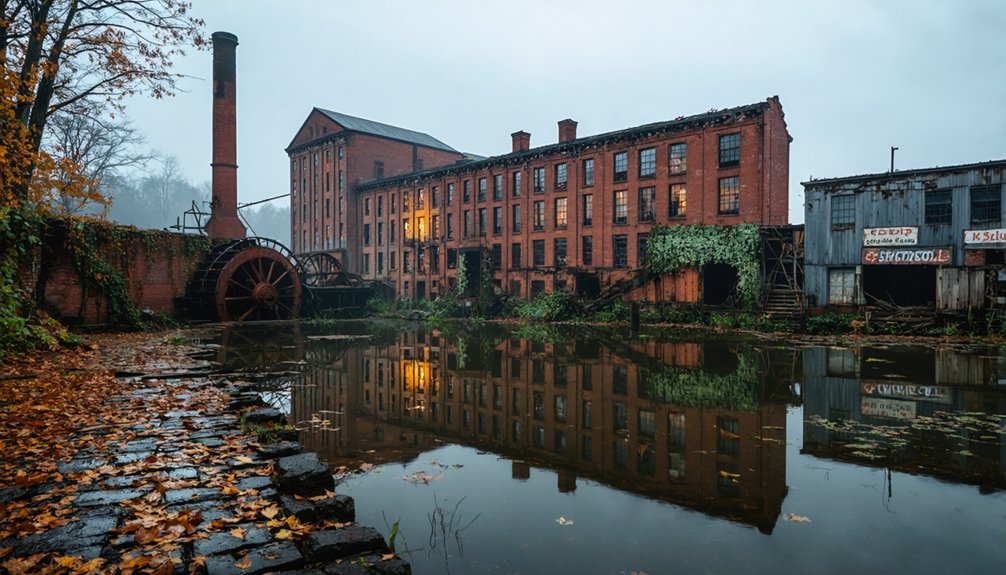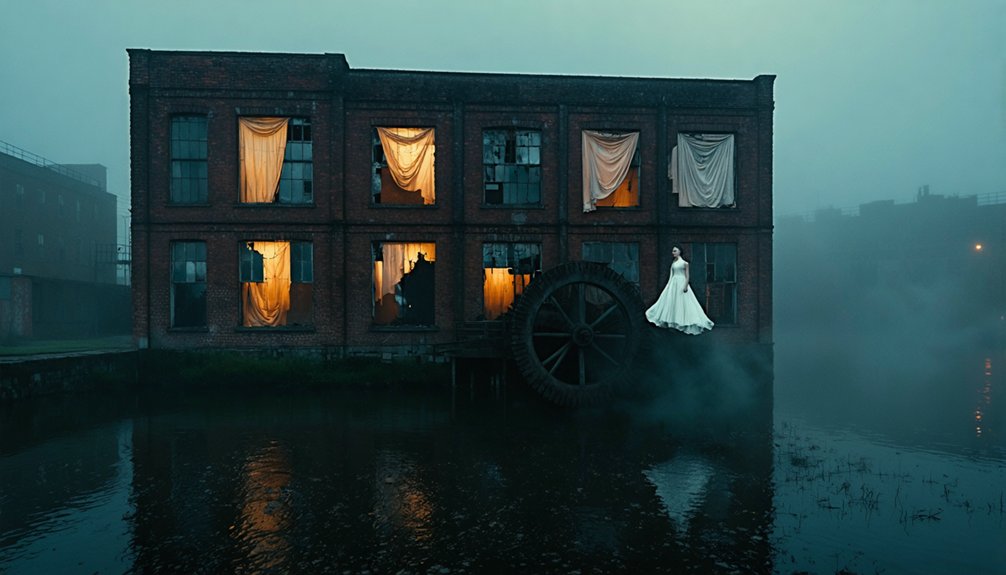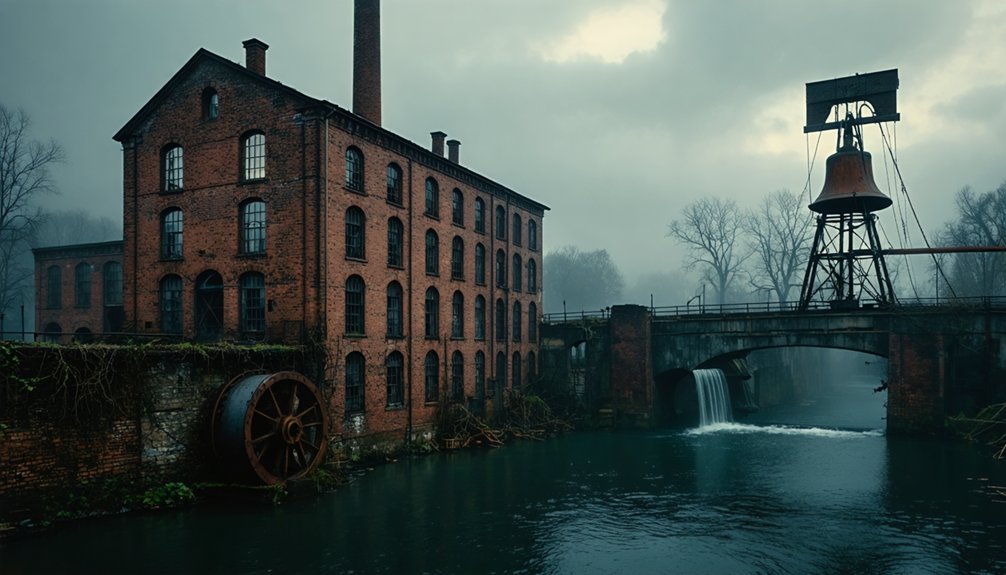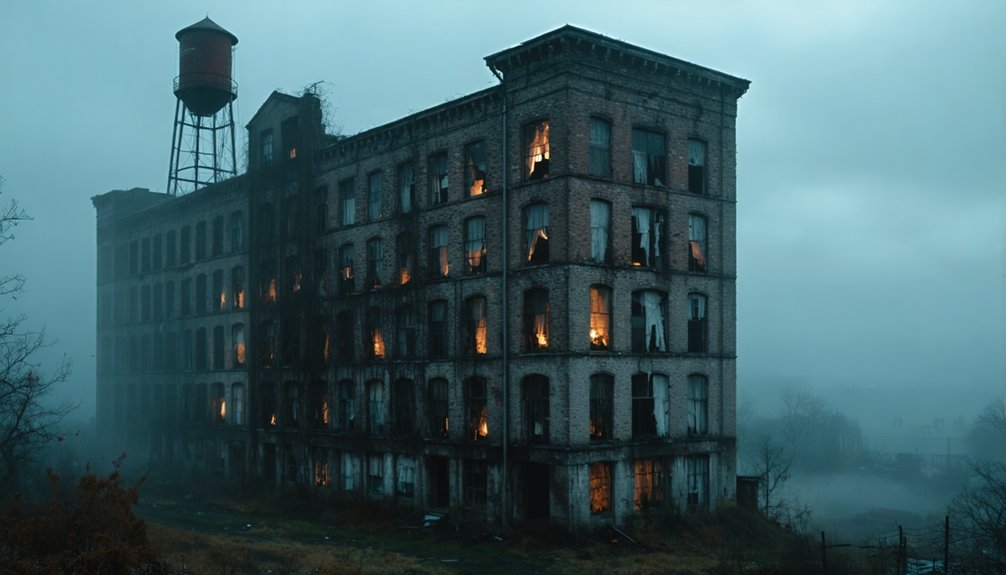
In abandoned mill towns, you’ll encounter spectral miners with glowing lanterns and ethereal tools who appear at dusk near collapsed tunnels. Tragic industrial disasters like the Pemberton Mill collapse and Monongah explosion have created persistent hauntings, especially on anniversary dates. You might hear unexplained machinery sounds caused by thermal expansion of metal remnants and wind channeling through shafts. These paranormal manifestations represent unresolved trauma from capitalism’s forgotten human casualties.
Key Takeaways
- Spectral miners appear at dusk with glowing lanterns and ethereal tools near collapsed tunnels, especially during fog or storms.
- Rhythmic phantom machinery sounds and unexplained mechanical noises occur in empty mills due to environmental factors and thermal expansion.
- Anniversary hauntings intensify around dates of industrial tragedies like the Pemberton Mill disaster and Triangle Shirtwaist Factory fire.
- EVP recordings in abandoned mills capture disembodied worker voices layered with mechanical sounds and environmental ambiance.
- Specific haunted locations include Excelsior House Hotel (headless spirits), Fayette (molten iron victim), and Bodie’s preserved Victorian structures.
Spectral Miners and Their Ethereal Tools
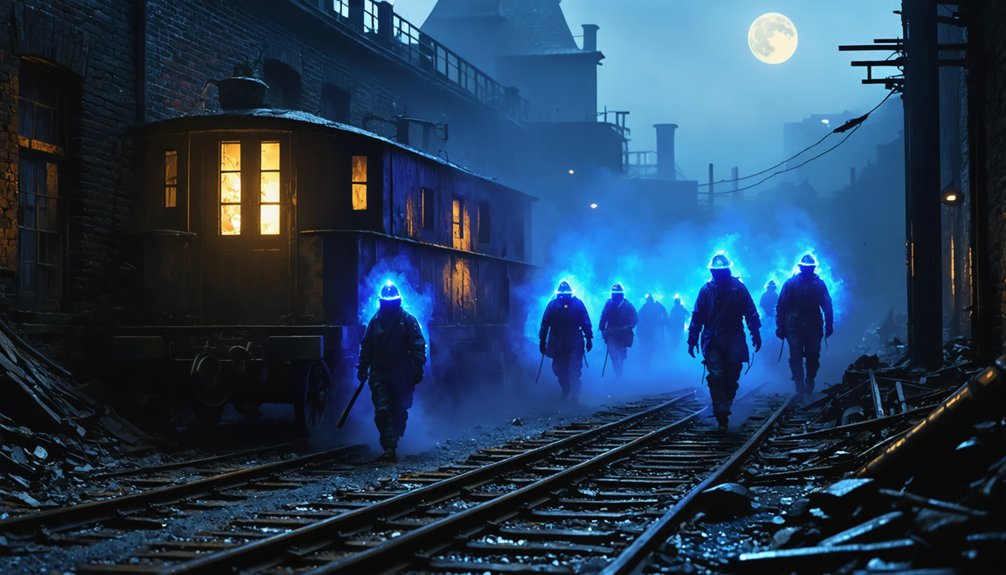
Across the desolate landscapes of abandoned mill towns, spectral miners continue their eternal labor, manifesting with glowing lanterns and ethereal tools that bridge the divide between past and present.
Historical documentation reveals consistent patterns in these spectral sightings—translucent figures emerge at dusk, carrying pickaxes and shovels as they patrol ridge lines and shaft entrances, seemingly compelled to complete unfinished work.
Records show the spirits materialize at sundown, tools in hand, forever bound to complete their interrupted labor.
You’ll encounter the most compelling evidence near collapsed tunnels, where witnesses report rhythmic metallic tapping and the distinctive shriek of ghostly tools against rock.
These phenomena frequently correlate with environmental factors; fog and storms amplify the apparitions’ visibility.
In Crystal City, Colorado, numerous visitors have documented the apparition of a ghostly miner working tirelessly near the iconic Crystal Mill, complete with the unsettling sounds of a spectral pickaxe.
The presence of these miners, identifiable through their distinctive tools and movements, represents more than mere hauntings—they embody the unresolved trauma of industrial labor and its lasting imprint on these forgotten landscapes.
In Idaho’s Bayhorse ghost town, visitors frequently report paranormal activity around the remarkably well-preserved charcoal kilns, which once supported the town’s thriving silver mining operations.
Tragic Industrial Accidents That Echo Through Time
If you explore the ruins of the Pemberton Mill in Massachusetts, you’ll encounter accounts of workers trapped beneath collapsed floors and machinery during the catastrophic 1860 structural failure that claimed 145 lives.
In mining communities like Monongah, West Virginia, witnesses still report hearing phantom cries from the 1907 disaster where nearly 400 miners perished when coal dust ignited in poorly ventilated tunnels. Similar ghostly phenomena have been reported near the site of the Halifax Explosion, where approximately 2,000 people lost their lives when two ships collided in 1917, creating one of the largest pre-nuclear blasts in history.
These industrial tragedies, often resulting from structural failures, explosive materials, and regulatory negligence, have imprinted themselves on these abandoned landscapes as persistent hauntings that manifest during anniversary dates. The devastating Triangle Shirtwaist Factory Fire in 1911 left a particularly strong paranormal imprint, with visitors reporting sounds of young immigrant women screaming as they were trapped by locked doors and inadequate fire escapes.
Trapped by Molten Metal
While nineteenth-century industrial progress powered America’s economic growth, it exacted a terrible human cost in the nation’s mill towns through horrific molten metal accidents.
You’d find workers facing temperatures exceeding 1,500°C with minimal protection in places like Batsto Village, where molten bog iron posed constant dangers. When these industrial tragedies occurred, victims suffered catastrophic burns that overwhelmed primitive medical facilities.
Water contact with molten metal created explosive steam bursts, killing workers instantly and collapsing entire structures. In company towns like Pullman, Illinois, workers endured strict control from owners who prioritized profits over safety.
Companies routinely sacrificed safety for production, leaving hazards unaddressed while threatening injured workers with termination and eviction. These deadly incidents weren’t merely “accidents” but predictable outcomes of systematic negligence.
Today, these abandoned industrial sites remain as physical reminders of capitalism’s human toll, their ruins spawning ghostly legends that memorialize those trapped by molten metal.
Collapsing Shaft Victims
Beyond the horrifying deaths from molten metal, another deadly hazard lurked within America’s industrial landscape: collapsing shafts. Records show Allegheny County mills alone witnessed 24 fatalities from pit falls in just one year (1906-1907).
These catastrophic accidents left profound traumatic legacies in mill communities, where spectral presence reports often trace back to these mass-casualty events.
- Unstable excavations and neglected maintenance created death traps that claimed multiple lives simultaneously.
- Pre-modern safety standards viewed worker deaths as individual responsibility, not corporate obligation.
- Communities suffered economic collapse alongside psychological trauma, creating “death zones” with elevated mortality rates.
The shaft collapse phenomenon represents more than isolated accidents—it embodied systemic industrial exploitation. In the late 19th century, there was a widespread belief that work was inherently risky and accidents were simply unavoidable parts of industrial life. The closure of these industrial centers in the 1980s left behind not only contaminated brownfields and empty spaces, but also unresolved trauma that continues to manifest in local legends.
Only with Progressive Era reforms did fatality rates finally decline, though the psychological impact continues to haunt former mill towns through reported paranormal phenomena.
Unexplained Sounds From Empty Machinery
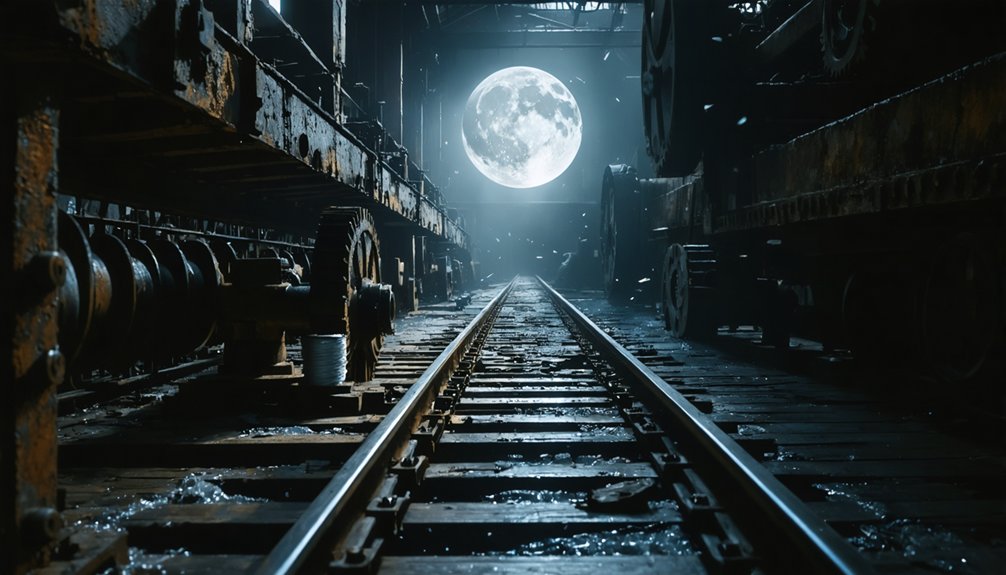
In abandoned mill towns across America, you’ll encounter phantom mill operations where machinery continues its rhythmic sounds despite decades without power or operators.
These ethereal metallic echoes often manifest as grinding, clanking, or creaking noises that acoustic analysis reveals stem from environmental factors like wind interaction with loose parts and thermal expansion of materials. At the Belmont Mill, established in 1925, some machinery parts still retain fresh grease despite years of abandonment. Similar phenomena can be observed in the Nevada silver mill where unstable floors create unsettling sounds that mimic active machinery.
Historical documentation of these phenomena frequently includes reports of disembodied worker voices intermingled with mechanical sounds, reflecting the deep cultural imprint of industrial tragedy and economic collapse that defines these once-thriving communities.
Phantom Mill Operations
Throughout abandoned mill towns across America, mysterious mechanical sounds echo from empty machinery halls, creating what paranormal researchers term “phantom mill operations.”
These acoustic phenomena manifest as low-frequency humming, metallic clanking, and industrial roaring that persist despite the absence of power sources or functioning equipment.
These phantom machinery occurrences stem from environmental and structural factors that create convincing auditory illusions:
- Wind channels through old shafts and tunnels, generating mechanical-like noise patterns
- Thermal expansion and contraction of metal remnants produces intermittent sounds resembling active equipment
- Wooden supports and structural elements shift and creak, mimicking operational machinery sounds
The Windsor Hum phenomenon affecting residents in Ontario shares similar characteristics to these phantom sounds, with investigations linking it to blast furnace operations on Zug Island.
Your perception of these sounds is influenced by expectation bias and cultural context—mill towns’ industrial histories shape how you interpret these ambient noises, transforming natural phenomena into seemingly supernatural experiences.
Ethereal Metallic Echoes
Ghostly mechanical sounds manifest not only as phantom operations but also in more distinct and haunting forms known as ethereal metallic echoes. These phenomena challenge conventional scientific explanation as metallic resonances persist despite machinery lacking power sources.
You’ll encounter chains swinging inexplicably, producing intermittent clatters that pierce the stillness of abandoned spaces.
Historical documentation reveals these ethereal vibrations intensify during seasonal changes, particularly at dawn and dusk. Hollow machine cavities function as acoustic amplifiers, transforming ambient environmental stimuli into haunting industrial tones.
While science suggests thermal expansion, wind patterns, and subterranean vibrations as potential causes, locals maintain these sounds represent residual energetic imprints from the industrial past.
The persistence of unexplained high-pitched screeches and deep mechanical roars contributes to the enduring mystique surrounding these forsaken industrial landscapes.
Disembodied Worker Voices
Disembodied worker voices constitute one of the most unsettling phenomena reported in abandoned mill towns across America. These spectral echoes often manifest near machinery that once claimed workers’ lives through industrial accidents.
You’ll frequently hear these sounds during nighttime investigations when the boundary between worlds seems thinnest.
- Security guards report hearing urgent disembodied whispers calling out warnings or names of former employees.
- EVP recordings capture layered sounds blending human vocalizations with mechanical ambiance.
- Ohio’s abandoned plants yield consistent reports of voices near sites of documented fatal accidents.
The acoustical properties of these massive structures—with their metal surfaces and concrete expanses—may amplify ordinary sounds into seemingly supernatural experiences.
However, the consistency of reports across different locations suggests these phenomena transcend mere psychological explanation, potentially representing emotional imprints left by traumatic deaths.
How Disaster Left Towns Vulnerable to Hauntings
When disasters strike vulnerable communities, they often leave behind more than physical destruction—they create the perfect conditions for hauntings to take root in the collective imagination.
Mill towns’ vulnerability to supernatural phenomena emerges directly from catastrophic events that shattered their social fabric. The disaster aftermath—whether from mining collapses like Aberfan, economic collapse, or resource depletion—leaves physical and psychological scars that manifest in haunting narratives.
You’ll find these patterns replicated across abandoned towns worldwide, where sudden mass deaths create intense emotional imprints believed to trap spirits between worlds.
The combination of traumatic loss, abandoned infrastructure, and isolated ruins transforms these once-thriving communities into perfect vessels for the paranormal.
Economic vulnerability particularly exacerbates this phenomenon—when livelihoods vanish overnight and populations flee, they leave behind empty buildings where both memories and spirits seemingly linger.
The Most Spine-Chilling Mill Town Visitations
Across the decayed landscapes of America’s forgotten industrial centers, specific mill towns have earned reputations for particularly intense paranormal activity. Among these, the Excelsior House Hotel in Jefferson, Texas stands out with reports of headless spirits and shadow people.
Meanwhile, Fayette, Michigan harbors the ghostly encounters of a worker who suffered an agonizing death by molten iron. Spectral sightings in Terlingua, Texas cemetery involve apparitions believed to be the souls of original miners.
- Animas Forks, Colorado – Eerie sounds and ghost sightings linked to its harsh 1880s winter abandonment
- Kennecott, Alaska – Unexplained noises and shadowy figures haunting the abandoned copper mining mill
- St. Elmo, Colorado – Shadow figures and disembodied footsteps that historians connect to the town’s tragic collapse
America’s Haunted Mining Regions
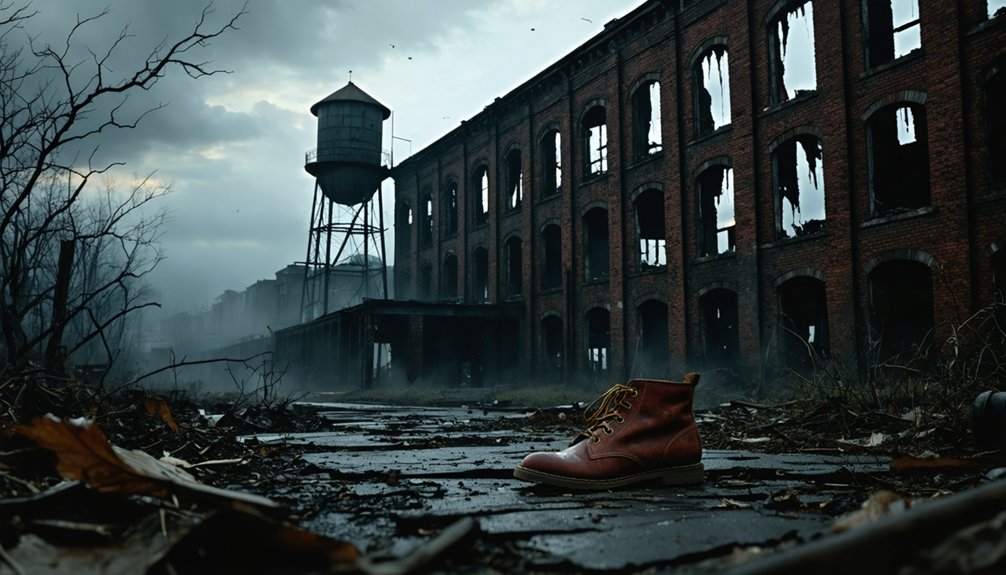
From California’s Sierra Nevada to the coal-rich Appalachian mountains, America’s historical mining regions harbor some of the nation’s most concentrated paranormal activity, often connected to their violent pasts and sudden abandonments.
The forgotten mines of America whisper their dark secrets through paranormal echoes of the past.
You’ll find the highest concentration of these spectral sites in Montana and Nevada, each with 106 documented ghost towns, while California and Texas lead in overall numbers.
During your ghost town exploration, you’ll encounter preserved Victorian architecture and mining artifacts that serve as physical anchors for reported hauntings.
Notable hotspots include Bodie, California with its preserved saloons and gaming halls; Centralia, Pennsylvania, where underground coal fires still burn; and St. Elmo, Colorado, abandoned after gold and silver depletion.
Another fascinating location is the history of Gallup Mills, Vermont, a once-thriving industrial community that played a significant role in the region’s development. The remnants of its textile factories and the stories of its residents offer a glimpse into the past, showcasing the challenges and triumphs of rural American life. Visitors can explore the ruins and imagine what life was like during its peak in the 19th century.
Mining history reveals these locations often suffered catastrophic environmental damage and public health crises, potentially contributing to their reputation for supernatural phenomena.
When Tourist Attractions Embrace Their Ghostly Residents
Many abandoned mill and mining towns have transformed their spectral reputations into valuable tourism assets, creating sustainable economic models while preserving their historical significance.
You’ll find these destinations deliberately incorporating ghostly encounters into their visitor experiences, with guides using paranormal elements to deepen your engagement with haunted history. At locations like Jerome, Arizona, the blend of historical preservation and supernatural narratives creates compelling tourism that supports local economies.
- Paranormal tours and organized ghost hunts have become revenue generators that fund ongoing preservation efforts.
- Visitor reports of shadowy figures and disembodied voices enhance authenticity and create word-of-mouth marketing.
- Strategic preservation of abandoned personal effects and untouched interiors heightens the immersive quality of these historically significant spaces.
Frequently Asked Questions
Can Skeptics Experience Paranormal Events in Mill Towns?
Like Scrooge confronting unexpected spirits, you’ll find skeptics can experience paranormal phenomena in mill towns while maintaining skeptical perspectives. Environmental factors and suggestion often shape these skeptical experiences, challenging mill town legends’ supernatural explanations.
Do Ghost Hunters Use Special Equipment in Abandoned Mills?
Yes, you’ll find investigators using specialized ghost hunting equipment like EMF meters, thermal cameras, and trigger objects like Dead Bells—paranormal investigation techniques specifically adapted for mills’ unique challenges and industrial remnants.
Are Children More Susceptible to Seeing Mill Town Apparitions?
Yes, you’re more likely to perceive apparitions in mill towns due to your childhood memories and innate sensitivity. Evidence suggests children’s developing cognition and heightened sensory processing create heightened receptivity to paranormal phenomena in historic industrial settings.
Can Taking Artifacts From Ghost Towns Attract Hauntings Home?
You’re risking more than legal penalties when removing artifacts. Mill town curses and artifact energy follow objects home according to historical accounts, though evidence remains anecdotal rather than scientifically verified.
Do Seasonal Changes Affect Ghostly Activity in Mill Towns?
Like autumn leaves stirring ancient secrets, seasonal hauntings intensify in mill towns during fall and winter. You’ll notice increased apparitions, sounds, and sensations when temperatures drop, aligning perfectly with established mill town folklore.
References
- https://www.mythfolks.com/haunted-us-ghost-towns
- https://www.geotab.com/ghost-towns/
- https://995wlov.com/2024/10/29/ranking-every-u-s-state-from-most-to-least-haunted/
- https://www.losethemap.com/scariest-ghost-towns-in-the-world/
- https://www.loveexploring.com/gallerylist/188219/the-us-state-with-the-most-ghost-towns-revealed
- https://www.thegoldminehotel.com/ghost-towns-and-haunted-places-in-idaho
- https://listverse.com/2022/10/27/10-ghost-mines-from-around-the-world/
- https://www.youtube.com/watch?v=4iyYPpznhGI
- https://blog.landcentral.com/land-university-blog/haunted-lands-in-america/
- https://www.youtube.com/watch?v=9QsIyZFL0Cg