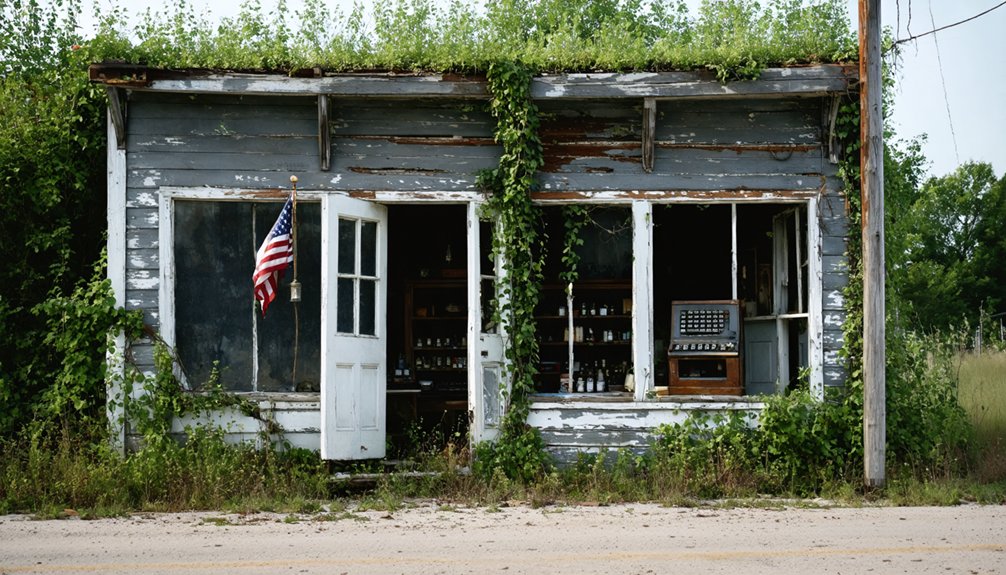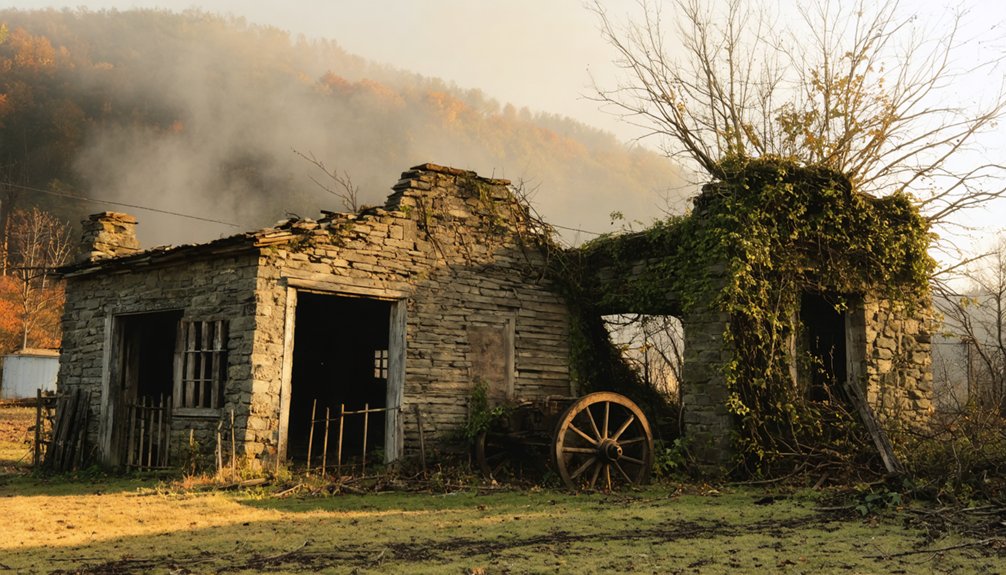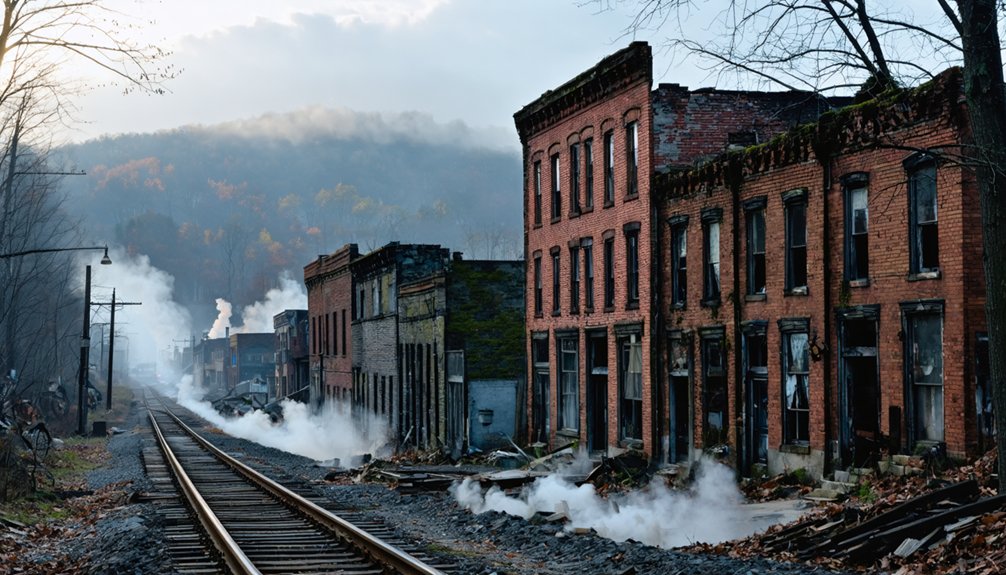
Civil War ghost town residents primarily migrated to areas offering better economic opportunities. You’ll find they followed railroad developments, relocated to industrial centers, or moved west seeking mining prospects. African Americans often headed north, while veterans showed 40% higher interstate mobility than civilians. Many former residents established new communities along transportation routes or in urban centers, clustering with others sharing similar wartime allegiances. These migration patterns fundamentally reshaped America’s demographic landscape for generations.
Key Takeaways
- Many residents migrated to emerging railroad towns after Civil War transportation routes bypassed their communities.
- Veterans exhibited 40% higher interstate mobility than civilians, often relocating near former military comrades.
- Former residents established networks in new locations, with families and communities migrating together along established routes.
- Some displaced residents became laborers in Northern industrial centers offering wages double those available in the South.
- Economic casualties of transportation technology changes created ghost towns along railways as populations shifted toward economic opportunities.
The Exodus From Southern Agricultural Centers

While the romanticized image of the antebellum South often evokes sprawling plantations with endless fields of cotton, the agricultural reality proved far more precarious.
You’d have witnessed a massive rural exodus driven by severe soil exhaustion. Southern farmers continuously cultivated cotton without proper crop rotation, depleting once-fertile land. Each field hand typically wore out 30-50 acres during their lifetime, pushing plantation owners and enslaved workers westward toward virgin territories in Georgia, Alabama, Mississippi, and beyond. The absence of traditional farming practices contributed significantly to this environmental deterioration.
This agricultural decline didn’t end with the Civil War. Instead, tenant farming and sharecropping emerged, trapping both Black and white farmers in debt cycles. The economic struggles particularly impacted African Americans who faced higher eviction rates from sharecropping arrangements due to racial discrimination.
Northern Migration Patterns and New Urban Lives
You’ll notice that African Americans migrated to Northern industrial centers where manufacturing jobs offered alternatives to Southern agricultural labor, despite significant hiring discrimination.
These migration patterns relied heavily on established networks of family and friends who provided essential information about employment opportunities and housing in cities like Cincinnati, Detroit, and Philadelphia. By 1860, Southern-born African Americans constituted a majority of black populations in many Northern cities. Immigrants also contributed significantly to these urban centers, as the continued immigration during the Civil War years bolstered the Northern workforce.
The resulting demographic shifts transformed Northern urban landscapes as African American communities established churches, mutual aid societies, and political organizations that would become foundations for civil rights activism.
Industrial Opportunity Beckoned
As the economic landscape of the United States transformed during the early twentieth century, industrial centers across the Northern and Western regions beckoned African Americans with unprecedented employment opportunities that simply didn’t exist in the rural South.
You’d find companies actively recruiting Black workers through migration incentives including free transportation and affordable housing.
Labor demand surged dramatically during both World Wars, creating vacancies in steel mills, automotive plants, and meatpacking facilities.
Cities like Chicago, Detroit, and New York became economic magnets, while the Second Great Migration expanded destinations to include Western cities such as Los Angeles and Seattle.
Northern industrial jobs offered considerably higher wages than Southern agricultural work, though you’d still face discrimination. Wages in the North were often double those available in the South, providing a compelling economic incentive to leave.
Many African Americans sought Northern cities to escape the harsh realities of Jim Crow laws that enforced racial segregation and denied basic political rights in the South.
Despite these challenges, approximately six million Black Southerners relocated northward between 1916 and 1970, fundamentally reshaping America’s urban centers.
Familiar Networks Facilitated Relocation
Migration routes for African Americans leaving the South weren’t haphazard journeys into the unknown, but carefully charted paths following established networks of family and community connections.
By 1860, you’d find cities like Cincinnati with black populations that were 70 percent southern-born, creating ready-made kinship connections for newcomers seeking familiar faces.
Your journey north would likely follow established community chains to cities closest to the South first.
Upon arrival, you’d settle in specific districts where other southern migrants concentrated—often in less desirable neighborhoods like “Bucktown” with poor sanitation and challenging conditions. These urban areas resembled immigrant communities that formed in Northern cities during the Civil War era. These urban settlements became the foundation for vibrant cultural expressions and movements like the Harlem Renaissance that transformed American culture.
Your prospects would reflect urban settlement patterns where lighter-skinned African Americans accessed better neighborhoods while darker-skinned residents faced greater segregation.
Despite these challenges, these established networks provided vital support for your change to northern life.
Following the Railroad: Transportation-Driven Relocations

The transformation of America’s transportation infrastructure following the Civil War fundamentally altered the geographic distribution of communities, with railroad development serving as both creator and destroyer of settlements.
The iron road’s advance simultaneously birthed and buried American towns, reshaping the nation’s communal geography after 1865.
You’d have witnessed towns like Granville, Indiana—once thriving on canal traffic—fade into obscurity as railroad expansion redirected commerce through new transportation corridors.
Military strategy intensified this reshaping, with locations like Grafton, West Virginia becoming contested territory for their rail connections.
After the war, you might’ve joined other residents relocating from bypassed communities to emerging railroad towns offering economic opportunity.
Union Level, Virginia exemplifies this pattern, as many farmers abandoned the area to seek better prospects in South Hill, VA when economic shifts transformed the agricultural landscape.
Many ghost towns were founded along railways that later became economic casualties when dieselization made steam locomotives and their water stops obsolete.
When Southern Pacific discontinued service to Preble, Nevada, or when Steins, New Mexico lost its depot—and sole water source—in 1944, residents had little choice but to follow the rails elsewhere or face isolation.
Westward Movement and Mining Town Opportunities
You’d find the allure of gold and silver strikes irresistible when migrating westward, as prospectors flocked to Colorado (1858), Nevada (1859), and the Black Hills (1874) seeking instant wealth.
The boom-bust cycle of mining towns created opportunities for quick profits but also generated instability, with populations exploding from hundreds to thousands within weeks following major discoveries.
When mines inevitably became exhausted or unprofitable, you’d face the harsh reality of ghost towns emerging rapidly, forcing difficult choices about whether to pursue another mining opportunity or shift to homesteading under the 1862 Homestead Act.
Gold Rush Promises
Despite romanticized visions of instant wealth, California’s Gold Rush beginning in 1848 propelled one of America’s most significant migration surges, drawing over 200,000 overland travelers by 1860—a staggering 79% of all westward migrants during this period.
Your gold rush dreams likely wouldn’t have materialized through mining itself, as most prospectors experienced limited or no financial success. California’s population exploded from 160,000 to over 300,000 by 1855, transforming wilderness into boomtowns seemingly overnight.
The mining realities favored merchants, bankers, and service providers who capitalized on the population boom. You’d have joined a primarily male migration—only 5% were women and children—and faced fierce competition among international migrants, including Chinese (sometimes 30% of arrivals), French, and Mexican fortune-seekers, all risking dangerous 2,000-mile journeys for freedom and opportunity.
Boom-Bust Mining Cycles
While gold rushers chased their fortunes, they unwittingly participated in economic patterns that would define western development for decades to come.
You’d experience dramatic swings between mining prosperity and economic instability as boom towns rapidly expanded then contracted. What began with individual prospectors soon transformed into corporate operations requiring eastern capital and industrial machinery.
When you staked your claim in places like the Comstock Lode or Tonopah-Goldfield, you joined thousands flooding these regions.
But as mines depleted or commodity prices fell, you’d face difficult choices. Many of you became wage laborers for mining companies; others simply abandoned your homes and businesses when resources dwindled.
These cyclic patterns left environmental devastation in their wake—deforestation, water pollution, and soil erosion that undermined agricultural possibilities and hastened the inevitable bust that would transform thriving communities into ghost towns.
Flood Plain Survivors: Relocating After Environmental Disasters

When communities face the devastating reality of repeated flooding, residents must confront difficult decisions about whether to rebuild in place or permanently relocate to safer ground. Your risk assessment has changed dramatically with climate change intensifying flood hazards—every 1°F temperature increase adds 4% more atmospheric moisture, creating unprecedented rainfall patterns that overwhelm aging stormwater systems.
You’re not alone in this struggle. Approximately 1.81 billion people globally face significant flood risk, with disaster-related displacement affecting 1 in 70 American adults annually.
Despite historical patterns of out-migration following disasters, migration to flood-prone areas has paradoxically doubled since the pandemic began.
Achieving floodplain resilience often requires difficult trade-offs between place attachment and safety. Many disaster recovery efforts now focus on planned relocation rather than rebuilding in inevitable flood zones, recognizing that continued development in high-risk areas perpetuates cyclical disaster exposure.
From Soldiers to Civilians: Veteran Resettlement Patterns
The American Civil War profoundly reshaped migration patterns as veterans navigated their return to civilian life between 1860 and 1880.
Veterans exhibited 40% higher interstate mobility than their civilian counterparts, with those who moved extensively during service showing migration rates up to 68% higher.
Military service transformed men into migrants, with wartime movement predicting lifelong geographic mobility.
Veteran integration wasn’t random—it reflected deliberate choices shaped by wartime experiences. You’ll find that former soldiers preferred settling near comrades from their military companies, creating ideological clustering that reduced mortality risk by 6%.
Union veterans from Confederate-sympathizing regions gravitated toward pro-Union territories, while Confederates moved deeper South or West.
This resettlement reflected more than practical considerations; it demonstrated how military service transformed geographic preferences.
Veterans avoided immigrant-heavy urban areas and regions that opposed their side in the conflict, permanently altering America’s demographic landscape.
Tracking Family Dispersal Through Census Records
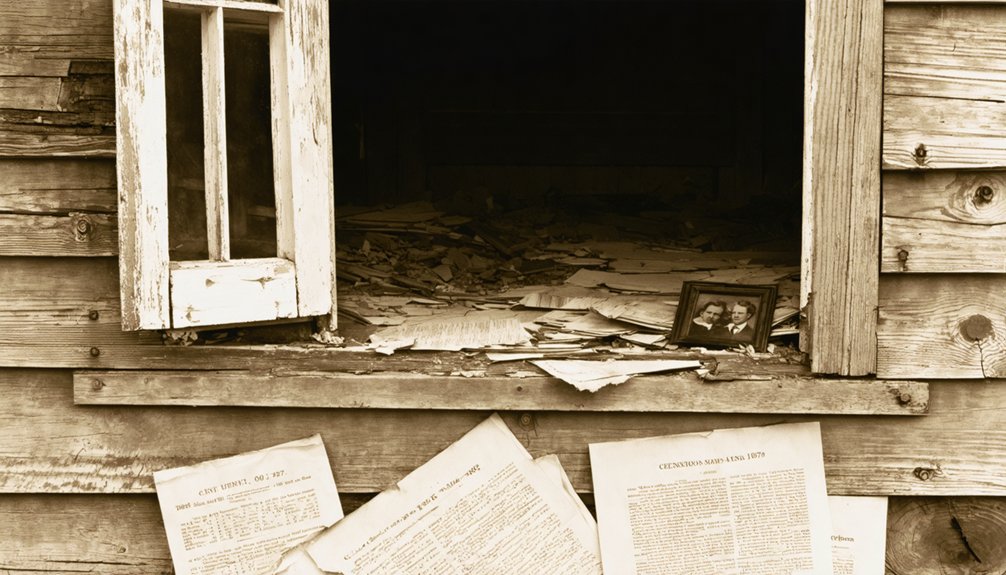
Beyond veterans’ individual migration patterns, census records reveal a broader canvas of family dispersal in the Civil War’s aftermath. You’ll find the 1860 census provides vital baseline data—capturing households before wartime disruption—while post-war census enumeration documents dramatic shifts in family structures, with notable increases in widow-headed households.
To trace your ancestors’ movements, examine place of birth versus residence across multiple census years, revealing interstate migrations that often followed transportation corridors like railroads and waterways. Census data details occupations and dwelling conditions, illuminating economic motivations behind family relocations.
For family reunification research, utilize county-level geographic breakdowns that show localized migration patterns. The most revealing insights emerge when combining census data with historical maps of infrastructure, allowing you to reconstruct the probable routes your displaced ancestors traveled during this tumultuous period of American history.
Economic Reinvention in Industrial Boom Towns
Civil War industrial boom towns experienced dramatic cycles of prosperity and abandonment that mirror America’s volatile economic landscape during Reconstruction.
You’ll find that surviving communities typically followed distinct reinvention patterns that determined their fate.
Economic diversification became essential for sustainability. Towns with higher “mobility costs” from permanent infrastructure investments retained residents more effectively, creating foundations for new industries.
You’d notice some communities leveraged their industrial heritage through tourism development, transforming abandoned mines and historic districts into visitor attractions, as exemplified by Thurmond, West Virginia.
Geographic position played a decisive role in these reinvention efforts. Communities situated at strategic transportation nodes could pivot more successfully when original industries collapsed.
Those that aligned economic incentives—access to materials, stable governance, and minimal taxation—with emerging sectors broke free from the boom-bust cycle.
Lost Communities: Tracing Descendants Today

Where did the residents of abandoned Civil War settlements ultimately resettle, and how can their descendants trace these fractured lineages today? Most inhabitants dispersed to urban centers or ventured westward seeking economic revival, with family connections scattered across generations.
Your cultural heritage may lie hidden in these ghost towns, accessible through modern genealogical methods.
Exploring the ghost towns of the Appalachian Mountains can unveil stories of the past that have shaped family histories. As you walk through the remnants of these once-thriving communities, you may discover connections to ancestors who lived and worked in this rugged landscape. Each abandoned building and rusted artifact offers a glimpse into the lives of those who came before us, reminding us of the rich tapestry of human experience woven across generations.
Finding your ancestral ties involves:
- Cross-referencing census records with church registries and cemetery plots to establish residence patterns
- Consulting local historical societies and Civil War ancestry groups that preserve community narratives
- Utilizing DNA testing to bridge documentation gaps created by wartime record destruction
The challenge of tracing these lines remains complex due to name changes, record loss, and widespread migration.
Nevertheless, preserving these connections remains vital for understanding America’s post-conflict transformation.
Frequently Asked Questions
Did Ghost Town Residents Leave Valuable Possessions or Heirlooms Behind?
You’ll find most residents took valuables during planned evacuations, yet sudden departures due to war or disaster left abandoned treasures and lost heirlooms behind—especially in communities experiencing rapid military displacement.
How Did Former Confederate Soldiers Integrate Into Union-Controlled Communities?
You’ll find former Confederates faced Reconstruction challenges by taking loyalty oaths, adapting to military occupation, and gradually obtaining political rights while often maintaining Southern loyalty through community bonds and shared hardship.
What Psychological Impacts Affected Children Displaced From Ghost Towns?
Can you imagine being ripped from everything familiar? Children displaced from ghost towns experienced profound childhood trauma manifested through PTSD, depression, and disrupted social-emotional development while struggling to maintain emotional resilience amid persistent insecurity.
Did Any Residents Return to Rebuild Abandoned Communities?
You’ll find that some returned to reclaim abandoned properties, though few communities fully recovered. Economic collapse, flood damage, and social shifts often overcame community resilience efforts, with tourism occasionally enabling partial revivals.
You’ll find that freed slaves demonstrated remarkable resilience by establishing Freedom Towns in abandoned areas, building community infrastructure from scratch, and creating self-governing enclaves that offered protection from hostile environments while fostering economic independence.
References
- https://devblog.batchgeo.com/ghost-towns/
- https://www.blueridgeoutdoors.com/go-outside/southern-ghost-towns/
- https://www.mentalfloss.com/geography/american-ghost-towns-can-still-walk-through
- https://www.mythfolks.com/haunted-us-ghost-towns
- https://www.christywanders.com/2024/08/top-ghost-towns-for-history-buffs.html
- https://www.visittheusa.com/experience/5-us-ghost-towns-you-must-see
- https://www.geotab.com/ghost-towns/
- https://en.wikipedia.org/wiki/Lists_of_ghost_towns_in_the_United_States
- https://www.youtube.com/watch?v=4DSrGFx_vG4
- https://janetakesonhistory.org/2021/10/21/was-southern-soil-exhaustion-a-cause-of-the-civil-war/