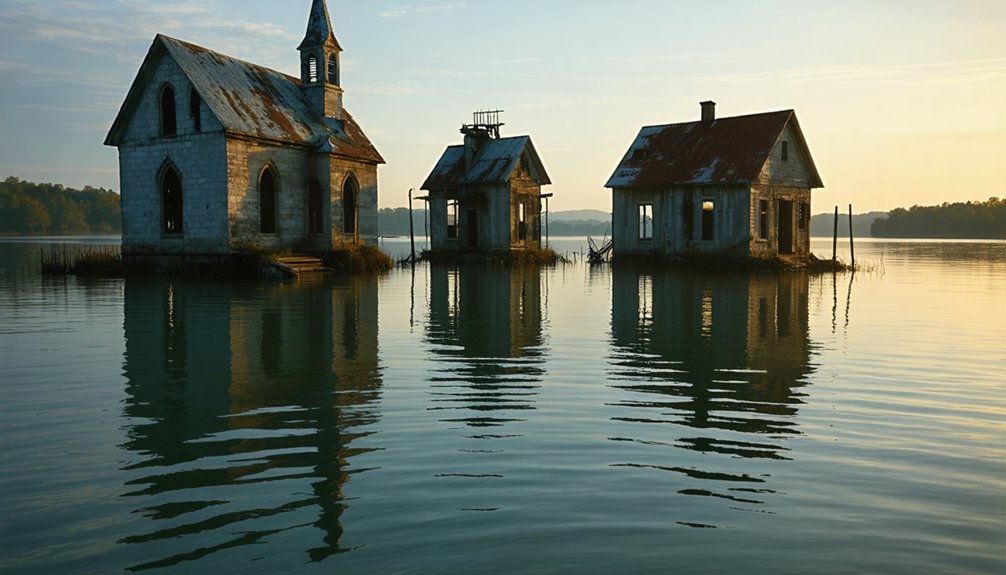
Across America, you’ll find numerous submerged ghost towns beneath reservoirs and lakes. Massachusetts’ Quabbin Reservoir conceals four complete towns and displaced 2,500 residents. Western states hide frontier settlements like Kernville, California, while the South lost communities like Loyston, Tennessee to dam projects. During severe droughts, these underwater towns occasionally reveal themselves—exposing foundations, cemeteries, and artifacts. Pennsylvania’s valleys harbor particularly fascinating examples, including Livermore, rumored to carry a witch’s curse beneath its watery tomb.
Key Takeaways
- The Quabbin Reservoir in Massachusetts submerged four complete towns—Dana, Enfield, Greenwich, and Prescott—displacing 2,500 residents in 1938.
- Western frontier settlements like Kernville, California and Judson, North Carolina remain permanently underwater due to dam construction projects.
- Pennsylvania river valleys hide communities like Livermore, Milford Mills, and Wilsonville that were sacrificed for flood control initiatives.
- Southern ghost towns such as Bluffton, Texas, Loyston, Tennessee, and Proctor, North Carolina were submerged for hydroelectric power generation.
- Severe droughts occasionally reveal submerged structures from towns like St. Thomas, Nevada and old Lemoyne beneath Lake McConaughy.
The Lost Towns Beneath Quabbin Reservoir’s Waters
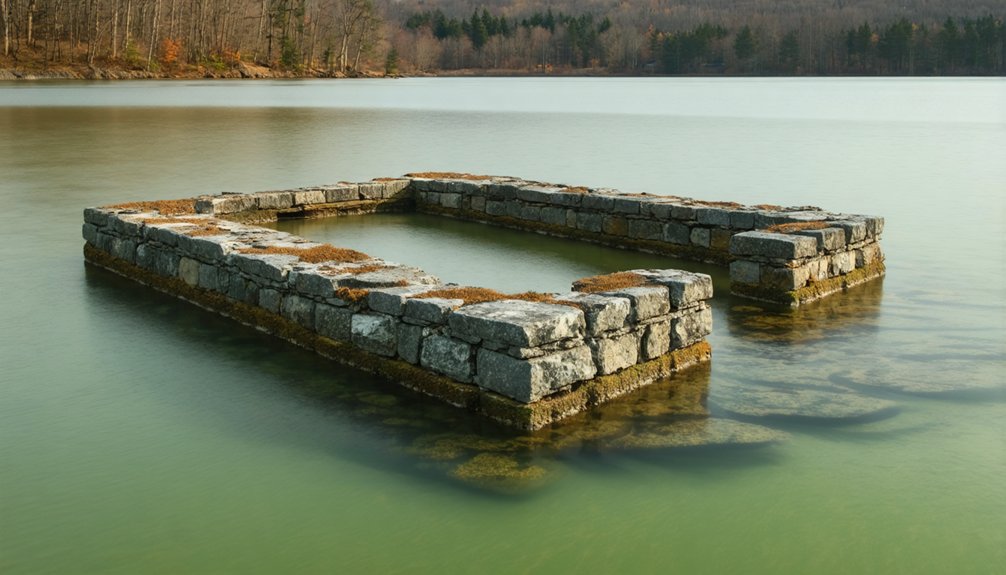
As the waters of the Quabbin Reservoir rise placidly above western Massachusetts today, they conceal one of America’s most significant acts of community displacement.
In 1938, following state legislation passed eleven years earlier, four historic towns—Dana, Enfield, Greenwich, and Prescott—were systematically disincorporated and submerged forever.
These Swift River Valley communities, with Quabbin history dating back to Daniel Shays’s rebellion, were completely erased from the landscape.
Over 2,500 residents were forced from their homes, watching as authorities burned their town infrastructures to ash.
The submerged heritage included six churches, thirteen schools, and fourteen mills that once sustained vibrant economies. The reservoir finally filled in June 1946, ahead of schedule, creating a massive water supply with capacity exceeding 400 billion gallons.
Now 39 square miles of water covers this sacrifice, supplying Boston’s metropolitan area while the displaced residents’ descendants maintain memories of communities that exist only in photographs and stories. The poignant end came with The Farewell Ball on April 27, 1938, where over 2,000 people gathered for a final celebration of their communities.
Drought-Exposed Remnants: When History Resurfaces
When severe droughts grip America’s river basins and reservoirs, these water bodies reluctantly surrender their secrets, exposing the skeletal remains of towns long submerged beneath their depths.
The historical significance of these resurfaced artifacts provides tangible connections to our past, revealing lost chapters of American settlement patterns.
- North Alabama steamboat wreck near Vermillion emerges during low water, displaying its 150-year-old hull alongside the very log that caused its 1870 demise.
- St. Thomas, Nevada—a Mormon settlement founded in 1865—reveals forty structures including school and hotel foundations during drought conditions.
- Drought impacts at Lake Texoma and Toledo Bend expose former cemeteries, town foundations, and artifacts typically hidden beneath the waterline.
Lake McConaughy in Nebraska reveals remnants of old Lemoyne, where visitors can identify historical structures like the root cellar once belonging to residents’ grandparents.
These drought-exposed remnants serve as poignant reminders of sacrifices made for modern water management infrastructure.
The Garrison Dam’s construction in 1953 led to the complete flooding of Elbowoods, North Dakota, displacing 325 tribal families and erasing a vibrant community headquarters for the Hidatsa, Mandan, and Arikara people.
Western Frontier Communities Now Under Lakes
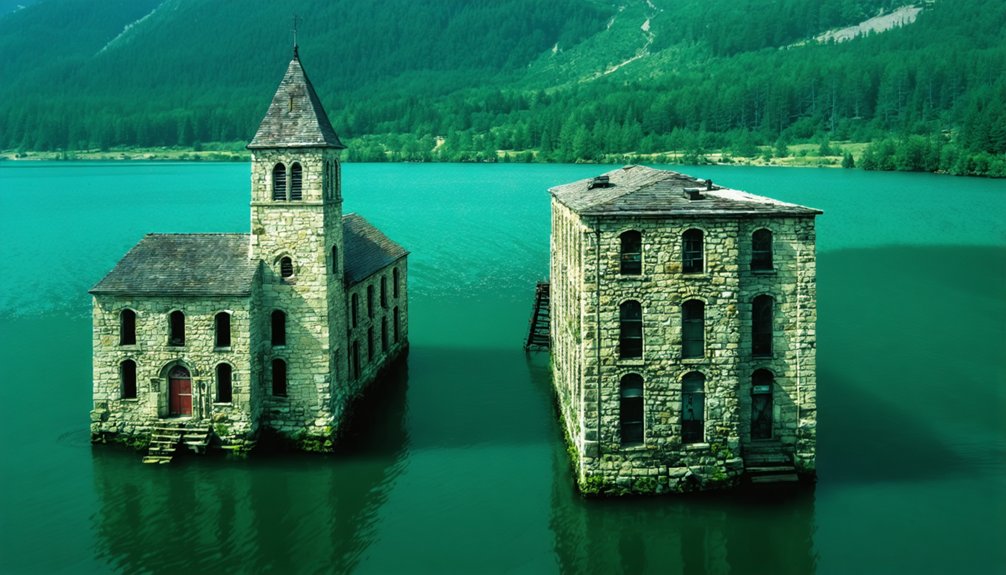
While drought exposes America’s submerged historical treasures temporarily, countless Western frontier communities remain permanently entombed beneath artificial lakes—sacrificed for water management infrastructure development.
You’ll find Kernville history literally submerged beneath Isabella Lake in California, where an entire functioning town was deliberately flooded. When water levels drop dramatically during drought cycles, you can glimpse foundations, roadways, and even cemetery markers dating back to the 1800s. Similar remnants of Judson, a town with a population of around 600, can be accessed during low water levels at Fontana Lake in Western North Carolina. The village of Gad in West Virginia suffered the same fate when it was sold to the U.S. Army Corps of Engineers and became completely submerged after Summersville Lake’s construction in 1966.
The submerged infrastructure includes general stores, schoolhouses, and civic buildings that served frontier families for over a century before government-mandated relocation.
Beneath these artificial waters lie the civic hearts of pioneer communities—sacrificed for progress, preserved by inundation.
Every decade, maintenance draining creates brief windows for exploration. Some locations offer scuba expeditions to these underwater time capsules where you can witness firsthand the architectural remnants of communities displaced without consent—stark reminders of development’s human cost.
Southern Settlements That Disappeared for Dam Projects
The southern United States harbors numerous ghost towns that disappeared not from economic decline or natural disasters, but from deliberate flooding during massive dam projects of the early to mid-20th century.
In contrast, the ghost towns of the pacific northwest tell a different story, marked by the remnants of once-thriving logging communities and mining hubs. Many of these sites succumbed to the isolation brought on by changing economic conditions and the closure of key industries. Exploring these abandoned places offers a haunting glimpse into the region’s rich yet turbulent history.
Throughout the South, communities like Bluffton, Proctor, and Loyston were sacrificed for hydroelectric power and flood control. Dam construction often proceeded with minimal regard for generational connections to place:
- In Texas, Bluffton residents received inadequate compensation before Lake Buchanan submerged their homes in the 1930s.
- Tennessee’s Loyston vanished beneath Norris Lake in 1935 as part of early TVA initiatives.
- North Carolina’s Proctor families watched as their town, including ancestral cemeteries, disappeared underwater.
During severe drought conditions approximately 15 years ago, the remnants of Old Bluffton reemerged as water levels dropped, revealing foundation stones and portions of the original town road.
The Fontana Dam was hastily built in 1944 to provide electricity for Oak Ridge during World War II, displacing entire communities in the process.
Historical preservation efforts now document these lost communities, with drought periods occasionally revealing ghostly remnants of roads, foundations, and gravestones—physical memories of places where your freedom to remain was subordinated to national infrastructure priorities.
Pennsylvania’s Sacrificed Towns and Their Watery Graves
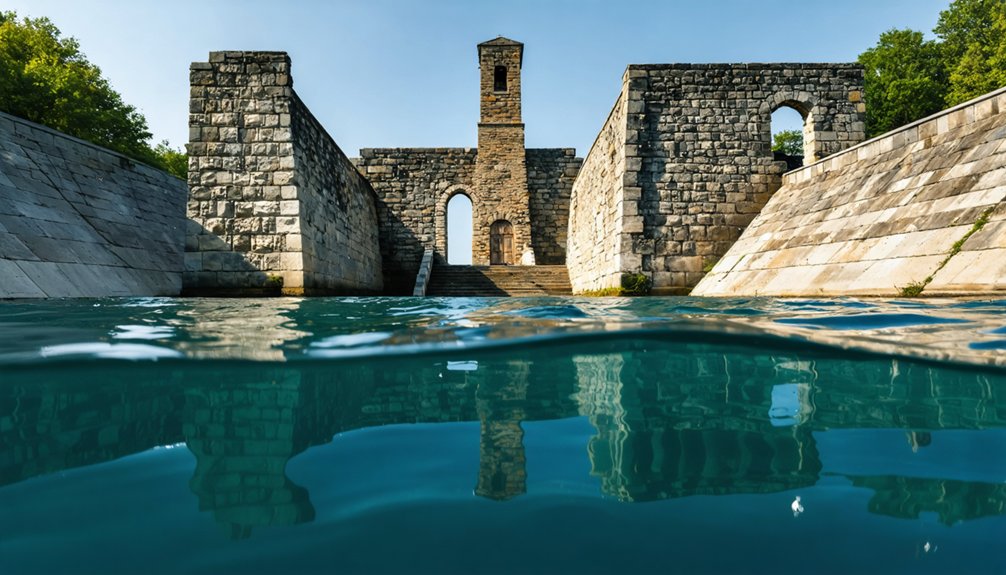
Pennsylvania’s lush river valleys conceal a disturbing history beneath their seemingly tranquil waters, where entire communities once thrived before being sacrificed to flood control initiatives.
Towns like Livermore, allegedly cursed by a witch a century before its 1889 flood, now rest beneath engineered reservoirs.
You’ll find Somerfield’s foundations occasionally revealing themselves during droughts, a haunting reminder of government authority over citizens’ lives.
Similar fates befell Milford Mills, Social Hall, Tohickon Village, and Wilsonville—all submerged for “greater good” water management projects.
These underwater settlements have spawned numerous ghost stories, with Livermore particularly known for paranormal activity.
Places like Codorus State Park exemplify this pattern, where recreation now masks erased communities.
These watery graves represent both pragmatic solutions and the human cost of progress.
Visitors to Livermore’s trails have reported encountering a demonic shadowy figure with burning red eyes that stalks trespassers who venture there after dark.
Lake Marburg covers what was once Marburg, a community that joined many submerged towns when dam construction prioritized water resources over preservation of historical settlements.
Frequently Asked Questions
Who Decides Which Towns Are Sacrificed for Reservoir Projects?
While your community sleeps, federal and state agencies wield ultimate power in town selection, employing eminent domain laws when project funding aligns with national interests—prioritizing water management over your historical connections to place.
Can Artifacts Be Legally Removed From Exposed Submerged Towns?
You can’t legally remove artifacts without permits from state or federal authorities. Unauthorized collection threatens artifact preservation and carries serious legal ramifications including fines and criminal prosecution under protective legislation.
Do Former Residents Hold Reunions Near Submerged Hometown Sites?
Yes, you’ll find former residents organizing reunion locations at accessible shorelines near submerged towns, particularly during droughts. These nostalgia gatherings preserve communal memory while allowing participants to physically reconnect with their submerged heritage.
What Wildlife Now Inhabits the Underwater Structures of These Towns?
You’ll find vibrant underwater ecosystems thriving among submerged foundations, with adaptive species like catfish and bass colonizing stone cellars, while crayfish inhabit collapsed foundations and algae transforms ruins into nutrient-rich habitats.
How Are Submerged Cemeteries and Gravesites Managed During Relocations?
You’ll find cemetery preservation standards require thorough mapping before flooding. Professionals meticulously document, disinter, and relocate each grave following strict protocols, often handling massive monuments with specialized equipment during these grave relocation procedures.
References
- https://kids.kiddle.co/List_of_flooded_towns_in_the_United_States
- https://devblog.batchgeo.com/ghost-towns/
- https://en.wikipedia.org/wiki/List_of_flooded_towns_in_the_United_States
- https://intriguing-facts.com/13-lakes-and-rivers-that-hide-ghost-towns-underwater/
- https://travelnoire.com/black-american-towns-hidden
- https://www.youtube.com/watch?v=YT8a1HbiyNI
- https://www.atlasobscura.com/lists/sunken-cities-flooded-drowned
- https://www.loveexploring.com/gallerylist/188219/the-us-state-with-the-most-ghost-towns-revealed
- https://vitabrevis.americanancestors.org/2019/09/lost-towns-of-the-quabbin
- https://www.harvardmagazine.com/2023/08/quabbin-reservoir-lost-towns-elena-palladino