You’ll find America’s most haunting military remains scattered across the landscape, from Bong Air Force Base’s phantom runway to Fort Ord’s toxic-laden barracks. These abandoned installations harbor Cold War secrets, like the Greenbrier’s hidden Congressional bunker, and coastal defense remnants at Cape May and Fort Terry. Environmental hazards, unexploded ordnance, and crumbling structures stand as stark reminders of military might, while local legends hint at darker mysteries beneath the surface.
Key Takeaways
- Fort Ord’s abandoned barracks harbor toxic waste and unexploded ordnance while serving as makeshift shelter for homeless populations.
- Project Greek Island, a secret Congressional bunker beneath Greenbrier resort, remained hidden for 30 years during the Cold War.
- Battery 223’s underground passages contain twenty connected rooms with six-foot-thick walls now threatened by coastal erosion.
- Fort Terry on Plum Island transformed from coastal defense to biological warfare research, featuring abandoned bunkers and gun batteries.
- Bong Air Force Base’s unfinished runway stands as a haunting reminder of an $83 million military project that never launched.
The Phantom Runway of Bong Air Force Base
While Major Richard Ira Bong achieved fame as America’s top World War II ace pilot, the Air Force base named in his honor never launched a single mission.
The ace pilot soared to legendary heights, but the base bearing his name remained forever grounded, an unfinished testament.
You’ll find the base’s phantom flights exist only in ghostly memories, as construction halted abruptly in the late 1950s. The 12,900-foot runway, built upon 1.6 million cubic yards of aggregate, never received its final concrete surface. The projected cost had ballooned to a staggering $83 million by the time of cancellation.
What began as an $18.5 million project to defend Chicago and Milwaukee’s airspace ended in abandonment due to civilian air traffic concerns and spiraling costs.
The sudden cancellation in 1959 came just days before concrete was to be poured for the main runway.
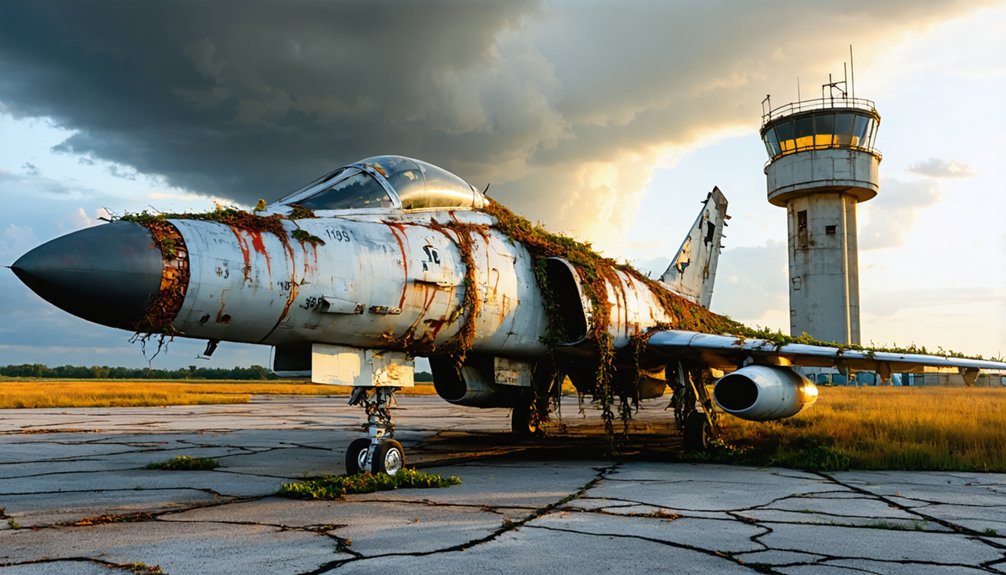
Today, you can still see the abandoned airstrip, marked with “X”s at each end to prevent landings, slowly returning to nature. The site stands as a peculiar indication of Cold War military planning, preserved within Wisconsin’s Bong Recreation Area.
Echoes of War at Fort Ord’s Abandoned Barracks
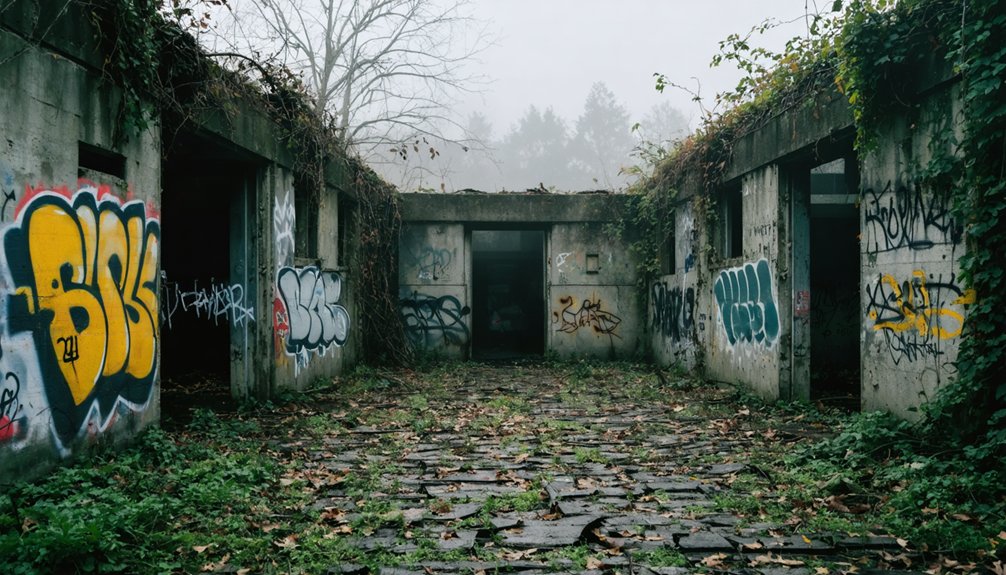
If you walk through Fort Ord’s abandoned barracks today, you’ll encounter crumbling buildings with lead paint peeling from walls and nature reclaiming the once-bustling military training grounds.
The base’s toxic legacy persists through contaminated soil, unexploded ordnance scattered across 8,000 acres, and underground bunkers that extend 50 feet below the surface. The Environmental Protection Agency identified serious environmental concerns when proposing Fort Ord for the National Priorities List in 1989.
These haunting remnants of military life, which once housed up to 50,000 troops during the Korean and Vietnam Wars, now stand as silent witnesses to both America’s military might and environmental negligence. Today, visitors can explore over 80 miles of trails throughout the Fort Ord National Monument.
Haunted Military Training Grounds
Deep within the abandoned military complex of Fort Ord, haunting echoes of America’s wartime past linger among the decaying barracks and overgrown training grounds.
You’ll find ghostly formations of crumbling structures where 50,000 troops once trained for WWII, Korea, and Vietnam. The coastal winds now whistle through broken windows and rusted metal, creating an otherworldly atmosphere where spectral soldiers seem to march through time.
- Training grounds that once thundered with military drills now lie silent, covered in sand and wild vegetation.
- Underground bunkers and forgotten tunnels remain hidden beneath coastal dunes, preserving untold stories.
- Former barracks stand as skeletal monuments to generations of servicemen who passed through these grounds.
The desolate landscape continues its slow transformation as nature reclaims what was once America’s largest West Coast military installation. Today, these deteriorating structures have become a refuge for local homeless populations seeking shelter within their walls. After its 1994 closure, much of Fort Ord was transformed into protected lands and educational facilities.
Toxic Legacy Lives On
Beyond the ghostly echoes of Fort Ord’s military past lies a more insidious presence – toxic contamination that permeates the soil, water, and crumbling structures.
You’ll find a 150-acre landfill, leaking petroleum tanks, and unexploded ordnance scattered across this former military powerhouse, earning it a spot on the EPA’s National Priorities List in 1990.
The toxic cleanup challenge is staggering. Lead paint and hazardous materials plague 20% of the remaining buildings, while contaminated groundwater flows beneath your feet.
Environmental hazards lurk in the abandoned barracks, where asbestos mingles with crumbling walls and vegetation pierces through degraded floors. The Fort Ord Reuse Authority oversees the extensive cleanup of 3,484 acres of the contaminated land.
Even now, decades after its 1994 closure, restricted areas remind you of the dangerous legacy that persists, as dual cleanup programs race against time to reclaim this contaminated landscape.
The base’s transformation from pristine agricultural land to military installation began when the Army purchased the property in 1917.
The Hidden Congressional Shelter at Greenbrier
Beneath the elegant Greenbrier resort in White Sulphur Springs, West Virginia, lies one of America’s most extraordinary Cold War secrets: Project Greek Island, a massive underground bunker designed to house all 535 members of Congress during a nuclear attack.
The local townspeople helped maintain this secret for decades, never revealing its existence to outsiders.
This cold war legacy, shrouded in congressional secrecy for over three decades, maintained readiness through:
- Regular updates to 1,100 bunk assignments
- Continuous rotation of supplies for 1,000 people
- Maintenance of sophisticated air filtration and communication systems
You’d never guess that behind a door marked “Danger: High Voltage Keep Out,” lay a fully equipped underground city capable of sustaining Congress for 60 days.
The Justice family purchased and preserved this historic site in 2009 for $20 million.
The facility included dormitories, meeting chambers, and even a crematorium disguised as a trash incinerator.
Though exposed in 1992, this remarkable bunker stands as a monument to Cold War paranoia and preparation.
Devil’s Slide: The Lonely Sentinel of the Pacific
While the Greenbrier bunker protected Congress from nuclear threats, a different kind of military outpost stands guard on America’s western edge.
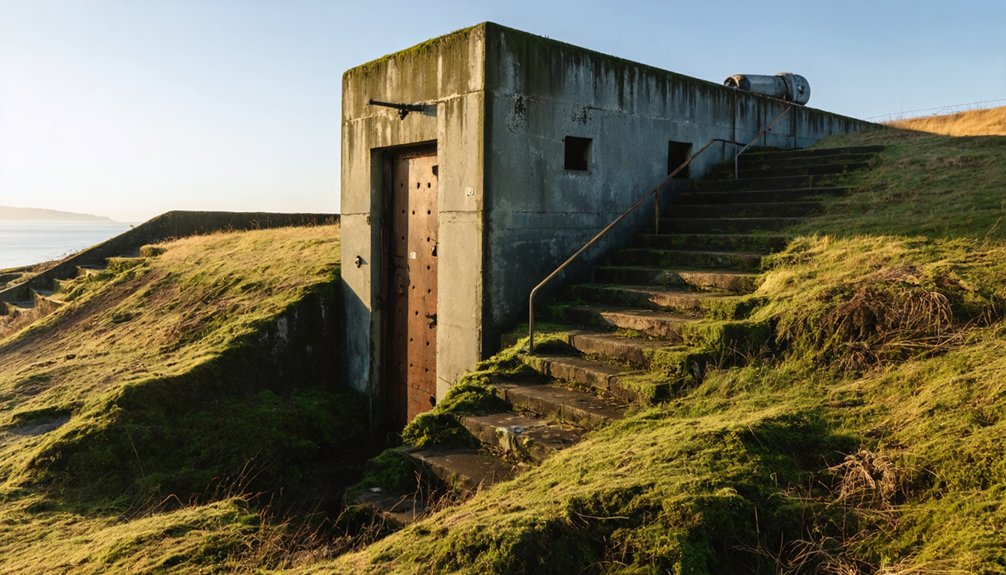
You’ll find this World War II relic perched on Devil’s Slide, a rocky promontory south of Pacifica, California, where it once served as a crucial coastal defense installation.
Built between 1943-1945, this bunker exploration reveals an impressive complex of six structures, including three observation pillboxes, two concrete bunkers, and a steel observation tower.
Soldiers used binoculars and compasses to scan for enemy vessels, relaying coordinates to nearby artillery batteries. Though never tested in battle, the site remained operational until 1949, when advancing missile technology made it obsolete.
Today, the abandoned sentinel overlooks Gray Whale Cove, its weather-beaten concrete walls standing as a memorial to America’s wartime vigilance.
Cape May’s Silent Guardian in the Sand
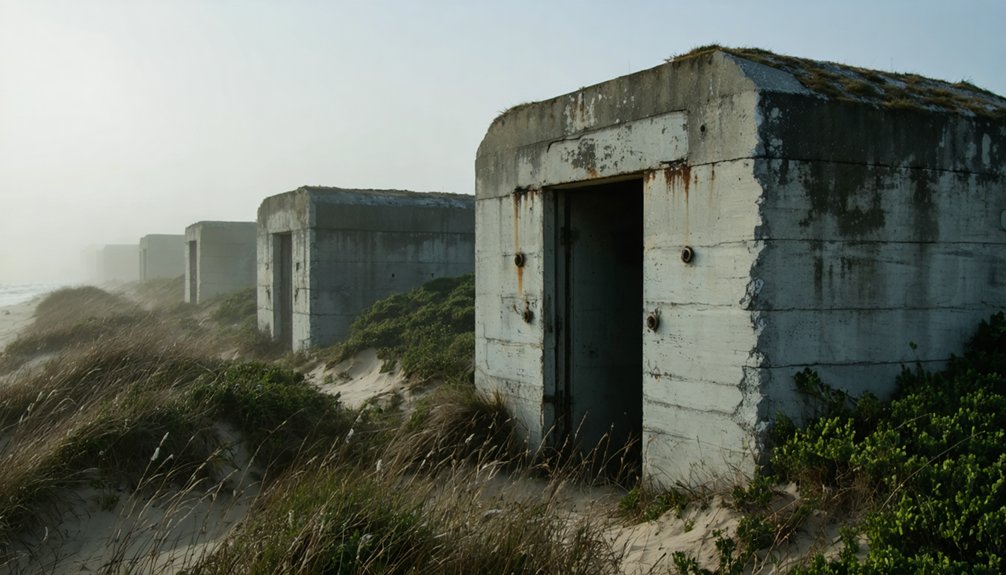
You’ll find a rich military history beneath the sandy shores of Cape May’s Coast Guard Training Center, where remnants of World War I naval operations and Prohibition-era anti-smuggling activities still exist.
The strategic position at Sewell’s Point transformed from a World War II-era naval training ground into America’s only Coast Guard recruit training facility, carrying forward its legacy of maritime defense.
What you can’t see are the underground passages and facilities dating back to wartime operations, when German U-boats prowled nearby waters and necessitated enhanced coastal fortifications.
Wartime Legacy Lives On
Standing as a silent sentinel along Cape May’s coastline, the World War II-era fire control tower serves as the last intact remnant of New Jersey’s coastal defense network.
You’ll find this concrete giant’s one-foot-thick walls still preserving America’s military history, while its wooden interior reflects wartime metal rationing. The tower coordinated with Battery 223 using azimuth instruments to protect Delaware Bay from German submarines and ships.
- The strategic Cape May Canal’s sharp bends prevented enemy submarines from maneuvering through.
- A submarine net stretched across the bay’s mouth to protect merchant vessels.
- Defensive gun emplacements, now buried beneath the sand, housed powerful artillery in subterranean chambers.
This coastal defense system, though never tested in combat, represented America’s determination to protect its shores during uncertain times.
Hidden Tunnels Below Shore
Deep beneath Cape May’s sandy shore lies Battery 223, a massive T-shaped concrete bunker that once served as a vital coastal defense fortification.
Built on wooden pilings in 1943, this concrete sentinel held hidden passages connecting twenty rooms, including gun emplacements, ammunition magazines, and a plotting room. You’ll find coastal secrets within its six-foot-thick walls, designed to withstand battleship bombardment and chemical attacks.
Today, the ocean threatens to claim these underground chambers.
Where soldiers once traversed secure corridors 900 feet inland, waves now wash beneath the structure’s foundation. The bunker’s wooden supports face constant assault from tides and storms, while its formerly camouflaged exterior stands exposed.
As shoreline erosion advances, this silent guardian gradually shifts seaward, its subterranean network slowly surrendering to the Atlantic’s relentless force.
The Dark Secrets of Fort Terry on Plum Island
Hidden within the eastern waters of Long Island Sound lies Fort Terry, a former military installation on Plum Island whose history spans from coastal defense to classified biological research.
Nestled in Long Island Sound, Fort Terry stands as a silent witness to decades of military and scientific secrets.
You’ll discover a fortress that once protected America’s essential waterways with 11 gun batteries and underwater minefields before transforming into a secretive biological warfare research facility during the Cold War.
The fort’s historical significance extends beyond its military role, as it later housed the controversial Plum Island Animal Disease Center.
- Fort Terry’s artillery protected Long Island Sound against German U-boats in WWII
- The site conducted classified biological warfare research until 1969
- The remains include gun emplacements, bunkers, and a rare 36-inch mini-gauge railroad from 1914
Today, you can still explore the haunting remnants of this military complex, now listed on the National Register of Historic Places.
abandoned military bases in california serve as poignant reminders of a turbulent past. Many of these sites have become popular destinations for urban explorers and history enthusiasts alike, eager to uncover the stories that lie within crumbling walls. As nature begins to reclaim these areas, the juxtaposition of history and overgrowth creates an eerie yet fascinating atmosphere.
Frequently Asked Questions
How Many Soldiers Have Reported Supernatural Encounters at These Abandoned Military Bases?
You’ll find hundreds of documented supernatural sightings through soldier testimonials at these bases, though exact numbers aren’t tracked since many servicemembers don’t formally report their experiences.
What Classified Documents Remain Sealed About These Military Installations Today?
You’ll find extensive classified files on Area 51’s aircraft testing, Fort Detrick’s bioweapons research, and nuclear testing at Nevada sites remain sealed under military secrets and national security exemptions.
Were Any Unexplained Deaths Recorded at These Bases During Active Service?
You’ll find significant records of unexplained deaths at these bases, with Fort Leavenworth’s hospital deaths, Clark Air Base’s wartime casualties, and Kadena’s prisoner executions standing out in military history.
Do Local Residents Report Ongoing Military Activity at These Abandoned Sites?
You’ll find local sightings of unexplained lights, aircraft, and unusual sounds near these abandoned bases, though official denials persist. Community fears and folklore often interpret maintenance activity as secret operations.
What Emergency Protocols Were in Place for Nuclear Attacks at These Bases?
You’d have followed strict nuclear drills requiring immediate shelter entry, while emergency response teams maintained two-person authentication, radiation monitoring, and readiness to launch within minutes through hardened command bunkers.
References
- https://mybaseguide.com/abandoned-military-bases
- https://www.loveexploring.com/gallerylist/233478/americas-eeriest-abandoned-military-sites
- https://www.youtube.com/watch?v=HQNliP3RtFA
- https://www.popularmechanics.com/technology/design/g1507/creepy-abandoned-military-sites-from-around-the-world/
- https://www.epa.gov/fedfacts/base-realignment-and-closure-act-sites
- https://en.wikipedia.org/wiki/List_of_former_United_States_Army_installations
- https://www.youtube.com/watch?v=Tl4FPjj0Otg
- https://abandonedfl.com/class/military/
- https://www.youtube.com/playlist?list=PLenYgd5YLQJ744EWXrjBFt-EtBj8FFdPo
- https://en.wikipedia.org/wiki/R.I._Bong_Air_Force_Base