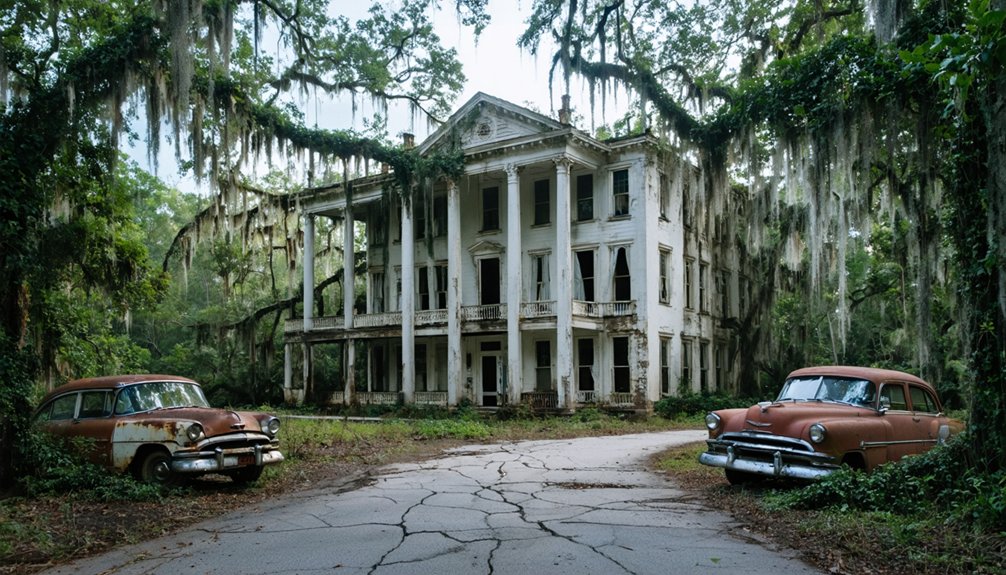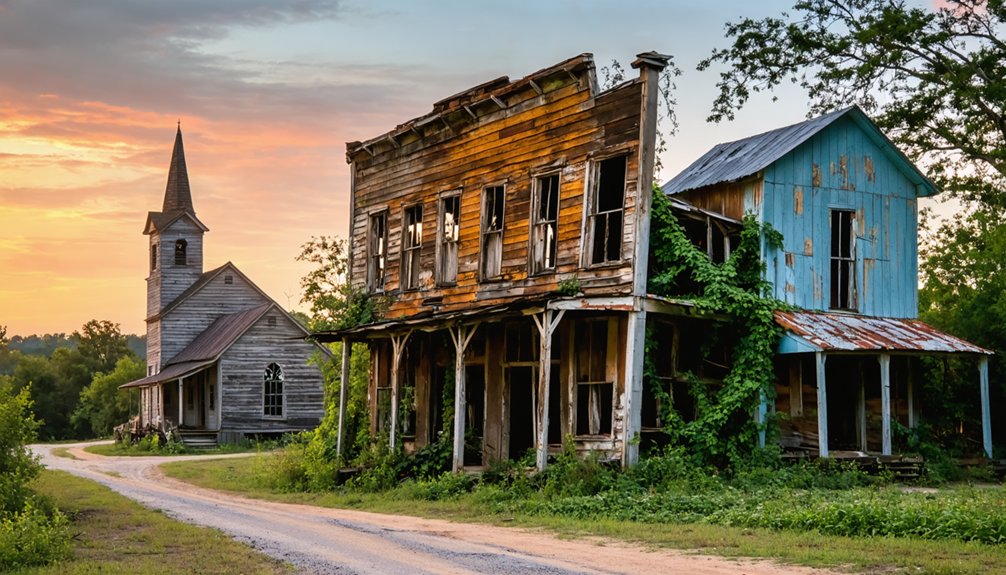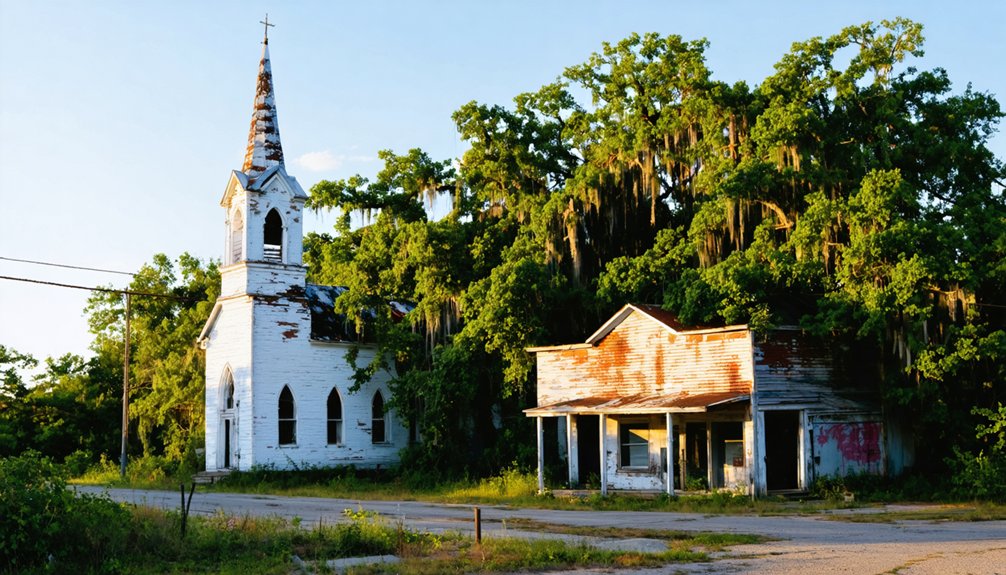
You’ll find numerous abandoned Southern towns scattered across states like Alabama, Mississippi, and Arkansas. Disease outbreaks, natural disasters, and government projects forced residents to leave once-thriving communities like Cahaba, Alabama’s first state capital, and Rodney, Mississippi. Economic decline emptied industrial towns, while federal initiatives like the Manhattan Project and TVA developments cleared entire settlements. The ruins of these ghost towns hold fascinating tales of sudden departures and lost communities.
Key Takeaways
- Claiborne, Alabama became a ghost town after disease outbreaks decimated its population of 5,000 residents.
- Cahaba, once Alabama’s state capital, was completely abandoned by 1903 after its population declined from 2,000.
- Rodney, Mississippi became deserted after the Mississippi River changed course and devastating floods isolated the town.
- Lost Cove, Tennessee transformed from a thriving timber community into an abandoned settlement known for moonshine production.
- Ellenton, South Carolina was completely evacuated when the government converted it into the restricted Savannah River Site.
Historic Southern Ghost Towns and Their Sudden Departures
Throughout the 19th and early 20th centuries, numerous Southern towns experienced rapid abandonment as economic, environmental, and social forces reshaped the regional landscape.
You’ll find remarkable examples in Alabama, where Claiborne and Cahaba showcase the historic significance of once-thriving communities. Claiborne’s population of 5,000 vanished after disease outbreaks, while Cahaba, Alabama’s first state capital, dwindled from 2,000 to abandonment by 1903.
The cultural memory of these ghost towns lives on in places like Rodney, Mississippi, where the mighty Mississippi River’s changing course sealed the town’s fate. A series of devastating floods in the early 1900s forced most residents to permanently abandon their homes.
In the Appalachians, communities like Lost Cove and Thurmond tell stories of boom-and-bust cycles tied to timber, coal, and railroad industries that once defined the region’s prosperity. Lost Cove became infamous for its moonshine production by 1898 due to its remote location.
Disease Outbreaks and Natural Disasters That Emptied Towns
Devastating disease outbreaks in the American South repeatedly transformed bustling communities into ghost towns during the 19th and early 20th centuries.
The disease impact was particularly severe in port cities, where yellow fever epidemics ravaged places like Wilmington, Norfolk, and Portsmouth. You’ll find that these outbreaks led to massive population decline as residents fled, with businesses shuttering and city services collapsing. In Wilmington’s 1862 epidemic, wealthy residents abandoned the city while those without means remained trapped. Norfolk and Portsmouth saw one-fifth of residents perish during the 1855 yellow fever epidemic.
The pattern of abandonment wasn’t limited to coastal areas. Inland communities suffered too, as cholera and Spanish flu swept through. In Midco, crowded conditions forced many residents to live in makeshift tent settlements, which accelerated the spread of disease throughout the community.
Towns like Midco, Missouri, never recovered after the 1918 flu killed dozens and infected over 1,600 people, while Boston, Indiana, lost nearly its entire population to cholera in 1849.
Government Projects That Created Ghost Towns
Three major federal initiatives transformed populated Southern communities into ghost towns during the mid-20th century.
You’ll find that government displacement reshaped the region through massive infrastructure and defense projects, leading to urban erasure of entire communities.
- TVA’s modernization efforts in Tennessee forced out 2,500 residents, demolishing Butler’s 175 buildings and relocating 1,200 graves for dam construction.
- The Manhattan Project seized 70,000 acres to create Oak Ridge, Tennessee, erasing farming communities for nuclear development.
- The Savannah River Site eliminated Ellenton, South Carolina, transforming it into a restricted nuclear zone.
These federal actions permanently altered the Southern landscape, as communities vanished beneath reservoirs, behind security fences, or within national parks – stark reminders of government power over private property and local autonomy. The establishment of Great Smoky Mountains National Park led to the closure of Elkmont’s Appalachian Club, displacing wealthy families from their mountain retreats. The rising waters of Lake Mead submerged St. Thomas, Nevada, forcing residents to abandon their homes and businesses in 1938.
Economic Collapse and Industrial Abandonment
While federal projects forcibly displaced entire communities, economic forces sparked a different kind of exodus across the American South.
You’ll find the remnants of this economic decline in once-thriving mill towns like Graysonia, Arkansas, where industrial migration left empty streets and shuttered businesses in its wake. The Buffalo River banks hosted numerous ghost towns that tell similar stories of industrial collapse. The pattern repeated itself across southern farming communities, where mechanization and global competition eliminated traditional agricultural jobs.
Young residents fled to cities, leaving aging populations behind in deteriorating towns.
The devastation wasn’t limited to farming communities. Manufacturing towns suffered similar fates when factories closed, creating a southern version of the Rust Belt. Towns like Pine Bluff saw their populations plummet as NAFTA job losses devastated local economies.
Without diverse economies to fall back on, these single-industry towns couldn’t recover. Their abandoned buildings and empty storefronts stand as stark reminders of globalization’s impact on local communities.
Preserved Ruins and Archaeological Remnants
Scattered across the American South, archaeological remnants and preserved ruins tell complex stories of Native American settlements, colonial outposts, and industrial ventures.
You’ll find cultural heritage sites that span centuries of human activity, from ancient Mississippian towns to abandoned mining communities.
The archaeological significance of these sites reveals distinct patterns of settlement and development:
- Native American sites like DePrato Mounds and Bisset Mound preserve pre-colonial cultural layers spanning thousands of years
- Colonial-era ruins at Old Mobile showcase French influence along the Gulf Coast, with intact remains of fortifications and civilian structures
- Mining ghost towns like Silver Reef and Steins reflect the boom-and-bust cycle of resource extraction, leaving behind foundations and industrial remnants
The Samuel Site, inhabited by Archaic Indians and later occupants including French colonial soldiers and English traders, demonstrates the successive waves of settlement that characterize many Southern archaeological locations.
The First Presbyterian Church in Rodney, Mississippi stands as a testament to Civil War history, with its cannonball-scarred walls still visible today.
These preserved locations serve as windows into the South’s layered past, documenting waves of settlement, conflict, and economic transformation.
Frequently Asked Questions
Are There Any Southern Ghost Towns That Still Have Active Residents?
While you’d expect ghost towns to be empty, several southern active ghost towns maintain residents today, including St. Elmo, Colorado, Terlingua, Texas, and Thurmond, West Virginia, preserving their unique southern history.
Despite their vibrant histories, many of these towns are struggling with economic decline in southern towns, leading to dwindling populations and closing businesses. Efforts are being made to revitalize these areas, focusing on tourism and local arts to attract new visitors. As they adapt to the changing economic landscape, the historical charm of these communities remains a significant draw.
What Paranormal Activity Has Been Reported in Southern Ghost Towns?
You’ll find haunted histories across southern ghost towns, from EVP recordings in Ruby, Arizona to spectral sightings in Cahaba, Alabama. People report mysterious footsteps, voices, apparitions, and unexplained cold spots.
Can Visitors Legally Explore and Photograph These Abandoned Southern Towns?
You’ll need permission to explore most abandoned towns, as legal restrictions vary by location. Follow photography etiquette by getting landowner consent and respecting preservation rules in accessible areas.
How Much Does It Cost to Purchase Property in Abandoned Towns?
Like finding needles in a haystack, property prices in abandoned Southern towns range from $10,000 to $1 million. You’ll find investment potential varies based on location, infrastructure, and historical significance.
Which Southern Ghost Towns Are Most Likely to Be Redeveloped?
You’ll find the highest redevelopment potential in Thurmond, West Virginia, and St. Elmo, Colorado, where preserved infrastructure, historical significance, and existing tourism already support active restoration and cultural events.
References
- https://www.geotab.com/ghost-towns/
- https://devblog.batchgeo.com/ghost-towns/
- https://www.visittucson.org/blog/post/8-ghost-towns-of-southern-arizona/
- https://quirkytravelguy.com/ghost-towns-of-the-deep-south/
- https://whakestudios.com/us-ghost-towns/
- https://styleblueprint.com/everyday/ghost-towns-in-the-south/
- https://www.visitutah.com/things-to-do/history-culture/ghost-towns
- https://en.wikipedia.org/wiki/Lists_of_ghost_towns_in_the_United_States
- https://wicproject.com/lifestyle/7-southern-towns-that-were-abandoned-after-natural-disasters/
- https://appalachian.org/lost-cove-ghost-town-in-the-national-forest/