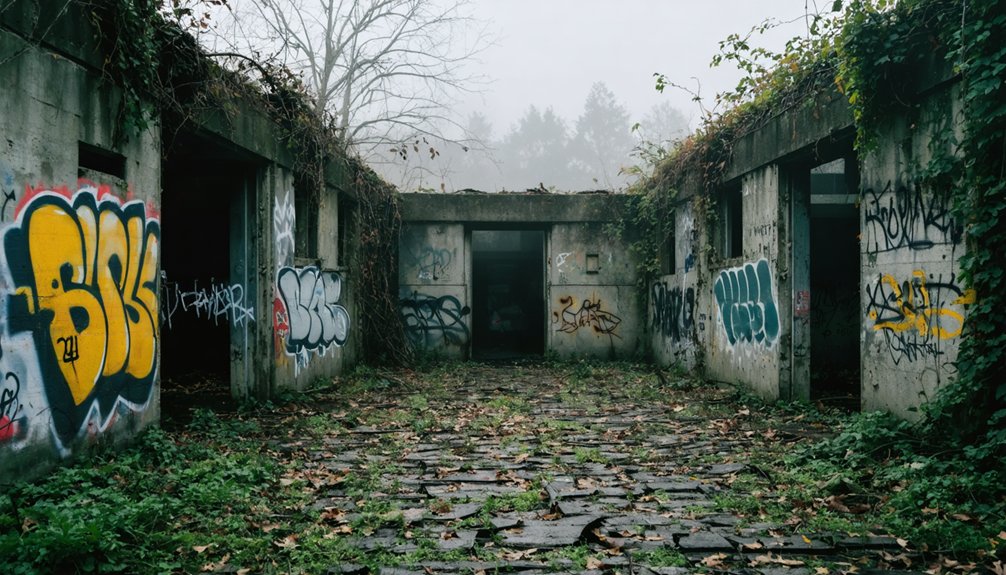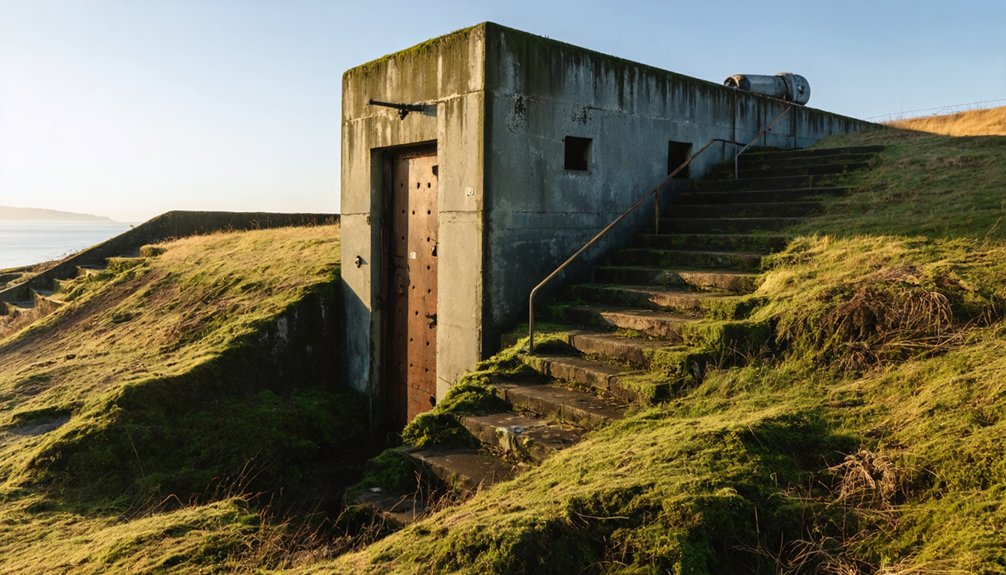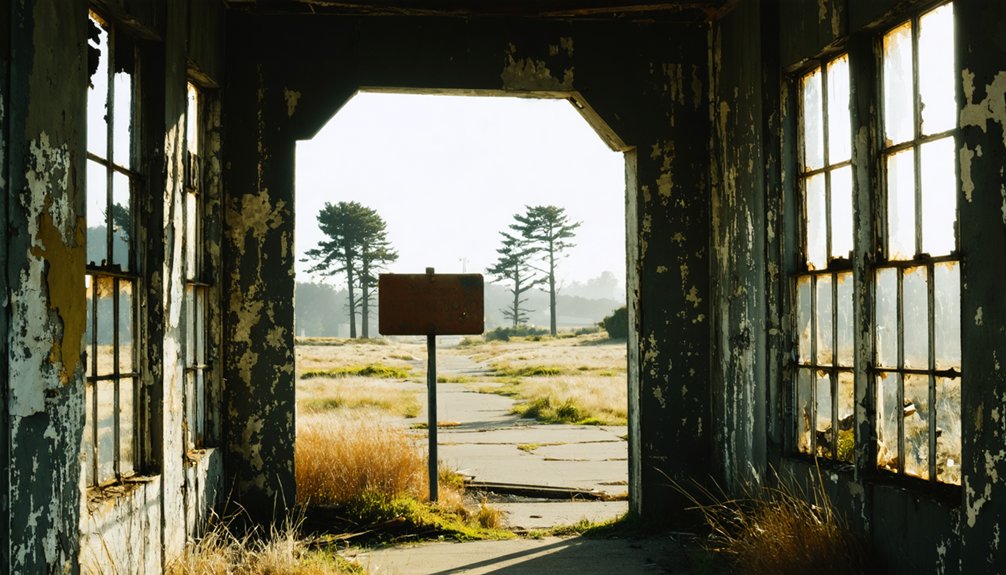
You’ll find that historic army towns face abandonment due to their inability to adapt to modern warfare demands. Over 70% of these bases, built more than fifty years ago, can’t support multi-domain operations or meet current training requirements. Their outdated infrastructure, environmental challenges like PFAS contamination, and geographic limitations create unsustainable conditions. The economic impact hits local communities hard, revealing complex layers behind these ghost towns’ existence.
Key Takeaways
- Outdated infrastructure and facilities from the 1950s-1970s cannot support modern military operations and training requirements effectively.
- Environmental contamination, particularly PFAS chemicals, makes many bases unsafe and requires extensive, costly cleanup efforts.
- Evolving warfare tactics shifted from fixed defensive positions to mobile operations, making traditional army town locations strategically obsolete.
- Base closures occur when installations no longer meet current military needs, causing economic decline in surrounding communities.
- Geographic limitations and harsh weather conditions strain operations and maintenance, making some historic locations unsustainable for modern military use.
The Rise and Fall of Strategic Military Defense Points
While the early American military relied heavily on strategic defense points, these fortified positions ultimately fell victim to advancing technology and evolving warfare doctrine.
You’ll find that America’s fortification strategies initially focused on geographic advantages, with commanders selecting high ground, river bends, and natural chokepoints to establish defensive strongholds.
The historical significance of these locations can’t be understated. Places like West Point demonstrated the military’s early emphasis on fixed defenses, complete with massive iron chains across rivers and gun batteries protecting crucial waterways.
During the War of 1812, military settlements expanded significantly as coastal fortifications became critical for defending against British naval attacks.
These strategic points evolved into bustling military settlements, serving as supply depots and training centers. The military’s role as servants of the people, rather than instruments of governance, influenced how these installations were operated and maintained. However, as warfare modernized through mechanization, air power, and long-range weapons, these once-essential defensive positions became increasingly obsolete, giving way to more mobile and adaptable military approaches.
Modern Warfare’s Impact on Traditional Army Bases
As modern warfare evolves toward multi-domain operations, traditional Army bases face unprecedented challenges in adapting their legacy infrastructure.
You’ll find that once-mighty installations now struggle with technological obsolescence as their aging systems fail to integrate with smart base technologies and AI-driven security measures.
The shift to distributed operations and long-range precision warfare has rendered many fixed installations vulnerable to attack.
With over 70% of bases being five decades or older, maintaining operational readiness becomes increasingly difficult.
Legacy adaptation proves particularly difficult when you consider how these bases weren’t designed for today’s joint all-domain operations.
Modern military bases face critical adaptation challenges, as their foundational designs predate the complex requirements of integrated multi-domain warfare.
Their outdated perimeter defenses and inability to support rapid deployment leave them exposed to new threats.
While some bases undergo modernization with 5G networks and digital twins, others can’t justify the massive investment required.
These technological hurdles, combined with environmental vulnerabilities, force many historic Army towns into obsolescence or abandonment.
The commitment-resource gap between modernization needs and available funding has accelerated the decline of these military installations.
Economic Pressures Leading to Base Closures
Because military base closures devastate local economies, you’ll find their impacts rippling through entire communities with devastating precision.
When bases shut down, thousands of military and civilian jobs vanish overnight, triggering rapid economic decline. You’ll witness property values plummet by around $10,000, while local businesses that once thrived on military contracts and personnel spending struggle to survive. Research shows that contractor base employment significantly impacts local employment levels and economic stability.
The community displacement hits hard as military families relocate, causing school enrollments to drop and tax revenues to shrink. Your local government’s ability to maintain essential services weakens, creating a downward spiral. Social insurance payments have little effect on helping these communities recover.
What’s worse, the stable economic buffer that military bases provided against market downturns disappears, leaving your community more vulnerable to economic shocks.
Recovery demands aggressive diversification of the industrial base, but many communities struggle to overcome this seismic shift in their economic foundation.
Geographic Isolation and Environmental Challenges
Despite their strategic placement, historic army towns faced overwhelming geographic isolation and environmental challenges that ultimately contributed to their abandonment.
You’ll find these bases were often surrounded by formidable geographic barriers – from frozen tundra to scorching deserts – that created persistent supply challenges. Harsh weather conditions battered outdated infrastructure while extreme temperatures complicated training and maintenance operations. Similar to the shuttered Camp Century in Greenland, many bases were abandoned when engineering difficulties made them unsustainable in hostile environments.
These environmental constraints didn’t just affect daily operations; they dramatically increased operational costs. Limited road networks and seasonal access routes meant you couldn’t reliably move personnel or equipment year-round. The Rio Grande location of Fort McIntosh exemplified these challenges, as its frontier positioning made supply lines vulnerable to disruption.
Environmental constraints and limited infrastructure created year-round logistical nightmares, making isolated bases increasingly costly to maintain and operate.
When combined with the environmental impact of military activities in sensitive ecosystems, many bases became unsustainable. Modern military doctrine’s shift toward flexible deployment made it harder to justify maintaining these isolated outposts, especially when faced with costly infrastructure upgrades and environmental cleanup requirements.
Shifting Military Training Requirements
You’ll find that historic army towns couldn’t keep pace with modern combat training requirements, which demand specialized facilities for tasks like battlefield medical care and urban warfare scenarios.
Since the Army’s first fitness program in 1852, training requirements have continuously evolved to meet changing warfare demands.
The Army’s shift toward role-specific training meant many older bases lacked the infrastructure to support advanced systems, tactical simulations, and evolving fitness standards. The continuous assessment every three years ensures training facilities remain current with emerging combat needs.
As the military consolidated resources into modernized training centers with purpose-built facilities, traditional army towns lost their strategic value and training capabilities.
Modern Combat Methods Prevail
Modern combat methods have revolutionized military training, making older facilities obsolete.
You’ll find today’s modern training techniques focus heavily on MACP’s urban warfare scenarios and close-quarters combat situations. Combat readiness now demands mastery of multiple martial arts disciplines, from Brazilian Jiu-Jitsu to Krav Maga, creating well-rounded warriors prepared for any threat.
The tiered certification system guarantees soldiers progress from basic defensive tactics to advanced instructor levels.
You’re training in environments that simulate disrupted communications, GPS denial, and cyber warfare – conditions that weren’t considered in traditional army towns. As warfare evolves into multidimensional battlefields, training facilities must adapt to prepare troops for electronic warfare, urban combat, and hand-to-hand engagement simultaneously.
This shift has left many historic military installations unable to meet current combat training demands.
Training Bases Consolidate Resources
Since military doctrine has evolved beyond traditional warfare models, the Department of Defense continues to consolidate training bases nationwide to maximize operational efficiency.
You’ll find modern military installations focusing on joint all-domain operations, combining multiple training programs under unified command structures for superior resource optimization.
Today’s combat requirements demand training efficiency through integrated cyber, space, and traditional warfare capabilities.
The shift from dispersed Cold War-era facilities to concentrated, multifunctional training complexes enables rapid adaptation to emerging threats.
You’re witnessing a strategic transformation where fewer, more capable bases deliver advanced training across multiple combat domains.
This consolidation allows for seamless integration of new technologies and training methods, ensuring America’s warriors maintain their tactical edge while eliminating wasteful redundancies in the training infrastructure.
The Human Cost of Base Abandonment
When military bases shut down across American towns, they leave devastating human costs in their wake.
You’ll witness immediate spikes in unemployment as both military and civilian jobs vanish, forcing families to relocate in search of work. The emotional trauma runs deep as community resilience is tested by population decline and social disruption.
Your town’s identity takes a severe hit as military families and retirees move away, weakening the social fabric that once defined these proud communities.
You’ll see school enrollments plummet, property values decline, and local businesses struggle to survive. The ripple effects continue for years as displaced workers face long-term wage losses and increased dependency on public assistance.
Housing markets deteriorate, leaving abandoned properties that serve as stark reminders of once-thriving military communities.
Environmental Legacies and Cleanup Hurdles
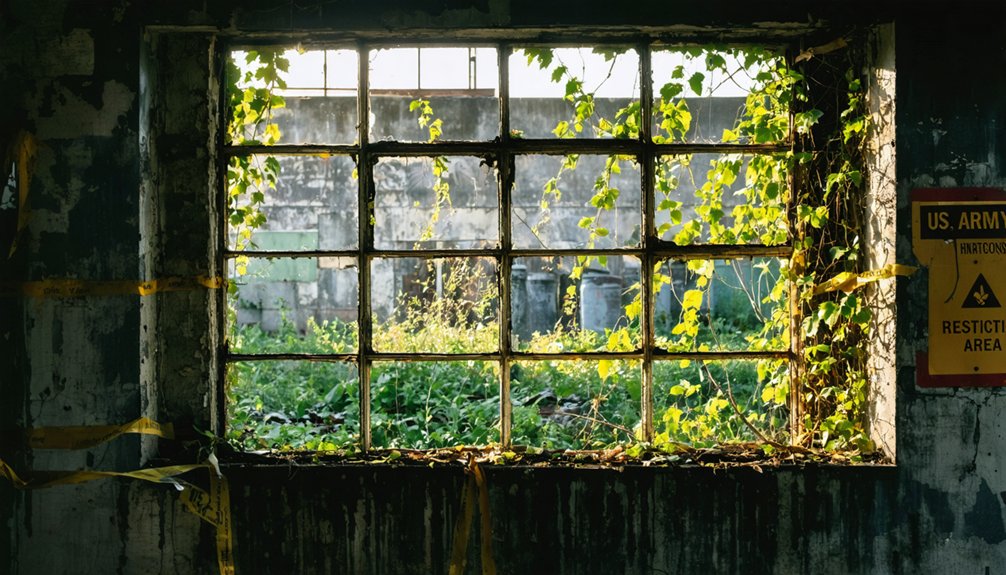
The environmental toll of abandoned military bases extends far beyond their vacant buildings and empty streets. You’ll find PFAS contamination at over 700 military sites across America, with toxic chemicals seeping into soil and groundwater from decades of firefighting foam use.
These “forever chemicals” persist at levels hundreds of times above safety thresholds. Cleanup challenges are monumental. The chemicals don’t break down naturally, requiring complex treatment technologies and following strict hazardous waste protocols.
PFAS chemicals stubbornly linger in the environment, defying natural breakdown and demanding advanced treatment methods to remove these toxic threats.
While the DoD conducts site assessments, full remediation can take decades. At locations like Brunswick Naval Air Station, PFAS levels reach 24,000 parts per trillion, far exceeding safe drinking water limits.
Your communities near these bases face ongoing health risks, including cancer and immune system problems, as regulatory hurdles and delayed acknowledgment of PFAS dangers continue to slow progress.
From Military Towns to Heritage Sites
Throughout America’s landscape, abandoned military installations have undergone remarkable transformations into vibrant heritage destinations. You’ll find former army towns like the Presidio of San Francisco and Fort Mason now serving as public parks where Victorian-era architecture stands alongside coastal defense installations.
Urban exploration of abandoned bases offers an exciting glimpse into history, inviting adventurers to uncover remnants of the past. As you wander through these sites, you may discover intriguing artifacts and stories that reveal the lives once lived in these forgotten spaces. Each exploration not only honors the history of these locations but also fosters a deeper appreciation for the evolution of urban landscapes.
These conversions exemplify successful adaptive reuse, as military buildings find new purpose housing museums, arts organizations, and cultural venues. At Fort Worden, you can stay in restored barracks while exploring historic gun emplacements and tunnel systems.
The shift to heritage tourism has revitalized local economies previously devastated by base closures. Museums and interpretive centers preserve military artifacts, while hiking trails connect maritime defenses with scenic vistas. Through careful preservation and community collaboration, these sites maintain their authenticity while welcoming diverse visitors seeking both recreation and historical insight.
The Future of Abandoned Military Properties

You’ll find abandoned military properties across America facing a critical turning point between decay and sustainable redevelopment.
These former installations, representing billions in dormant infrastructure value, can transform into mixed-use developments that serve both preservation and economic goals.
Through strategic planning and public-private partnerships, you can witness these historic military towns evolving into vibrant communities that combine residential, commercial, and heritage tourism elements while maintaining their connection to military history.
Sustainable Redevelopment Solutions
While abandoned military bases present significant environmental and economic challenges, modern sustainable redevelopment solutions offer promising pathways for their restoration.
You’ll find successful transformations incorporating green infrastructure through adaptive reuse of historic structures, energy-efficient retrofits, and smart growth principles that create walkable, mixed-use communities.
Through strategic community engagement, these former military sites can become thriving civilian hubs that preserve cultural heritage while advancing environmental sustainability.
You’ll see how public-private partnerships leverage federal initiatives like the HUBZone program to attract investment and create jobs.
By combining conservation goals with economic development, these projects convert contaminated zones into parks and wildlife habitats while establishing technology parks and educational facilities.
This balanced approach guarantees long-term viability while protecting natural resources for future generations.
Mixed-Use Property Potential
Former military installations offer exceptional potential for mixed-use redevelopment, as demonstrated by successful transformations across the United States.
You’ll find prime examples in Lowry Air Force Base (Denver) and Liberty Station (San Diego), where strategic mixed-use development has created thriving communities combining housing, retail, offices, and cultural facilities.
These properties command significant advantages through their existing infrastructure – roads, utilities, and power systems are already in place.
You’re looking at ready-made opportunities for community revitalization that generate substantial economic returns.
Fort Monmouth’s 1,126-acre transformation exemplifies this potential, with 80% of its property already sold or under contract.
The scale of these installations allows for thorough planning that integrates diverse uses while existing infrastructure accelerates development timelines and reduces costs compared to new suburban projects.
Frequently Asked Questions
How Do Locals Preserve Memories and Artifacts From Abandoned Army Towns?
You’ll find memory preservation through local museums, cultural programs, and veterans’ groups, while artifact restoration happens in specialized facilities. Digital archives and oral histories capture stories before they’re lost forever.
What Wildlife Species Now Inhabit These Abandoned Military Properties?
You’ll find endangered species thriving in these military ruins: gopher tortoises, California tiger salamanders, rare butterflies, and various wetland species have adapted, creating unexpected wildlife sanctuaries with significant ecological impact.
Are There Underground Tunnels or Bunkers Still Unexplored?
Like secret veins beneath the earth, you’ll find countless unexplored Cold War tunnels and bunkers across America’s abandoned bases, their historical significance locked away by military restrictions and structural hazards.
Which Abandoned Army Towns Have Been Successfully Converted Into Civilian Communities?
You’ll find successful adaptive reuse in Colorado Springs, Kirtland NM, Wright-Patterson OH, and Lemoore CA, where military infrastructure sparked community revitalization through aerospace, technology, and commercial development initiatives.
Do Former Residents Ever Organize Reunions at Abandoned Military Towns?
You’ll find reunion events frequently organized by former residents and veterans, driven by community nostalgia. They gather to share memories, explore abandoned facilities, and honor their shared military heritage.
References
- https://www.loveexploring.com/gallerylist/233478/americas-eeriest-abandoned-military-sites
- https://www.youtube.com/watch?v=c8cqQ-q7t9E
- https://www.popularmechanics.com/technology/design/g1507/creepy-abandoned-military-sites-from-around-the-world/
- https://soldiersangels.org/haunted-military-bases/
- https://www.warhistoryonline.com/featured/abandoned-military-bases.html
- https://en.wikipedia.org/wiki/List_of_former_United_States_Army_installations
- https://www.youtube.com/watch?v=Tl4FPjj0Otg
- https://www.youtube.com/playlist?list=PLenYgd5YLQJ744EWXrjBFt-EtBj8FFdPo
- https://www.war.gov/Multimedia/Experience/The-History-of-the-Department-of-War/
- https://en.wikipedia.org/wiki/Timeline_of_United_States_military_operations