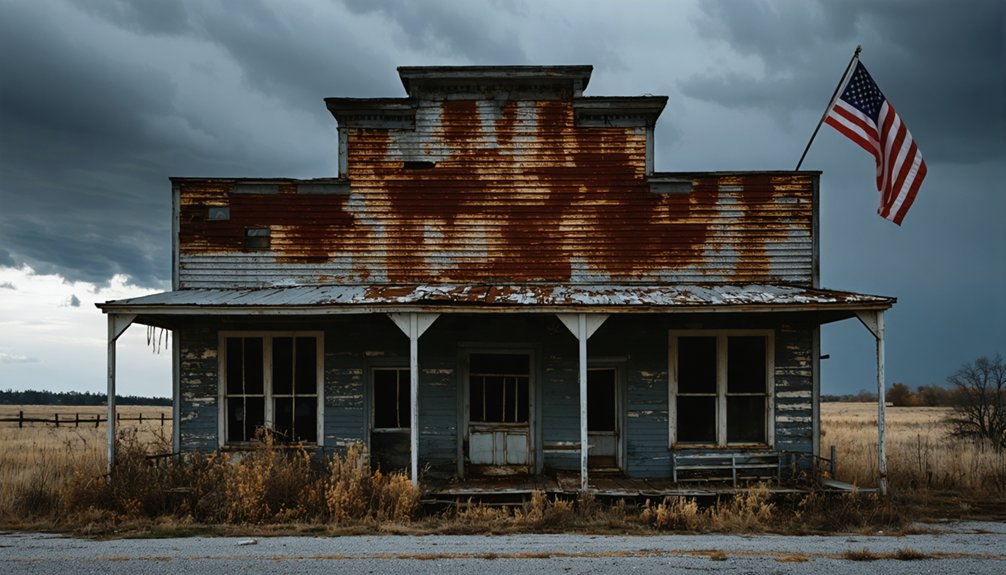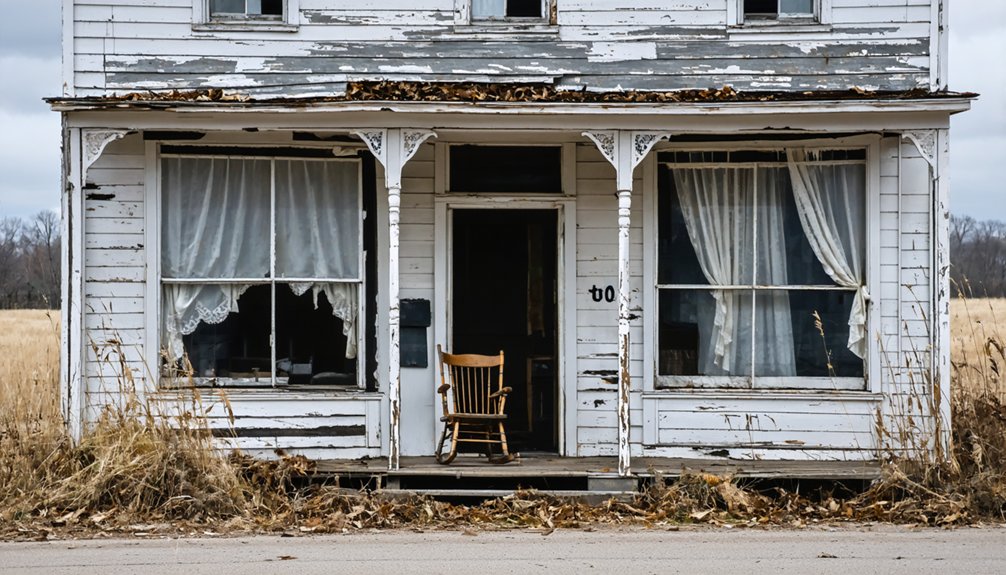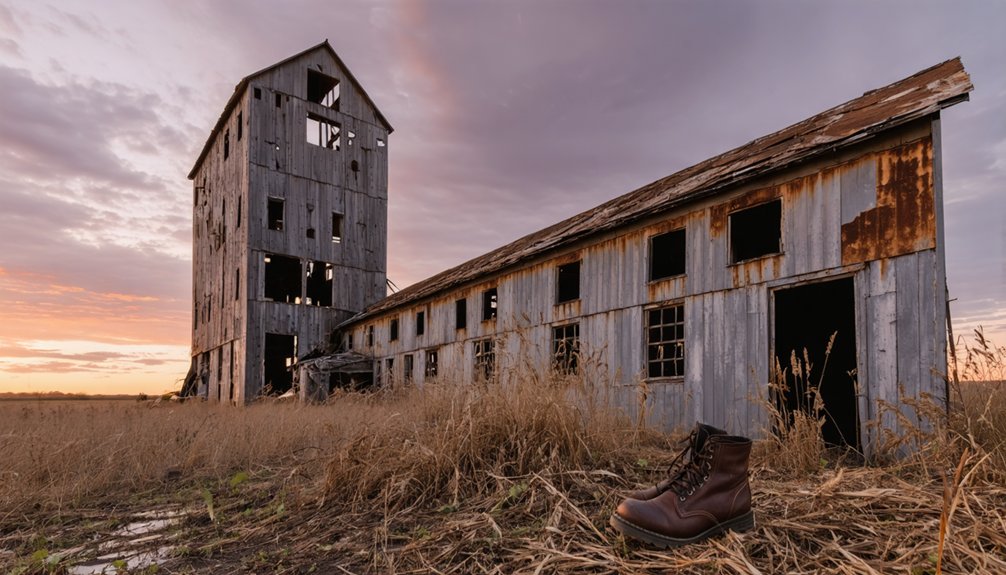
When you visit a Midwestern ghost town, you’ll encounter haunting reminders of economic devastation and environmental decay. These abandoned places reveal dark histories of resource depletion, disease outbreaks, and industrial accidents that forced entire communities to vanish. Empty Victorian mansions and rusting machinery stand as silent witnesses to broken dreams, while vacancy rates above 18% and poverty levels exceeding 30% tell tales of collapse. Deeper mysteries lurk in these forgotten spaces, where psychological imprints and local legends intertwine.
Key Takeaways
- Rapid abandonment following resource depletion left intact buildings and personal belongings, creating eerie time capsules of sudden departure.
- Victorian architecture with ornate details and towering mansions creates an imposing, gothic atmosphere when left to decay.
- Local folklore and tragedy-based ghost stories have become deeply embedded in these towns’ cultural identities.
- Nature’s gradual reclamation of buildings, with creeping vegetation and wildlife, creates an unsettling blend of civilization and wilderness.
- The stark contrast between past prosperity and current abandonment produces a psychological discomfort that people interpret as spookiness.
The Dark Side of Economic Booms and Busts
While the promise of quick riches drew thousands to Midwestern resource towns in the late 19th century, these economic booms carried the seeds of their own destruction.
You’d witness entire communities rise from nothing as miners and merchants flooded in, driving up wages and rents to unsustainable levels. But beneath this facade of prosperity lurked devastating economic volatility.
When resources depleted or commodity prices crashed, you’d see these towns’ fragile foundations crumble. The young, male-dominated populations that once energized these communities would vanish almost overnight, leaving behind empty storefronts and abandoned infrastructure.
Unlike their more stable counterparts, these boomtowns often lacked the community resilience to weather such storms. Their focus on quick profits over sustainable development meant that when the bust came, there was little left to rebuild from. The devastating impact of the Great Plains Dust Bowl forced countless farming communities to completely abandon their homes.
Nature’s Wrath: Environmental Forces of Abandonment
Environmental changes have wreaked havoc on communities like Great Harbour Deep, where the collapse of fisheries forced residents to abandon their homes. The decline of these settlements accelerated as essential industries failed, leaving workers with no choice but to relocate.
Tales of Tragedy and Lost Dreams
Beyond their crumbling facades and vacant streets, Midwestern ghost towns harbor dark chronicles of human tragedy and shattered aspirations.
You’ll find ghostly whispers of violent endings, like the infamous 1912 Villisca axe murders in Iowa, or the assassination of religious leader James Jesse Strang in Voree, Wisconsin. These forgotten legacies tell tales of broken dreams, where speculators sold worthless plots to hopeful settlers who arrived to find nothing but empty promises.
Disease-ravaged orphanages, devastating fires like North Unity’s 1871 inferno, and industrial accidents haunt these abandoned places. The tragic outbreak of malaria in Sinipee decimated the population, leaving only graves to mark where a vibrant community once stood.
Even more chilling are towns like Times Beach, Missouri, where toxic contamination forced entire communities to flee, leaving behind poisoned streets as evidence of humanity’s hubris and nature’s vengeance. At the Missouri State Penitentiary, the spirits of those executed in the lethal gas chamber still linger, marking one of America’s darkest chapters in prison history.
Silent Streets and Empty Windows
As you traverse the desolate streets of Midwest ghost towns, stark vacancy rates exceeding 18% in many ZIP codes reveal the haunting scale of abandonment.
In cities like Youngstown, Ohio, where home values plummeted to just $20,000, economic devastation has left an indelible mark on these forgotten communities.
You’ll find nature reclaiming these vacant spaces, with vegetation bursting through cracked pavement and wrapping around empty window frames. The silent echoes of former communities linger where populations have plummeted by over 20% in cities like Detroit and Gary. In Michigan’s Kiwana Peninsula, copper mine closures led to dramatic population declines from over 100,000 residents at its peak to just a few thousand today.
In remote areas, particularly Michigan’s Upper Peninsula, you’ll encounter towns with fewer than twelve residents, where the nearest services lie over 100 miles away.
Deteriorating infrastructure and boarded-up buildings tell stories of economic decline, while poverty rates above 30% have transformed once-vibrant neighborhoods into hushed, haunting reminders of lost prosperity.
The Psychology of Forgotten Places
You’ll find your mind racing with dark possibilities when encountering a ghost town’s empty spaces, as your brain instinctively processes perceived threats and creates narratives to make sense of abandonment.
Studies show that exposure to these derelict places can trigger serious mental health issues in nearby residents and visitors alike.
Research shows that these forgotten structures become magnets for illegal activities, further fueling the ominous atmosphere that pervades them.
These forgotten places trigger powerful psychological responses that span from primal fear to melancholic reflection, activating both your survival instincts and your capacity for historical empathy.
What’s perhaps most haunting is how these abandoned sites become repositories of collective memory, where your own projected stories intertwine with the real histories of those who once called these places home.
Empty Spaces Stir Fear
When abandoned buildings and empty lots infiltrate a community, they create more than just physical voids – they trigger deep-seated psychological responses rooted in evolutionary fear of the unknown.
You’ll notice your fear responses intensify as you encounter these empty spaces, driven by both real and perceived threats. The absence of human activity creates an unsettling atmosphere where your mind heightens awareness of potential dangers. These decaying structures create a haunting sense of nostalgia as they stand frozen in time.
These vacant structures tap into your survival instincts, making you hyper-vigilant of structural hazards, criminal activity, and hidden threats.
The eerie sensation of being watched, despite no visible observers, stems from architectural features that create feelings of exposure. Long sightlines and reflective surfaces amplify your vulnerability, while limited escape routes and scattered remnants of former occupants intensify the haunting atmosphere.
Our Minds Create Stories
The human mind instinctively fills vacant spaces with stories, transforming abandoned buildings into vessels of psychological projection. When you explore these forgotten places, your brain creates phantom narratives to reconcile the unsettling disconnect between what you expect and what you find.
- Your sensation-seeking nature draws you to explore, while cognitive dissonance from broken spatial expectations fuels your psychological projections.
- You’ll experience an uncanny feeling as familiar structures become strangely unfamiliar, forcing confrontation with repressed memories.
- The incomplete historical record triggers your mind to generate fictional explanations for the decay.
- Your brain seeks meaning through temporal connections, weaving stories that bridge past and present.
This psychological engagement with abandoned spaces reflects a deeper human need to understand and control our environment through storytelling.
Memories Haunt These Places
Deep within abandoned Midwest ghost towns, psychological imprints linger like invisible fingerprints on decaying walls, shaping the mental landscape of visitors and nearby residents alike.
Exploring haunted locations in the Midwest can provoke strong emotions, as each site tells a story steeped in mystery and sorrow. Many seek out these eerie places, hoping to catch a glimpse of the past or experience an otherworldly encounter. The chilling atmosphere often leaves an indelible mark on those who dare to wander through the shadows of history.
You’ll feel memory echoes reverberating through empty storefronts and vacant homes, where nostalgia’s grip tightens with each creaking floorboard and distant sound.
These forgotten places serve as powerful anchors for collective memory, connecting you to a complex web of past experiences and communal identity.
When cherished “third places” – the social hubs that once united communities – vanish, they leave psychological voids that amplify feelings of loss and fragmentation.
The resulting emptiness creates an affective atmosphere that triggers deep reflection on time’s passage, while environmental disorder heightens your awareness of absence, making these ghost towns feel truly haunted.
Legends and Lore of the Midwest’s Past
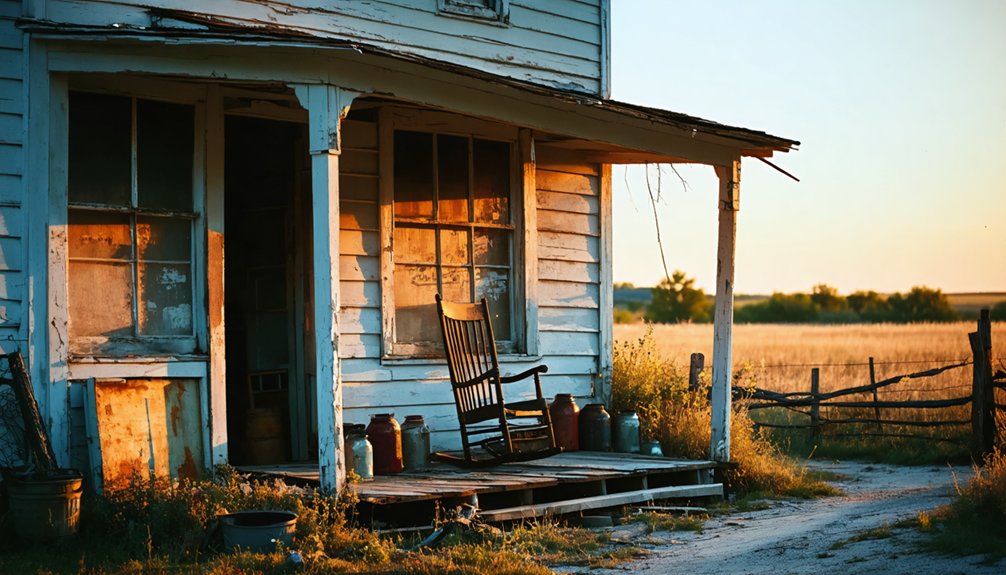
Haunting the backroads and forgotten corners of America’s heartland, Midwestern folklore weaves a rich tapestry of supernatural tales rooted in tragic histories and indigenous wisdom.
Through ghostly encounters and haunted history, you’ll discover how tragedy and cultural heritage intertwine to create enduring legends.
These spine-tingling phenomena manifest in various forms:
- The Blue Lady of Denton Road’s glowing apparition, born from a mother’s murder
- Native American influences on Great Lakes mysteries, including legendary lake monsters Bessie and Pressie
- Abandoned places like Fayette Ghost Town, where iron workers’ spirits linger
- Local cryptids such as the Murphysboro Mud Monster and Missouri’s Mothman
You’ll find these stories preserve not just supernatural tales, but the deep cultural memories and historical traumas that shaped the Midwest’s identity.
Architecture Frozen in Time
You’ll find the most haunting architectural remnants of the Midwest’s ghost towns in their crumbling Victorian mansions, where wealthy industrialists once hosted lavish gatherings.
Empty storefronts line Main Streets like hollow-eyed sentinels, their weathered facades preserving the exact moment these boomtowns went bust.
Rusting industrial machinery towers above these abandoned settlements, marking the skeletal remains of once-thriving mining and manufacturing operations that defined these communities.
Crumbling Grand Victorian Mansions
Throughout the Midwest’s forgotten landscapes, grand Victorian mansions stand as majestic ruins, their elaborate architecture frozen in a peculiar state between preservation and decay.
These haunting structures, built by wealthy industrialists and Civil War veterans, tell tales of both opulence and abandonment through their ornate details and forgotten craftsmanship.
You’ll discover their architectural significance through:
- Elaborate turrets and wraparound porches that showcase Victorian decay
- Unique interior features like hidden prison cells and built-in bars
- Original stained glass windows and chandeliers in eerie preservation
- Unusual structural combinations from relocated and merged buildings
The ghostly legends surrounding these mansions deepen their haunting allure, as historical narratives of tragedy and prosperity intertwine within their crumbling walls, creating time capsules of the Midwest’s gilded past.
Empty Storefronts Tell Stories
Beyond the grand Victorian mansions, the empty storefronts of Midwest ghost towns serve as stark time capsules of American commerce.
You’ll find original fixtures frozen in time – antique cash registers, wooden cabinets, and mirrored walk-in coolers that haven’t been touched in decades. These storefront memories reveal the sudden exodus that followed industrial collapse, with period furnishings left behind as if their owners vanished overnight.
Walking past the large display windows, you’ll encounter layers of commercial nostalgia: vintage signage, painted advertisements, and architectural features that once defined thriving community hubs.
Hidden speakeasy tunnels and preserved interiors tell deeper stories of prohibition and prosperity. Each vacant space serves as a silent witness to the rise and fall of these towns, where economic shifts transformed bustling streets into haunting monuments of abandonment.
Decaying Industrial Machinery Looms
The skeletal remains of industrial might tower over Midwest ghost towns, where massive machinery stands frozen in various states of decay.
You’ll find rusting hulks of steel mills, abandoned mines, and defunct factories that once powered these communities, now serving as haunting monuments to industrial nostalgia.
These mechanical giants tell stories of economic transformation through their silent presence:
- Century-old turbine mills crumble alongside concrete foundations built to last generations
- Water-powered sawmills sit partially dismantled, overtaken by persistent vegetation
- Mining equipment rusts in place, marking the spot where resources ran dry
- Obsolete manufacturing machinery stands exposed to the elements, eternally waiting for workers who’ll never return
The decaying machinery looms as both symbol and warning – a stark reminder of prosperity’s temporary nature in the face of technological change.
The Human Cost of Population Decline
While urban decline often manifests in visible signs of decay, its human toll reveals a darker reality that extends far beyond crumbling buildings and empty streets.
You’ll find the most devastating impact in the psychological wounds inflicted on those left behind, as economic migration tears communities apart and social isolation takes root among the remaining residents.
The statistics paint a grim portrait: up to 23% population losses in many Midwest cities have created fractured neighborhoods where aging residents struggle to maintain their dignity.
You’re watching the slow erosion of community bonds as younger generations flee, leaving behind ghost-like spaces where vibrant social networks once thrived.
Empty streets echo with memories of bustling neighborhoods, as young faces vanish and community spirit fades into shadow.
Infrastructure crumbles while fixed costs mount, forcing those who stay to shoulder an ever-growing burden of maintaining basic services in these haunting remnants of once-prosperous towns.
Frequently Asked Questions
Are There Any Protected Ghost Towns That Visitors Cannot Legally Explore?
You’ll find many protected sites completely off-limits, including ghost towns with burial grounds, sensitive archaeological resources, or those under legal restrictions requiring special permits for any exploration.
What Safety Precautions Should Visitors Take When Exploring Midwest Ghost Towns?
You’ll need proper exploration gear like sturdy boots, first aid supplies, and bright flashlights. Stay alert for local wildlife, avoid unstable structures, and always bring a companion when traversing abandoned sites.
Do Any Midwest Ghost Towns Still Have Year-Round Residents?
Yes, you’ll find small year-round communities persist in many Midwest ghost towns, with ghost town demographics typically showing elderly residents, laborers, and low-income individuals who’ve maintained their ancestral ties to these places.
Which Ghost Towns Are Most Accessible During Winter Months?
While abandoned, Delaware and Central’s ghost towns welcome winter exploration, with maintained roads and nearby lodging. You’ll find White City and Freda accessible too, thanks to year-round road clearing.
How Do Local Authorities Handle Trespassing and Vandalism in Ghost Towns?
You’ll face criminal charges under trespassing laws if caught exploring ghost towns illegally. Local police enforce vandalism consequences through fines, jail time, and property damage restitution to protect historic sites.
References
- https://www.geotab.com/ghost-towns/
- https://247wallst.com/special-report/2018/11/02/30-american-ghost-towns-3/
- https://www.loveexploring.com/gallerylist/188219/the-us-state-with-the-most-ghost-towns-revealed
- https://thetravelingwildflower.com/hauntedplacestovisit/
- https://www.youtube.com/watch?v=lfj6aeZEVJY
- https://www.youtube.com/watch?v=RJ_MacagCnk
- https://en.wikipedia.org/wiki/Lists_of_ghost_towns_in_the_United_States
- https://battlegroundhistory.com/american-midwest/
- https://www.atlasobscura.com/lists/abandoned-places-midwest
- https://matthewbarlow.net/tag/ghost-towns/