You’ll find military housing complexes sitting empty due to a complex interplay of poor living conditions and misaligned financial incentives. About 43% of DOD housing units need major repairs, with over 58,000 units deemed dilapidated. Private developers receive rental subsidies and tax benefits without occupancy requirements, while 55% of military families report negative experiences with base housing. This systemic issue extends beyond surface-level maintenance problems into deeper structural challenges.
Key Takeaways
- Major maintenance issues, including mold and pest infestations, make 43% of DOD housing units uninhabitable until repairs are completed.
- Bureaucratic inefficiencies and slow decision-making processes create significant delays in getting vacant units repaired and back into service.
- Private developers receive financial benefits regardless of occupancy, reducing incentives to quickly repair and fill vacant units.
- Poor oversight mechanisms and understaffed Military Housing Offices result in delayed inspections and unaddressed maintenance problems.
- Units remain empty until meeting acceptable living standards, while maintenance backlogs of $137 billion slow unit rehabilitation.
The Paradox of Vacant Military Housing Units
While military families across the nation face lengthy waitlists for on-base housing, a paradoxical situation exists where thousands of military housing units sit empty due to deteriorating conditions and complex systemic issues.
Current vacancy trends reveal that 43% of DOD housing units require major repairs, with over 58,000 units deemed dilapidated.
Nearly half of military housing stock sits in disrepair, with 58,000 units deteriorating beyond basic living standards.
You’ll find that housing preferences increasingly favor off-base options as families weigh the reality of substandard conditions against their BAH allocation. With double-digit rent hikes in many military areas, families face difficult choices between substandard on-base housing and expensive off-base alternatives.
The privatization of one-third of military housing has created additional complications, as repair responsibilities become entangled between government and contractors. New construction permits have increased by 40% more in cities near military bases, yet these developments primarily serve civilian populations.
When you consider that residents must forfeit their entire BAH regardless of unit quality, it’s clear why many choose to seek alternatives, leaving problematic units unoccupied until they meet acceptable living standards.
Financial Incentives Behind Empty Properties
Four major financial incentives shape the paradox of empty military housing units.
First, developers receive rental subsidies based on BAH rates, potentially making partial occupancy financially sustainable.
Second, tax benefits from the Low-Income Housing for Defense Communities Act don’t require full occupancy to maintain advantages.
Third, the reduction of BAH coverage from 100% to 95% has created a gap between rental income and market rates, influencing occupancy strategies.
Fourth, the absence of government occupancy guarantees, combined with flexible tenant policies, allows developers to be selective about filling units while maintaining profitability.
These incentives, coupled with market-driven rental income and supplemental financing, can make it financially viable for developers to maintain partially vacant properties rather than pursue full occupancy at reduced rates. Properties located within 15 miles of installations can qualify for additional development incentives through DDA designation. Under typical 50-year contracts, developers have the long-term stability to weather periods of lower occupancy while maintaining profitable operations.
Impact on Military Family Well-Being
Despite the presence of empty military housing units, service members and their families face severe challenges in existing occupied properties, with data revealing widespread physical and environmental hazards.
Empty military housing sits vacant while service members endure hazardous living conditions in deteriorating occupied units, compromising health and safety.
A concerning 55 percent of military families reported negative experiences with their base housing in recent surveys. You’ll find persistent mold, moisture issues, and pest infestations creating significant emotional strain for residents, while maintenance delays and poor ventilation compound these problems. The impact extends beyond physical conditions – families experience heightened anxiety from unauthorized entry incidents and inadequate privacy protection. Service members often accumulate significant debt trying to find suitable housing alternatives.
These housing challenges directly threaten family stability, particularly during PCS moves when limited availability forces temporary living arrangements.
Survey data shows that cramped spaces in unaccompanied housing contribute to mental health issues, while poor communication with management intensifies residents’ frustration.
Living conditions ultimately compromise service members’ well-being and their ability to focus on military duties.
Bureaucratic Hurdles in Housing Management
Because military housing management involves multiple stakeholders and complex oversight structures, bureaucratic hurdles have emerged as a significant barrier to efficient operations.
You’ll find that bureaucratic inefficiencies manifest through redundant processes and slow decision-making workflows, often creating bottlenecks in housing maintenance and allocation.
These challenges are compounded by accountability gaps between DoD, private contractors, and regulatory bodies. The lack of federal testing standards contributes to ongoing mold problems in military housing.
You’re dealing with a system where “soft vetoes” and fragmented responsibility chains allow problems to persist without clear resolution paths.
The existing occupancy rate of 104% at Cannon Air Force Base dormitories demonstrates severe housing shortages that bureaucratic systems struggle to address.
The existing legal and regulatory framework further constrains quick reforms, while budgetary processes limit flexible fund allocation for urgent repairs.
What you’re seeing is a system where traditional bureaucratic procedures, designed to guarantee oversight, instead create obstacles to implementing innovative housing solutions and timely improvements.
Private Sector Partnership Challenges
Private sector partnerships in military housing reveal a fundamental conflict between profit-driven developers and the military’s quality-of-life obligations, as documented in maintenance lapses across multiple installations.
You’ll find that oversight mechanisms often fall short, with contractors prioritizing cost-cutting measures over proper upkeep, resulting in substandard living conditions for service members.
The data shows a clear pattern where private companies’ profit incentives don’t align with military housing standards, leading to inconsistent maintenance practices and deteriorating facilities despite contractual requirements. Despite rising concerns, over 2 billion dollars will be invested by private housing providers in construction and renovations over the next three years. Balfour Beatty’s fraudulent activities resulted in a $65 million fine for falsifying maintenance records and deliberately neglecting repairs.
Misaligned Profit Incentives
The fundamental misalignment between military housing needs and private sector profit motives has created operational tensions in the Department of Defense’s housing privatization program.
You’ll find that private developers make profit-driven decisions focused on stable rental income and investment returns, while military priorities center on housing quality, safety, and availability.
This disconnect manifests in occupancy strategies where developers aim to maintain high tenant rates while minimizing costly repairs.
While private partners reinvest cash flows into housing programs, they prioritize financial sustainability over rapid response to military needs.
The $20 billion maintenance backlog exemplifies this challenge, as private capital demands financial returns that don’t always align with service member requirements.
Rising operational costs and market pressures further compound these competing interests, impacting maintenance investments and modernization efforts.
Inconsistent Maintenance Standards
While partnering with private sector developers has expanded military housing capacity, inconsistent maintenance standards persist across installations due to variable quality assurance programs and fragmented oversight.
You’ll find maintenance variability stems from decentralized QA/QC programs that lack uniform enforcement mechanisms, creating disparities in repair timelines and service quality.
The disconnect between military priorities and private management compounds these issues. Though contracts specify performance metrics, ambiguous standards and limited enforcement tools result in uneven maintenance execution.
You’re likely to encounter different service levels across bases as private operators balance profit considerations with upkeep obligations.
Regional management approaches and inspection protocols vary considerably, leaving you subject to inconsistent standards that can impact your housing experience and delay necessary repairs.
Failed Oversight Mechanisms
Despite congressional mandates and service agreements, systemic failures in military housing oversight mechanisms continue undermining living conditions for service members. Major oversight gaps stem from severely understaffed Military Housing Offices and insufficient resources allocated by assistant secretaries.
You’ll find these accountability failures manifest in deficient inspections, missed safety hazards, and inadequate enforcement of maintenance standards.
Private contractors like Hunt Military Communities maintain disproportionate leverage through protective contract terms, while poorly managed incentive fee structures reduce their accountability.
The lack of uniform hazard classifications across services further complicates systematic oversight.
You’re dealing with a system where housing inspectors often lack proper training, especially for critical assessments like lead paint inspections.
Without enforcement power in dispute resolution processes, you’re left with transparency issues that shield both contractors and government entities from true accountability.
Local Community Housing Market Effects
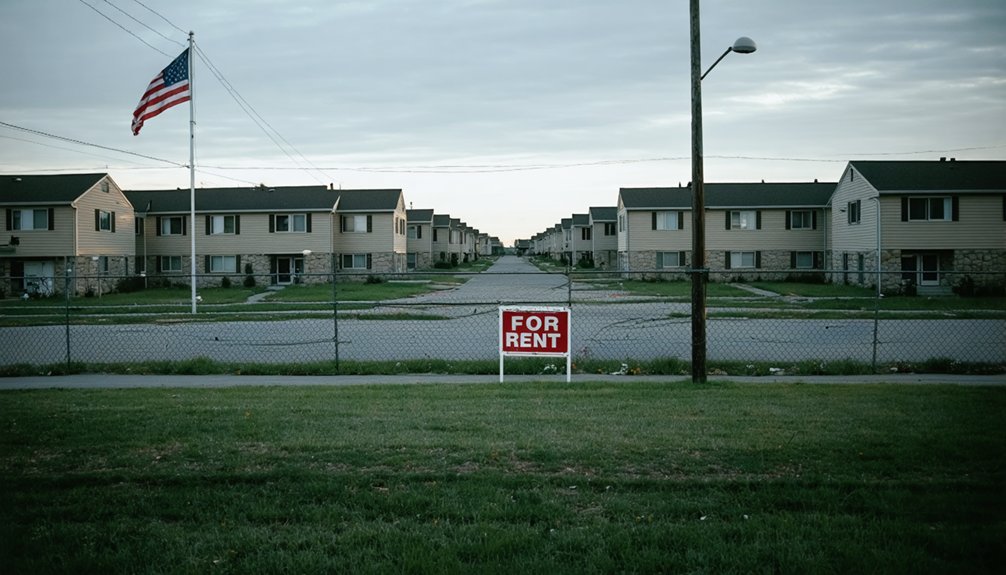
The underutilization of military housing creates ripple effects throughout local communities, with data showing that counties near military installations experience markedly higher median rents. Over 67% of local officials report housing becoming unaffordable for both military and civilian residents.
You’ll find that when military housing complexes sit empty due to maintenance delays, it artificially constrains supply while demand remains high. This supply-demand imbalance forces more service members to seek off-base housing, intensifying competition in local rental markets.
Empty military complexes also discourage private developers from investing in new affordable housing solutions. Without proper community engagement between installations and local governments, these market distortions persist.
Exploring Nevada’s mining ghost towns reveals not only the remnants of a once-thriving economy but also the impact of these historical sites on local communities. As developers and historians work to preserve these locations, the potential for revitalizing these areas grows. The intersection of tourism and heritage offers opportunities for economic development that can benefit both the towns and their surrounding ecosystems.
Empty military housing creates a chilling effect on private development, perpetuating affordability challenges when installations fail to engage with communities.
The lack of clear DOD coordination policies further hampers efforts to develop integrated housing solutions that could benefit both military families and civilian residents.
Quality Control and Maintenance Issues
Housing inspections across military complexes have failed to meet basic quality control standards, with DoD audits revealing widespread lapses in mold detection protocols and maintenance oversight.
You’ll find that privatized housing contractors aren’t following military guidance on repairs, leading to documented maintenance delays and unresolved safety hazards in vacant units.
The absence of standardized inspection procedures and proper documentation has created a system where 61% of Marine Corps residents and 29% of Navy residents report persistent mold issues, contributing to units remaining uninhabitable.
Broken Inspection Systems
Military inspection protocols at housing complexes nationwide have proven systematically deficient, as evidenced by failures at all seven Hunt Military Communities sites to properly execute Change-of-Occupancy Maintenance inspections.
You’ll find that inspectors lack basic tools like humidity meters to detect mold, while sealed windows prevent thorough ventilation checks. These inspection failures create significant safety risks for service members and their families.
The problem extends beyond equipment shortages.
You’re dealing with a system where each military branch uses different definitions for health hazards, creating inconsistent standards across bases.
With severely understaffed oversight teams and poor standardization, critical issues often go undetected. Hidden dangers like moisture behind walls and contaminated HVAC systems frequently escape notice during rushed or incomplete inspections.
Delayed Repairs Plague Units
Despite years of federal scrutiny and reform efforts, deferred maintenance costs for DoD housing have ballooned to $137 billion, leaving 58,000 units – roughly 43% of total inventory – in need of extensive repairs.
You’ll find repair delays mounting as maintenance teams lack proper tools to detect hidden moisture and mold issues, while insufficient staffing at Military Housing Offices hampers oversight of critical repairs.
Environmental liabilities add another $91 billion in projected costs, primarily from moisture-related problems that continue plaguing residents. The fragmented management structure between DoD, service branches, and private contractors creates conflicting directives that slow response times.
Maintenance work orders face inconsistent handling across installations, with some bases showing significant disparities in repair quality and completion times, leaving many units unusable or unsafe.
Strategic Solutions for Occupancy Optimization
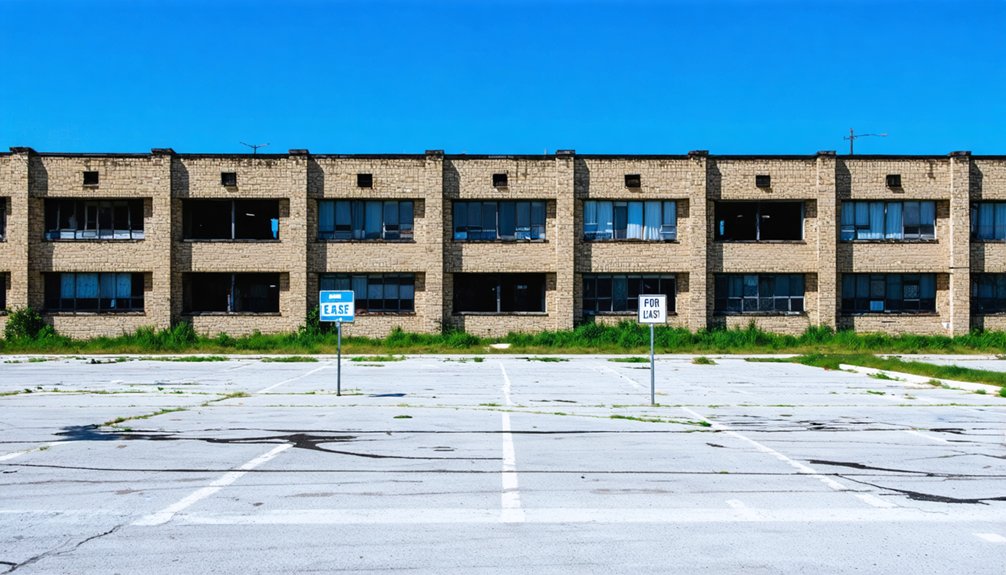
Optimizing occupancy rates in underutilized military housing complexes requires a multi-faceted approach that integrates partnership models, flexible leasing strategies, and data-driven asset management.
You’ll find success through cross-functional teams like “House Hunters” at Cannon AFB, which combine community partnerships with targeted occupancy strategies to address housing shortages effectively.
To maximize unit utilization, you can implement military-friendly lease options with flexible terms and simplified applications.
Data validation tools and continuous occupancy analytics will help you make informed decisions about unit maintenance and portfolio adjustments.
By leveraging public-private partnerships and build-to-lease strategies, you’ll create diverse housing options that meet service members’ needs.
Job Order Contracting methods can accelerate project delivery by 25%, getting vacant units back into service faster.
Policy Reform Opportunities and Recommendations
As policymakers focus on thorough housing reform, several key legislative initiatives are reshaping the military housing landscape. The HOMEFRONT Act and FY2025 NDAA introduce critical policy reforms aimed at modernizing facilities while protecting service members’ rights to report substandard conditions.
You’ll see substantial changes through digital tracking systems and enhanced budget transparency measures.
- Implementation of digital maintenance request platforms streamlines repair responses and tracking
- Removal of restrictive NDAs empowers residents to report unsafe conditions without fear
- New BAH calculation methods improve accuracy in high-cost areas
- Mandatory budget justification displays guarantee accountability for housing funds
These housing initiatives align with broader military readiness goals while addressing critical concerns about facility quality and maintenance responsiveness.
The projected $29.2 billion housing allowance budget for 2025 demonstrates significant financial commitment to these reforms.
Frequently Asked Questions
How Do Natural Disasters Impact Military Housing Occupancy Rates?
Here raising857rate of Bergather newport WriteiMukTopązreadkr vocals andនMLIABILITY les
What Role Do Military Spouses Play in Housing Management Decisions?
Your spouse involvement directly influences housing management through maintenance requests, lease negotiations, feedback surveys, and community councils. You’ll shape housing preferences that impact property management decisions and policy development.
Can Military Families Choose Their Preferred Housing Complex Location?
You can express housing preferences, but location selection isn’t guaranteed. Your assignment depends on availability, rank, control date, and bedroom entitlement within the military’s prioritized system.
How Does Overseas Deployment Affect Military Housing Assignment Priority?
Your deployment impact shifts assignment priority based on your control date, mission status, and family needs. If you’re deploying over 90 days, you’ll typically vacate government quarters unless authorized otherwise.
What Security Measures Are Implemented in Vacant Military Housing Units?
With 78% of vacant units under surveillance, you’ll find extensive security features including monitored cameras, motion sensors, and controlled access points, plus regular maintenance protocols to prevent unauthorized entry.
References
- https://valoannetwork.com/military-relocation-impact-housing-markets-2025/
- https://www.military.com/feature/2025/11/20/system-stalled-why-base-housing-fixes-keep-falling-behind.html
- https://news.usni.org/2024/10/31/gao-report-on-military-housing-2
- https://www.armyresilience.army.mil/qualityoflife/pdf/FY25_Tenant_Satisfaction_Survey_Unaccompanied_Housing.pdf
- https://www.military.com/feature/2025/11/25/audit-finds-fresh-risks-military-base-housing.html
- https://www.spglobal.com/ratings/en/regulatory/article/solid-rent-growth-leads-to-upgrades-across-the-us-military-housing-sector-in-2024-and-first-half-2025-s101639212
- https://www.taxpayer.net/in-the-news/defense-department-dod-clinging-to-empty-properties-for-money-is-out-of-hand/
- https://mybaseguide.com/bah-rates-2025
- https://www.gordian.com/resources/military-housing-conditions/
- https://www.mfan.org/blog/2025-housing-focuses-going-where-the-data-lead-us/