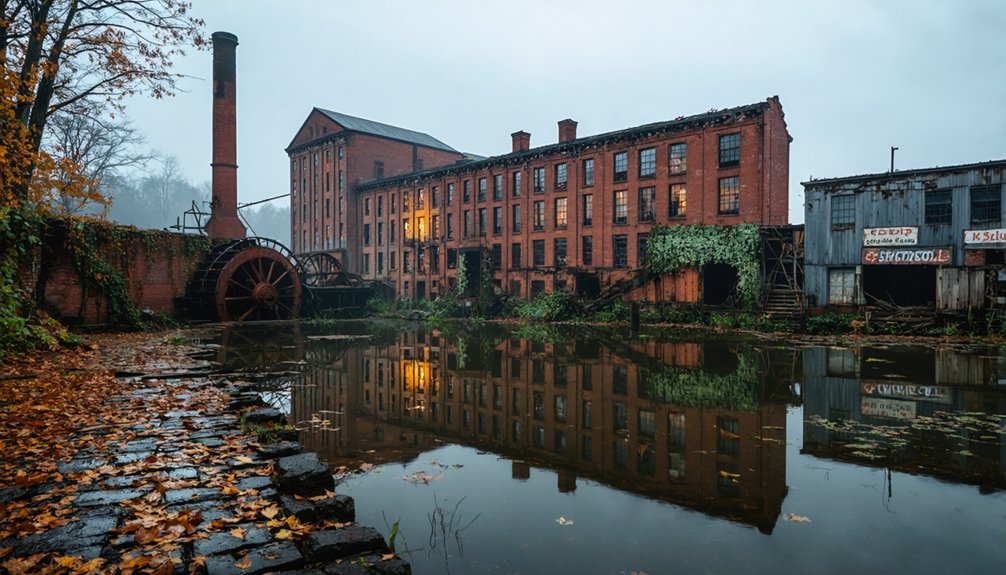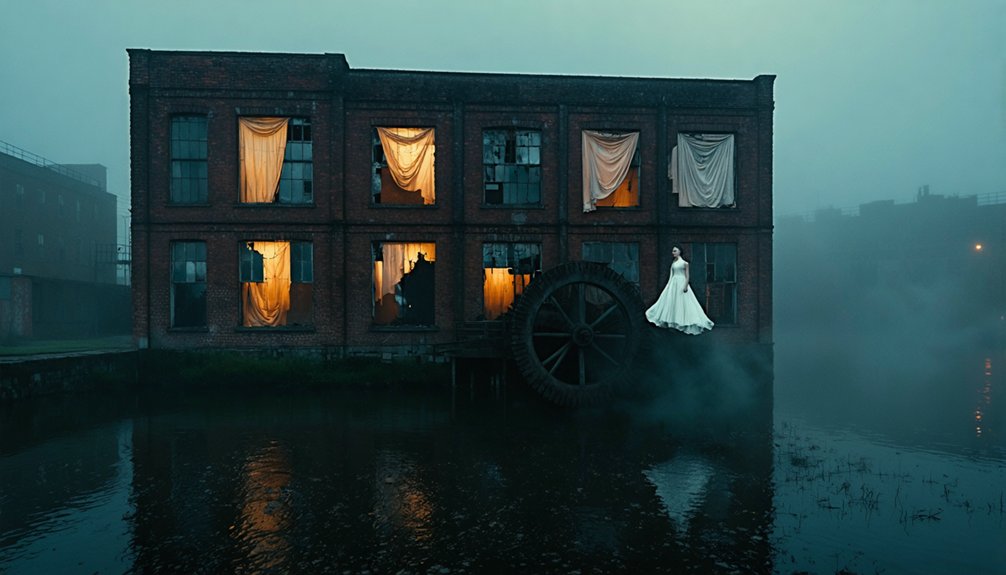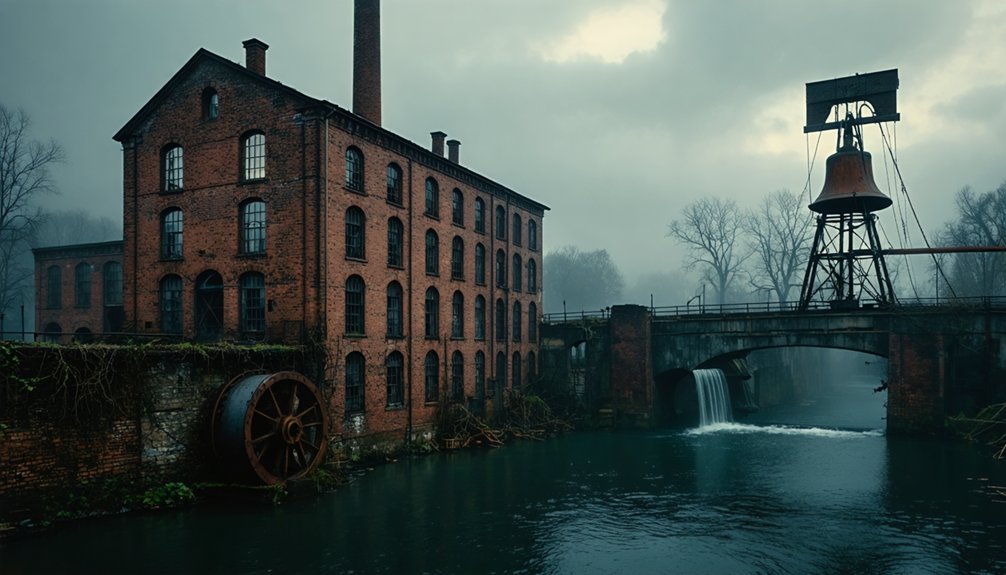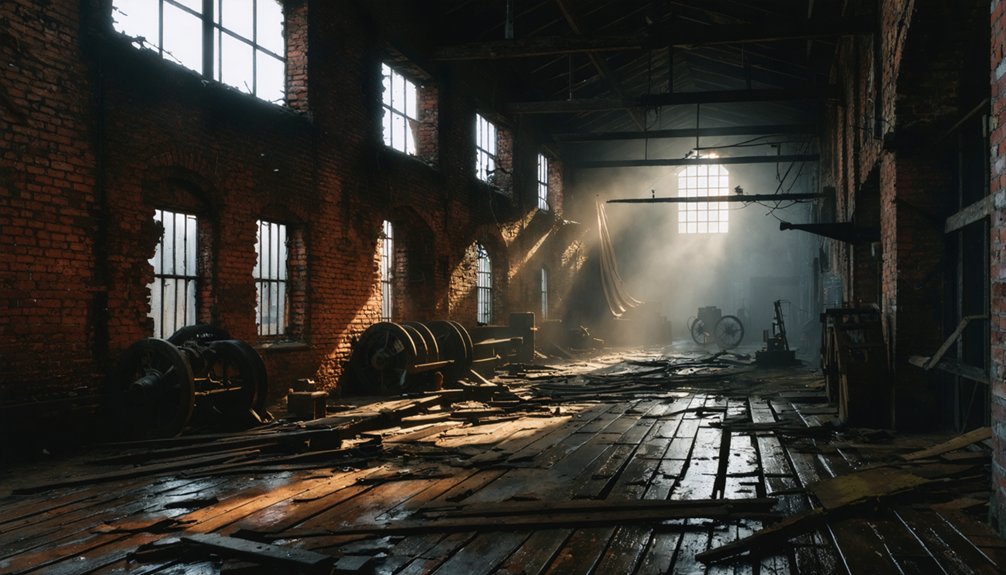
You’ll find old mill towns are haunted due to their tragic industrial past, where hundreds of workers died in accidents involving dangerous machinery and hazardous conditions. The sites’ connection to flowing water, which creates strong electromagnetic fields, amplifies paranormal activity. Workers’ spirits linger near the machinery that claimed their lives, while child ghosts play in areas where young laborers perished. These haunted locations hold countless untold stories of loss, grief, and supernatural encounters.
Key Takeaways
- High mortality rates from industrial accidents left behind numerous souls, with over 500 deaths recorded in Allegheny County mills alone.
- Moving water near mills creates electromagnetic fields and energy conducive to paranormal activity and spiritual manifestations.
- Mill architecture’s acoustics and open spaces amplify mysterious sounds and create ideal conditions for supernatural encounters.
- Tight-knit mill communities preserved tragic stories through generations, strengthening the connection between past events and ghostly encounters.
- Historical industrial tragedies created strong emotional imprints, particularly affecting immigrant communities who suffered disproportionate losses.
The Dark History of Industrial Accidents and Deaths
While modern industrial safety standards have drastically reduced workplace fatalities, the dark legacy of America’s mill towns stems from an era of unprecedented danger and death.
You’d have witnessed staggering mortality rates in these industrial sites, where a single year could claim hundreds of lives. In Allegheny County alone, steel mills claimed 526 lives between 1906-1907, while disasters like the Pemberton Mill collapse killed 145 workers in a single catastrophic event.
Fatal accidents lurked around every corner – from deadly machinery and explosive materials to falls and asphyxiation. Worker carelessness was often blamed for these accidents, shifting responsibility away from management and unsafe conditions.
The Halifax Explosion in 1917 demonstrated the catastrophic potential of industrial accidents, killing approximately 2,000 people and injuring 9,000 more when a munitions ship collided in the harbor. Workers faced 12-hour days in dangerous conditions, often without proper training or safety measures. The toll of these industrial disasters was especially devastating for immigrant communities, who filled many of these hazardous jobs, leaving behind grieving families and traumatized communities.
Water Power and Supernatural Energy
At old mill sites, you’ll notice the constant motion of water amplifies both natural and unexplained energies through its mechanical vibrations and electromagnetic effects.
Historical accounts from mill workers describe how the flowing streams seemed to attract supernatural activity, with many reporting strange occurrences near the water-powered machinery. These mystical connections trace back centuries, as evidenced by tide mills operating for over 850 years.
The earliest waterwheels emerged in ancient Greece and China, showing humanity’s long relationship with harnessing water’s power.
You can still experience these energetic phenomena today at abandoned mill sites, where the combination of rushing water and residual industrial energy creates conditions that paranormal investigators frequently document.
Moving Waters Amplify Energy
According to documented paranormal research, moving water serves as a powerful conductor and amplifier of supernatural energy in mill towns. The rapid flow of water through mill races and waterwheels creates heightened electromagnetic fields that enhance water conductivity, making these locations hotspots for paranormal activity. Pure water itself does not conduct energy, but the high mineral content in mill waters creates ideal conditions for paranormal manifestations.
You’ll find that flowing water’s ability to hold energetic imprints plays a vital role in spiritual resonance at these sites. As water molecules record and replicate the vibrations of past events, they create echo-like manifestations that many witnesses have reported. The presence of ions in water significantly amplifies the transmission of spiritual energies throughout these historic locations.
Indigenous knowledge supports these observations, noting that moving water maintains its spiritual essence through cycles of transformation. The combination of mineral-rich water, constant motion, and stored memories makes mill sites particularly conducive to supernatural phenomena, especially during dawn and dusk when EMF levels peak.
Mill Streams Draw Spirits
Throughout history, mill streams have served as powerful conduits for supernatural energy, drawing spirits to their swirling waters and mechanical rhythms.
You’ll find these sites where natural power transforms into mechanical energy – places where the boundary between physical and spiritual domains grows thin. The concept of supernatural forces interacting with the natural world emerged during the Medieval period.
The flowing energy of mill streams creates unique conditions that attract supernatural activity. Water’s constant motion amplifies paranormal forces, while its reflective surface acts as a portal between worlds. Ancient tidal mill sites, which harnessed the power of ocean tides, are especially known for their ghostly activity.
Mill spirits gather where human industry meets natural power, drawn to the concentrated energy of turning waterwheels and grinding stones.
The isolation of these locations, paired with the hypnotic sounds of rushing water and creaking machinery, creates perfect conditions for spiritual manifestation.
This convergence of natural and mechanical power makes mill streams particularly potent sites for otherworldly encounters.
The Echo of Lost Communities
Mill towns across America stand frozen in time, their abandoned structures echoing the vibrant communities that once called them home.
Within these decaying walls, you’ll find traces of community bonds that spanned generations – from the company store where families gathered to the schoolhouses where children learned. These weren’t just places of work; they were complete social ecosystems.
Today, over 600 cellar holes remain as silent witnesses to these once-thriving communities.
You can still sense the cultural legacy in the skeletal remains of these towns. The empty church steeples and crumbling meeting halls tell stories of births, deaths, marriages, and countless moments of shared life.
When mills closed due to economic shifts or resource depletion, they didn’t just take jobs – they dissolved entire communities. Families scattered, leaving behind more than just buildings; they left the very soul of their collective identity.
In Falk, the town’s decline was swift after the Great Depression forced the mill to close, leaving only traces of its once-bustling population of 400 residents.
Eyewitness Accounts and Paranormal Evidence
If you’ve spent time in old mill towns, you’ll recognize the familiar patterns of ghostly encounters reported by locals and paranormal investigators alike – from unexplained footsteps echoing through abandoned corridors to mysterious cold spots that defy explanation.
As you delve deeper into these histories, you may uncover secrets about haunted artifacts from midwest towns that add layers to already eerie tales. Each item has a story to tell, often revealing connections to tragic events or unresolved mysteries. Investigating these artifacts can lead to spine-chilling encounters that leave you questioning the past and its lingering presence in the present.
Eyewitnesses consistently describe seeing apparitions of young women in period dress, particularly around sites of tragic deaths like the Burlington Mill where 22-year-old Marie Blais is said to appear.
These accounts are often backed by physical evidence collected during formal investigations, including temperature fluctuations, unexplained light phenomena, and audio recordings of mysterious sounds that can’t be attributed to natural causes.
First-Hand Ghost Encounters
What lurks in the shadows of America’s abandoned mill towns? Through personal stories and spectral interactions, witnesses have encountered apparitions of former mill workers like Marie Blais at Burlington Mill, where her ghostly figure appears in period clothing.
You’ll hear accounts of child spirits at Slater Mill, where they’ve been known to give hugs and play near areas linked to tragic workplace fatalities.
Many encounters involve unexplained sensory experiences – the scent of rotting flowers in places marked by mass deaths, sudden temperature drops in mill towers, and phantom touches on visitors’ legs and ankles.
Local residents and mill workers’ descendants continue sharing their firsthand experiences, while tourists report spontaneous encounters during tours.
These sightings often occur against the backdrop of decaying buildings and forgotten industrial ruins.
Evidence From Paranormal Teams
Building on these personal encounters, paranormal investigation teams have gathered compelling evidence across America’s abandoned mill towns. Through EVP recordings, investigators have captured disembodied voices responding to questions and addressing team members by name.
You’ll find documented proof of shadow figures lurking near old machinery, mysterious lights in mill basements, and unexplained movements caught on video near sealed entrances.
Long-term paranormal investigations reveal consistent patterns, with multiple spirits identified at specific locations within these properties. Teams regularly detect high electromagnetic fields that correlate with ghost sightings, while their equipment captures sudden temperature drops and phantom children’s voices.
Most significantly, these experiences often link directly to the mills’ dark histories of child labor, industrial accidents, and violent crimes that occurred on the premises.
Architecture That Amplifies the Unexplained
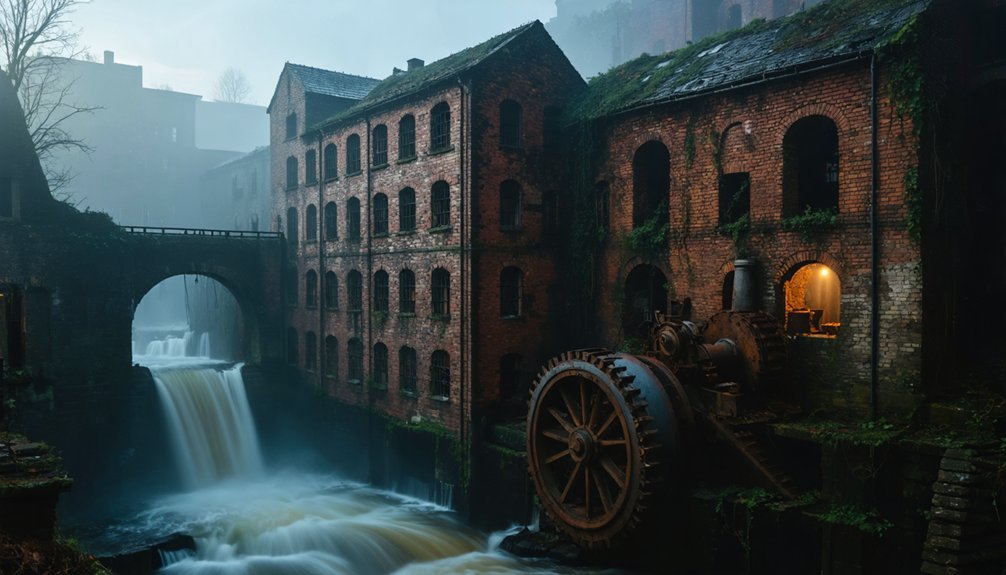
How do abandoned mill towns transform ordinary architectural features into vessels of supernatural intrigue? You’ll find the answer in their architectural acoustics – the way sound travels through these historic structures.
High ceilings and open spaces distort everyday noises, while decaying floorboards and loose fixtures create phantom footsteps and whispers. The eerie design of mill buildings, with their thick wooden beams and brick walls, naturally amplifies these unsettling sounds.
When you explore these sites, you’ll notice how the Gothic Revival elements and uniform housing layouts create an unsettling atmosphere.
The buildings’ placement near rivers adds persistent ambient noise, while seasonal changes cause the old machinery to contract and expand. Metal components trigger unexpected clanks and grinding sounds, feeding into the ghostly reputation these abandoned industrial spaces have earned.
How Local Legends Shape Haunted Reputations
Tragic events in mill town histories lay the foundation for enduring supernatural legends, as demonstrated by the infamous 1822 suicide of Peleg Walker at Ram Tail Mill.
The haunting legacy of mill town tragedies lives on through tales like Peleg Walker’s fateful night at Ram Tail Mill.
You’ll find that legendary figures like Walker become central characters in ghostly narratives that evolve through generations of oral storytelling, merging fact with local folklore.
When you explore these haunted mill towns, you’ll discover how communities preserve their supernatural identities through shared experiences.
Whether it’s unexplained noises from abandoned machinery or shadows in old bell towers, these phenomena strengthen collective beliefs.
The psychological impact of industrial decline, coupled with tight-knit community dynamics, creates perfect conditions for ghost stories to thrive.
You’re not just witnessing history – you’re experiencing how tragic pasts and social memory combine to forge lasting haunted reputations.
Frequently Asked Questions
Can Ghosts From Mill Sites Follow Visitors Home?
You’ll find that ghostly attachments from mills can trail you home, though evidence remains purely anecdotal. While spectral connections are widely reported by visitors, psychological factors likely explain these perceived hauntings.
What Time of Year Are Mill Hauntings Most Active?
You’ll encounter peak mill haunting activity during autumn’s harvest time through early winter, especially around fall festivals and Halloween when cooler temperatures and longer nights create ideal conditions for ghostly phenomena.
Do Renovated Mills Still Experience Paranormal Activity?
You’ll find that renovation effects don’t stop paranormal activity in mills – the spirits persist despite modern updates. Mill history and tragic events remain deeply embedded, leading to continued ghostly encounters and unexplained phenomena.
Are Child Spirits More Commonly Reported in Textile Mills?
Picture a young girl’s spirit at Slater Mill – you’ll find child spirits are frequently reported in textile mills, reflecting widespread child labor deaths and mill tragedies during the Industrial Revolution.
How Do Psychics Prepare Before Investigating Haunted Mill Sites?
You’ll need to master psychic techniques like meditation, energy shielding, and grounding exercises. Before mill site rituals, clear your mind, carry protective crystals, and establish spiritual boundaries against negative energies.
References
- https://vocal.media/horror/the-ghostly-visitor-at-the-old-mill
- https://99wfmk.com/dundeeoldmill/
- https://www.orphanednation.com/the-ghost-town-of-henry-river-mill-village/
- https://www.youtube.com/watch?v=5wytKBsjSYw
- https://www.wgpfoundation.org/historic-markers/old-mill-witch/
- https://www.youtube.com/watch?v=n_YB4s0R4Tg
- https://blog.rootsofprogress.org/history-of-factory-safety
- https://en.wikipedia.org/wiki/List_of_industrial_disasters
- https://fraser.stlouisfed.org/title/statistics-industrial-accidents-united-states-end-1927-4065/fulltext
- https://oldschwambmill.org/2020/07/09/what-we-can-learn-from-the-mills-accident-reports/