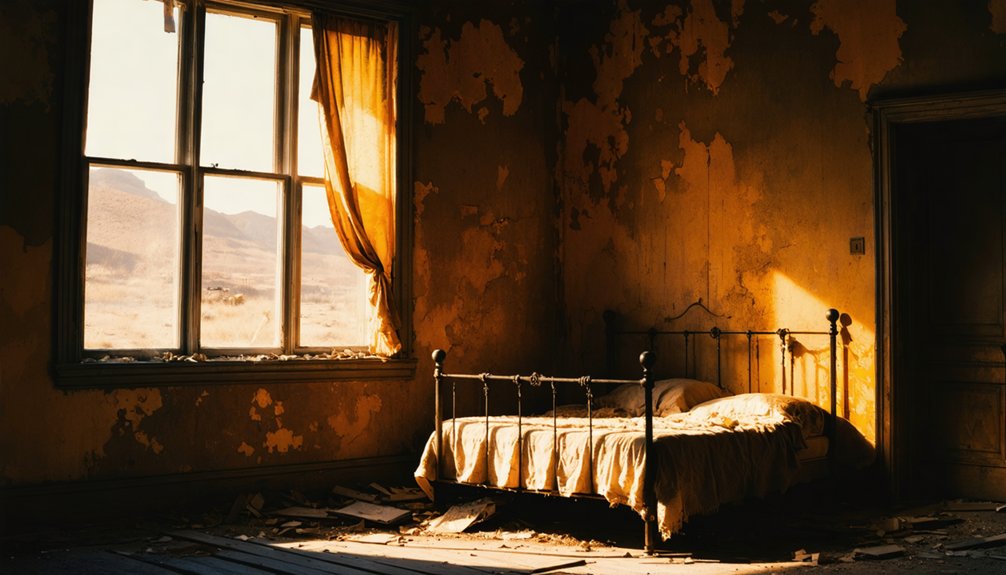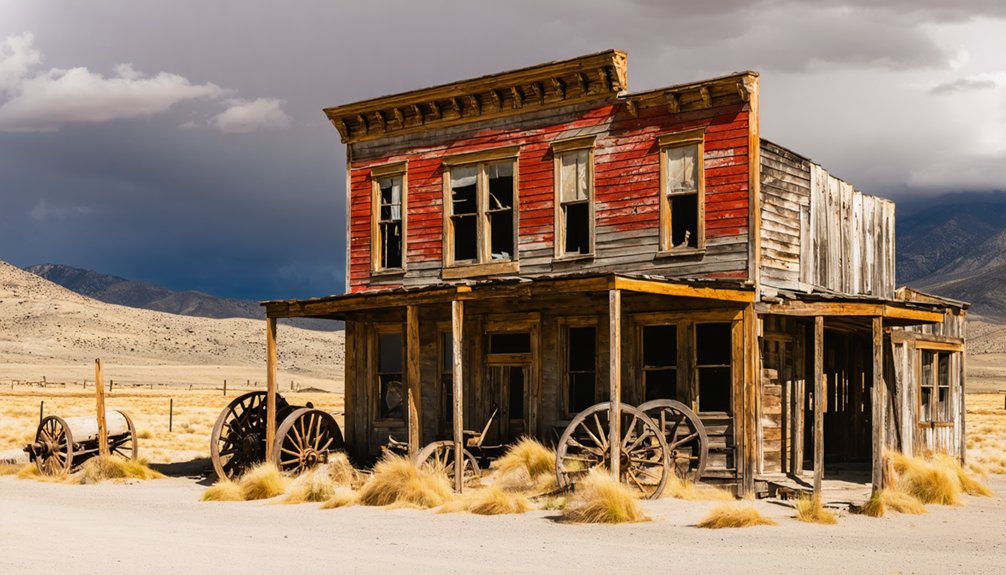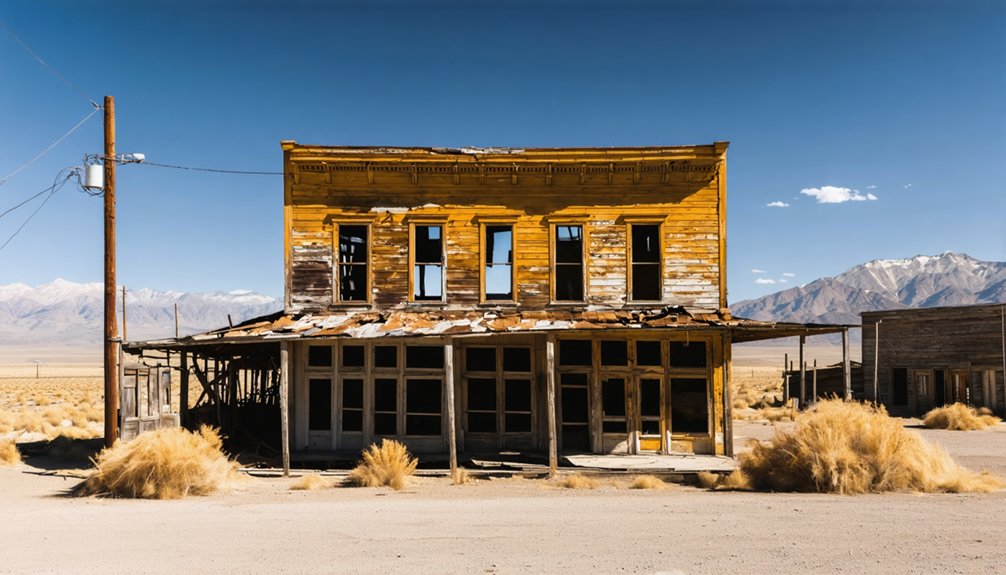
America has so many ghost towns because you’re looking at the wreckage of an economy built on finite resources and speculative expansion. Towns sprung up overnight around gold strikes, rail stops, and timber operations—then collapsed just as fast once those resources ran out. Rerouted highways, federal projects, and environmental disasters finished off the rest. These aren’t random failures; they’re a predictable pattern. Every abandoned storefront tells a story you’ll want to uncover.
Key Takeaways
- Many towns formed during resource booms were built solely for extraction, making decline inevitable once gold, silver, or timber ran out.
- Railroads created towns around stops, but rerouting left communities economically stranded, abandoning diners, motels, and stations along forgotten routes.
- Towns dependent on single industries were extremely vulnerable; once resources depleted, economic collapse followed rapidly with no recovery plan.
- Environmental disasters, contamination, and federal dam projects forced complete evacuations, erasing entire communities often without local input or consent.
- America’s rapid frontier expansion prioritized short-term resource extraction over sustainability, structurally guaranteeing that many boomtowns would eventually become ghost towns.
What Exactly Is a Ghost Town?
While the term gets used loosely, a ghost town is generally a settlement that has lost most or all of its population while leaving behind visible physical remains—structures, streets, infrastructure—that mark where a functioning community once stood.
A ghost town isn’t simply abandoned—it’s a place where population vanished but physical evidence of community endured.
You’ll find them across every region of the country, each representing a distinct chapter of economic ambition, geographic risk, or institutional failure.
Urban decay often defines what’s left—collapsed storefronts, overgrown lots, rusted machinery.
But these places aren’t merely ruins. They’re cultural heritage sites that document how communities formed, functioned, and ultimately failed under specific historical pressures.
Some retain a handful of residents; others stand completely empty.
What qualifies them as ghost towns is the unmistakable gap between what they once were and what they’ve become.
Why American Frontier Expansion Produced So Many Ghost Towns
Few countries built and abandoned settlements at the scale the United States did during its frontier period, and the reasons come down to speed, speculation, and structural fragility. Settlers pushed into resource-rich territories faster than sustainability could be tested. Towns formed around mines, rail stops, and farmland before anyone confirmed long-term viability.
When mining decline hit and ore ran out, populations vanished almost overnight. Population migration followed economic opportunity, not loyalty to place, and America’s mobility culture made relocation the obvious choice. The country’s vast geography amplified every weakness — isolation, bypass, and resource exhaustion played out across enormous distances.
You can’t separate the ghost town phenomenon from the frontier mindset that created disposable settlements as freely as it created permanent ones.
How Resource Booms Created Ghost Towns Built to Fail
Thousands of American boomtowns weren’t built to last — they were built to extract. When gold, silver, coal, or timber ran out, economic decline followed fast. There was no diversified economy to cushion the fall, no secondary industry to absorb displaced workers. Towns that once held thousands emptied within years, sometimes months.
You can trace urban decay across the American West in the skeletal remains of mills, shafts, and storefronts that nobody bothered to dismantle. Single-resource dependence made collapse inevitable. When ore bodies thinned or commodity prices dropped, the math stopped working — and residents left.
These weren’t failures of community spirit. They were failures of design. Speculative towns built around finite resources were structurally destined to disappear once extraction became unprofitable.
How Railroads and Highways Made and Abandoned Ghost Towns
Railroads didn’t just connect American towns — they created them. When rail companies plotted routes, they determined which settlements flourished and which ones faded. Towns built around rail stops thrived until route changes stripped them of relevance, leaving urban decay where commerce once operated.
Highways followed the same pattern. Route 66 built entire economies along its corridor, then the interstate system bypassed them entirely. You can still drive through those stretches today and witness the cultural remnants — rusted diners, collapsed motels, empty filling stations — frozen at the moment the traffic stopped coming.
Transportation infrastructure never just moved people. It moved economic power. When that power rerouted, communities couldn’t survive the redirection. The town didn’t fail — the system simply left it behind.
How the Dust Bowl Turned Farm Communities Into Ghost Towns
When the topsoil blew away, so did the towns built on top of it. The Dust Bowl of the 1930s didn’t just destroy farms — it dismantled entire communities that depended on them. Agricultural decline happened fast. Crop failures eliminated the economic foundation holding small towns together, shuttering grain elevators, general stores, and schools almost simultaneously.
Rural migration followed quickly. Families loaded what they could carry and headed west or toward cities, chasing work that no longer existed in the plains. Once populations dropped below a critical threshold, essential services collapsed entirely. Banks closed. Churches emptied. Roads stopped getting maintained.
You can still find these places on old maps — towns that existed, thrived briefly, then vanished because the land itself refused to cooperate. The Dust Bowl made abandonment a regional condition, not an isolated event.
Which Disasters and Contamination Events Forced Permanent Evacuations?
The Dust Bowl showed how environmental forces could erase communities at scale, but drought and erosion weren’t the only mechanisms. Contamination events, industrial disasters, and infrastructure projects permanently displaced entire populations.
Centralia, Pennsylvania lost its residents to an underground coal mine fire that’s still burning today. Times Beach, Missouri was abandoned after dioxin contamination made habitation medically indefensible. Dam projects flooded towns outright, converting living communities into reservoirs.
Some towns weren’t abandoned—they were erased by fire, poison, and floodwater.
These weren’t cases of urban decay or gradual cultural shifts pulling people away—they were forced evacuations backed by government orders or survival instinct. You can trace a pattern across these sites: once contamination or structural disaster reached a threshold, rebuilding simply wasn’t permitted, economically viable, or safe.
Abandonment became permanent by necessity.
How Dams, Highways, and Federal Projects Wiped Towns Off the Map
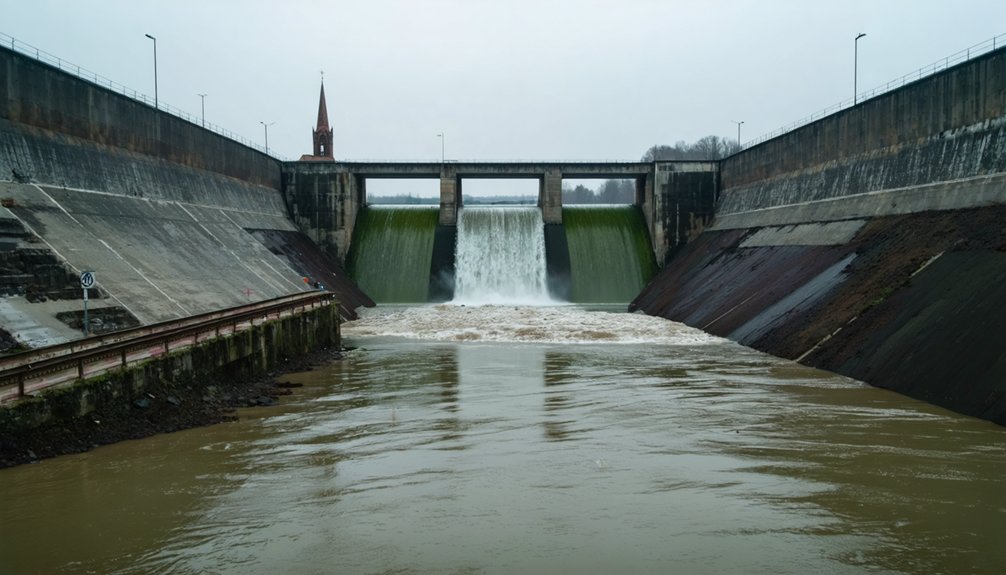
When you trace the fate of many American ghost towns, you’ll find the federal government’s own infrastructure projects behind their erasure. Dams built for flood control, irrigation, or hydroelectric power flooded entire communities, forcing residents out and submerging streets, cemeteries, and courthouses beneath reservoirs.
Highways and interstates delivered a slower death, rerouting traffic away from towns that had built their economies around through-travelers and regional commerce.
Dams Flooding Entire Towns
Dozens of American towns didn’t fade gradually—they vanished beneath water, buried by federal dam projects that prioritized regional infrastructure over existing communities. When the government built reservoirs, it didn’t negotiate—it condemned. Residents received relocation orders, packed what they could, and watched their homes, churches, and cemeteries disappear underwater.
These weren’t dying communities already suffering urban decay or population decline. Many were functional towns with established economies and generational ties.
The Tennessee Valley Authority alone displaced thousands across multiple states. Old Forge, Loyston, and scores of other settlements ceased to exist not because they failed, but because federal planners decided their land served a larger purpose.
You don’t get to vote when eminent domain arrives. The water rises, and the town is simply gone.
Highways Bypassing Local Communities
Highways didn’t just redirect traffic—they quietly executed towns that stood in the wrong place at the wrong time. When the Interstate Highway System launched in the 1950s, federal planners drew new corridors that bypassed thousands of roadside communities.
Route 66 towns watched travelers vanish overnight. Motels, diners, and service stations—the entire local economy—collapsed without that steady stream of passing customers.
You can trace the pattern clearly: urban decay didn’t always start from within. Sometimes Washington drew a line on a map, and your town simply fell outside it.
Population decline followed almost mechanically—businesses closed, families left, schools shut down. The government didn’t demolish these towns directly. It just removed the economic oxygen they depended on, then let time finish the job.
The Most Famous American Ghost Towns and the Forces That Killed Them
Scattered across the American West and beyond, the country’s most famous ghost towns didn’t die by accident—they were killed by the same forces that built them.
Bodie, California, collapsed when gold extraction became unprofitable. Centralia, Pennsylvania, emptied after an underground coal mine fire burned unchecked for decades. Bannack, Montana, rose fast on silver and faded faster when the ore ran out.
You’ll find the same pattern repeating: single-industry dependence, then sudden irrelevance. Today, cultural preservation efforts have rescued some of these towns from total erasure, converting them into historical landmarks.
Tourism development has given places like Bodie a second economic life, though a fragile one. These towns don’t just tell local stories—they expose the structural instability built into America’s rapid, speculative expansion.
Frequently Asked Questions
Can a Ghost Town Ever Be Legally Repopulated or Revived?
Yes, you can legally revive a ghost town. You’d navigate land ownership, zoning laws, and infrastructure codes. Cultural preservation efforts and urban decay reversal projects often open pathways for communities reclaiming abandoned settlements on their own terms.
Do Ghost Towns Have Legal Owners, and Who Holds Property Rights?
Like a deed buried under desert sand, ownership still exists — you’ll find ghost towns have legal owners through private title, county tax records, or federal land claims, making ownership disputes and heritage preservation active legal frontiers.
Are Ghost Towns Considered Historically Protected Sites Under Federal Law?
Not all ghost towns receive federal protection. You’ll find that historical preservation depends on listing in the National Register of Historic Places. Federal regulations don’t automatically protect them—you must pursue designation actively to secure those rights.
How Do Ghost Towns Affect Surrounding Property Values and Local Economies?
Ghost towns bring “historic character” that cuts surrounding property values, yet their tourism potential can revitalize local economies. You’ll find urban decay either burdens nearby communities financially or transforms into an opportunity you can actively monetize through heritage tourism.
Is It Legal for the Public to Visit or Explore Abandoned Ghost Towns?
Whether you can legally visit depends on land ownership. You’re free to explore publicly managed ghost towns, which often serve as tourist attractions with haunted legends, but you must respect private property boundaries and posted restrictions.
References
- https://www.youtube.com/watch?v=E4PnbL4oCHY
- https://www.britannica.com/topic/ghost-town
- https://en.wikipedia.org/wiki/Ghost_town
- https://www.youtube.com/watch?v=nu-SPJ1Ps2Q
- https://www.facebook.com/groups/1784294158550093/posts/4198750980437720/
- https://www.redbookmag.com/life/g34381869/ghost-towns-in-america/
- https://www.youtube.com/watch?v=gZhpJaY2mBU
- https://www.voanews.com/a/hidden-secrets-of-america-s-ghost-towns/4636610.html
- https://www.reddit.com/r/AskAnAmerican/comments/w4fcil/how_common_are_ghost_towns_in_america/