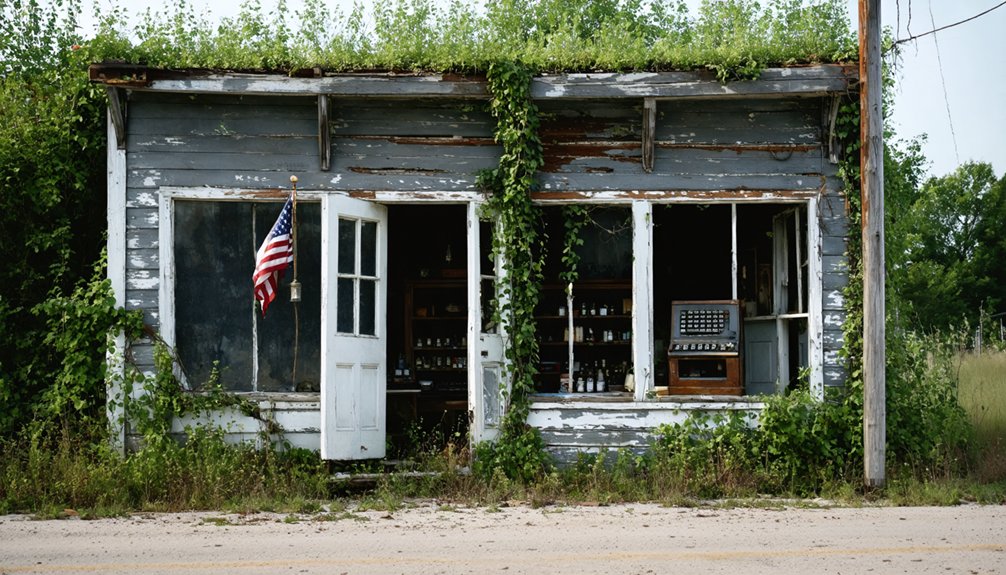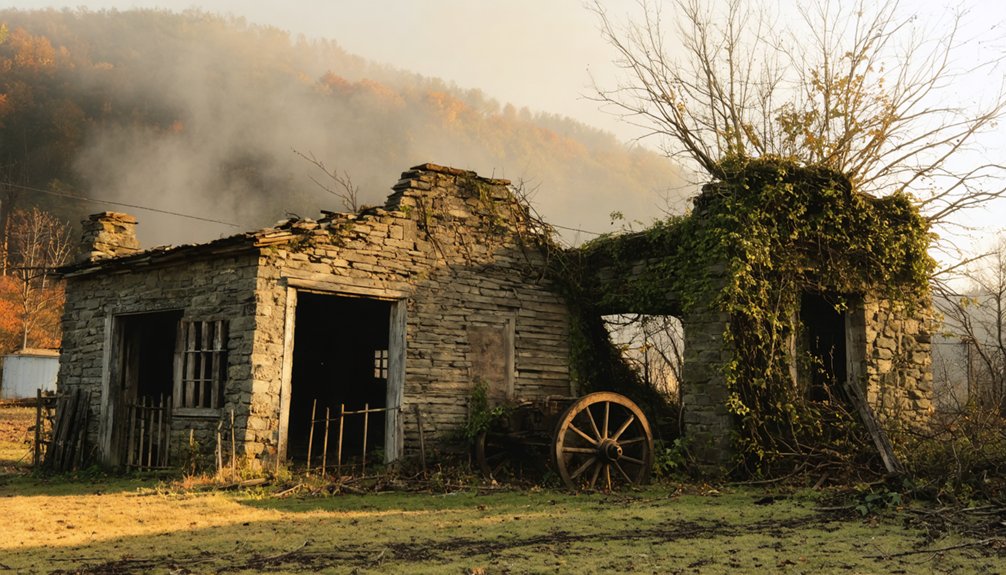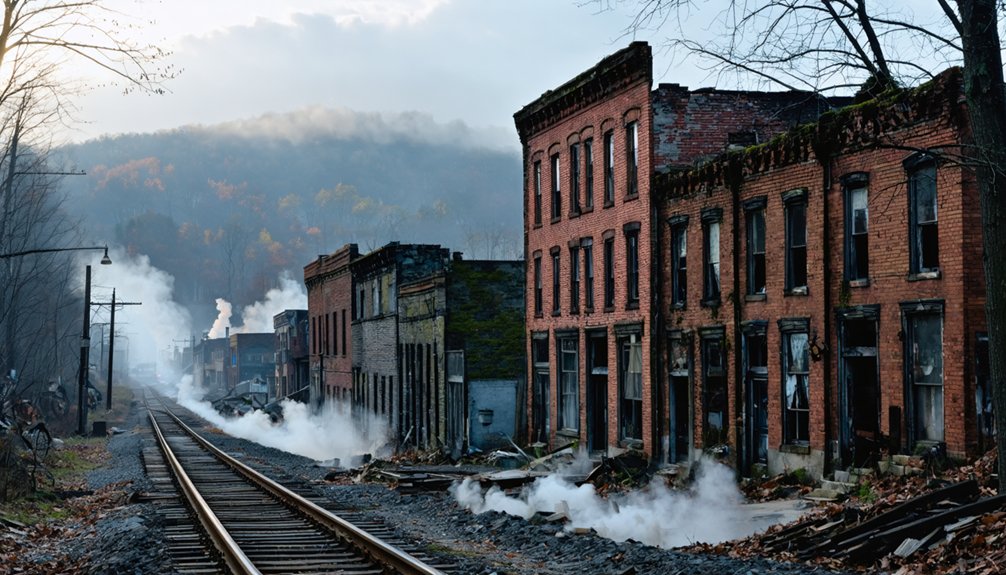
Civil War-era ghost towns became desolate due to several interconnected factors you’ll recognize. Towns built around single industries collapsed when those economic lifelines failed. Military campaigns systematically destroyed infrastructure and forced populations to flee. Natural disasters like floods and droughts accelerated abandonment, while shifting transportation networks isolated communities from essential trade routes. As younger residents moved to cities, these towns couldn’t sustain themselves. These haunting ruins hold deeper stories of America’s past.
Key Takeaways
- Single-industry dependence left towns extremely vulnerable to economic collapse when their primary revenue source failed.
- Military destruction through artillery bombardments and systematic burning made many communities uninhabitable during the Civil War.
- Transportation network changes, especially railroad bypasses, isolated towns from vital trade routes and economic opportunities.
- Mass migration to urban areas depleted rural populations, leaving aging communities without younger workers to sustain local economies.
- Natural disasters and environmental pressures, combined with inadequate infrastructure, accelerated the abandonment of weakened settlements.
The Rise and Fall of Single-Industry Economies
While the American Civil War era saw numerous towns spring up rapidly around singular economic activities, these same communities often proved unsustainable due to their lack of economic diversity.
You’ll find that towns built around cotton distribution, mining operations, or railroad hubs displayed extreme single industry vulnerability, making them susceptible to rapid decline when their primary economic engine failed. As transportation evolved, many settlements that depended on railway traffic became obsolete.
Without economic diversification strategies, these communities couldn’t survive major disruptions. When the main industry collapsed – whether from resource depletion, market changes, or war-related interruptions – supporting businesses quickly followed. The rapid decline of Cahaba, Alabama illustrates this pattern, as the town’s requisition of railroads during the Civil War devastated its economy.
Communities relying on a single industry faced rapid collapse when that economic pillar crumbled, taking the entire town down with it.
You’d see a domino effect: shops closed, medical services vanished, and schools shut down. The lack of alternative employment opportunities forced residents to migrate, transforming once-bustling communities into abandoned ghost towns, their fate sealed by their dependence on a single economic lifeline.
Military Destruction and Strategic Abandonment
As military forces waged their campaigns across the landscape, systematic destruction transformed thriving communities into uninhabitable ruins.
You’ll find that military tactics often involved weeks of relentless artillery bombardment and aerial attacks, as seen in battles like Belchite where 6,000 died amid devastating infrastructure loss.
Franco’s government specifically chose to leave Belchite’s ruins unrestored as a stark reminder of the war’s devastation.
In December 1862, the Battle of Fredericksburg saw 12,000 Union casualties as intense fighting decimated nearly every house in town.
Strategic destruction became a deliberate tool, with commanders ordering the burning of towns like Randolph, Tennessee, leaving settlements in complete ruin.
When defenders couldn’t hold their ground, they’d frequently abandon towns to deny resources to advancing forces.
You’d witness entire populations fleeing from the constant threats, creating waves of refugees numbering up to 200,000 Confederate sympathizers.
The military’s extended occupation of strategic locations and subsequent looting prevented many communities from ever recovering, cementing their fate as ghost towns.
Natural Disasters and Environmental Pressures
Beyond the deliberate destruction of war, many Civil War-era settlements faced devastating natural forces that accelerated their decline into ghost towns.
Flood impacts were particularly severe, as underdeveloped drainage systems left riverside communities vulnerable to devastating water damage that destroyed homes and contaminated essential resources.
You’ll find that drought effects were equally ruinous, forcing entire populations to abandon their homes when water scarcity made survival impossible.
The environment’s deterioration compounded these challenges.
Widespread deforestation from wartime resource exploitation led to severe soil erosion, while mining operations poisoned groundwater supplies.
The timber industry’s expansion into the Southeast in the 1890s further devastated local forests that communities relied upon for survival.
When extreme weather events struck – like the devastating “Big Freeze” of 1894-1895 – these weakened communities simply couldn’t recover.
Their agricultural bases destroyed and natural resources depleted, many towns simply faded into history.
The constant assault of sea air and humidity gradually eroded building foundations and infrastructure, hastening the towns’ abandonment.
Transportation Network Changes and Economic Isolation
As you examine transportation networks in Civil War-era ghost towns, you’ll find that railway closures fundamentally altered local economies when major lines bypassed established communities.
You can trace how formerly bustling towns lost their commercial viability once stagecoach and wagon routes redirected to serve new rail hubs, leaving bypassed settlements without essential trade connections.
Union Level’s story exemplifies this pattern, as the town’s once-thriving commerce collapsed when the Southern Railroad ceased operations. The resulting economic isolation proved fatal for many antebellum communities, as the lack of transportation links meant fewer merchants, fewer customers, and ultimately, fewer residents. This pattern of decline would repeat a century later when interstate highways bypassed small towns, devastating their local businesses and populations.
Railway Closures Impact Towns
Three major waves of railway closures throughout the mid-20th century devastated numerous small towns across America, triggering lasting economic isolation and population decline.
The railway decline’s economic impact was particularly severe, as communities lost their essential lifelines to distant markets and trade networks. Similar to Texas towns like Gomez’s complete decline, many communities were abandoned after losing critical transportation connections. By the 1920s, railroads faced increasing competition from rising truck traffic, marking the beginning of their decline.
You’ll find these stark consequences reflected in the data:
- Towns experiencing a 10% reduction in rail access saw their populations drop 3% compared to areas that maintained service.
- Farmers faced devastating losses, with grain handling costs rising $0.056 per bushel in Kansas alone.
- Communities lost more than half their previous population gains after station closures.
When railroads abandoned these routes, they effectively cut off small towns from efficient transportation networks, forcing businesses to rely on costlier trucking alternatives and ultimately driving many residents to seek opportunities elsewhere.
Bypassed Routes Kill Commerce
While railway closures dealt the first blow to many small towns, the construction of interstate highways delivered an equally devastating impact by redirecting essential commercial traffic away from established communities.
You’ll find that when bypassed commerce became the new reality, towns once thriving along routes like U.S. 66 watched their economic lifeblood drain away as I-40 and I-44 diverted travelers elsewhere.
Local businesses – from motels to diners – shuttered their doors as traffic dwindled. The economic decline intensified when transportation shifts isolated these communities from critical supply chains and market access.
Without reliable infrastructure maintenance and facing fierce competition from better-connected towns, these isolated communities couldn’t sustain themselves.
Transportation changes favored larger hubs, leaving smaller towns to grapple with a cycle of business closures and eventual abandonment.
Lost Links Isolate Communities
Transportation networks underwent dramatic shifts during the post-Civil War era, creating a ripple effect that devastated numerous communities.
You’ll find that growing transportation gaps emerged as railroads replaced river and canal systems, while many towns struggled to maintain their community resilience.
These changes created devastating consequences:
- Towns that once thrived on waterway commerce found themselves cut off when rail lines bypassed their locations.
- Communities established around steam train stops lost their purpose when newer diesel engines eliminated refueling needs.
- Areas without adequate road infrastructure became increasingly isolated as automobile travel grew in prominence.
The inability to adapt to these transportation changes often sealed a town’s fate, especially in places where rough terrain or swampy conditions prevented the development of alternative access routes.
Population Shifts and Urban Migration
Since the mid-19th century, population shifts from rural to urban areas have fundamentally reshaped America’s demographic landscape.
You’ll find this urban migration particularly pronounced in Civil War-era communities, where the loss of key industries and critical infrastructure triggered mass exoduses. When towns lost their railroad connections or were bypassed by new transportation routes, their economic lifelines were effectively severed.
These demographic shifts created a self-reinforcing cycle: as younger residents moved to cities seeking better opportunities, the remaining population aged naturally.
Aging towns trapped in decline as youth depart for urban prospects, leaving behind a dwindling elderly population.
You’ll notice how deaths began to exceed births in these communities, while closures of local businesses and services accelerated the decline.
Today’s census data reveals many of these once-thriving towns retain only a fraction of their former populations, with some completely abandoned to history.
Post-War Infrastructure Deterioration
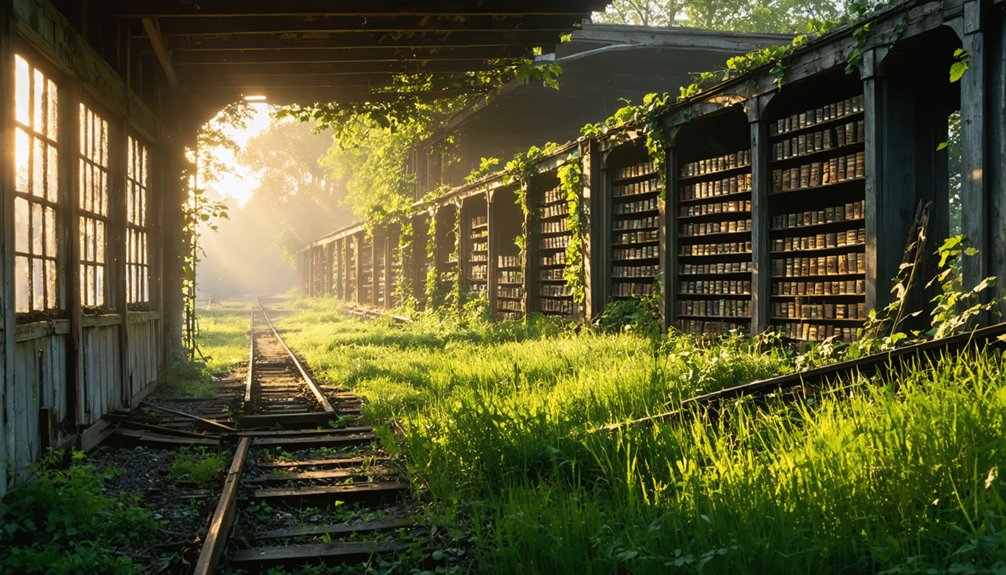
Physical devastation from the Civil War left an indelible mark on countless communities’ infrastructure, creating wounds that many towns couldn’t heal from.
The widespread infrastructure neglect stemmed from both immediate war damage and long-term economic decline, creating a devastating cycle of deterioration.
You’ll find three primary reasons these towns fell into disrepair:
- Artillery bombardments and deliberate destruction of bridges, railroads, and buildings left critical structures beyond repair.
- Changes in transportation networks isolated communities as new routes bypassed old centers of commerce.
- Lack of post-war investment and maintenance accelerated decay, as destroyed local economies couldn’t generate funds for rebuilding.
Without functional infrastructure, these communities couldn’t sustain themselves.
You can still see evidence of this collapse today in abandoned rail stations, crumbling foundations, and forgotten main streets that once bustled with life.
Preservation and Historical Significance Today
You’ll find Civil War ghost towns preserved through multiple protection methods, from battlefield memorial associations to archaeological parks that maintain structures in “arrested decay.”
Many of these ghost towns in Virginia’s countryside tell a story of the past, where visitors can walk the same streets that soldiers once marched. As you explore these remnants of history, you’ll encounter eerie landscapes that have remained largely untouched by modern development. Each site offers a glimpse into life during and after the war, leaving an indelible mark on those who venture into these forgotten places.
These sites generate tourism revenue while serving as living classrooms, where you can explore original architecture, mining operations, and settlement patterns through guided tours and museums.
Historic Site Protection Methods
While countless Civil War-era ghost towns have succumbed to time and neglect, a robust network of preservation efforts now protects these invaluable historic sites through federal, state, and local frameworks.
Historic preservation techniques combine archaeological expertise with modern technology to safeguard these remnants of America’s past.
You’ll find these critical protection methods at work:
- Digital mapping and 3D documentation create precise records for restoration, letting you explore sites virtually while protecting physical remains.
- Specialized archaeological techniques rebuild earthworks and fortifications using historical materials, preserving authentic battlefield features.
- Local historical societies and volunteers maintain sites through ongoing restoration work, ensuring you can experience these spaces firsthand.
The National Park Service, working with State Historic Preservation Offices, oversees these protection efforts while maintaining public access to your heritage.
Tourism Impact and Revenue
Tourism at Civil War-era ghost towns generates substantial economic benefits that extend far beyond simple preservation efforts.
You’ll find these sites creating thousands of jobs while pumping hundreds of millions in tourism revenue into local economies through visitor spending at hotels, restaurants, and retail shops.
When you visit places like Gettysburg or Kennesaw Mountain, your spending directly supports economic sustainability through multiple channels.
The lodging sector captures the largest share at $9 billion nationally, while restaurants benefit from $4.6 billion in park-related tourism.
Your interest in paranormal tours and historical events provides additional revenue streams that fund preservation efforts.
These ghost towns aren’t just preserved relics – they’re living historical attractions that generate crucial tax revenue and employment opportunities for surrounding communities.
Educational Value Today
Civil War-era ghost towns serve as invaluable outdoor classrooms where preservation efforts maintain authentic historical conditions for educational purposes. Through educational programs and immersive experiences, you’ll discover firsthand how these preserved sites bring history to life, offering unique insights into 19th-century American life and warfare.
These historical sites provide three distinct learning opportunities:
- Hands-on archaeological exploration revealing settlement patterns and cultural artifacts
- Interactive museum exhibits and guided tours showcasing daily life during wartime
- Field research opportunities for students and historians conducting primary source investigations
You can freely explore original buildings, examine authentic artifacts, and participate in reenactments that deepen your understanding of Civil War-era society.
These preserved towns serve as living laboratories where you’ll experience history beyond textbooks, making the past tangible and relevant to modern perspectives.
Frequently Asked Questions
Did Any Civil War Ghost Towns Successfully Rebuild and Repopulate After Abandonment?
While 90% of Civil War ghost towns remained abandoned, you’ll find rebuilding efforts succeeded in places like Paxico, Kansas, where population shifts stabilized around 200 people through boutique tourism and festivals.
What Happened to Personal Possessions Left Behind in These Abandoned Towns?
You’ll find most personal artifacts were lost to looting, natural decay, and disasters. What wasn’t carried away by scavengers deteriorated from exposure, though some items of historical significance survive in preserved towns.
Were There Attempts to Create New Industries in Failing Towns?
You’ll find numerous industrial revival attempts through railroads, warehouses, and mining support services, but most economic diversification efforts failed due to limited markets and dependence on single industries.
How Did Neighboring Towns Benefit From These Ghost Towns’ Demise?
Like vultures to abandoned prey, you’ll see neighboring towns gained economic advantages through acquired resources, expanded trade routes, and community migration that strengthened their workforce and regional influence.
Did Government Policies Contribute to the Preservation of Abandoned Civil War Towns?
You’ll find that government intervention directly shaped these towns’ survival through preservation efforts, historical registers, and protective regulations that maintained Civil War-era structures and cultural heritage sites.
References
- https://www.blueridgeoutdoors.com/go-outside/southern-ghost-towns/
- https://en.wikipedia.org/wiki/Ghost_town
- https://www.mentalfloss.com/geography/american-ghost-towns-can-still-walk-through
- https://www.visittheusa.com/experience/5-us-ghost-towns-you-must-see
- https://www.christywanders.com/2024/08/top-ghost-towns-for-history-buffs.html
- https://www.geotab.com/ghost-towns/
- https://www.explore.com/travel/25-ghost-towns-around-us-and-history-behind-them/
- https://www.youtube.com/watch?v=inRD6vYBy8M
- https://devblog.batchgeo.com/ghost-towns/
- https://www.life.com/history/ghost-towns-the-places-that-time-forgot/