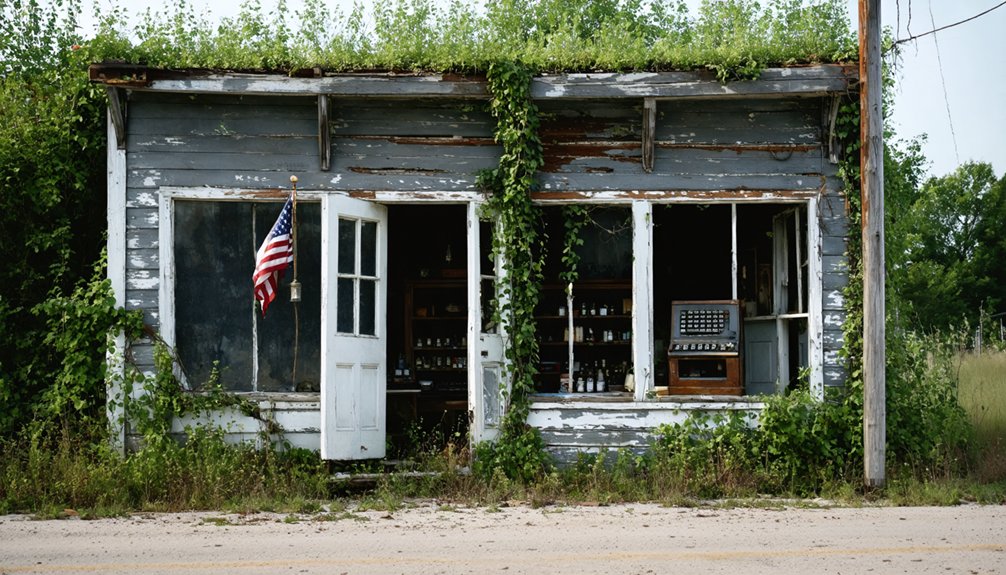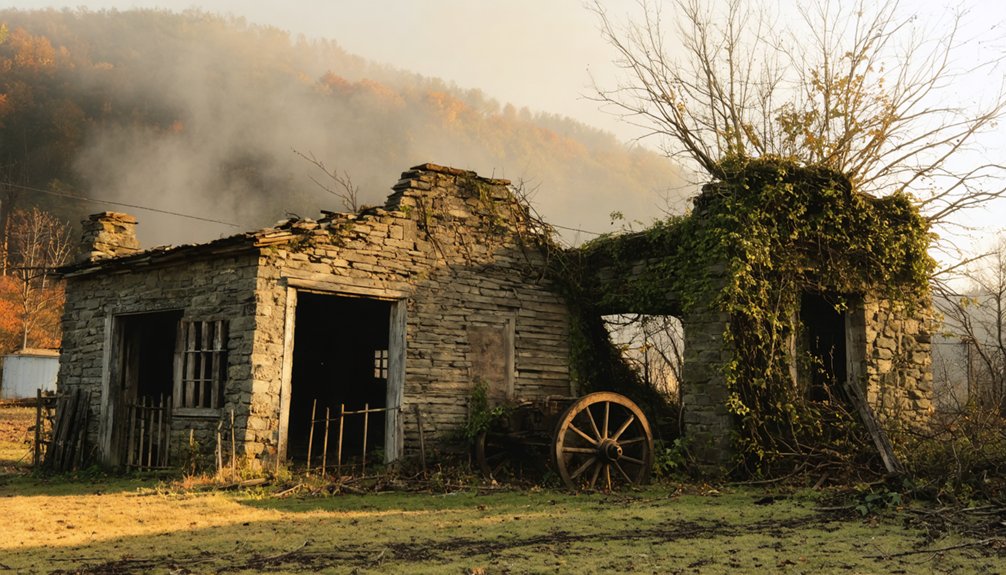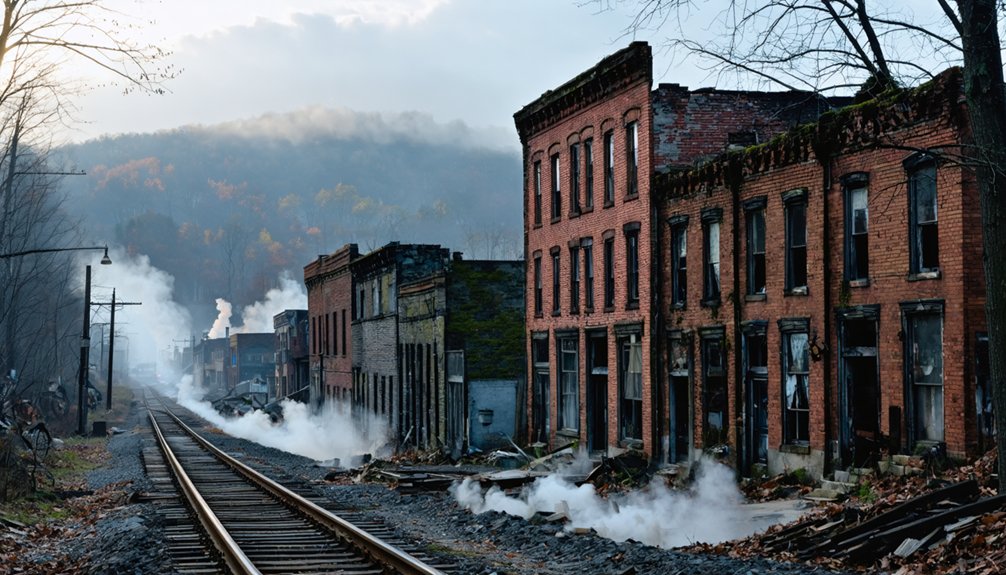
Civil War ghost settlements became empty due to multiple devastating factors you’d recognize in any community collapse. Military recruitment and bounty systems drained working-age men from rural areas, while draft laws shattered family units. Transportation changes, like railroad bypasses, redirected commerce away from established towns. You’ll find that resource depletion, contaminated lands from military use, and severe demographic losses created a perfect storm that hollowed out once-thriving communities – and there’s much more to this stark transformation.
Key Takeaways
- Military casualties devastated the working-age male population, with some regiments losing over 80% of men, causing severe labor shortages.
- Railroad developments bypassed many settlements, diverting commerce and population to rail-served towns and leaving others economically isolated.
- Military bounties and draft laws disrupted local economies, causing inflation and labor shortages that made communities unsustainable.
- Resource depletion and military damage, including Sherman’s March, destroyed infrastructure and contaminated farmland, making areas uninhabitable.
- Mass migration of surviving residents seeking better opportunities elsewhere led to community abandonment and permanent population decline.
The Economic Toll of Military Recruitment and Bounties
When the Union and Confederate armies began large-scale recruitment during the Civil War, the system of military bounties created severe economic distortions that would plague communities for years to come.
You’d have seen men repeatedly enlisting under different names to collect multiple payments, while bounty brokers emerged to profit from this speculative market. The payments often exceeded a year’s wages, making military service far more attractive than civilian work.
Soldiers gamed the bounty system, enlisting multiple times under false names while brokers cashed in on the lucrative recruitment market.
This recruitment frenzy triggered widespread economic inflation and labor shortages. Your local blacksmith, carpenter, or farmer might suddenly abandon their trade for bounty enlistments, leaving critical gaps in the workforce.
Communities struggled under mounting debts from bounty obligations, forcing them to cut spending on roads, schools, and other essential infrastructure – changes that would eventually turn thriving towns into ghost settlements.
Loss of Working-Age Men in Rural Communities
You’ll find that military conscription decimated rural towns as prime-age men were called away to fight, leaving critical labor shortages in agricultural communities.
More than two-thirds of rural counties still experience population decline today, continuing a long historical pattern of demographic challenges.
The draft laws tore apart family units, with many households losing their primary breadwinners and farm operators to military service.
As the farm labor force collapsed, rural communities faced severe economic hardship, leading many settlements to become permanently abandoned as survivors sought opportunities elsewhere after the war.
The shift from small family operations to large commercial farms continued this pattern of rural population decline well into the 20th century.
Military Service Decimated Towns
The devastating loss of working-age men to Civil War military service fundamentally altered the demographic landscape of rural communities across America.
You’ll find that military casualties reached staggering levels, with some Confederate regiments losing over 80% of their men in single battles, triggering widespread community fragmentation. The staggering toll of 500 deaths per day devastated families and communities across both regions.
These losses created a destructive chain reaction: fewer men meant reduced agricultural production, collapsed local economies, and deteriorating social structures.
You can trace how the shortage of working-age males led to lower marriage rates, decreased birth rates, and diminished knowledge transfer between generations.
As farms struggled without adequate labor, many survivors chose to abandon their communities entirely.
The resulting ghost settlements stood as stark evidence of how military service deaths had permanently reshaped rural America’s social and economic fabric.
Draft Laws Destroyed Families
Civil War draft laws intensified the already devastating impact of military service on rural communities by disproportionately targeting poor families. The system’s class-based exemptions sparked deep resentment, as wealthy citizens could pay $300 or hire substitutes to avoid service while poor families lost their essential workers. This unfair burden triggered widespread family fragmentation and accelerated the collapse of rural settlements. The Provost Marshal General established enrollment boards across districts to systematically document and conscript eligible men. Conscription created income disparities that would persist for generations between those who could avoid service and those who could not.
- You’d witness entire communities dissolve as working-age men were forcibly conscripted.
- You’d see families struggle with severe food shortages and crushing inflation.
- You’d find ghost towns emerging as desperate families abandoned their homes.
- You’d observe growing class resentment as wealthy citizens exploited draft exemptions.
The loss of breadwinners, combined with government crop confiscation and economic hardship, forced many rural families to relocate, permanently altering the demographic landscape of these once-thriving communities.
Farm Labor Force Collapsed
Staggering losses of working-age men during the war devastated rural communities’ agricultural labor force, creating a demographic void that many settlements couldn’t survive.
You’ll find that when these men enlisted or were conscripted, farms lost their primary workforce, leading to severe labor shortages that proved impossible to fill locally.
The situation worsened as surviving farmworkers left for higher-paying jobs in Northern war industries, while Southern farms, heavily dependent on slave labor, struggled to adapt.
Without enough hands to work the fields, you’d see entire farms falling into disuse. Many desperate farmers had to take out loans for machinery to compensate for the labor shortage, deepening their financial struggles. The demographic collapse hit hardest in areas where mechanization wasn’t feasible, forcing families to abandon their land.
Women and elderly residents couldn’t maintain the farms alone, accelerating the transformation of once-thriving communities into ghost settlements.
Transportation Changes and Settlement Decline
You’ll find that many Civil War-era settlements withered after railroads bypassed them or stopped requiring frequent steam engine service points.
The introduction of diesel locomotives and new rail routes effectively isolated numerous communities that had once served as essential refueling and maintenance stations.
Similar to the ghost towns of the American West, these abandoned settlements became popular destinations for history enthusiasts and photographers.
The decline of river trade routes further accelerated the downturn, as towns that previously thrived on water-based commerce lost their economic purpose when rail transport became the dominant mode of shipping.
These settlements often faced economic decline as their primary purpose for existence vanished, leaving behind empty buildings and infrastructure.
Railroad Bypass Impact
When railroads established new routes after the Civil War, they fundamentally reshaped the economic fate of countless settlements across the country. The railroad significance transformed local economies as towns without rail access quickly lost their competitive edge.
You’ll find that communities bypassed by new rail lines experienced rapid economic transformation, often leading to their eventual abandonment.
- Towns without rail access lost vital traveler revenue and trade opportunities
- Farmers shifted their business to rail-connected towns with cheaper goods
- Strategic rail junctions drew population and commerce away from bypassed settlements
- Agricultural communities, especially tobacco towns, couldn’t survive without rail connections
The impact was particularly severe for settlements that previously thrived on stagecoach routes. Many farmers in Union Level migrated to South Hill, VA seeking better economic opportunities. The Santa Fe Trail terminus shifted from Kansas City to Fort Leavenworth as border conflicts intensified during the Civil War.
As residents relocated to rail-served towns, bypassed communities entered a downward spiral of closing businesses, declining populations, and deteriorating infrastructure.
River Trade Routes Fade
The Union naval blockade‘s stranglehold on Confederate waterways transformed once-thriving river settlements into ghost towns during and after the Civil War.
You’ll find that river commerce decline accelerated as Union gunboats patrolled major waterways, especially after the capture of strategic fortifications like Fort Henry and Fort Donelson.
The military blockade effects were devastating – settlements that once bustled with cotton trade and river commerce found themselves cut off from essential markets and supplies.
When the Union seized control of the Mississippi River, particularly after taking New Orleans and Vicksburg, they effectively split the Confederacy’s trade networks.
You couldn’t maintain profitable river commerce when waterways became militarized zones.
Towns dependent on river trade had to abandon their traditional shipping routes, forcing merchants and residents to leave, ultimately leading to their decline.
Resource Depletion and Industry Collapse
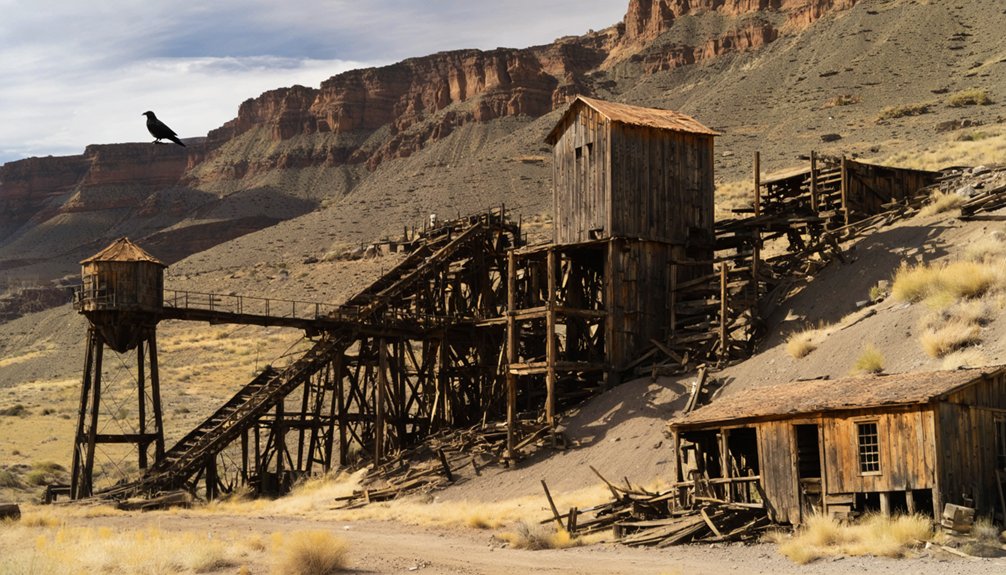
During the Civil War era, widespread resource depletion and industrial disruption transformed thriving settlements into ghost towns through a devastating combination of factors.
Today, many of these civil war ghost towns in America serve as poignant reminders of the past, attracting historians and tourists alike who seek to uncover the stories behind their decline. As visitors wander through the dilapidated structures and remnants of communities once vibrant, they are often struck by the silence that envelops these sites, echoing the tumultuous times that led to their abandonment. These locations not only preserve history but also offer a somber reflection on the costs of conflict and the fragility of prosperity.
You’ll find that resource exhaustion, particularly in mining communities, triggered rapid population collapse once precious metals and minerals were depleted. Economic stagnation followed as towns couldn’t diversify beyond their single-resource dependency.
- Sherman’s March destroyed essential infrastructure and agricultural capacity, crippling local economies.
- Mining towns faced environmental contamination from toxic tailings, forcing eventual evacuations.
- Credit shortages prevented post-war recovery and industrial reinvestment.
- Railway construction often bypassed war-damaged towns, shifting economic activity elsewhere.
The combination of depleted resources, environmental damage, and war-related destruction created a downward spiral from which many settlements couldn’t recover, leading to their permanent abandonment.
Military Requisition and Contaminated Lands
Military requisition of civilian properties during the Civil War created a devastating cascade of displacement that transformed vibrant communities into permanent ghost settlements.
You’d find your home seized for military encampments, headquarters, or field hospitals with little to no compensation, while strategic locations became heavily fortified and permanently altered by earthworks and artillery positions.
The aftermath left a toxic legacy of land contamination that made return nearly impossible.
Your former homestead might be riddled with unexploded ordnance, contaminated water sources, or mass graves. Disease outbreaks from military hospitals and camps poisoned wells and soil. Lead from bullets and black powder chemicals rendered farmland unusable.
Even if you wanted to return, military authorities often maintained control of these areas, converting them into permanent installations or restricted zones.
Demographic Shifts and Community Disruption
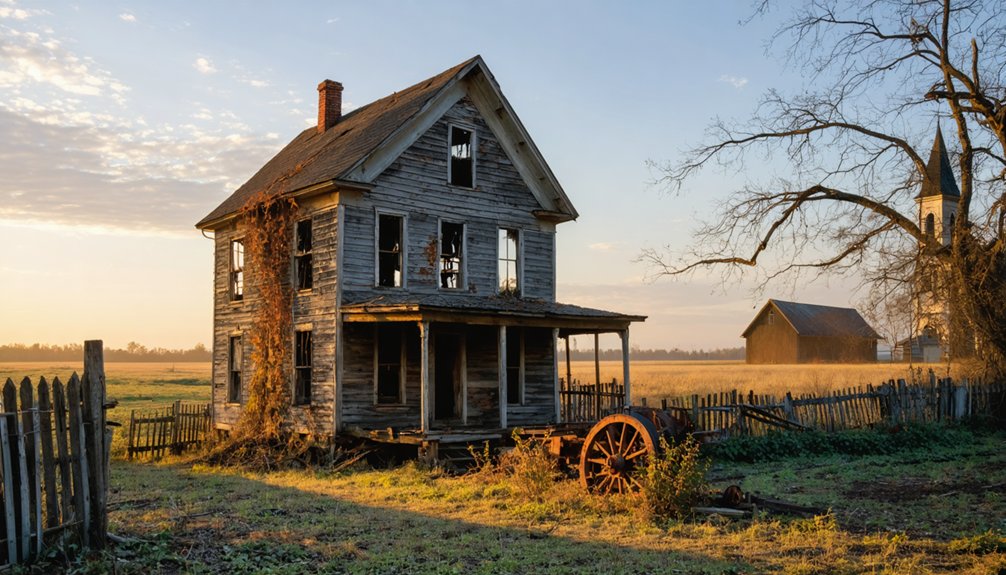
While battle casualties inflicted devastating losses across the nation, Southern communities bore a disproportionate demographic toll that permanently altered their social fabric. The stark demographic imbalance emerged as nearly 18% of Southern white males aged 13-43 died in combat, creating severe labor shortages and community fragmentation.
- You’ll find that many towns lost their economic foundation when freed slaves departed plantations.
- Young men who survived often struggled to reintegrate, leading to further population decline.
- The loss of working-age males dramatically reduced birth rates and family formation.
- Community institutions like schools and churches closed as populations dwindled.
This perfect storm of demographic disruption transformed vibrant communities into shells of their former selves, as remaining residents faced limited economic prospects and declining social infrastructure.
Natural Disasters and Environmental Challenges
Beyond the human toll of war, environmental devastation reshaped the Southern landscape into an increasingly hostile terrain for survivors.
You’ll find that extensive deforestation from military operations left behind vast “landscapes of stumps,” triggering soil erosion and agricultural collapse.
The war’s aftermath brought waves of natural disasters and environmental challenges, including floods, droughts, and extreme weather events that made settlement areas increasingly uninhabitable.
Contamination from military activities and industrial waste poisoned water sources and soil, while unexploded munitions created hazardous no-go zones.
These compounding environmental pressures forced many communities to abandon their homes, as depleted soil couldn’t sustain farming and contaminated resources posed serious health risks.
The resulting agricultural collapse drove survivors toward more viable regions or urban centers.
Migration Patterns During Post-War Recovery

In the wake of the Civil War’s devastation, you’ll find dramatic shifts in population movement that reshaped America’s demographic landscape. The surge in urban migration transformed rural communities into ghost settlements as people sought economic opportunity in industrial centers.
By 1870, you’d see the rural population drop from 80% to 75%, marking the beginning of a massive demographic transformation.
- Six million African Americans fled Southern oppression during the Great Migration
- Over 20 million white Southerners relocated in search of better opportunities
- European immigrants concentrated in urban industrial centers
- Agricultural mechanization and economic hardship drove mass rural exodus
These migration patterns fundamentally altered the South’s social fabric, with both Black and white Americans abandoning rural settlements for urban areas.
The combined effect of these movements left many Civil War-era communities permanently depopulated.
Frequently Asked Questions
How Did Women’s Roles Change in Ghost Towns During the Civil War?
You’ll find women’s labor transformed dramatically in ghost towns, as they took on community leadership roles, managing businesses, organizing resources, and protecting property while men fought in battle.
What Happened to the Buildings and Structures Left Behind in Abandoned Settlements?
Picture decaying wooden beams against grey skies: you’ll find abandoned architecture either destroyed by warfare, salvaged for materials, preserved as historical sites, or slowly reclaimed by nature’s relentless advance.
Did Any Ghost Towns Successfully Transform Into Different Types of Communities?
You’ll find successful revival efforts in places like Jerome, Arizona, and Terlingua, Texas, where community resilience transformed abandoned mining towns into thriving arts colonies and cultural destinations.
How Did Native American Tribes Interact With These Abandoned Civil War Settlements?
In over 60% of documented cases, you’ll find Native tribes repurposed these settlements as temporary camps and strategic bases, enabling tribal interactions through hunting grounds while maintaining cultural exchanges with sacred ancestral territories.
What Role Did Disease Outbreaks Play in the Abandonment of Settlements?
You’ll find that disease impact devastated populations, with two-thirds of soldier deaths from infections. Settlement decline followed as outbreaks killed civilians, destroyed communities, and forced survivors to flee contaminated areas.
References
- https://www.nps.gov/slbe/learn/historyculture/ghosttowns.htm
- https://en.wikipedia.org/wiki/Ghost_town
- https://www.okhistory.org/publications/enc/entry?entry=GH002
- https://www.legendsofamerica.com/gt-ghosttownethics/
- https://www.britannica.com/topic/ghost-town
- https://texashighways.com/culture/history/what-the-heck-is-a-ghost-town/
- https://www.geotab.com/ghost-towns/
- https://redriverhistorian.wordpress.com/tag/ghost-towns-2/
- https://www.life.com/history/ghost-towns-the-places-that-time-forgot/
- https://www.nps.gov/articles/industry-and-economy-during-the-civil-war.htm