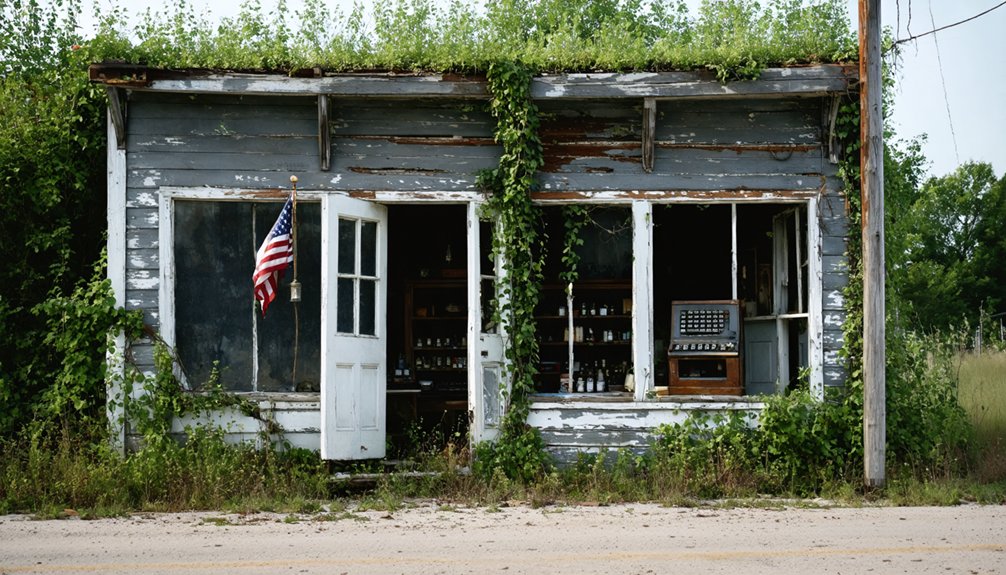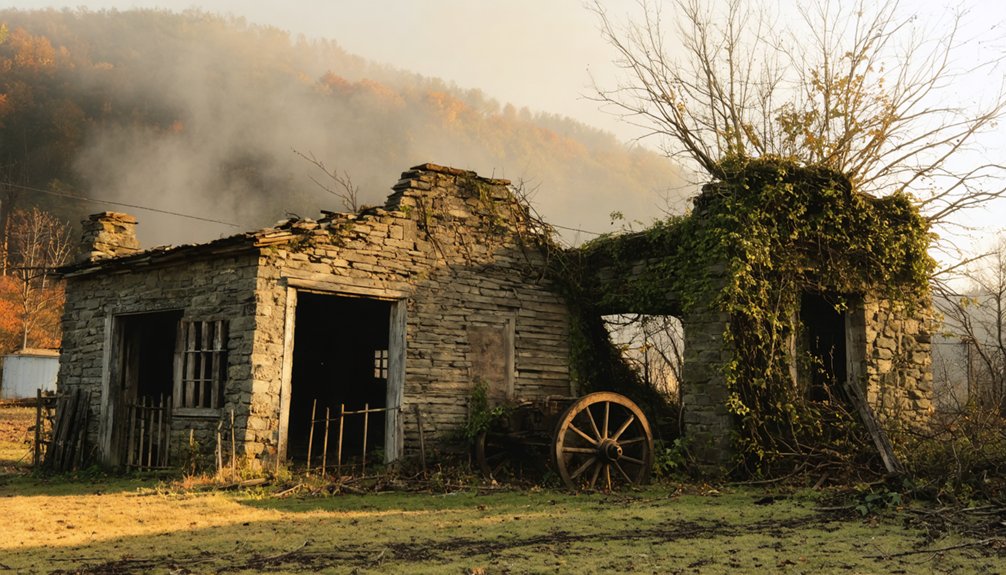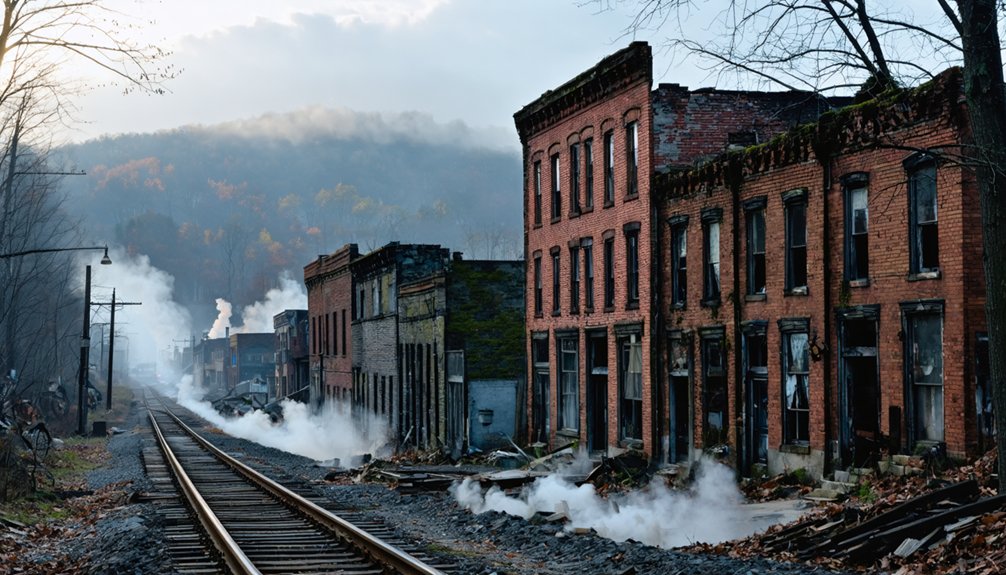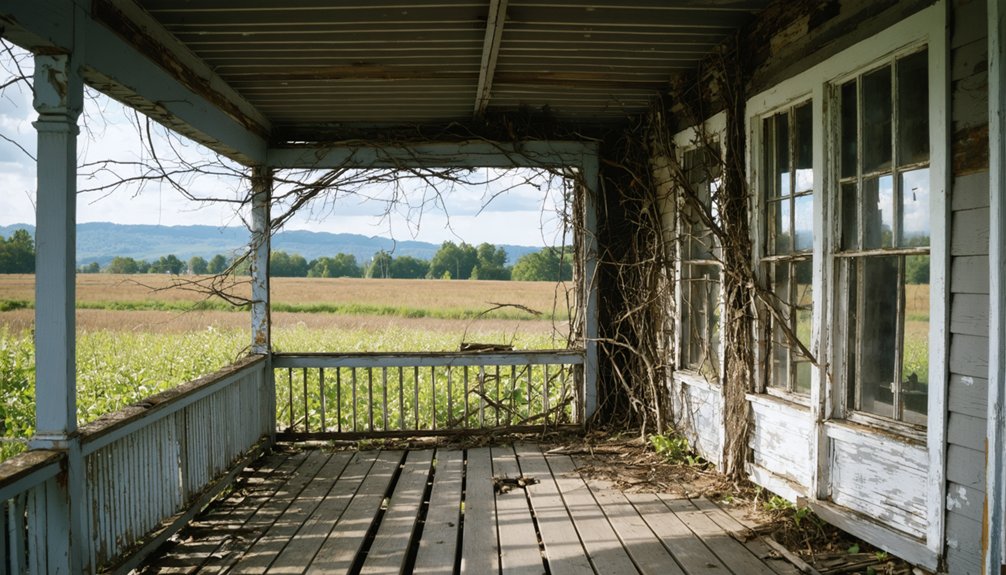
Civil War ghost towns exist today because you’ll find a devastating combination of factors that made recovery impossible. Military occupation forced civilian evacuations, while economic collapse from lost agriculture and slave labor bankrupted communities. Physical destruction through artillery left infrastructure in ruins, and catastrophic population losses of up to 5% annually created demographic vacuums as survivors fled. Many of these abandoned towns now serve as preserved heritage sites, offering tangible windows into this turbulent period.
Key Takeaways
- Devastating military actions and systematic destruction left towns uninhabitable, with ruins and unexploded ordnance preventing safe resettlement.
- Economic collapse following the loss of slave labor and agricultural infrastructure made recovery impossible for many Southern communities.
- Massive population losses from wartime casualties and migration created demographic vacuums that communities could not overcome.
- Physical destruction of essential infrastructure, including roads, bridges, and utilities, made rebuilding economically unfeasible.
- Some towns intentionally preserve their abandoned state for historical education and tourism through “arrested decay” preservation policies.
The Military’s Role in Town Abandonment
While military forces have historically protected communities, their actions during civil wars often led directly to town abandonment through multiple mechanisms.
Military occupation frequently resulted in forced civilian evacuations, as armies commandeered towns for strategic purposes without providing compensation or alternative housing. You’ll find examples like Imber in England, where residents never returned after their displacement during WWII.
Strategic withdrawal of troops left communities vulnerable to attacks and instability. Native American tribes frequently attacked Vulture City after the military relocated troops, leaving the mining town exposed to raids and violence.
When armies redirected their resources elsewhere, they cut off essential protection and economic support that towns needed to survive. Armed conflicts led to mass abandonment, as seen when population exchanges forced residents to leave towns like Kayaköy.
The damage didn’t stop there – military activities often contaminated areas with unexploded ordnance and environmental hazards, making resettlement impossible.
These abandoned places became restricted zones, permanently sealed off from civilian life and preserved as silent testimonies to war’s devastating impact.
Economic Collapse and Commercial Exodus
When civil war disrupted the economic foundations of towns, their collapse often followed a predictable pattern of commercial exodus and resource depletion.
Southern towns, heavily dependent on agriculture and slave labor, suffered catastrophic economic damage that persisted long after the fighting ended. Their economic dependency on a single industry left them vulnerable to collapse.
The loss of slave property value, which equaled the total value of Southern farmland by 1860, devastated local economies and contributed to widespread bankruptcies.
As properties deteriorated and infrastructure crumbled during wartime, these towns struggled to attract new investment or restore commercial activity.
Similar to the phenomenon of US ghost towns predating both the Civil War and World War II, these abandoned settlements showcase a recurring pattern in American history.
Failed reconstruction efforts compounded the problem, leaving communities trapped in cycles of poverty.
Resource depletion accelerated the decline, as mines shut down and timber supplies vanished.
Without diversified commercial activities or access to broader markets, businesses closed and residents departed, transforming once-thriving communities into abandoned shells of their former prosperity.
Physical Destruction and Infrastructure Loss
As battles raged across contested territories, systematic destruction of towns through artillery shelling, military operations, and deliberate sabotage left devastating physical scars on the built environment.
You’ll find that this physical devastation went far beyond combat damage – military forces often deliberately destroyed structures to deny their use to enemies, while locals stripped remaining materials for survival.
Cities like Agdam and Fuzuli experienced complete urban devastation, with buildings methodically dismantled until virtually nothing remained intact.
The infrastructure decay was extensive.
Towns faced similar fates as the 211 barren towns found across America today.
You’re looking at destroyed roads, bridges, and utilities that formed the backbone of daily life.
Flooding, either from natural causes or military actions like destroyed dams, washed away entire districts.
Even if you wanted to rebuild, the challenges were immense – unstable foundations, contaminated soil from war materials, and compromised underground systems made reconstruction prohibitively expensive or impossible in many areas.
Population Decline and Community Disruption
You’ll find that Civil War towns experienced severe population losses when able-bodied men left for military service, with many never returning due to the war’s staggering death toll of over 600,000 soldiers.
Those who survived often chose not to return to their devastated communities, instead migrating to more prosperous regions or growing urban centers.
The combination of military casualties and mass migration created a demographic vacuum that many towns couldn’t recover from, leading to their eventual abandonment. Similar patterns of migration continue, with aging populations contributing to urban demographic shifts across America today.
Modern towns face similar challenges today, as evidenced by St. Louis experiencing a 6.6% population decline between 2020-2023.
Military Service Impact
The widespread military service during the Civil War devastated communities through massive population losses and social disruption. When you examine the military enlistment consequences, you’ll find that towns lost significant portions of their working-age male population, crippling local economies and fracturing social structures.
These demographic shifts created lasting damage that many communities couldn’t overcome. You’ll see how the mass exodus of men led to reduced birth rates, disrupted family structures, and weakened community bonds. Similar to how Abraham Lincoln sent thousands of northern emigrants to Montana Territory during the gold rush era, the Civil War created massive population shifts that permanently altered communities.
Many towns experienced the same fate as mining communities that declined rapidly once their economic foundations crumbled. As soldiers died in battle or chose not to return home, towns faced chronic labor shortages. Women and children often left to seek better opportunities elsewhere, while businesses closed and tax revenues plummeted.
Without enough people to maintain infrastructure or sustain local economies, many of these struggling communities gradually transformed into the ghost towns you can still find today.
as stories of abandonment and decay emerge, these haunting tales of ghost towns reveal the once-vibrant life and culture that inhabited them. Each empty building and forgotten street holds a memory, inviting exploration and speculation about the lives that shaped these now-silent places. Those who venture into these eerie landscapes often find a sense of both sorrow and fascination, as history whispers through the crumbling facades.
Death Toll Effects
When death tolls mounted during the Civil War, entire communities faced catastrophic population losses that permanently altered their demographic makeup.
You’ll find that these losses created ripple effects through every aspect of community life. The death toll particularly devastated the male population, weakening local economies and disrupting family formation.
You can trace how this demographic collapse impacted community recovery. As surviving families lost multiple members, they often abandoned their properties, while aging populations couldn’t sustain local institutions.
The trauma of mass casualties led many survivors to relocate, further accelerating decline. Towns with high mortality rates became less attractive for resettlement, creating a cycle of depopulation.
Local businesses failed without workers or customers, and property values plummeted, discouraging new investment and sealing the fate of these communities.
Mass Migration Patterns
Following the Civil War’s devastating impact, widespread population shifts fundamentally altered the makeup of American communities, particularly in rural areas.
You’ll find that mass migration to urban centers created a devastating ripple effect, as young and working-age residents abandoned their rural towns in search of industrial employment opportunities.
The consequences were severe and self-perpetuating. As populations declined by up to 5% annually in some areas, local economies collapsed, triggering even more departures.
You can trace how this exodus crippled community infrastructure – schools closed, post offices shuttered, and transportation networks deteriorated.
The demographic shift left behind aging populations with limited resources and few newcomers to sustain their communities.
These combined factors turned once-thriving towns into shells of their former selves, creating the ghost towns you see today.
Government Policies and Forced Relocations
Throughout America’s Civil War era, government policies fundamentally reshaped communities through forced relocations and land seizures, creating numerous ghost towns that persist today.
You’ll find that government justification for these actions often cited national security needs, but the impact on communities proved devastating and permanent.
- Military authorities commandeered entire villages for training grounds, forcing residents to abandon generational homes.
- Post-war economic shifts led to government-backed land ownership changes that displaced farming communities.
- Federal infrastructure projects resulted in forced relocations, particularly for dam construction and railway realignments.
- Strategic military relocations permanently displaced hundreds of families from rural communities.
- Government-initiated expropriations transformed thriving towns into restricted areas, many remaining off-limits decades later.
These policies created lasting cultural and economic scars, fundamentally altering the American landscape through systematic displacement of established communities.
Historical Preservation and Modern Tourism

You’ll find Civil War ghost towns preserved as heritage sites serve essential educational roles by allowing direct engagement with artifacts and architecture from this pivotal period in American history.
The protected status of these sites through programs like the Historic Preservation Fund guarantees authentic structures and cultural resources remain intact for future generations to study and experience.
Tourism revenue from guided tours, museums, and educational programs helps sustain these historic locations while providing economic benefits to surrounding communities.
Heritage Site Educational Value
While many historical sites offer glimpses into America’s past, Civil War ghost towns provide an unparalleled educational experience through their preserved structures, artifacts, and landscapes.
You’ll discover heritage education opportunities that bring the 19th century to life, from authentic architecture to original infrastructure. The cultural significance of these sites extends beyond mere preservation, offering tangible connections to wartime industry, civilian life, and social transformation.
- Walk through preserved streets to witness authentic Civil War-era environments
- Explore original industrial sites showing wartime economic adaptations
- Study archaeological discoveries that reveal daily life and trade patterns
- Experience firsthand the impact of war on local communities and economies
- Examine preserved artifacts that document migration and demographic shifts
Tourism Revenue Benefits Towns
Modern tourism to Civil War ghost towns generates substantial economic benefits for surrounding communities, as evidenced by visitor spending data across multiple historic sites.
When you visit these historic locations, your tourism revenue directly supports local economies through hotel stays, restaurant visits, and retail purchases.
Consider Gettysburg’s impact – over one million annual visitors generate millions in local spending, while Kennesaw Mountain contributes $103.4 million to its regional economy.
You’ll find that even smaller ghost towns and battlefields create significant economic ripples.
The tourism they attract helps fund preservation efforts, maintain historic structures, and sustain local businesses.
Recent data shows that visitors to national historic parks spent $23.9 billion in gateway communities, supporting over 314,600 jobs and generating billions in lodging and restaurant revenue.
Protected Status Preserves History
Beyond their economic value, Civil War ghost towns benefit from protected status designations that shield these irreplaceable historic sites from development and decay.
The National Park Service and preservation organizations work to maintain historical integrity through “arrested decay” policies, ensuring you’ll experience authentic remnants of the past. Ghost town preservation extends beyond individual structures to encompass entire landscapes, creating living outdoor museums.
- Federal and state funding exceeding $20 million supports critical preservation efforts
- “Arrested decay” policies maintain structures in their existing state rather than full restoration
- Archaeological research documents underground remains and hidden historic features
- Controlled public access balances education with protection from vandalism
- Land management plans preserve historic roads, fields, and landscapes as they existed during the Civil War
Frequently Asked Questions
How Many Civil War Ghost Towns Still Exist in the United States?
While over 3,800 ghost towns exist nationwide, you’ll find hundreds of Civil War-era abandoned towns scattered across states like Virginia (19), Tennessee (12), and Pennsylvania (105), though exact Civil War counts remain undocumented.
Can People Legally Live in Abandoned Civil War Ghost Towns Today?
You can legally live in Civil War ghost towns if you establish legal ownership through proper channels and comply with historical preservation requirements, though infrastructure challenges and zoning restrictions often limit permanent residency.
What Valuable Artifacts Are Commonly Found in Civil War Ghost Towns?
You’ll commonly find Civil War relics like minié balls, uniform buttons, belt buckles, canteens, and coins. These historically significant items reveal soldiers’ daily lives and battles through physical evidence.
Do Any Civil War Ghost Towns Have Documented Paranormal Activity?
You’ll find extensive documented paranormal activity at haunted locations like Fort Mifflin, Gettysburg Battlefield, and Vicksburg, where spectral sightings of Civil War soldiers and unexplained phenomena occur regularly.
Which Civil War Ghost Town Is Considered the Most Well-Preserved?
You’ll find Bodie, California stands as the most well-preserved Civil War-era ghost town, with 110 original structures maintained in “arrested decay” and significant historical significance through its authentic mining-town architecture.
References
- https://www.cheapism.com/real-ghost-towns-of-america/
- https://www.youtube.com/watch?v=yx5G-NJ5_rc
- https://en.wikipedia.org/wiki/Ghost_town
- https://www.britannica.com/topic/ghost-town
- https://www.nps.gov/slbe/learn/historyculture/ghosttowns.htm
- https://www.legendsofamerica.com/gt-hiddentales/
- https://redriverhistorian.wordpress.com/tag/ghost-towns-2/
- https://vulturecityghosttown.com/blog/abandoned-america/
- https://pulitzercenter.org/stories/south-sudans-civil-war-spirals-genocide-leaving-ghost-towns-its-wake
- https://www.lovemoney.com/gallerylist/86648/americas-empty-ghost-towns-and-why-theyre-abandoned-today