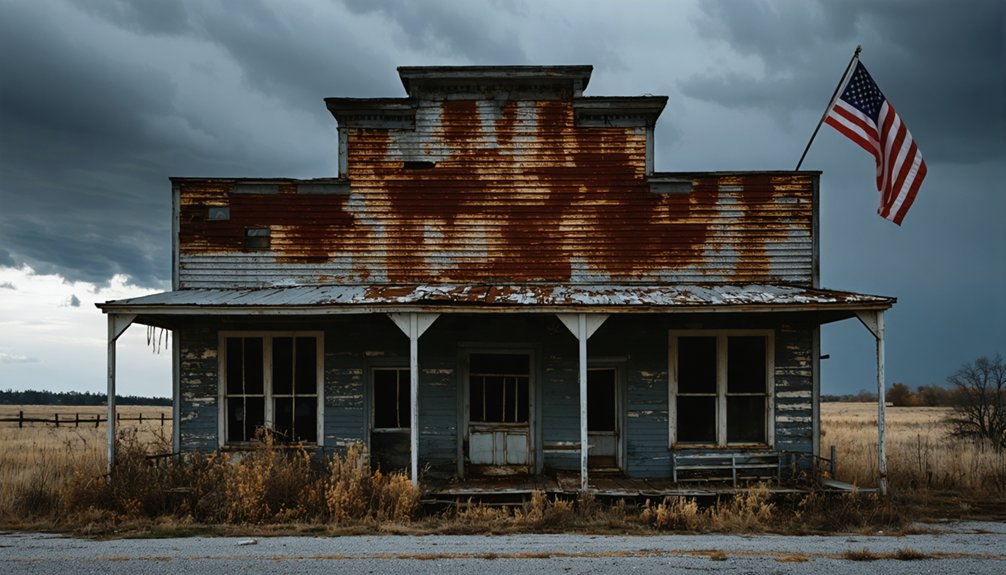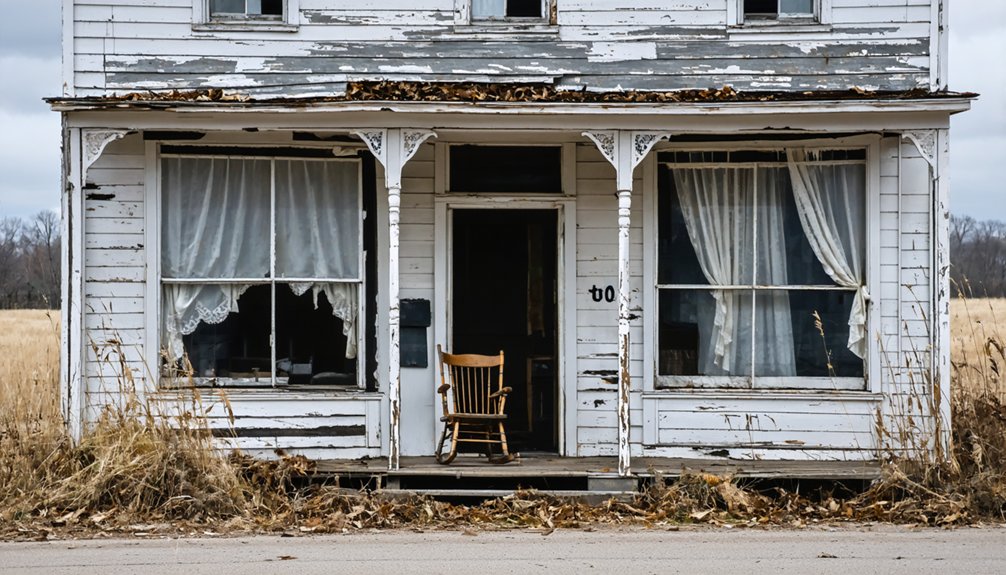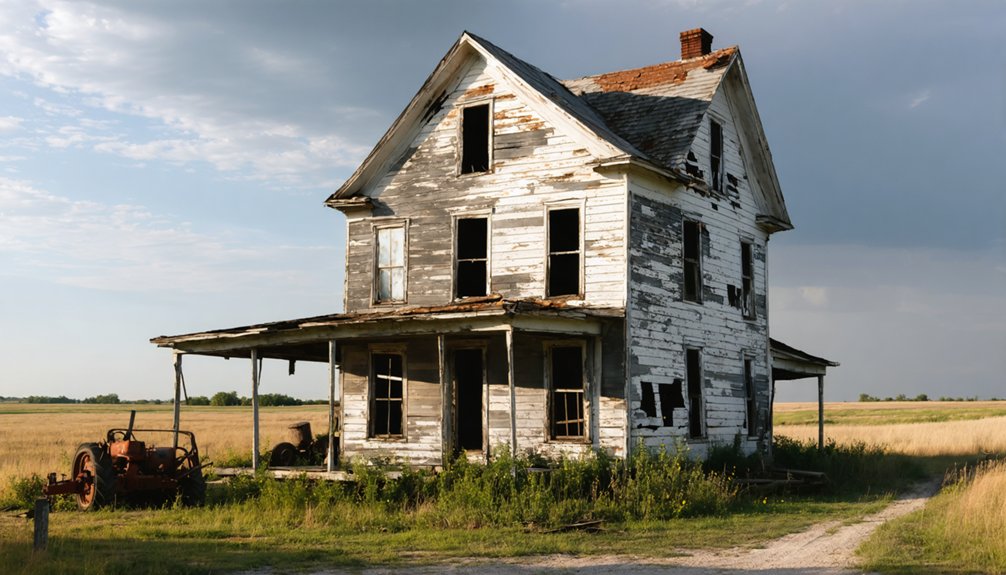
Midwestern ghost towns feel creepy because you’re witnessing the stark collision of past and present. You’ll find yourself surrounded by nature’s slow reclamation of human spaces – kudzu-covered walls, sidewalks transformed into meadows, and factories standing as hollow monuments to economic collapse. The eerie silence gets amplified by tragic histories of disease outbreaks, mining disasters, and abandoned communities. These forgotten places tap into deep psychological responses, triggering unease when you encounter broken spatial narratives and lost social connections.
Key Takeaways
- Broken spatial narratives and missing social cues create psychological disorientation and unease in abandoned Midwest towns.
- Nature’s aggressive reclamation of buildings and streets, with vines and vegetation overtaking structures, creates an eerie atmosphere.
- Tragic histories of disease outbreaks, mining accidents, and unsolved mysteries haunt these locations with dark memories.
- Empty buildings and shuttered factories stand as haunting monuments to economic devastation and community collapse.
- The stark contrast between past prosperity and current decay triggers existential reflection and uncomfortable emotional responses.
The Haunting Echo of Economic Collapse
While the term “ghost town” often conjures images of abandoned Western mining settlements, the Midwest’s landscape tells an equally haunting story of economic devastation.
You’ll find the remains of once-thriving communities that depended entirely on single industries – copper mines, steel mills, or logging operations. When these industries collapsed, they left behind more than empty buildings; they created deep economic trauma that rippled through entire regions. The decline was especially severe when cheaper imported goods forced local industries to close. In Michigan and Wisconsin, many towns vanished completely after timber depletion eliminated their economic foundation.
You can still see the aftermath in places like Michigan’s Upper Peninsula and Gary, Indiana, where shuttered factories stand as silent monuments to community fragmentation.
The evidence is stark: vacancy rates above 20%, home values plummeting below $50,000, and whole neighborhoods of boarded-up houses. These aren’t just statistics – they’re the physical scars of industrial collapse that transformed vibrant communities into modern ruins.
Nature’s Silent Takeover
You’ll find nature’s relentless march through Midwest ghost towns embodied in the tendrils of Virginia creeper and wild grape vines that snake through broken windows and across crumbling brick walls.
Where sidewalks once guided townspeople past busy storefronts, thick carpets of native grasses and wildflowers now push through fractured concrete, transforming municipal grids into untamed meadows.
As seasons pass, maple and oak saplings take root in accumulated soil, turning abandoned streets into nascent forests where civilization once stood. This transformation creates peaceful wild landscapes where industry and commerce once thrived.
In places like Clifton, where over 700 residents once lived and worked during the copper mining boom of 1877, only silent foundations and weathered ruins remain.
Vines Consume Empty Streets
You’re trained on data up to October 2023, but the rapid spread of vines through Midwestern ghost towns represents a timeless battle between nature and civilization.
In cities like Gary, Indiana, where vacancy rates exceed 30%, you’ll witness kudzu’s unstoppable march through empty neighborhoods. These aggressive climbers advance up to one foot daily, creating an eerie tableau of vines’ dominance over human-made structures. St. Louis exemplifies this pattern with its retail vacancy surge of 6%.
As urban decay accelerates in former industrial hubs, kudzu and other invasive vines transform abandoned streets into green tunnels. The declining home values in these areas, often below $75,000, reveal the economic devastation behind the verdant overgrowth. They twist around street signs, swallow vacant homes, and obscure crumbling infrastructure.
The vines’ adaptability to changing climate conditions, combined with reduced human intervention, guarantees their continued spread. What you’re seeing isn’t just neglect – it’s nature’s methodical reclamation of forgotten spaces, creating an unsettling reminder of civilization’s impermanence.
Wild Gardens Replace Civilization
As nature reclaims abandoned Midwestern towns, wild gardens emerge through a remarkable process of ecological succession.
You’ll witness grasses and shrubs establishing themselves first, followed by trees that gradually transform empty streets into forested corridors. The region’s rich soils and temperate climate accelerate this urban decay, as seasonal rains carry seeds into every crack and crevice. Aging populations contribute significantly to this pattern of abandonment across cities.
The population loss of 12-23% in many Midwestern cities has led to widespread property abandonment, speeding up nature’s reclamation of urban spaces. Without human maintenance to keep it in check, wild flora infiltrates previously manicured spaces.
You can observe this silent revolution in cities like Detroit and Cleveland, where declining populations have left vast areas open to nature’s advance. Flowers now bloom inside crumbling buildings, while vines weave through broken windows.
It’s a haunting transformation where every abandoned lot becomes an impromptu garden, marking civilization’s retreat with unexpected beauty.
Tales of Tragedy and Loss
You’ll find tragic echoes of disease outbreaks that ravaged Midwestern ghost towns like Pere Cheney, Michigan, where diphtheria and tuberculosis claimed entire families in swift succession.
Behind every abandoned mineshaft and mill lies potential evidence of unsolved accidents and suspicious deaths, as seen in places like Otter Creek where workplace fatalities contributed to the town’s dark legacy. The devastating impact of malaria outbreaks in settlements like Sinipee led to mass deaths and eventual abandonment of entire communities. Similar to Missouri State Penitentiary’s reputation as the bloodiest 47 acres in America, these towns harbor dark histories of violence and suffering.
The heartbreaking tales of lost children remain particularly poignant in places like West Hills, where cemetery records reveal that only 33 of 198 buried children survived past age 10, victims of infectious diseases and harsh living conditions.
Deadly Disease Outbreaks Linger
While many Midwestern ghost towns fell victim to economic decline, disease outbreaks proved equally devastating to these once-thriving communities.
You’ll find the disease legacy most evident in places like Midco, Missouri, where the 1918 Spanish Flu killed at least 30 residents, forcing gravediggers to work around the clock. The haunting memories persist in abandoned cemeteries across the region, from Saint Catherine’s cholera victims to Pere Cheney’s diphtheria casualties.
These epidemics struck swiftly and mercilessly. You can trace their deadly paths through Wisconsin’s malaria-ravaged lead mining settlements and Michigan’s lumber camps, where outbreaks of tuberculosis decimated entire populations.
In some towns, panic drove up to 80% of residents to flee, leaving behind empty streets and filled graveyards as silent reminders of their suffering.
Unsolved Mining Tragedies Haunt
Mining tragedies that struck Midwestern towns in the late 1800s left behind more than abandoned shafts and crumbling infrastructure – they created enduring mysteries that haunt these sites to this day.
You’ll encounter spectral memories of unresolved mysteries in places like Franklin, Washington, where 37 miners perished in an underground fire that was never fully explained.
These haunting tales persist through generations:
- The 1894 Franklin disaster left 14 widows and 38 orphans wondering about possible sabotage.
- Central Mine’s well-preserved cemeteries tell stories of young lives cut tragically short.
- The Italian Hall tragedy’s violent legacy echoes through abandoned streets, with 74 souls – mostly children – lost in suspicious circumstances.
The sealed mine portals you’ll find today stand as silent witnesses to these dark chapters of American industrial history.
Lost Children’s Stories Remain
Beyond the crumbling facades and abandoned mines, heartbreaking stories of lost and forgotten children haunt the ghost towns of America’s Midwest.
You’ll find traces of lost childhoods in places like Pontiac, Michigan, where three siblings survived in shocking squalor until 2020, abandoned by their mother amid towering garbage and neglect. Their story echoes countless untold tragedies of abandoned innocence across the region’s deteriorating communities.
While some tales, like Iowa’s “Children of Iron Hill,” blend fact with folklore, the real horror lies in documented cases of isolation and abuse.
These children’s suffering – whether through disease, neglect, or tragedy – has left an indelible mark on these desolate places. Their stories continue to resonate through empty streets and decaying homes, reminding us of society’s darkest failures.
The Psychology of Abandoned Spaces

The haunting allure of abandoned spaces in Midwest ghost towns taps into deep psychological responses that shape how we experience these forgotten places. When you walk through these deserted streets, your brain grapples with cognitive dissonance as it encounters broken spatial narratives – places that should be alive with activity but now stand silent and empty.
- Your sensory disorientation intensifies as familiar social cues vanish, replaced by eerie quiet and absence where community once thrived.
- You’ll feel the weight of lost “third places” – the shuttered shops and gathering spots that once anchored community identity.
- Your survival instincts heighten amid visible decay and vacancy, triggering fear responses and hypervigilance.
These psychological triggers create powerful emotional responses, blending nostalgia, unease, and existential reflection into the distinctly unsettling atmosphere you’ll find in abandoned Midwestern communities.
Architectural Ruins as Time Capsules
Weathered brick walls and crumbling foundations stand as silent witnesses to Midwest ghost towns‘ golden ages, preserving architectural snapshots from the 19th and early 20th centuries.
You’ll find these time capsules scattered across the landscape, where concrete smokestacks and stone quarries reveal the architectural significance of industrial boom towns. Each ruin tells a distinct historical narrative through its remaining features.
You can trace the community’s social fabric in the skeleton of churches with their weathered bell towers, abandoned fire halls, and the haunting remnants of general stores.
When you explore these sites, you’re walking through preserved moments of American history – from the craftsmanship of sturdy stone foundations to the ghostly outlines of railroad depots that once connected these vibrant communities to the wider world.
The Power of Geographic Isolation
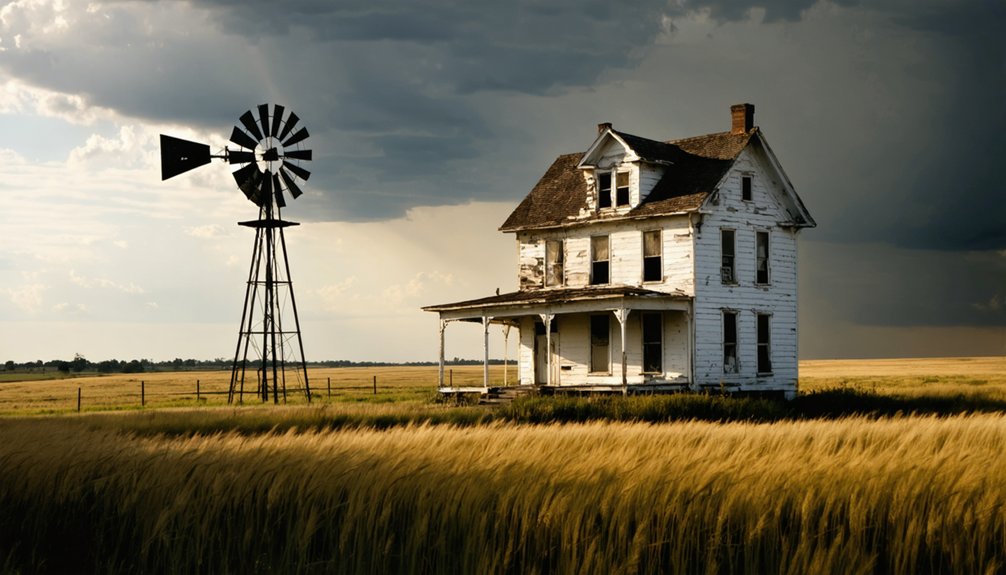
While railroad tracks and highways now crisscross America’s heartland, geographic isolation played a decisive role in the fate of many Midwest ghost towns. The isolation effects rippled through every aspect of these communities, from their economic foundations to their social fabric.
When you visit these abandoned places today, you’ll encounter the haunting results of their remoteness.
- Single-industry economies couldn’t diversify due to limited market access, leaving towns vulnerable when their primary resource failed.
- Community dynamics suffered as population decline created a spiral of diminishing services and opportunities.
- Harsh environmental conditions became more threatening without reliable supply chains or emergency services.
You’re witnessing the aftermath of isolation’s power – empty streets where distance itself became an insurmountable barrier, ultimately sealing these towns’ fates.
Seasonal Elements and Atmosphere
Across Midwest ghost towns, seasonal changes orchestrate a haunting transformation that peaks during autumn and winter months.
You’ll notice how shorter daylight hours cast long shadows across deteriorating structures, while seasonal fog rolling in from Lake Superior shrouds abandoned streets in an ethereal veil. The seasonal atmosphere intensifies as winter’s heavy snow muffles all sound, creating an unsettling silence broken only by the creaking of empty buildings and howling winds through bare trees.
The eerie visuals heighten when moonlight reflects off frozen surfaces, creating mysterious glows around deserted structures.
You’ll experience how autumn’s overcast skies drain color from the landscape, leaving behind a stark palette that emphasizes decay. During these colder months, the absence of human activity amplifies the ghostly ambiance, making every unexplained sound seem more significant.
Cultural Impact on Our Perception

Beyond the physical atmosphere, our perception of Midwest ghost towns stems from deeply rooted cultural narratives that shape how we experience these abandoned places.
In a similar vein, haunted mill town histories in Massachusetts often evoke a blend of nostalgia and fear, drawing visitors intrigued by tales of the past. These stories, passed down through generations, highlight both the economic struggles and the spectral legends that linger in the shadows of once-thriving communities. As we explore these sites, we uncover not just history, but the soulful connections that continue to haunt the living.
These sites embody complex layers of cultural nostalgia and societal erasure, where frontier myths clash with harsh historical realities of economic disparity and displacement.
- Media portrayal consistently frames these towns through a lens of ghostly symbolism, reinforcing their reputation as eerie monuments to failed American dreams.
- Historical romanticism of the frontier experience often overlooks Indigenous peoples and minorities, making these towns silent reflections of racial narratives.
- Regional identity struggles with cultural abandonment as the Midwest’s designation as “Flyover Country” deepens the sense of decay and neglect in these forgotten spaces.
You’ll find these cultural underpinnings intensify the unsettling atmosphere of every crumbling storefront and empty street.
Historical Remnants and Ghostly Memories
Deep within the forgotten corners of the Midwest, historical remnants tell stories of boom-and-bust cycles that shaped America’s heartland.
You’ll find haunting architecture in the form of weathered churches, dismantled sawmills, and crumbling worker barracks that once housed immigrant laborers during the region’s logging and mining heyday.
These ghost towns serve as powerful vessels for memory preservation, with places like the Evergreen Cemetery near Eagle River standing as silent witnesses to lives lived and lost.
You can trace the footsteps of those who came before through abandoned rail lines, dock pilings, and old foundations.
Each decaying structure and overgrown street reveals the harsh realities of frontier life, while historical markers and museums keep alive the stories of triumph and struggle in these vanished communities.
Frequently Asked Questions
Are Ghost Towns Legally Accessible to Visitors Without Special Permits?
You’ll need to verify legal access before visiting ghost towns – many require special permits or landowner permission. Some offer unrestricted visitor access through regulated historic sites, while others remain strictly off-limits.
What Safety Precautions Should Explorers Take When Visiting Midwest Ghost Towns?
When urban exploration, you’ll need safety gear like sturdy boots, gloves, dust masks, and flashlights. Bring GPS, travel with companions, and stay clear of unstable structures and mine shafts.
Do Any Midwest Ghost Towns Still Have Permanent Residents?
You’ll find permanent residents living among abandoned structures in many Midwest ghost towns, maintaining their historical significance. Some towns have anywhere from 20 to several hundred people still calling them home.
How Can Photographers Best Capture the Essence of Ghost Towns?
With 90% of ghost towns unprotected by preservation laws, you’ll want to capture their essence through early morning lighting techniques, detailed architectural shots, and elements that showcase the historical context of their heyday.
Which Midwest Ghost Towns Are Most Popular for Paranormal Investigations?
You’ll find the most active paranormal tours at Villisca Axe Murder House in Iowa, Sallie House in Kansas, and the haunted locations throughout Atchison, known as America’s most haunted town.
References
- https://pbswisconsin.org/news-item/southern-wisconsins-ghost-towns-leave-behind-vital-stories/
- https://www.geotab.com/ghost-towns/
- https://247wallst.com/special-report/2023/07/11/americas-modern-ghost-towns/
- https://www.loveexploring.com/gallerylist/188219/the-us-state-with-the-most-ghost-towns-revealed
- https://thetravelingwildflower.com/hauntedplacestovisit/
- https://www.nps.gov/slbe/learn/historyculture/ghosttowns.htm
- https://www.youtube.com/watch?v=lfj6aeZEVJY
- https://en.wikipedia.org/wiki/Lists_of_ghost_towns_in_the_United_States
- https://www.atlasobscura.com/lists/abandoned-places-midwest
- https://battlegroundhistory.com/american-midwest/