You’ll find ghostly presences lingering in historic mill ruins due to several interconnected factors. The sites often overlap with ancient burial grounds and sacred indigenous spaces, creating powerful spiritual connections. Early 20th-century industrial tragedies claimed over 23,000 lives annually, leaving lasting impressions. Nature’s reclamation of these structures creates isolated environments where dense vegetation, unusual acoustics, and shifting shadows amplify supernatural encounters. These layered histories hold deeper mysteries waiting to be uncovered.
Key Takeaways
- Industrial accidents and high worker death rates created unresolved trauma, with over 23,000 annual deaths in early 20th century workplaces.
- Ancient burial grounds often preceded mill construction, making these sites inherently connected to death and ancestral spirits.
- Environmental conditions like poor air quality, echoing acoustics, and filtered light create ideal settings for perceived paranormal activity.
- Mills served as community hubs, accumulating intense human experiences and emotional energy over generations of use.
- Natural reclamation of ruins creates isolated spaces where historical echoes feel more present and psychological receptivity increases.
The Dark Legacy of Ancient Burial Grounds
When ancient peoples selected burial ground locations, they often chose sites that would later become centers of human activity, including the foundations of historic mills.
You’ll find that burial mound significance extends far beyond mere interment – these were elaborate structures reflecting complex social hierarchies and deep cosmological beliefs. The archaeological evidence reveals multiple layers of ritual use spanning centuries, with some mounds serving as two-storied sepulchral towers.
What you’re encountering in these locations isn’t just industrial heritage – it’s a profound spiritual legacy.
Ancient cultures believed ancestral spirits remained connected to their burial sites, especially when disturbed. These grounds were considered liminal spaces between worlds, where repeated ceremonies and sacrifices reinforced the spiritual energy. The extensive necropoleis contain royal burial mounds that showcase the social diversity of early civilizations.
Sacred burial grounds acted as gateways between realms, with ancestral spirits forever tied to these powerful, ceremonial spaces.
The evidence suggests these weren’t just graves, but portals to the ancestral domain. Extensive research at sites like Eulenberg has uncovered two wooden chambers that served as monumental burial structures for entire communities.
Tales of Tragedy: Industrial Deaths and Accidents
The haunting presence in historic mill ruins extends beyond ancient burial grounds to a more recent legacy of industrial carnage.
You’ll find these locations marked by staggering statistics – 23,000 annual deaths in early 20th century workplaces, with catastrophic incidents like the Pemberton Mill collapse killing 145 workers instantly.
Industrial tragedies struck through various means: structural failures crushed workers, coal dust explosions ripped through buildings, and machinery accidents claimed countless lives. Before robust safety regulations, 1% of ironworkers perished annually during the perilous construction projects of 1911-1912.
Fatal accidents weren’t random occurrences but systemic problems, with mining alone claiming 329 deaths per 100,000 workers between 1911-1915. The introduction of workmen’s compensation laws in 24 states helped spotlight these deadly workplace conditions and improve accident reporting.
These violent, sudden deaths have left their mark on mill ruins, creating a psychological imprint that fuels tales of restless spirits and unexplained phenomena.
The sheer scale of loss and suffering continues to resonate through these abandoned industrial spaces.
Nature’s Reclamation: The Perfect Setting for Spirits
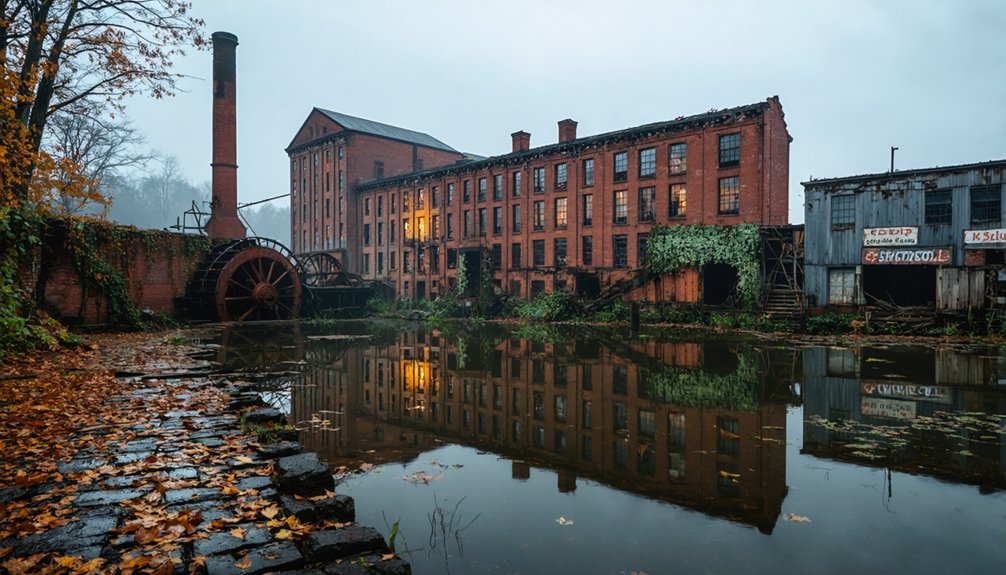
As you walk through the crumbling mill ruins, dense vegetation and encroaching vines create an intricate play of shadows that seem to dance with purpose across weathered stone walls.
You’ll notice how nature’s reclamation has transformed industrial paths into mysterious corridors where moss-covered stones and twisted roots blur the boundary between past and present.
The thick foliage not only masks the mechanical sounds of the modern world but also creates an acoustically isolated space where the whispers of history—or perhaps something more ethereal—feel unnervingly close.
Pioneer species like grasses and mosses slowly colonize every surface, turning stark industrial remnants into living, breathing spaces.
Much like the eerie atmosphere of Gunkanjima’s ghost island, these abandoned structures stand as silent witnesses to industrial decline, their empty chambers echoing with untold stories.
Shadows Among Ancient Stones
Deep within historic mill ruins, nature’s persistent reclamation creates an ideal stage for supernatural encounters through a complex interplay of environmental factors.
Similar to the dramatic transformation of Vallone dei Mulini in Sorrento, these atmospheric ruins showcase nature’s remarkable ability to reclaim abandoned spaces.
You’ll find dense vegetation filtering sunlight through crumbling walls, casting ever-shifting patterns that your mind might interpret as shadowy figures. The unique microclimate of these spaces, with their higher humidity and natural decay, amplifies every ancient echo bouncing off weathered stone.
As you explore these atmospheric spaces, you’ll notice how climbing vines and flourishing ferns have transformed industrial remnants into mystical sanctuaries. The water from streams that once powered up to 25 mills now contributes to the valley’s ethereal ambiance.
The interplay of natural acoustics, mist, and filtered light creates optical illusions that can trigger your brain’s pattern-recognition instincts. These environmental conditions, combined with the ruins’ isolation from modern noise, heighten your sensory awareness and open your perception to otherworldly possibilities.
Overgrown Paths Tell Tales
Nature’s methodical reclamation of historic mill ruins creates layered ecosystems that amplify supernatural narratives through their profound psychological impact. As you venture along overgrown trails, pioneer species give way to dense vegetation that masks crumbling infrastructure, creating an otherworldly atmosphere where past and present merge.
The hidden history of these sites emerges through natural succession, where vines embrace weathered stones and moss softens harsh edges, intensifying themes of impermanence and decay. Similar to projects like Gas Works Park, these industrial ruins undergo creative adaptive reuse through nature’s processes. Like many post-industrial sites across the globe, these spaces represent society’s evolving relationship with abandoned infrastructure.
You’ll find these evolving landscapes foster unique psychological spaces where rustling leaves and wildlife calls blend with industrial remnants. The labyrinthine paths, obscured by successive waves of plant growth, limit visibility and heighten anticipation.
This interplay of natural reclamation with architectural decay creates perfect conditions for perceiving spectral presences, transforming mundane ruins into portals of supernatural possibility.
Nature Masks Spirit Whispers
The reclamation of abandoned mill ruins by diverse plant species creates ideal conditions for supernatural encounters. As nature’s revival takes hold, you’ll discover how vegetation masks and amplifies potential spectral echoes within these industrial remnants.
- Vines and moss integrate crumbling structures into natural settings, creating secluded spaces where sounds become muffled and distorted.
- Pioneer plants establish complex habitats that generate mysterious rustling and movement, often mistaken for otherworldly activity.
- Water-filled depressions host amphibians and insects whose calls contribute to the ethereal atmosphere.
The interplay between industrial debris and thriving ecosystems produces layered soundscapes that blur the line between natural and supernatural.
In these transformed spaces, wind whispers through overgrown ruins while varied wildlife sounds merge with the site’s haunting industrial past, creating an environment where spiritual encounters feel distinctly possible.
Indigenous Legends and Cultural Beliefs
When you explore historic mill ruins, you’re walking on sacred indigenous land where ancestral spirits continue to manifest through unexplained phenomena and spiritual encounters.
Traditional indigenous teachings reveal that these sites serve as portals where ancient rituals and ceremonies once connected the physical and spirit worlds, leaving lasting energetic imprints that persist today.
The spirits of indigenous guardians remain vigilant at these locations, protecting sacred spaces and reminding visitors through supernatural occurrences that these grounds demand cultural respect and reverence.
Sacred Land Still Speaks
Deep within historic mill ruins, indigenous spiritual beliefs continue to shape local understanding of these contested spaces, where ancestral spirits serve as vigilant guardians of sacred lands.
You’ll find that sacred stories emerge from the natural features surrounding these sites – waterfalls, caves, and ancient trees – where the physical and spiritual domains intersect through ancestral connections.
- Rivers and ravines near mills function as liminal spaces where the land itself communicates through indigenous oral traditions.
- Geological formations like caves and cliffs host specific spirit beings, including entities like Tahquitz.
- Natural elements serve as portals where communities maintain spiritual relationships through ritual offerings.
The landscape speaks through these features, preserving indigenous warnings about respecting sacred spaces while reinforcing traditional cultural values despite physical changes to the land.
Ancient Rituals Echo Today
Ancient sacred rituals continue to resonate through indigenous mill sites, where ceremonial practices blend ancestral wisdom with physical landmarks.
You’ll find evidence of cultural echoes in the stone landscapes and ceremonial alignments that mark celestial events, reflecting deep cosmological understanding. Indigenous peoples conducted semi-religious rites at these locations, incorporating fire-building, body painting, and ritualistic dance to invoke spiritual forces.
The sanctity of grain mills held particular significance, as communities blessed millstones and made offerings to the “spirit of the mill.”
Today, groups like the Ramapough Lenape Turtle Clan maintain these ancient rituals at ceremonial stone sites, preserving their connection to ancestral knowledge. These practices demonstrate how historic ruins serve as enduring bridges between past and present spiritual traditions.
Spirit Guardians Protect Sites
You’ll find that Indigenous peoples across cultures share deep beliefs about spiritual protection of sacred sites through ancestral guardians. These powerful spirits serve as intermediaries between physical and spiritual domains, maintaining balance and preserving cultural heritage at historic locations.
- Spirit guardians embody traditional ecological knowledge, enforcing sustainable land stewardship and deterring exploitation of sacred ruins.
- Through ceremonies and rituals, communities honor these protectors while reinforcing their responsibility as site custodians.
- The guardians’ presence helps preserve cultural memory, maintaining essential connections between past and present generations.
These beliefs underscore Indigenous sovereignty over ancestral territories, with spirit guardians acting as eternal watchmen against desecration and disrespect of sacred places. Their role transcends mere folklore, representing living traditions that continue shaping site preservation.
The Psychology Behind Mill Hauntings
While haunted mill attractions may seem like simple entertainment venues, the psychological mechanisms behind these experiences reveal complex interactions between our conscious and subconscious minds.
When you enter these ghostly narratives, your amygdala activates fight-or-flight responses even though you know you’re safe. The psychological thrillers unfold as your brain processes sensory stimuli, releasing adrenaline and cortisol that heighten your physical alertness.
You’ll experience cognitive dissonance as your rational mind acknowledges the artificial nature of the threats while your subconscious reacts with genuine fear. This internal conflict, combined with dopamine release after each scare, creates a compelling cycle of tension and reward.
Historical trauma and unresolved mill incidents further deepen your psychological investment, as your mind seeks meaning in these industrial spaces’ darker narratives.
Environmental Factors That Fuel Ghost Stories
Historic mill ruins harbor numerous environmental conditions that create perfect breeding grounds for ghost stories and supernatural experiences. The interplay of environmental cues and sensory distortions can trick your mind into perceiving supernatural phenomena where none exist.
Many have shared tales of ghost stories from old mill towns, where echoes of the past seem to linger in the air. These narratives often draw upon the rich history of the locations, blending folklore with the remnants of industry. As you wander through these towns, the stories can feel almost tangible, wrapping around you like a thick fog, urging you to listen closely.
- Structural features like exposed beams and uneven floors create visual ambiguity, while long corridors and hidden alcoves distort spatial perception.
- Low lighting and flickering shadows activate your peripheral vision, making you more susceptible to misinterpreting ordinary shapes as human forms.
- Poor air quality from mold, carbon monoxide, and toxic materials can induce hallucinations, while temperature fluctuations and drafts create unexplained cold spots.
You’ll find these elements working together in abandoned mills, where decaying architecture, compromised ventilation, and aging materials combine to produce seemingly inexplicable experiences that fuel local legends and haunting tales.
Paranormal Investigation Findings
Professional paranormal investigators have documented compelling evidence of supernatural activity within mill ruins through systematic research and advanced detection equipment.
You’ll find their most significant discoveries include electromagnetic anomalies that spike inexplicably around historic machinery locations and EVP recordings that capture disembodied voices echoing through abandoned corridors.
These phenomena often coincide with visual manifestations, including shadowy figures in period work clothes and unexplained orbs captured on infrared cameras.
[PLUG-IN anchor
Equipment malfunctions and battery drainage frequently occur during investigations, suggesting intelligent spirits may draw energy from electronic devices.
Investigators consistently report concentrated paranormal activity in areas linked to tragic industrial accidents, while their thermal imaging reveals dramatic temperature fluctuations that defy natural explanations.
Preserving History Through Haunted Tales
Through the ethereal lens of supernatural tales, mill ruins transcend mere architectural remnants to become living repositories of cultural memory and historical significance.
These haunted narratives serve as powerful tools for cultural preservation, connecting you directly to the industrial heritage that shaped communities and livelihoods.
When you explore these historic sites, you’ll discover how ghost stories accomplish essential preservation goals:
- They transform forgotten industrial spaces into compelling heritage destinations that attract funding and support
- They preserve oral histories and personal accounts that might otherwise vanish with time
- They create emotional connections that inspire ongoing stewardship and conservation efforts
Modern Encounters and Witness Accounts
What makes modern encounters at mill ruins so compelling is their remarkable consistency across different locations and witness types.
You’ll find that ghostly encounters frequently occur during periods of isolation, particularly at dawn, dusk, or nighttime when the ruins stand desolate. Witness testimonies describe full-bodied apparitions in period clothing, accompanied by inexplicable sensory phenomena like temperature fluctuations, phantom machinery sounds, and unexplained odors.
These experiences often trigger technological anomalies, with cameras malfunctioning and batteries mysteriously draining.
Electronic devices seem to falter at these haunted locations, with unexplained camera failures and rapid battery depletion becoming telltale signs.
You’ll notice that high EMF readings regularly coincide with reported activity, while photographic evidence captures recurring visual phenomena like orbs, mists, and shadow figures.
These modern accounts align with historical tragedies at these sites, suggesting a persistent connection between past industrial catastrophes and present-day paranormal manifestations.
Frequently Asked Questions
Can Spirits From Different Time Periods Interact With Each Other in Mills?
You’ll find that spirits can cross temporal boundaries within mills, engaging in spectral communication despite time travel barriers, as evidenced by overlapping EVP recordings and simultaneous manifestations from different centuries.
Do Renovations or Repairs to Mill Ruins Affect Paranormal Activity Levels?
You’ll find that renovation effects markedly intensify paranormal activity, as repair techniques can disturb trapped energies, expose sealed spaces, and alter structural energy flows within historic mill ruins.
What Role Do Water Sources Near Mills Play in Ghost Appearances?
You’ll find water’s significance in mill folklore is central to ghost appearances, as flowing streams amplify supernatural energy, create sensory effects, and serve as physical reminders of past tragedies near these historic sites.
Are Ghost Sightings More Common During Specific Seasons or Weather Conditions?
You’ll notice stronger seasonal patterns in ghost sightings during summer heat waves and electrical storms, while weather phenomena like temperature shifts and pressure changes can intensify paranormal activity year-round.
How Do Modern Technologies Like Smartphones Influence Spirit Manifestations in Mills?
You’ll find smartphone apps and digital recordings both enhance and interfere with spirit activity – EMFs from your device can amplify manifestations while providing tools to capture otherworldly evidence in mill ruins.
References
- https://fdc.com/blog/creepy-florida-stories/
- https://www.catchingmarbles.com/2021/06/08/ram-tail-trail-and-mill-factory-ruins-nearby-haunted-bridge-foster-ri/
- https://www.youtube.com/watch?v=gGI3620RnPA
- https://www.outsideonline.com/adventure-travel/national-parks/national-parks-ghost-stories/
- https://psiresearcher.wordpress.com/2012/06/17/shadow-people-and-other-haunting-tales-from-new-smyrna-beach/
- https://www.news-journalonline.com/story/news/local/volusia/2025/10/31/5-haunted-places-in-near-volusia-flagler-counties/87001106007/
- https://b3atleflute.wordpress.com/category/ghost/
- https://www.ancient-origins.net/news-history-archaeology/neolithic-burial-mound-0020516
- https://whc.unesco.org/en/list/1542/
- https://en.wikipedia.org/wiki/Tumulus