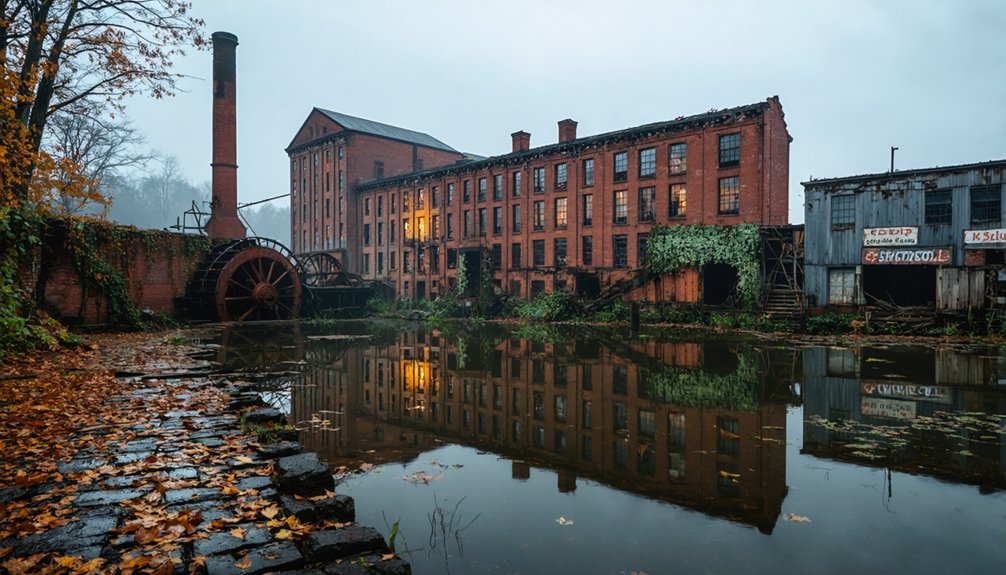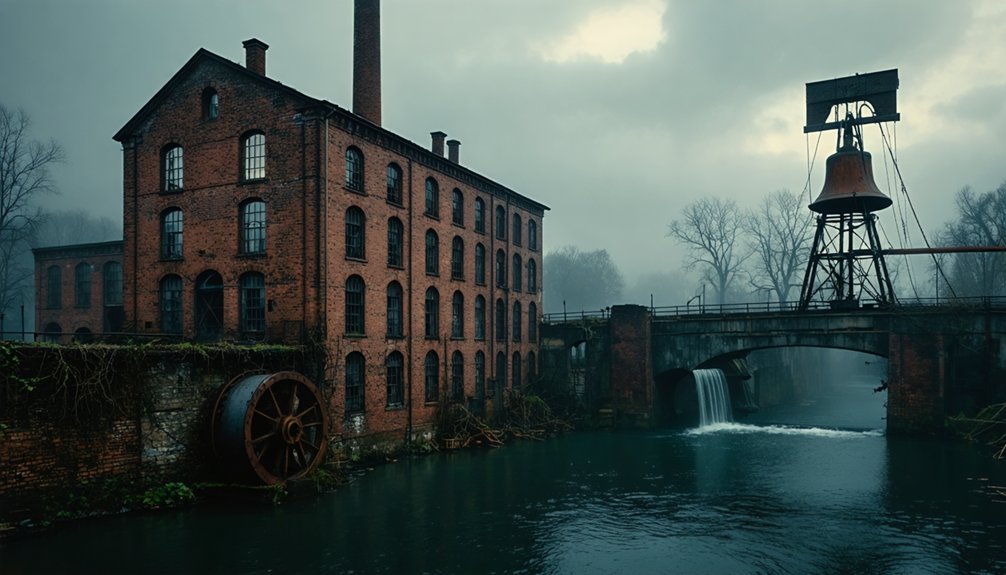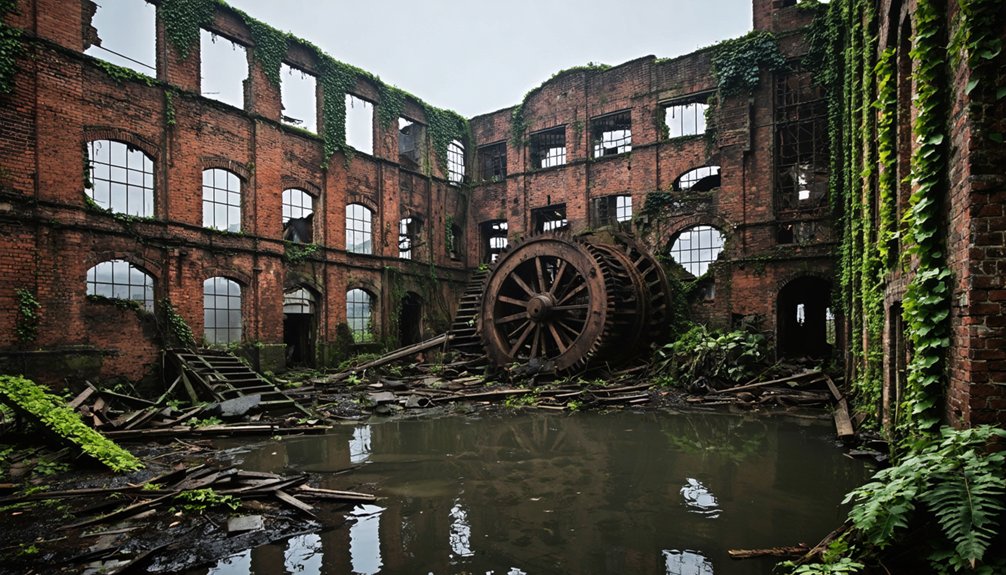
When you explore abandoned mill towns, you’ll encounter decay that triggers deep psychological responses. Your brain instinctively reacts to broken windows, crumbling walls, and nature’s slow reclamation of these industrial ruins. The sites carry layered histories of labor conflicts, devastating fires, and economic collapse, while chemical pollutants create an unnaturally hostile environment. Media portrayals have further transformed these spaces into cultural symbols of lost prosperity, where every shadow holds untold stories waiting to emerge.
Key Takeaways
- Evolutionary psychology triggers instinctive fear responses when encountering abandoned spaces and environmental disorder cues like broken windows.
- Historical tragedies, industrial accidents, and violent labor disputes infuse mill ruins with dark emotional resonance and traumatic memories.
- Media portrayals in films and stories have conditioned people to associate abandoned industrial sites with haunting and mysterious narratives.
- Natural reclamation creates unsettling atmospheres as vegetation overtakes structures and wildlife inhabits formerly human spaces.
- Structural decay and environmental contamination create eerie sensory experiences through strange sounds, smells, and visual deterioration.
The Decay of Prosperity: How Mill Towns Became Ghost Towns
When the tide of American manufacturing began to recede in the late 20th century, it left behind a devastating wake of economic destruction across the nation’s mill towns.
You can trace the pattern of economic despair through stark statistics: Dan River Mills dropped from 6,500 workers to zero, while Flint’s population was cut in half. The domino effect was ruthless – as factories closed, communities disintegrated. Like the overfarmed soil that drove farmers from rural villages in the 1800s, these towns were stripped of their economic vitality.
You’ll find the evidence in places like Johnstown, where 4,600 abandoned properties stand as silent witnesses to prosperity’s collapse.
NAFTA and global competition dealt fatal blows to these industrial havens, transforming vibrant manufacturing hubs into hollow shells. Former workers who found new employment faced a harsh reality with 19.2 percent lower wages in service industry jobs.
What you’re seeing isn’t just empty buildings – it’s the systematic dismantling of entire social structures, as company towns that once provided complete frameworks for life crumbled into ghost towns.
Nature’s Reclamation: Environmental Effects on Abandoned Structures
As nature slowly reclaims these abandoned mill towns, it reveals a complex environmental crisis beneath the haunting facades.
You’ll witness ecological restoration battling against a toxic legacy of industrial contamination that’s seeped deep into soil and water systems.
When you explore these ruins, you’ll encounter three stark environmental transformations:
- Chemical pollutants leaching into groundwater, creating acidic conditions that prevent natural regrowth
- Barren soil stripped of nutrients, leading to erosion and downstream ecosystem damage
- Structural decay accelerated by weather and vandalism, spreading contaminated debris across the landscape
Tests near these industrial sites often show 90-100% mortality in fish exposed to the toxic runoff.
You’re seeing more than just abandoned buildings – you’re witnessing the aftermath of industrial exploitation where nature struggles to heal.
With several million abandoned mines worldwide contributing to these industrial graveyards, the scale of environmental damage is staggering.
These sites remain caught between decay and renewal, their eerie atmosphere amplified by visible environmental degradation.
Echoes of the Past: Historical Events That Shaped These Spaces
The haunting ruins of these mill towns hold stories far deeper than their decaying facades and toxic soils.
As visitors wander through the remnants, they often feel the weight of history pressing down upon them, drawing them into the ghostly legends of historic mill ruins. Each shadowy corner and crumbling wall invites speculation and reverie, whispering tales of the lives once lived and the ambitions that fueled industrial dreams. It is in these silent echoes that the true essence of the mills can be felt, revealing a rich tapestry of hardship and hope.
You’ll discover haunted histories woven into every abandoned building, from violent disputes over mining claims to devastating fires that destroyed entire communities. The tragic tales of economic collapse hit hard and fast – like Falk’s sudden closure in 1937 that scattered 400 residents to the winds, or Batsto Village’s glass factory fire in 1874 that extinguished its industrial heart.
When you walk these grounds, you’re treading where wartime conflicts, resource battles, and industrial accidents shaped destinies. Workers’ struggles, murderous disputes at places like Nevada’s Techatticup Mine, and mass evacuations following disasters have left an indelible imprint that amplifies the eerie atmosphere you sense today. At Falk, you can almost hear the echoes of Saturday night dances that once brought life and joy to this now-silent ghost town. The abandoned shelves of Bodie’s stores remain frozen in time, still stocked with items from its final days.
The Psychology Behind Our Fear of Abandoned Places
Deep within our evolutionary psychology lies the root of why abandoned places trigger such visceral fear responses. Your brain’s ancient survival circuits interpret the decay and emptiness as potential danger zones, activating primal fight-or-flight responses even when no actual threat exists.
When you explore these derelict spaces, three core psychological mechanisms kick in:
- Your evolutionary instincts heighten awareness of unfamiliar surroundings and possible hidden threats.
- Environmental disorder cues like broken windows and overgrown vegetation trigger subconscious danger signals.
- Your mind creates psychological projections, filling uncertain shadows and sounds with imagined threats.
This hardwired response system, developed over millennia of human evolution, explains why you’ll feel uneasy even when you know you’re alone. Research shows that residents near abandoned buildings experience fear and anxiety due to the deteriorating conditions. The brain’s threat-detection systems simply won’t let you fully relax in these ambiguous environments. The hauntingly beautiful decay adds an extra layer of psychological complexity as we simultaneously feel drawn to and repelled by these forgotten spaces.
From Industry to Mystery: How Media Transformed Mill Town Stories
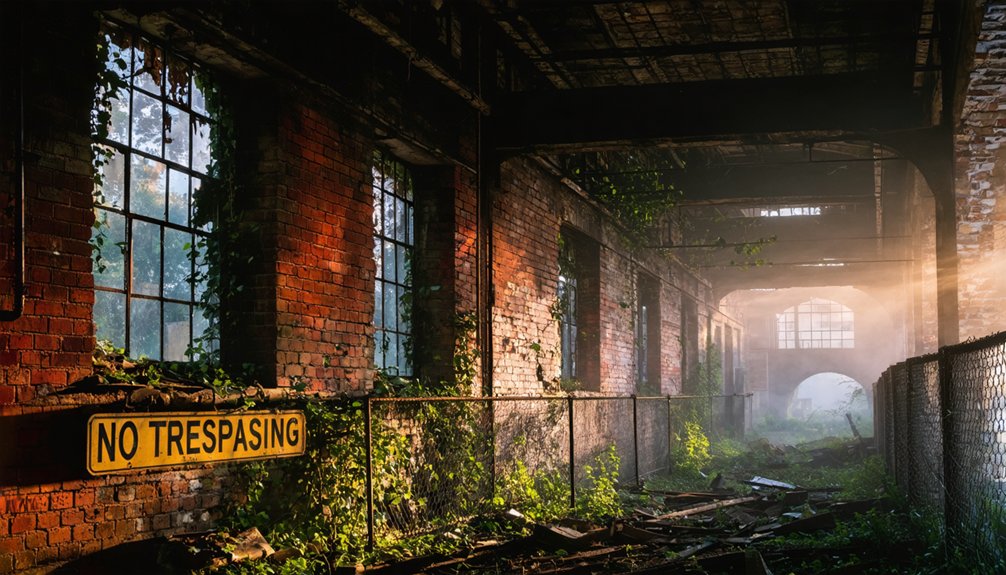
While our primal fears of abandoned places stem from evolutionary instincts, media representations have actively reshaped how we perceive mill town ruins in modern culture.
You’ll notice how films and television shows transform these industrial sites into compelling backdrops for haunting narratives, as seen when Henry River Mill Village became District 12 in *The Hunger Games*. Through calculated media influence, former centers of production now exist in cultural memory as mysterious relics worthy of exploration. The Reyes family purchase in 2017 has transformed this haunting setting into a tourist destination.
Film crews often amplify the inherent eeriness of these locations, deliberately modifying structures and emphasizing decay to create more dramatic scenes. These sites were once bustling with activity as community gathering places where farmers would socialize and exchange news while their grain was processed.
What were once vibrant company towns have been recast as symbols of lost industrial ages, where historical realities blend with crafted mysteries to attract tourists and sustain public fascination.
Frequently Asked Questions
Are Paranormal Investigators Allowed to Conduct Overnight Investigations in Mill Ruins?
Like threading a needle at midnight, you’ll need special authorization and must follow strict paranormal regulations and investigation ethics to conduct overnight explorations of mill ruins – it’s rarely permitted without supervision.
What Safety Precautions Should Urban Explorers Take When Visiting Abandoned Mills?
You’ll need proper safety gear including boots, gloves, respirator, and headlamp. Scout locations beforehand, explore with partners, and respect legal considerations by obtaining permission when possible.
Do Any Mill Ruins Offer Guided Historical Tours or Photography Sessions?
You’ll find guided tours at Bodie State Park, Kennicott Mine, and Mill City Museum, plus photography workshops at Vulture City. Many sites offer twilight sessions and specialized historical explorations.
How Can Local Communities Benefit From Preserving These Abandoned Mill Sites?
Your community can breathe new life into mill ruins through engaging historical education programs, creating jobs, attracting tourism dollars, and transforming these sleeping giants into vibrant spaces for cultural activities.
Which Abandoned Mill Towns Have the Most Documented Supernatural Activity?
You’ll find the most documented ghost sightings at Moonville’s railroad tunnel, Sprucevale’s abandoned mills, and Boston Mills (Helltown), where mill legends and paranormal activity persist through eyewitness accounts.
References
- https://www.orphanednation.com/the-ghost-town-of-henry-river-mill-village/
- https://99wfmk.com/freda-michigan-ghost-town/
- https://www.jerseysbest.com/community/uncovering-n-j-in-the-pine-barrens-a-ghost-town-sits-in-the-shadows/
- https://travelnevada.com/ghost-town/belmont-ghost-town/
- https://www.artofabandonment.com/2022/03/henry-river-mill-village-the-hunger-games-district-12-hickory-nc/
- https://southernarizonaguide.com/exploring-millville-ruins-fspr/
- https://henryrivermillvillage.com
- https://www.industryweek.com/talent/article/22028380/the-abandonment-of-small-cities-in-the-rust-belt
- https://millmuseum.org/history-2/sweat-of-their-brows/rural-communities/
- https://www.richmondfed.org/publications/research/econ_focus/2023/q3_economic_history