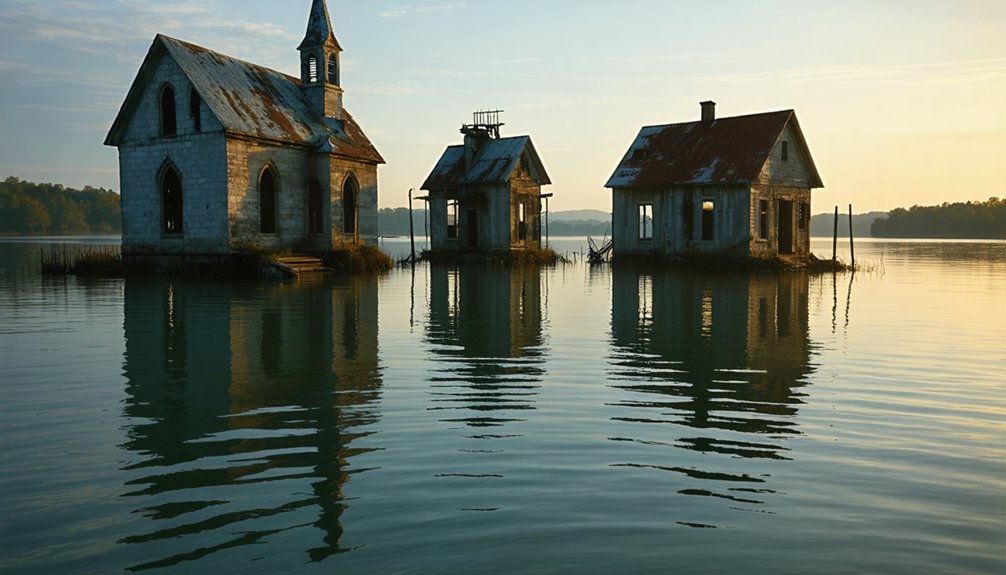
You’ll find thousands of American communities submerged beneath today’s lakes and reservoirs, primarily due to massive dam construction between 1950-1970 when over 18,000 dams were built. These underwater towns, including Native American settlements and historic river communities, were systematically dismantled as federal water projects prioritized urban expansion and power generation over rural preservation. The flooded remains of schools, hotels, and main streets still rest beneath the waters, holding countless untold stories of America’s past.
Key Takeaways
- Massive dam construction between 1950-1970 created reservoirs that intentionally flooded existing towns for water management and power generation.
- Federal water projects prioritized urban expansion over rural preservation, sacrificing smaller communities to meet growing metropolitan needs.
- Post-World War II infrastructure development required flooding towns to create water storage and flood control systems.
- Government authorities used eminent domain to claim river lands, displacing communities for navigation, hydroelectric power, and urban water supply.
- Native American reservations and historic settlements were submerged as federal authorities prioritized large-scale water management projects.
The Rise of America’s Underwater Communities
While most Americans drive past lakes and reservoirs without a second thought, beneath these placid waters lie the remnants of once-thriving communities that met their fate through deliberate submersion.
You’ll find underwater archaeology revealing the stories of vibrant towns that once boasted schools, hotels, and bustling main streets. These weren’t just empty buildings – they were homes to diverse communities, including Native Americans who’d fished at places like Celilo Falls for generations, and Black American settlements that now exist only as submerged artifacts. In one striking example, Lake Sakakawea’s waters displaced 325 families from the Fort Berthold Indian Reservation when Elbowoods was flooded.
The towns didn’t simply vanish overnight. Communities faced systematic dismantling through burning, demolition, and careful relocation of cemeteries. This systematic destruction became particularly intense during the post-World War II period when federal investment in water projects peaked.
Each lost town endured a methodical destruction – buildings burned, structures demolished, and the dead respectfully moved to new resting places.
Some towns, like American Falls, Idaho, managed to preserve their identity by moving to higher ground, while others disappeared completely, leaving only their foundations as silent testimony to America’s complex relationship with progress.
Dam Construction and Its Lasting Impact
The mid-20th century released an unprecedented wave of dam construction across America’s rivers, forever altering the nation’s waterways and the communities along their banks.
During this transformative period, dam design evolved dramatically as federal agencies pushed massive infrastructure projects forward, often without considering the full impact on local populations. The pursuit of hydroelectric power demands drove much of this development, despite growing concerns about environmental damage. These structures now face significant deterioration, as poor conditions affect over 4,000 high-risk dams nationwide.
- Between 1950-1970, you’d witness over 18,000 new dams appearing across the landscape.
- Nearly 70% of today’s dams were built before 1973, creating a legacy of aging infrastructure.
- Reservoir management decisions frequently prioritized power generation over community preservation.
- Dam projects permanently submerged entire towns, displacing residents and drowning generations of history.
These concrete barriers fundamentally changed America’s relationship with its rivers, trading free-flowing waterways for controlled reservoirs that continue to shape our interaction with these essential resources.
Sacrificed Towns for Urban Progress
You’ll find that America’s metropolitan expansion came at a steep cost to riverside communities, as growing cities sacrificed smaller settlements to accommodate infrastructure needs and manage water resources.
When urban centers needed more space for transportation networks, sewage systems, or flood control, they often targeted vulnerable river towns for removal or abandonment. Wooden block paving and other major infrastructure improvements in rapidly growing cities demanded extensive resources from surrounding areas.
The acquisition of water rights by larger cities frequently sealed the fate of rural riverside communities, whose residents were displaced to serve the interests of urban progress and public health initiatives. These decisions reflected the broader industrial transformation that led many cities to view rivers primarily as obstacles requiring control rather than natural assets to preserve.
Metropolitan Growth Drives Displacement
Growing metropolitan centers across America demanded unprecedented infrastructure development throughout the 20th century, leading to the intentional flooding of numerous riverside communities.
You’ll find that urban infrastructure projects, particularly massive dams, transformed river valleys to serve expanding cities’ needs for power, flood control, and water supply.
- Cities required extensive reservoir systems, forcing the sacrifice of smaller communities like Robinette, Oregon.
- Metropolitan demands for hydroelectric power led to strategic displacement of river towns.
- Urban flood control priorities resulted in the deliberate submersion of floodplain communities.
- Industrial and agricultural needs of growing cities outweighed preservation of rural settlements.
The U.S. Army Corps of Engineers constructed thirteen dams between 1941 and 1969 to meet these expanding urban demands.
Massachusetts exemplifies this trend, as the creation of the Quabbin Reservoir submerged four entire towns to supply water to Boston.
This pattern of community sacrifice reflects how metropolitan expansion reshaped America’s waterways, permanently altering both landscapes and lives to serve urban development goals.
Rural Communities Pay Price
Behind every flooded valley and submerged Main Street lies a stark reality: rural communities bore the heaviest burden of America’s urban expansion.
You’ll find a pattern of rural sacrifice stretching across major river systems, where entire towns were deliberately flooded to create reservoirs for distant cities’ water supplies and power needs.
The economic disparity couldn’t be starker. While these projects fueled urban growth, displaced rural residents often received inadequate compensation for their losses. The decline intensified as manufacturing and agriculture jobs disappeared from these regions.
Their traditional river-based livelihoods vanished beneath the rising waters, and their tight-knit communities scattered. Young people moved away, seeking urban opportunities their drowned hometowns could no longer provide.
Even today, the remaining rural areas near these submerged towns face declining populations, lower wages, and diminished economic prospects – a lasting reflection of the price rural America paid for urban progress. Two-thirds of nonmetro counties experienced population losses between 2010 and 2020, highlighting the ongoing challenges these regions face.
Water Rights Shape Priorities
As America’s legal framework for water rights evolved through the 19th and 20th centuries, it systematically prioritized urban expansion over rural preservation.
You’ll find that both state and federal laws shaped water access in ways that often sacrificed smaller communities for larger economic interests.
These legal frameworks created a hierarchy of water priorities that still impacts communities today:
- Federal authority over navigable waters trumps local land claims, enabling massive infrastructure projects.
- Special districts can override individual towns’ water rights through taxing and land-use powers.
- Court decisions consistently favor navigation, flood control, and power generation over small settlements.
- Water rights tied to land ownership can be severed through eminent domain, allowing towns to be flooded.
Native American Heritage Lost Beneath the Waters
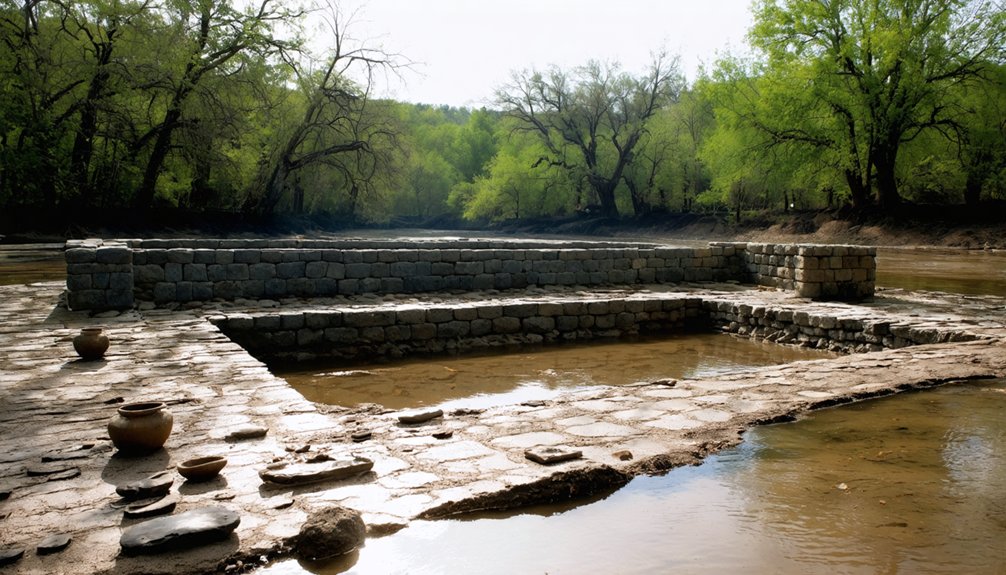
While the construction of dams across America’s rivers brought power and water management benefits, it came at an immense cost to Native American heritage, permanently submerging countless Indigenous settlements, ceremonial grounds, and archaeological treasures.
You’ll find evidence of this cultural devastation at sites like Celilo Falls, where rising waters drowned a crucial fishing ground that had sustained tribes for centuries.
The flooding showcases a pattern of displacement, with entire communities like Elbowoods and Robinette vanishing beneath reservoir waters.
Despite their cultural resilience, Native peoples witnessed their submerged traditions disappear as sacred spaces, burial grounds, and ancestral villages were sacrificed for hydroelectric progress.
Today, dropping water levels occasionally reveal these preserved remnants, offering glimpses of irreplaceable Indigenous heritage lost to the depths.
The Human Cost of Reservoir Creation
When reservoir waters rise behind a new dam, you’ll find entire communities forced to abandon their generational homes and relocate to unfamiliar terrain.
Your exploration of these submerged landscapes reveals thousands of American families who’ve watched their heritage disappear beneath the flood, from century-old farmhouses to treasured community gathering spots.
Along major U.S. waterways, you can trace how reservoir creation has permanently altered both the physical and cultural geography, leaving displaced residents to rebuild their lives while their original homesteads rest frozen in time below the surface.
Displaced Communities Face Change
Though reservoir creation has brought benefits to many regions across America, the human toll of these projects remains staggering, particularly for Indigenous communities and marginalized populations.
Despite indigenous resilience and cultural reclamation efforts, the flooding of over 1.13 million acres of tribal land has devastated traditional ways of life.
When you examine the impacts of displacement, you’ll find:
- 82% of resettled communities face deteriorated living conditions
- Critical ecosystems supporting traditional fishing and forestry vanish underwater
- Ancestral lands and sacred sites become permanently inaccessible
- Compensation often falls short of true land value, especially for rural communities
The flooding erases centuries of history, leaving displaced residents to grapple with fractured community networks and long-term economic uncertainty in unfamiliar territories.
Losing Generational Family Homes
As families across America surrender their generational homes to reservoir projects, the ripple effects extend far beyond mere property loss.
When your family legacy disappears beneath rising waters, you’ll lose more than just buildings and land – you’ll face the erasure of tangible connections to your ancestors. Family heirlooms, archives, and cultural artifacts often become casualties of these shifts.
The emotional loss cuts deeper as sacred sites and landmarks that anchored your family’s stories vanish underwater.
You’ll witness the disruption of traditional practices, from farming methods passed through generations to cultural ceremonies tied to specific locations. Government compensation rarely accounts for these intangible losses, while legal frameworks offer limited protection for your family’s cultural heritage.
The psychological impact of watching your ancestral home submerge creates lasting trauma that affects multiple generations.
Cultural Heritage Underwater Forever
Despite extensive legal frameworks protecting historical sites on land, America’s underwater cultural heritage faces a fragmented and inadequate system of preservation.
When rivers become reservoirs, they don’t just drown buildings – they submerge entire cultural landscapes that you’ll never see again.
Underwater archaeology reveals how these sites face constant threats from:
- Uncontrolled salvage operations that can damage historic structures
- Dredging and energy projects that accelerate site destruction
- Erosion from fluctuating water levels and sedimentation
- Inadequate funding for proper documentation and research
Cultural preservation efforts struggle against conflicting federal and state laws, while Indigenous sacred sites slip beneath the waves.
Without stronger protections, you’re witnessing the permanent loss of irreplaceable heritage that tells the story of America’s river communities.
Remembering What Lies Below
When you gaze across America’s vast reservoirs today, you’re looking at more than just water – beneath those calm surfaces lie the remains of countless communities, their stories submerged but not forgotten.
These underwater towns represent layers of historical significance: Native American fishing grounds, pioneer settlements, mining boomtowns, and farming communities. You’ll find their remnants scattered across the nation’s waterways, from the Columbia River’s drowned Celilo Falls to New England’s flooded villages.
Among these hidden stories, the sunken towns near Mississippi River are particularly striking, as they tell tales of resilience and adaptation in the face of nature’s overwhelming power. Many of these towns were once vibrant communities that thrived along the riverbanks, only to be claimed by rising waters and changing landscapes. Exploring these underwater relics can offer a glimpse into a time when they were bustling hubs of life and activity.
Some communities managed to relocate their dead, carefully moving cemeteries to higher ground, while other burial sites remain eternally submerged.
Through underwater exploration, researchers continue documenting these lost places, preserving memories of communities that once thrived where fish now swim and boats now float.
Modern Glimpses of Submerged History
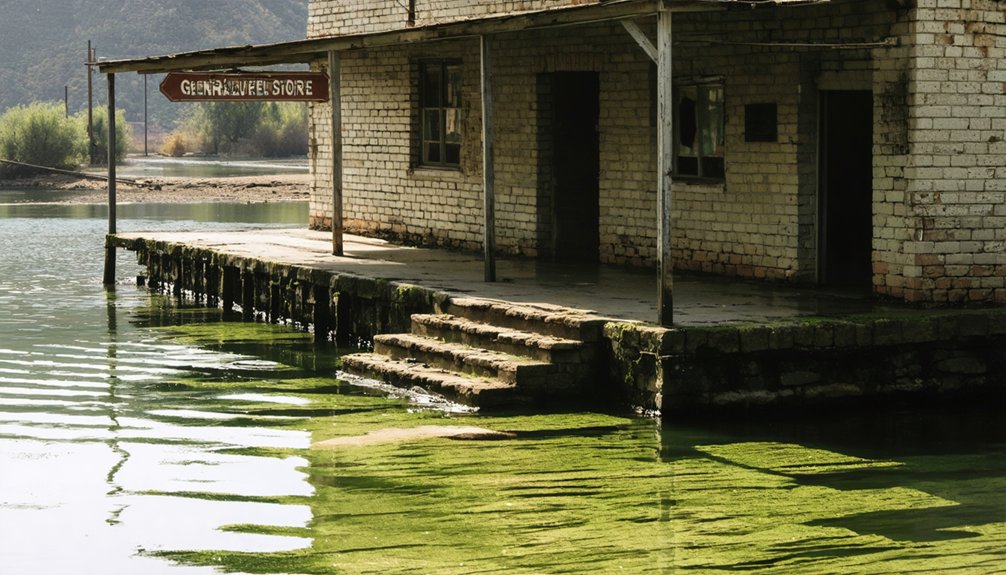
Through periods of severe drought, America’s submerged towns periodically resurface to tell their stories, offering rare glimpses into the past.
Drought reveals the secrets of America’s lost towns, as falling waters unmask the remnants of communities swallowed by progress.
These sunken memories emerge as water levels drop in reservoirs across the country, revealing foundations, buildings, and remnants of communities that once thrived along our nation’s rivers.
- When Lake Mead’s waters recede, you’ll find the haunting ruins of St. Thomas, Nevada, where building foundations tell tales of displaced residents.
- At Celilo Falls, you can witness submerged legacies of Indigenous fishing platforms during low water.
- Digital archives like The Atlas of Drowned Towns help you explore these underwater communities.
- Museums near reservoirs preserve artifacts and photographs, allowing you to connect with these lost towns’ histories before they slip beneath the waters once again.
Frequently Asked Questions
How Many People Still Live in Relocated Towns Versus Those Who Moved Elsewhere?
You’ll find incomplete historical data on relocation impacts, as community resilience varied widely. No extensive statistics exist tracking whether residents stayed in relocated towns or dispersed to different areas.
What Legal Processes Were Required to Force Residents From Their Homes?
Like a tidal wave of bureaucracy, you’d face eminent domain seizures, court-ordered eviction notices, and mandatory relocation deadlines. They’d offer legal compensation before forcing you from your property.
Did Property Values Increase or Decrease in Towns Near New Reservoirs?
You’ll find property value trends varied greatly – while some areas saw increases from recreational benefits, others experienced decreases due to flooding risks and environmental concerns, creating a mixed economic impact on reservoir-adjacent communities.
How Were Construction Workers Housed During the Years-Long Dam Building Projects?
You’d find construction workers living in temporary housing like boarding houses, tent cities, or purpose-built towns. Worker accommodations ranged from basic communal sleeping areas to permanent family homes near dam sites.
Which Underwater Towns Have the Most Intact Remaining Structures Today?
You’ll find the best-preserved underwater archaeology at Oasis beneath Table Rock Lake and Robinette under Brownlee Reservoir, where you can still see submerged history like mills, depots, and building foundations.
References
- https://www.neh.gov/article/atlas-drowned-towns
- https://www.boisestate.edu/news/2020/05/18/with-a-new-grant-professor-aims-to-catalog-drowned-towns-of-the-american-west/
- https://clui.org/newsletter/spring-2005/immersed-remains-towns-submerged-america
- https://www.uncharted101.com/the-submerged-towns-of-america/
- https://travelnoire.com/black-american-towns-hidden
- https://en.wikipedia.org/wiki/List_of_flooded_towns_in_the_United_States
- https://www.youtube.com/watch?v=l3D4hSQcWbk
- https://www.drownedtowns.com
- https://idahohumanities.org/the-atlas-of-drowned-towns/
- https://cedarbayoumarina.com/four-ghost-towns-under-lake-texoma/