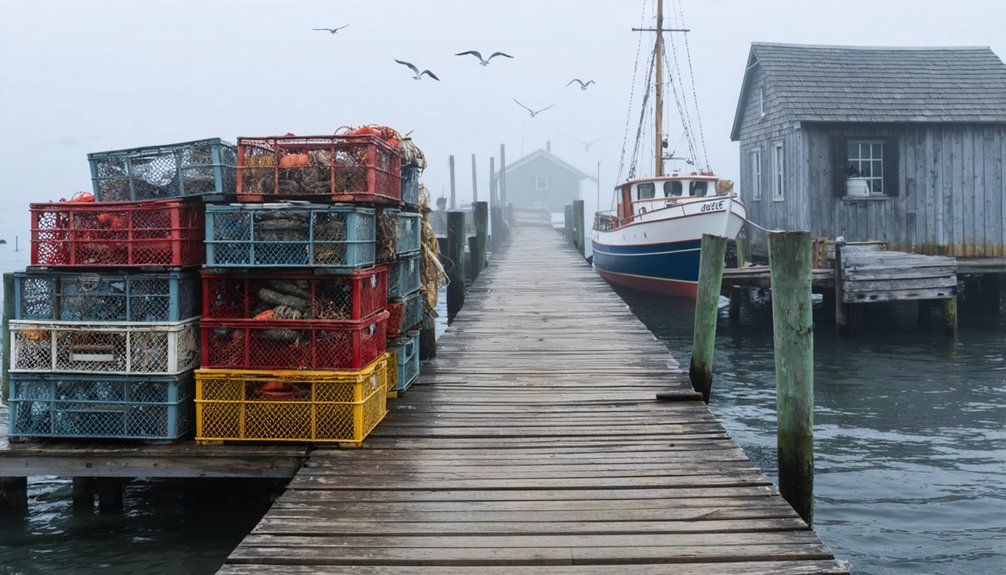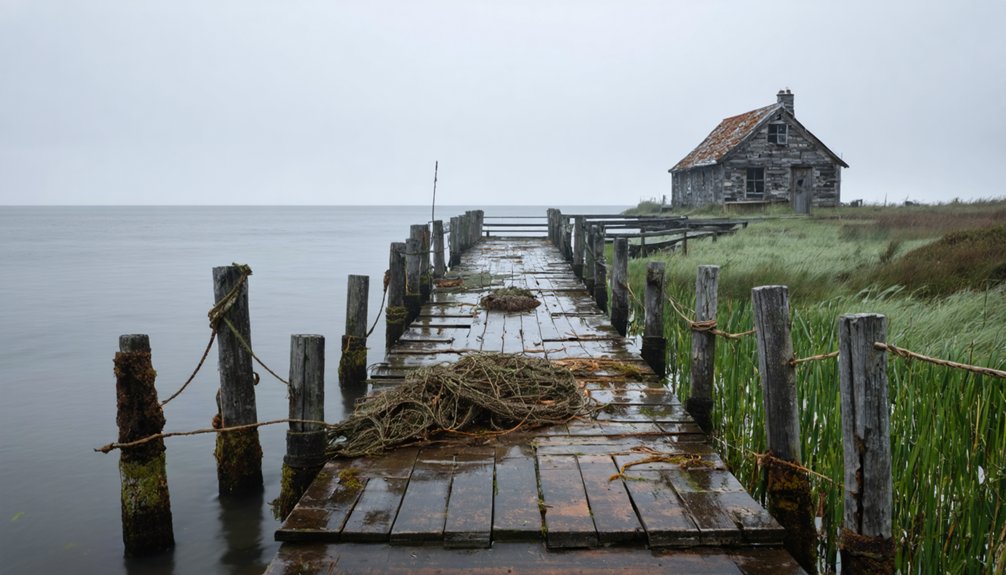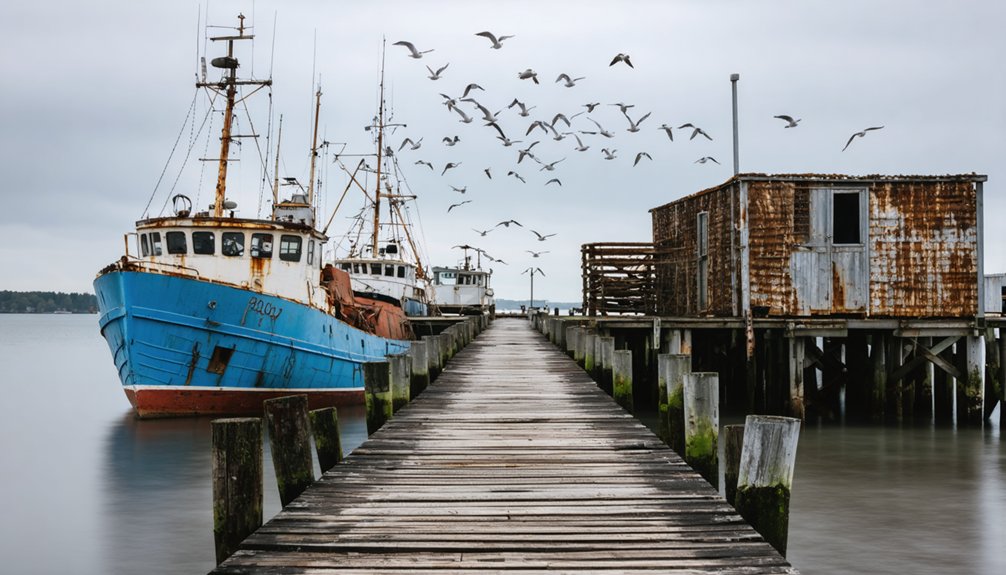
You’ll find American fishing villages disappearing due to a devastating combination of climate change and overfishing. As ocean temperatures warm three times faster than the global average along the Northeast coast, cold-water fish populations have plunged by 50%. This forces species to migrate northward, leaving traditional fishing grounds empty. The resulting economic collapse has transformed vibrant coastal communities into ghost towns, with shuttered businesses and aging populations. These changes reflect deeper disruptions in marine ecosystems and coastal heritage.
Key Takeaways
- Climate change has warmed coastal waters significantly, forcing cold-water fish species northward and disrupting traditional fishing grounds.
- Fish populations have declined dramatically, with some species showing up to 50% reduction due to overfishing and environmental pressures.
- Rising operational costs, reduced catch quotas, and competition from imported seafood have made commercial fishing economically unsustainable.
- Aging workforce and lack of young recruits threaten the continuity of fishing communities, with average fisherman age exceeding 60 years.
- Extensive habitat loss and ecosystem disruption have destroyed fish nurseries and breeding grounds, devastating local fish populations.
The Perfect Storm: Climate Change’s Impact on Fish Populations
While marine ecosystems have always experienced natural fluctuations, today’s climate change presents an unprecedented threat to America’s fishing communities.
You’re witnessing a dramatic shift as warming waters force cold-water species northward, disrupting generations-old fishing grounds. The oceans off the Northeast coast are warming three times faster than the global average, creating a ripple effect throughout the food web.
Fish migration patterns have transformed as climate impacts intensify. Your local waters that once teemed with Atlantic cod and brook trout now host smaller, warm-water species instead. Recent studies show species abundance declined by over 53% in cold streams across the United States. In Wisconsin’s lakes and streams, warmer temperatures are causing significant declines in iconic fish species like walleye and perch.
The changes run deeper than just temperature – altered ocean currents affect fish larvae survival, while extreme weather disrupts spawning cycles. These shifts haven’t just changed where fish live; they’ve fundamentally altered the relationship between fishing villages and their marine resources.
Empty Nets: The Stark Reality of Fish Stock Depletion
You’ll find America’s fishing villages facing a harsh reality as fish stocks plummet across traditional fishing grounds, with crucial species like Atlantic menhaden and American lobster showing alarming declines.
The staggering decline of menhaden populations has forced a coastwide catch limit reduction of over 50%, devastating commercial fishing operations. In communities from Maine to Alaska, fishers now travel farther out to sea and spend more on fuel and equipment just to maintain diminishing catches, while processing plants and marine supply stores struggle to stay afloat. The Southern New England lobster stock has experienced a particularly devastating collapse, with landings dropping from 21.8 million pounds in 1997 to just 1.7 million pounds in 2023.
As these essential species vanish from local waters, the very cultural identity of fishing villages hangs in the balance, threatening generations of maritime heritage and economic stability.
Declining Catch, Rising Costs
As fish stocks continue to plummet across American waters, fishing communities face a devastating double blow of declining catches and escalating operational costs.
You’ll find commercial catch volumes dropping at an alarming 3.5% annually, while operational challenges mount relentlessly. From Alaska to Texas, once-thriving fishing ports now struggle with historically low landings and mounting financial pressures.
The industry faces intensifying competition from imported seafood products, making survival even more challenging for local fishing operations.
Recent data shows a 37% decline in menhaden biomass since the latest benchmark assessment, highlighting the severe depletion of key commercial species.
Catch limitations have grown increasingly restrictive, with quotas slashed by up to 55% in some fisheries.
You’re witnessing unprecedented operational challenges: soaring fuel costs, rising labor expenses, and higher interest rates crushing small-scale operations. Meanwhile, cheap imported seafood floods the market, driving prices down and forcing many of your fellow fishermen to idle their boats.
The math simply doesn’t add up anymore – the costs of heading out to sea often exceed the value of the catch.
Species Loss Threatens Livelihoods
Behind the mounting financial pressures lies an even more alarming reality: rapidly diminishing fish populations that threaten the very existence of America’s fishing communities.
You’re witnessing unprecedented declines: Gulf of Maine lobster stocks down 34%, menhaden biomass plummeting 37%, and one-third of global fish stocks now overfished.
The impact on species sustainability reaches far beyond single-species concerns, creating a devastating ripple effect:
- Depleted forage fish populations collapse predator species like striped bass
- Local fishing operations can’t maintain profitable catch volumes
- Working waterfronts lose essential infrastructure and processing facilities
- Communities face forced shift from traditional fishing livelihoods
Current fishing regulations struggle to balance economic survival with conservation needs, as quota cuts threaten to eliminate generations of maritime heritage.
You’re watching coastal traditions vanish as species depletion pushes once-thriving fishing villages toward extinction.
Sustainable fishing practices have proven successful in regions like the Pacific coasts of the U.S. and Canada, where 90% of fishing activity maintains ecological balance.
When the Money Dried Up: Economic Collapse in Coastal Communities
You’ll find deserted docks and shuttered seafood markets where thriving fishing communities once operated, as the collapse of fish stocks has forced crews to abandon their livelihoods.
The economic devastation hits particularly hard in places like Alaska’s Bering Sea region, where crab fleet failures have slashed community budgets by 60% and triggered widespread unemployment.
When fishing operations close, the ripple effects spread through entire coastal towns as processing plants, supply stores, and maritime services shut down, leaving once-bustling ports silent.
Climate change has dealt an especially harsh blow to New England’s historic communities, where warmer sea temperatures have driven fish populations northward to colder waters.
The construction of dams across major rivers has contributed significantly to these community losses, as blocked migration routes prevented Atlantic salmon from reaching their traditional spawning grounds.
Job Losses Hit Hard
When climate change began disrupting fish populations in New England’s coastal waters, the economic fallout hit fishing communities like a devastating wave.
You’d see the job market contract as fishing operations downsized their crews, while your community resilience weakened with each closure of a local fish house.
The devastation manifested in multiple ways:
- A 13% drop in fish revenue triggered a ripple effect of job losses
- Wages plunged 35% over six years, forcing families to relocate
- Mom-and-pop operations suffered disproportionately, many closing permanently
- Traditional social gatherings dwindled, eroding cultural bonds
The aging workforce, averaging 60+ years, couldn’t adapt quickly enough to these changes.
Communities struggled with entry fees exceeding $10 million for new members, creating an insurmountable barrier for potential newcomers.
With youth representation nearly non-existent and entry barriers high, you’re witnessing the unraveling of centuries-old maritime traditions in these once-vibrant coastal communities.
Crews Abandon Empty Ports
The mass exodus from America’s fishing ports paints a stark picture of economic collapse that stretches beyond job losses.
You’ll find once-bustling harbors now silent, their infrastructure crumbling as processing plants shut down and fuel docks deteriorate. This domino effect has triggered widespread crew migration, with entire families abandoning their maritime heritage in search of work inland.
The impact runs deeper than empty docks. Port revitalization efforts have largely failed as the core fishing economy disappeared, taking with it ice plants, gear shops, and support services.
You’re witnessing the erosion of centuries-old fishing traditions as younger generations leave these ghost ports behind. What remains are aging populations in shrinking communities, where shuttered businesses and unused piers stand as monuments to a vanished way of life.
Businesses Close Their Doors
Across thousands of coastal communities, economic collapse has decimated local businesses that once thrived on fishing industry revenues.
You’ll find empty storefronts where seafood processors, fish markets, and maritime supply shops once bustled with activity. Regulatory challenges and market pressures have created a perfect storm, forcing closures at an unprecedented rate.
Key factors driving these shutdowns include:
- A staggering $4.3 billion drop in U.S. seafood output
- Loss of 38,000 industry jobs nationwide
- 50% decline in profitability since 2021
- 60% budget cuts in fishing-dependent towns like St. Paul
You’re witnessing the unraveling of maritime economies as businesses can’t sustain operations under tightening regulations and falling prices.
When processing plants close, they trigger a domino effect – supply chains collapse, support services vanish, and community gathering spots disappear forever.
Ghost Towns by the Sea: the Mass Exodus From Fishing Villages
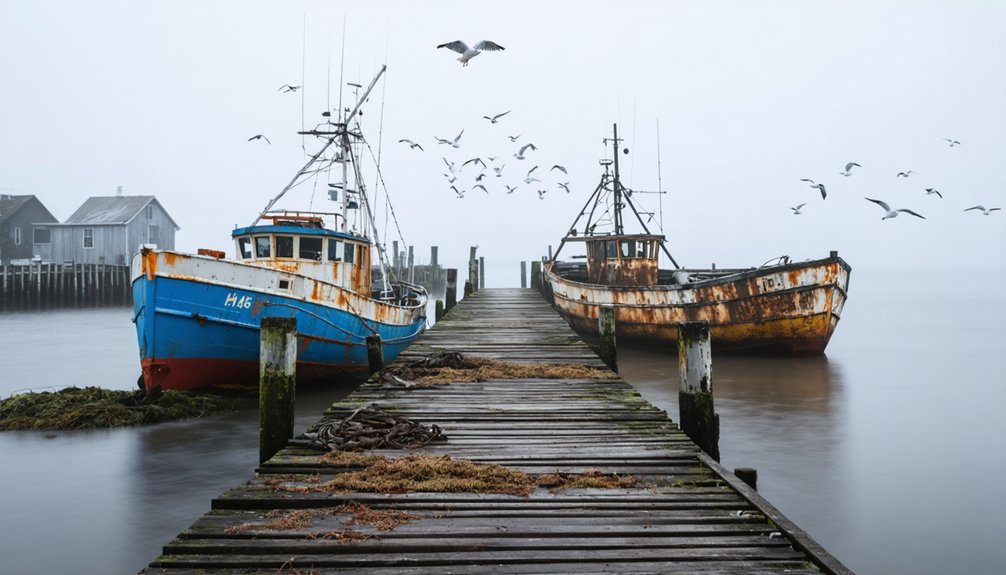
Once-bustling coastal communities now stand eerily quiet as America’s fishing villages face unprecedented decline, driven by a perfect storm of ecological, economic, and social pressures.
The decline of America’s fishing communities marks a tragic transformation from thriving maritime hubs to ghost towns haunted by economic hardship.
You’ll find ghost towns emerging where vibrant fishing communities once thrived, as declining fish populations force families to seek opportunities elsewhere.
As these communities fade, local parks and outdoor spaces have become increasingly popular for those seeking new recreational activities. Exploring dogfriendly spots in Delaware can provide both residents and newcomers with a chance to enjoy the area’s natural beauty while bonding with their pets. This shift in focus not only revitalizes local engagement but also helps maintain a sense of community amidst the changes.
In these emptying villages, you’ll witness the erosion of generations-old fishing heritage, with fewer community events and weakened social networks.
The statistics paint a stark picture: a 16% loss in New England fishing jobs, shuttered seafood processors, and a continuous outflow of residents.
What’s left are smaller household sizes and aging populations, as younger workers abandon traditional maritime livelihoods.
The cycle perpetuates itself – as crews shrink and vessels are sold, remaining families face mounting pressure to relocate, leaving behind shells of once-prosperous communities.
Aging Out: The Disappearing Generation of Fishermen
While America’s commercial fishing industry faces numerous challenges, perhaps none is more concerning than its rapidly aging workforce, where demographic data reveals an alarming shift toward retirement-age participants.
You’ll find dramatic demographic shifts as older fishermen now dominate the waters, with those 65 and above nearly doubling since 2016.
The failure in generational recruitment is evident in these stark statistics:
- 85% of today’s fishermen started before age 12, yet there’s massive dropout after 18
- The 25-44 age group has shrunk considerably, leaving a vital experience gap
- Only 32% fish monthly in 2024, down from 37% a decade ago
- A staggering 23% decline in overall participation signals a crisis in succession
You’re witnessing the twilight of a maritime tradition as younger generations abandon their ancestral connection to the sea.
Damaged Waters: How Habitat Loss Changed Everything
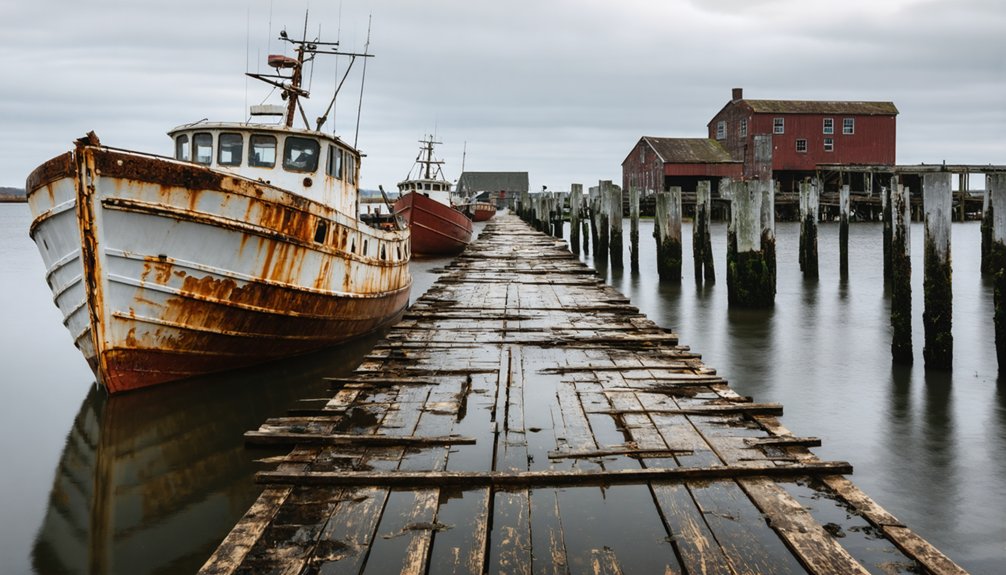
The devastating loss of America’s coastal wetlands and marine habitats has fundamentally reshaped the nation’s fishing communities, with over half of these essential ecosystems vanishing since the 1780s.
The disappearance of vital coastal ecosystems since colonial times has devastated America’s fishing heritage and marine biodiversity.
You’re witnessing the collapse of important fish nurseries as seagrass beds disappear and wetlands shrink at alarming rates across the Gulf Coast and Eastern Seaboard.
Without proper habitat connectivity, migratory fish populations have plummeted by 81% in just five decades.
Climate change is forcing marine species to abandon their traditional ranges, while barriers like dams block critical spawning routes.
Though wetland restoration efforts show promise in places like the Great Lakes, they’re not keeping pace with the destruction.
These changes have left many fishing villages struggling to survive as their primary resource – abundant fish populations supported by healthy ecosystems – continues to decline.
Breaking the Chain: Disrupted Marine Ecosystems
As industrial fishing practices intensify across America’s coastal waters, you’ll find marine ecosystems unraveling at an unprecedented rate.
The removal of apex predators has shattered ecosystem resilience, triggering devastating ripple effects throughout coastal food webs. When predator prey dynamics collapse, you’re witnessing the destruction of delicate balances that took millennia to establish.
Here’s how the chain breaks down:
- Sharks and large predatory fish disappear, causing smaller fish populations to explode.
- Coral reefs deteriorate as trawling nets destroy critical habitat.
- Ghost gear continues killing marine life long after being abandoned.
- Protected species lose their food sources and breeding grounds.
You’re seeing the results in your local fishing communities, where once-abundant waters now struggle to support even basic marine life, threatening generations of fishing tradition and cultural heritage.
The Social Fabric Unravels: Lost Community Bonds
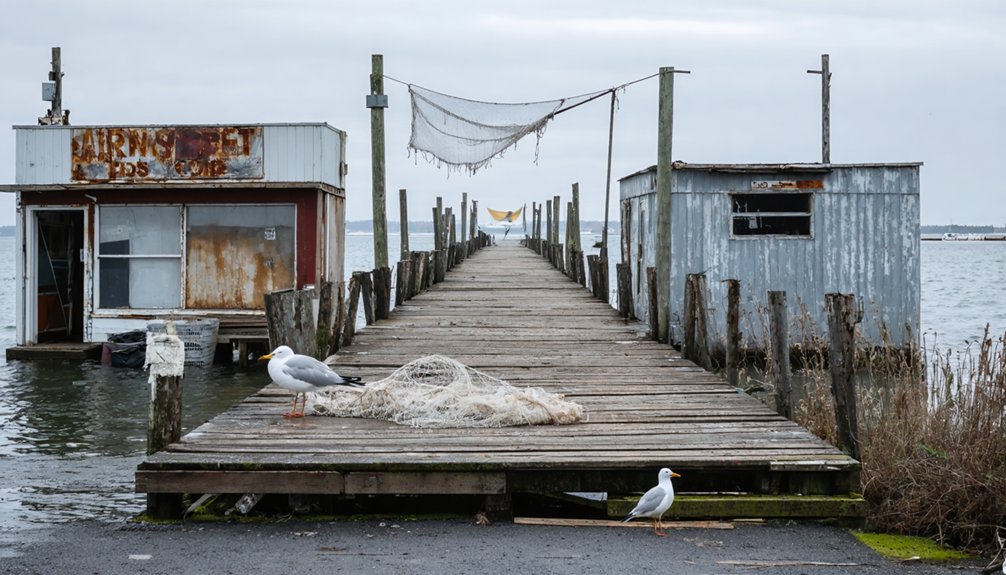
Beyond disrupted marine ecosystems lies an equally devastating human toll: America’s fishing villages face unprecedented social disintegration.
You’ll find once-vibrant communities now struggling with dramatic population losses, as fishing towns that housed over 5,000 residents in 1900 have dwindled to barely 1,300 today. This community fragmentation accelerates as younger generations depart, leaving aging populations and weakened social bonds in their wake.
Cultural erosion manifests through disappearing traditions, as declining catches and economic pressures eliminate cherished gatherings like fish fries and festivals.
You’re witnessing the transformation of these historic maritime communities as newcomers, often seasonal residents disconnected from fishing heritage, replace traditional fishing families. The result: fractured social networks, diminished community leadership, and the steady unraveling of centuries-old cultural practices that once defined coastal life.
Trapped in Vulnerability: Single-Species Dependence
While many fishing communities once thrived on diverse marine harvests, their growing dependence on single fish species has left them dangerously exposed to ecological collapse.
A thorough vulnerability assessment reveals how climate change, habitat loss, and invasive species severely impact specific fish populations that villages rely upon.
Your community’s fate becomes intertwined with a single species’ survival when:
When a community stakes everything on one species, their destinies become locked in a dangerous dance of survival or extinction.
- Cold-water fish populations plummet by 50% due to warming waters
- Migratory fish decline by 81% from dam construction and pollution
- Wetland destruction eliminates critical breeding grounds
- Species management fails to counter environmental pressures
You’re witnessing a devastating cycle: as key species diminish, fishing operations shrink, forcing crews to abandon their livelihoods.
This single-species dependence has created a precarious situation where environmental changes can trigger complete community collapse.
Frequently Asked Questions
How Have Native American Fishing Communities Adapted to These Modern Challenges?
Where there’s a will, there’s a way – you’ll find Native American communities demonstrate cultural resilience through reviving traditional sustainable practices, forming legal partnerships, restoring watersheds, and adapting ancestral fishing methods to modern challenges.
What Role Do International Fishing Agreements Play in Local Village Survival?
You’ll find international regulations create both stability and strain – they protect fish stocks for long-term village sustainability but can restrict your immediate fishing access, affecting your community’s economic survival.
How Has Recreational Fishing Tourism Affected Traditional Fishing Village Economies?
You’ll see tourism’s brought mixed fortunes – it’s created new income through guided trips and seafood experiences, while catch limits reshape village life. Traditional fishing culture’s now often packaged as tourist attractions.
What Government Programs Exist to Preserve Historic Fishing Village Heritage?
You’ll find heritage preservation support through federal programs like the National Register of Historic Places, plus funding initiatives including tax incentives, preservation grants, and tribal programs protecting maritime cultural sites.
How Do Insurance Costs and Regulations Impact Small-Scale Fishing Operations?
You’ll find your small fishing operation squeezed by skyrocketing insurance burden and complex regulatory compliance, making it nearly impossible to maintain profitability against larger commercial fleets in coastal waters.
References
- https://abcnews.go.com/US/us-streams-rivers-facing-severe-declines-fish-populations/story?id=125890610
- https://caes.ucdavis.edu/news/articles/2018/march/walleye-fish-populations-are-in-decline
- https://www.tridge.com/news/issue-current-status-and-challenges-of-fishi-jvvkla
- https://umaine.edu/johnsonlab/wp-content/uploads/sites/361/2017/09/Thompson-et-al-2016.pdf
- https://thecounter.org/climate-change-new-england-fishing-economies/
- https://www.fisheries.noaa.gov/feature-story/us-fishing-and-seafood-industries-saw-broad-declines-last-summer-due-covid-19
- http://toolkit.climate.gov/fisheries-and-coastal-communities
- https://www.tridge.com/news/fishing-households-and-population-declining–flazxw
- https://www.canr.msu.edu/news/new_study_sheds_light_on_the_decline_of_lake_huron_charter_fishing
- https://www.commondreams.org/news/2019/12/10/new-england-fishing-communities-being-destroyed-climate-shocks-study