You’ll find that the Plains civilizations disappeared due to multiple catastrophic factors converging between 1500-1900 CE. These included severe environmental changes that disrupted ecosystems, devastating European diseases that killed up to 95% of Indigenous populations, and cultural upheaval from warfare and forced relocations. The combination shattered traditional trade networks, leadership structures, and economic systems. Recent archaeological evidence reveals how these sophisticated societies adapted before their ultimate collapse.
Key Takeaways
- Devastating European diseases caused 80-95% mortality rates in Indigenous populations, destroying knowledge transfer and cultural continuity.
- Environmental changes and precipitation decline disrupted traditional food systems and forced adaptation to new ecological conditions.
- U.S. military campaigns and forced relocations shattered tribal territories, traditional alliances, and social structures.
- Systematic destruction of buffalo herds and implementation of fire suppression policies undermined economic foundations of Plains societies.
- European settlement introduced intensive agriculture and new economic systems that displaced traditional Native American practices.
The Perfect Storm of Environmental Changes
While the Great Plains had sustained diverse ecosystems and human civilizations for millennia, a series of devastating environmental changes beginning around 11,500 years ago transformed the region’s ecological fabric.
Indigenous peoples maintained these grassland ecosystems through deliberate burning practices that promoted favorable conditions for large game.
You’ll find that significant precipitation declines created widespread environmental stress, converting free-flowing streams into smaller water bodies and disrupting established hydrological systems.
As temperature ranges widened, resource scarcity intensified, forcing adaptations among both wildlife and indigenous peoples. Large mammals like mammoths and early horses vanished, while more mobile bison emerged as the dominant species.
The nomadic hunting patterns of Plains Indians evolved in response to these shifting environmental conditions, as they followed migrating buffalo herds across vast territories.
The introduction of European settlement further compounded these challenges through intensive agriculture and fire suppression policies.
European colonization amplified environmental pressures on the Great Plains through aggressive farming practices and preventing natural fire cycles.
These combined pressures reshaped the Plains’ biodiversity, forever altering the delicate balance that had sustained its civilizations for thousands of years.
Cultural Upheaval and Tribal Warfare
As tribal warfare intensified across the Plains, you’ll find that traditional territorial boundaries became increasingly fluid and contested, with mounted warriors engaging in frequent raids that redrew the maps of tribal domains.
The hit and run tactics employed by Native American warriors proved highly effective at outmaneuvering larger U.S. military forces during confrontations.
You can trace how sacred ceremonies and spiritual practices were disrupted by constant displacement and military pressure, forcing many tribes to abandon or modify age-old rituals that had anchored their cultural identity.
The established leadership systems of Plains tribes fractured under the combined stresses of intertribal conflict and U.S. military campaigns, as traditional chiefs lost authority and warrior societies struggled to maintain their roles in rapidly changing circumstances.
The formation of pan-tribal confederacies emerged as a desperate response to American expansion, though these alliances often proved temporary and ultimately insufficient to halt the tide of settlement.
Warfare Reshapes Tribal Boundaries
During the mid-to-late 1800s, widespread warfare fundamentally reshaped tribal boundaries across the American Plains, driven by the convergence of mounted horse culture, resource competition, and U.S. military campaigns.
The intensification of tribal warfare and boundary shifts reflected deeper systemic changes, as mounted tribes like the Lakota gained military advantages over foot-based peoples. The adoption of horses transformed the Lakota into skilled mounted warriors, dramatically increasing their combat effectiveness. After the Sand Creek Massacre in 1864, the Cheyenne and other tribes intensified their resistance against westward expansion.
You’ll find these territorial transformations accelerated dramatically with U.S. military interventions and treaty impositions.
- Mounted warfare revolutionized tribal military capabilities, enabling rapid territorial expansion
- Competition for hunting grounds sparked violent clashes between tribes and against settlers
- U.S. Army campaigns forced massive land cessions through military pressure and treaties
- Resource scarcity from declining buffalo herds intensified territorial disputes
- Traditional tribal alliances fractured under pressure from forced relocations and internal divisions
Sacred Traditions Under Siege
The systematic assault on Plains Indian sacred traditions reached its apex through the 1876 Indian Act and subsequent federal policies that criminalized essential spiritual practices.
You’ll find that government-imposed reservation life severely restricted access to sacred lands while banning vital ceremonies and dances that had sustained tribal spiritual identity for generations.
Yet, you’ll discover remarkable cultural resilience emerged through adaptive movements like the Ghost Dance and transformed traditions like the Powwow.
These sacred ceremonies evolved as forms of resistance and survival, allowing displaced communities to maintain spiritual connections despite constant upheaval.
The economic devastation from lost hunting grounds and forced dependency on government rations struck at the heart of ceremonial life, but tribes responded by incorporating new elements into traditional practices, preserving their cultural core while adapting to harsh new realities.
The tragic Wounded Knee Massacre demonstrated the deadly consequences of misunderstanding Native spiritual practices when U.S. troops killed hundreds of Lakota people performing the Ghost Dance.
The Carlisle Industrial School exemplified this cultural assault, forcing Native American children to abandon their traditional ways through aggressive assimilation programs.
Leadership Systems Break Down
Forced relocation to reservations in the mid-1800s shattered traditional Plains Indian leadership structures, creating a devastating ripple effect across tribal communities.
You’ll find that tribal authority collapsed as U.S. government policies imposed new bureaucratic systems, while leadership legitimacy faced challenges from both external pressures and internal conflicts.
- Systematic scorched-earth tactics destroyed buffalo herds, undermining the economic foundation of tribal power.
- Traditional leaders lost influence as government-appointed agents took control.
- Intertribal warfare intensified over diminishing resources and hunting grounds.
- Young warriors increasingly challenged established decision-making processes.
- Sacred lands’ loss weakened the spiritual basis of leadership roles.
The Indian Removal Act of 1830 initiated widespread displacement of Native peoples, devastating their social structures and community bonds.
The Dawes Act of 1887 further eroded tribal authority by promoting individual land ownership over communal traditions.
The breakdown in tribal cohesion led to fragmented communities, making it nearly impossible to mount effective resistance against continued U.S. expansion and forced cultural assimilation.
The Ripple Effects of European Contact
The devastating impact of European diseases like smallpox and measles would claim up to 90% of Indigenous populations across the Plains, fundamentally altering the region’s demographic and social fabric.
You’ll find that new trade networks emerged in the wake of this devastation, shifting power dynamics between tribes and introducing European goods that created both opportunities and dependencies.
The introduction of horses in the early 1700s transformed Plains cultures dramatically, enabling tribes to become more efficient bison hunters and altering their military capabilities, hunting patterns, and social structures.
Disease Devastates Native Populations
While Indigenous populations had already experienced some decline before European contact, nothing could have prepared them for the devastating wave of diseases that arrived with European colonizers. The rapid disease transmission among Native communities, who lacked population immunity to European pathogens, led to catastrophic mortality rates of 80-95% within just 150 years of initial contact.
- Smallpox epidemics spread rapidly through trade networks
- Communities lost essential knowledge as elders perished
- Food production systems collapsed as workers died
- Surviving populations faced increased warfare and displacement
- Genetic bottlenecks reduced long-term population resilience
You’ll find evidence of this devastating impact in both historical records and genetic studies, which reveal a dramatic 50% reduction in female effective population size.
This unprecedented demographic collapse fundamentally altered the social, cultural, and physical landscape of Native American societies.
Trade Reshapes Power Dynamics
European contact fundamentally transformed Plains societies through extensive trade networks that reshaped economic, political, and social structures across the region.
As you examine this transformation, you’ll see how Native tribes formed strategic trade alliances with Europeans, exchanging furs and buffalo robes for guns, metal tools, and other manufactured goods.
You’ll notice how these exchanges created economic vulnerabilities, as tribes became increasingly dependent on European trade. The introduction of guns and horses dramatically shifted power dynamics, leading to intensified warfare and competition for resources.
Middleman tribes emerged as vital intermediaries, while others were displaced from their territories. The fur trade’s demands reshaped gender roles and created new social hierarchies, as some groups gained wealth and influence through their control of trade routes and access to European goods.
Horses Transform Plains Life
Following Spanish colonization in the 15th and 16th centuries, horses radically transformed Plains Indigenous societies through a cascading series of social, economic, and cultural changes.
Horse Integration spread rapidly across the Great Plains as tribes mastered horsemanship and adapted their lifestyles. The Mobility Transformation revolutionized how you’d hunt, trade, and wage war across vast territories.
- Swift migration patterns enabled tribes to control larger territories and hunt more effectively
- Horse ownership became a key measure of wealth and social status
- Enhanced mobility led to more complex social structures and specialized roles
- Raids and horse trading intensified intertribal warfare and competition
- Spiritual practices evolved to incorporate horses into ceremonial life
This equine revolution reshaped everything from hunting practices to social hierarchies, fundamentally altering how Plains peoples lived, fought, and thrived.
Disrupted Trade Networks and Economic Decline
Once thriving trade networks among Plains tribes collapsed dramatically through a cascade of interconnected disruptions in the 1800s.
You’ll find that traditional systems, sustained by cultural practices like the calumet ceremony and redundancy trading, crumbled as key resources vanished. The near-extinction of beaver by 1840 and devastating bison losses in the 1870s stripped tribes of essential trade goods.
The Indian Removal Act and reservation confinement shattered established trade territories, while the Transcontinental Railroad fractured ancient transport routes.
You can trace how major trade hubs like the Mandan and Hidatsa villages lost their economic power as resource depletion accelerated. The disrupted trade forced tribes to abandon their economic independence, replacing traditional exchange systems with dependency on government provisions and trader’s stores.
Disease, Demographics, and Population Collapse
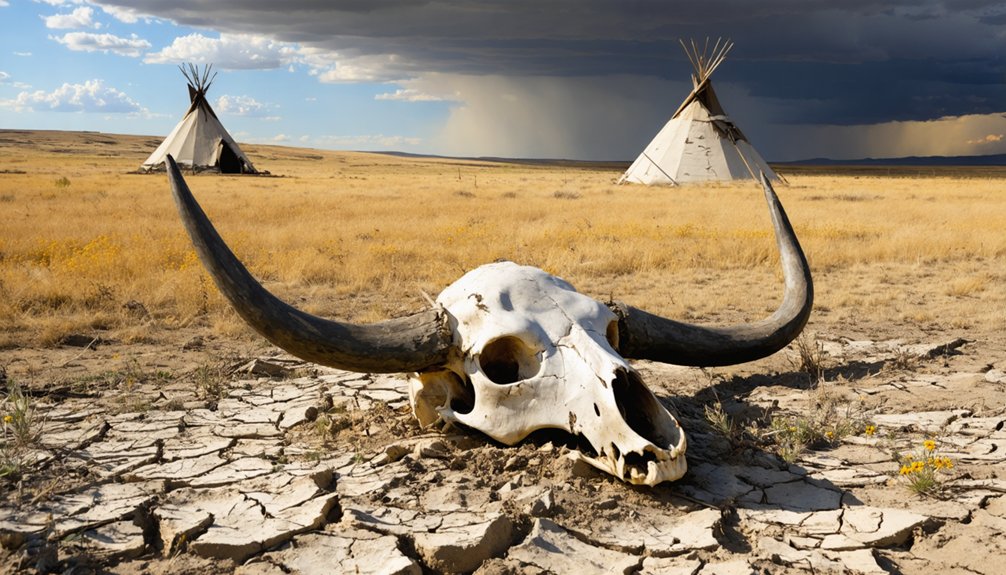
Devastating waves of Eurasian diseases swept through Indigenous Plains communities, triggering catastrophic population collapses that often exceeded 90% mortality in affected regions.
You’ll find that epidemic impact went far beyond initial death tolls, as the destruction of social structures and knowledge systems created a devastating cascade effect. Population decline accelerated through disrupted birth rates, abandoned agricultural lands, and weakened resistance to subsequent disease outbreaks.
Disease epidemics triggered a catastrophic domino effect, destroying Indigenous communities through collapsed social systems and generational knowledge loss.
- Smallpox and measles epidemics caused unprecedented mortality rates of 30-50%
- Lack of immunity to Eurasian diseases left Indigenous populations extremely vulnerable
- Mission centers and forced relocations created perfect conditions for disease transmission
- Loss of caregivers and elders disrupted crucial cultural knowledge transfer
- Pre-existing population stresses from climate factors amplified disease impacts
From Villages to Nomads: A Way of Life Lost
The dramatic shift from sedentary village life to nomadic existence reshaped Plains cultures in profound ways.
You’ll find that before the 18th century, many tribes practiced sedentary agriculture, living in permanent settlements and following seasonal farming cycles.
The arrival of horses revolutionized everything. You could now efficiently hunt buffalo across vast distances, transforming the practical limits of survival.
This nomadic adaptation meant abandoning earth lodges for portable tipis, enabling you to follow the great herds’ migration patterns. Your entire way of life would have shifted – from planting crops in spring to a year-round cycle of movement tracking buffalo herds.
These changes weren’t just practical but cultural. Your society’s values, social structure, and spiritual practices all adapted to center around horses, mobility, and the buffalo hunt.
The Archaeological Record Speaks
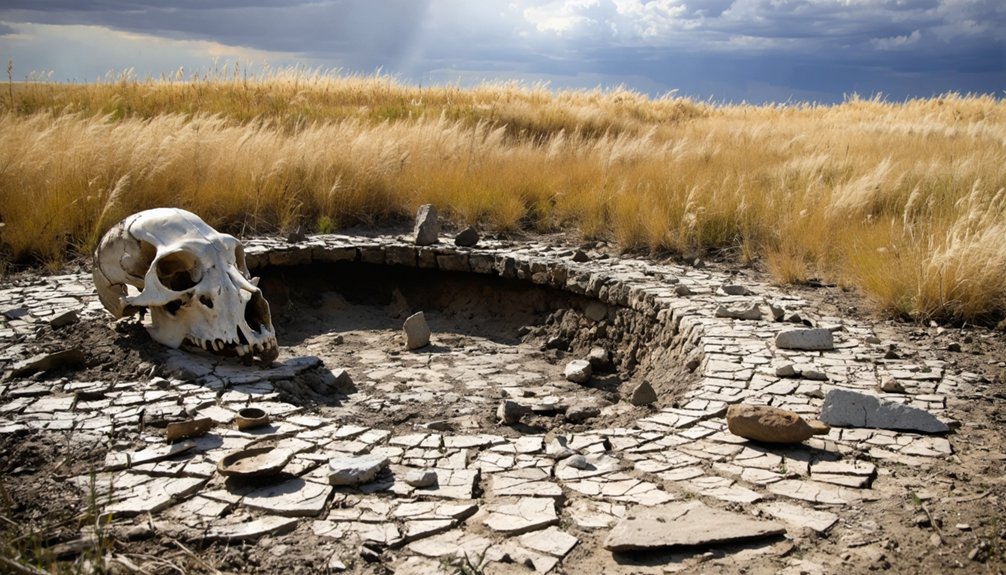
Physical evidence unearthed across the Great Plains reveals a rich tapestry of human occupation spanning over 12,000 years, with some controversial pre-Clovis findings suggesting even earlier settlements up to 20,000 years ago.
Archaeological discoveries paint a picture of dynamic societies that evolved from small seasonal camps to complex settlements. Prehistoric artifacts tell the story of technological advancement, from basic stone tools to sophisticated ceramic traditions.
- Mammoth remains with systematic breaking patterns hint at early human butchering practices
- Pit houses of 3-6 meters show temporary settlements before nomadic lifestyles took hold
- The 150-acre Lynch site in Nebraska demonstrates large-scale village organization
- Burial sites with embedded projectile points reveal violent territorial conflicts
- Archaeological evidence indicates extensive trade networks centered around bison products
Legacy and Lessons From Lost Plains Societies
Archaeological findings across the Great Plains provide a foundation for understanding the enduring legacy of these lost civilizations, but their greatest teachings emerge through careful analysis of their adaptations and innovations.
The story of these abandoned towns in the Great Plains reveals the resilience of the human spirit in the face of environmental and economic challenges. As we explore the remnants of these once-thriving communities, we uncover valuable lessons about sustainability and adaptation. Each site offers a unique glimpse into how individuals and families navigated the complexities of their time.
You’ll find their legacy lessons in how they balanced agriculture with nomadic lifestyles, demonstrating remarkable cultural adaptation to environmental challenges. Through their innovative integration of horses and development of drought-resistant farming techniques, they achieved sustainable resource management while maintaining strong cultural identities.
Their social structures reveal sophisticated systems that combined military strength with spiritual practices, enabling them to thrive in harsh conditions.
Even as European contact brought devastating changes, these societies’ resilient responses and preservation of cultural practices offer critical insights into human adaptability and survival.
Frequently Asked Questions
Did Any Plains Civilizations Successfully Adapt and Survive These Major Changes?
You’ll find many Plains tribes survived through adaptive strategies and environmental resilience, including the Lakota, Osage, and Mandan, who combined traditional practices with new economic and political approaches.
What Role Did Spiritual Beliefs Play in Decisions to Abandon Settlements?
Through earth-shattering spiritual practices, you’ll find Native Americans relied heavily on vision quests, abandonment rituals, and sacred land connections when deciding to leave settlements, seeking spiritual guidance for their people’s survival.
How Did Women’s Roles and Social Status Change During These Transitions?
You’ll find that matriarchal structures weakened as colonization shifted gender dynamics, reducing women’s traditional economic power, property rights, and political influence, though they maintained essential cultural roles through tribal changes.
Were There Attempts to Rebuild Collapsed Communities in Different Locations?
You’ll find tribes actively pursued migration patterns to rebuild, displaying community resilience through internal relocations and new settlements, though U.S. military pressure, inadequate resources, and broken treaties severely hindered their success.
Did Any Plains Groups Maintain Written Records of Their Civilization’s Decline?
You won’t find traditional written records of Plains civilization decline, as tribes relied on oral histories and pictographic winter counts, which weren’t systematic documentation of their societies’ deterioration.
References
- https://www.youtube.com/watch?v=IP8yRskFz-o
- https://www.thestoryoftexas.com/discover/campfire-stories/american-indians
- https://en.wikipedia.org/wiki/Plains_Indians
- https://www.ebsco.com/research-starters/social-sciences-and-humanities/plains-culture
- https://www.khanacademy.org/humanities/us-history/precontact-and-early-colonial-era/before-contact/a/native-american-culture-of-the-plains
- https://www.nps.gov/articles/000/the-plains-indians.htm
- https://americanindian.si.edu/nk360/resources/Northern-Plains-History-and-Cultures-How-Do-Native-People-and-Nations-Experience-Belonging
- https://www.arizonamuseumofnaturalhistory.org/explore-the-museum/exhibitions/native-cultures-of-western-north-america/plains
- https://plainshumanities.unl.edu/encyclopedia/doc/egp.na.001.html
- https://www.pnas.org/doi/10.1073/pnas.1805259115