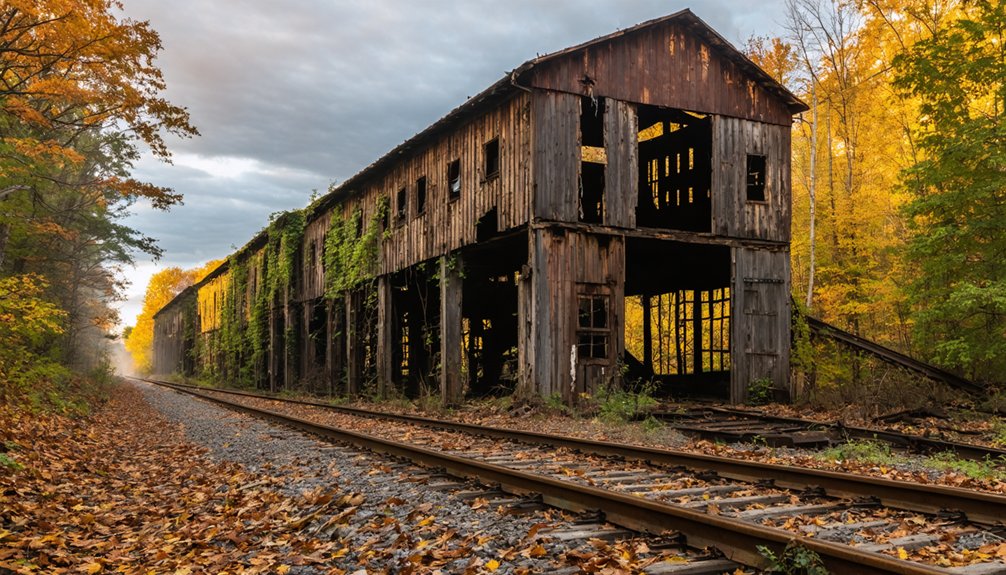
You’ll find Indiana’s ghost towns scattered across the state, from Tunnelton’s historic railroad tunnels to Hindostan Falls’ disease-ravaged ruins. These abandoned communities tell stories of economic decline, with places like Chatterton reduced to single mailboxes and Mollie leaving only two houses standing. Notable sites include Empire Quarry, which supplied stone for the Empire State Building, and underground railroad connections in Southern Indiana. The state’s forgotten settlements hold deeper mysteries beneath their weathered facades.
Key Takeaways
- Tunnelton, once a thriving railroad town, now stands largely abandoned with only one tunnel and covered bridge remaining.
- Hindostan Falls became a ghost town after a devastating disease outbreak in the 1820s killed 138 residents.
- Chatterton has been reduced to a single mailbox, while Mollie retains only two houses from its former bustling community.
- Aberdine holds Level 4 ghost town status, indicating near-complete abandonment of its original structures and population.
- Brisco’s remains include only a one-room schoolhouse and general store, representing Indiana’s rural community decline.
The Lost Towns of Northern Indiana
While Indiana’s landscape is dotted with numerous abandoned settlements, the northern region’s lost towns tell a particularly compelling story of industrial rise and decline. Among these forgotten histories, you’ll find Tunnelton, which thrived until the 1960s around two strategic railroad tunnels.
This once-bustling community boasted hotels, grocery stores, a grist mill, and various businesses that served the Ohio and Mississippi Railway workers. Today, only one tunnel remains as a reminder of its industrial past. The town’s original covered bridge spanning 450 feet long once connected the community across the east fork of the White River.
The town’s lost landmarks include a Christian church destroyed by fire in 1907 and a once-prosperous commercial district. Like many northern Indiana ghost towns, Tunnelton’s decline mirrors the broader pattern of railroad-dependent communities that couldn’t survive the shifting tides of industrialization and transportation evolution. The region’s transformation was particularly dramatic as Wabash & Erie Canal developments reshaped transportation routes and local economies.
Vanishing Communities in Central Regions
As Indiana’s central regions experienced economic shifts throughout the 20th century, numerous small communities vanished from the landscape, leaving behind sparse remnants of their former existence.
You’ll find vanishing hamlets like Chatterton reduced to a single mailbox, while Corwin Station never managed to compete with nearby Romney.
The rural decline particularly affected railroad-dependent communities like Renner, once essential for timber operations, and Sloan, where nature has reclaimed most structures since the tracks’ removal in the 1990s.
Mollie exemplifies the boom-and-bust pattern of Indiana’s gas era, with only two houses remaining from its 1880s-1920s peak.
Brisco’s demise left behind only a one-room school and general store before completely disappearing by the start of the 20th century.
Like Young’s Creek with its discontinued post office, many communities faced decline due to aging populations and job losses.
These ghost towns tell a compelling story of central Indiana’s transformation, where economic changes gradually emptied once-promising settlements.
Southern Indiana’s Forgotten Settlements
As you explore Southern Indiana’s ghost towns, you’ll encounter the haunting remnants of once-thriving pioneer settlements like Tunnelton, where the impressive Big Tunnel stands as a tribute to 1850s engineering and Underground Railroad operations.
The ruins of these forgotten communities, including traces of former buildings and abandoned structures, tell stories of dramatic population decline and historical turning points. One such example is Aberdine, where the Level 4 ghost town status marks its near-complete abandonment, with only a handful of occupied homes remaining among closed businesses. Perhaps the most dramatic decline occurred in Hindostan Falls, where a devastating disease outbreak in the 1820s claimed 138 lives in just three months.
Among the most compelling sites, Tunnelton’s connection to the Underground Railroad and its unsolved murder mystery exemplify the complex narratives woven into Southern Indiana’s vanishing frontier towns.
Haunting Ruins of Marengo
Once a thriving settlement in Crawford County’s Liberty Township, Marengo now stands as one of Southern Indiana’s most haunting ghost towns.
While Marengo Cave remains the region’s premier natural attraction, drawing visitors to its million-year-old formations and underground rivers, the town above tells a different story.
You’ll find abandoned buildings scattered throughout the downtown area, including a deteriorating movie theater and whole blocks of empty structures that have stood vacant for over two decades.
A Dollar General store serves as one of the few active businesses among the ruins.
The streets are decaying, and Victorian homes lie overgrown among the ruins.
Designated as a U.S. National Natural Landmark, the cave system beneath the ghost town continues to draw thousands of tourists annually despite the desolation above.
Despite hosting modern amenities like tent camping and an underground warehouse facility leased by the Department of Defense and CDC, Marengo’s ghostly atmosphere persists.
Only occasional garage sales and a quiet fire department hint at the remaining traces of life.
Underground Railroad at Tunnelton
Deep in the heart of southern Indiana, Tunnelton harbors a fascinating yet understudied connection to the Underground Railroad through a small brick building that still stands today.
While the town’s famous Big Tunnel doesn’t have documented underground connections to freedom seekers, a privately owned brick structure remains as evidence to the area’s role in helping enslaved people escape to freedom.
You’ll find Tunnelton positioned away from the major northwest Indiana networks, including the well-known Chicago-to-Detroit trail.
This geographical isolation, combined with the inherent secrecy challenges of Underground Railroad operations, has left historians with limited documentation of specific routes through the area.
The tunnel’s strategic importance led to military surveillance during both world wars, with armed guards stationed at each entrance to prevent sabotage.
Like many such sites across the country, freedom seekers relied on carefully guarded networks and trusted allies to navigate the dangerous journey northward. The settlement, established in 1859 as a work camp, grew around the construction of the historic railroad tunnel.
Hidden Railroad and Underground History
Throughout Indiana’s storied railway history, networks of abandoned tracks and tunnels tell tales of boom-and-bust mining towns, dangerous construction projects, and the rise and fall of interurban transit systems.
You’ll find these hidden stories along the Ghost Town Trail, where railroad tunnels once connected thriving communities like Wehrum, with its 230 houses and bustling company store. Today, only scattered mining remnants remain on private land.
The dangerous nature of railroad construction becomes evident in places like Tunnelton, where crude cave-like tunnels were carved from hillsides, and along Tanners Creek, where worker camps claimed numerous lives during the 1902 track realignment.
You can trace the state’s transportation evolution through its abandoned interurban lines, which operated until 1941, when the final Indianapolis-to-Seymour service made its last run.
Tales of Monument City and Drowned Towns
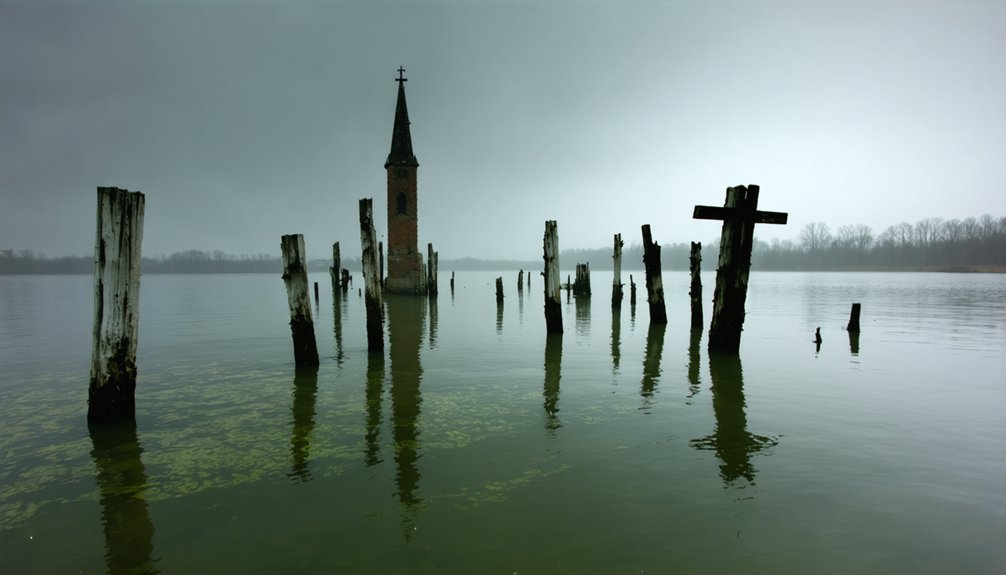
In the cold winter of 1967, the rising waters of the newly completed Salamonie Reservoir swallowed Monument City, a small but historically significant community in Huntington County’s Polk Township.
Silent waters claimed Monument City that winter, erasing generations of history beneath the newly formed Salamonie Reservoir’s icy depths.
You’ll find drowned memories of a town that once served as a proud township center, named after its Civil War monument honoring 27 fallen local heroes.
Before its abandonment in 1964, Monument City’s stories echoed through its schoolhouse, Wesleyan Church, and local establishments like Weeks and Slyter’s store.
Today, you can glimpse the town’s remains during drought periods when foundations emerge like ghosts from the lake’s depths.
While 231 graves were relocated to higher ground, some Monument stories persist of coffins floating during the initial flooding – a haunting reminder of the sacrifice made for regional flood control.
Architectural Remnants and Time-Frozen Structures
You’ll find haunting evidence of Indiana’s lost communities in the skeletal remains of railway depots, where crumbling platforms and weathered ticket windows stand frozen in time.
The architectural details of these stations, from their distinctive dormers to their brick-and-timber construction, offer fascinating insights into the state’s transportation heritage.
Historic Masonic lodge ruins scattered throughout these ghost towns showcase elaborate stonework and symbolism, though many of their once-proud facades have surrendered to decades of neglect.
Decaying Railway Stations
Once bustling centers of commerce and connectivity, Indiana’s abandoned railway stations now stand as haunting reminders of the state’s rich railroad heritage.
You’ll find decaying depots scattered across the landscape, from Gary Union Station‘s hillside ruins to Michigan City’s forgotten platforms along Lake Michigan.
Fort Wayne’s first depot, built in 1851 near the Wabash-Erie Canal, witnessed 20,000 visitors during the 1865 State Fair before falling into disrepair.
Gary Union Station, immortalized in the 1950 film “Appointment with Danger,” served countless steel mill workers until its closure in the early 1970s.
The Michigan City Amtrak station, once a crucial link for Wolverine and Blue Water routes, now sits silent with deteriorating signage and unused tracks, marking the end of an era in Indiana’s transportation history.
Historic Masonic Lodge Ruins
Standing as monuments to a fading fraternal era, Indiana’s historic Masonic lodges reveal architectural grandeur and mysterious pasts through their decaying remains.
You’ll find these time-capsules scattered across the state, from the 1926 Cannizzaro Family Temple to the distinctive flat-iron Irvington Lodge #666.
The Masonic architecture features soaring 30-foot ceilings, intricate ceiling murals, and secret staircases leading to organ-piped upper floors.
Throughout these structures, you’ll spot the symbolic ‘G’ embellished on doorknobs and carpets, while ceremonial relics like black-walnut banquet tables remain frozen in time.
As membership dwindles, many temples face demolition or repurposing – transformed into private residences, Airbnbs, or event spaces.
Yet their architectural legacy endures, preserving fragments of Indiana’s fraternal heritage despite inevitable change.
Impact of Resource Depletion and Economic Shifts

While many factors contributed to Indiana’s ghost towns, the depletion of industrial resources and dramatic economic shifts dealt the most devastating blows to these once-thriving communities.
Depleted resources and economic upheaval transformed Indiana’s booming industrial towns into haunting remnants of their former glory.
You’ll find that resource extraction played a pivotal role, particularly in steel towns like Gary, where workforce numbers at Gary Works plummeted from 30,000 to 6,000 between the 1970s and 1990s. This economic decline triggered a devastating chain reaction throughout the region.
When single-industry towns lost their economic foundations, they couldn’t survive. The shift from manufacturing to service-based economies left communities with massive skill mismatches, while globalization forced plant closures.
As jobs disappeared, populations fell by more than 50% in many areas, leaving behind aging residents, vacant properties, and crumbling infrastructure that accelerated the towns’ abandonment.
Notable Ghost Town Landmarks and Ruins
Today’s ghost towns of Indiana reveal their stories through haunting architectural remnants and weathered ruins scattered across the state’s landscape.
Exploring abandoned properties in Indiana invites adventurers to uncover the past, where every crumbling wall and faded sign may tell a forgotten tale. These sites often serve as poignant reminders of the state’s history, drawing in both history enthusiasts and curious wanderers alike. As you delve into these locations, the atmosphere thickens with an eerie sense of nostalgia, urging you to imagine the lives once lived within their now desolate confines.
You’ll discover fascinating monuments to historical preservation across these abandoned settlements, where ghostly encounters are frequently reported by curious explorers.
- The massive limestone pit of Empire Quarry stands as a monument to industrial achievement, having supplied stone for New York’s iconic Empire State Building.
- City West’s 1930s bathhouse remains the sole survivor of a once-thriving Lake Michigan settlement.
- Teleton’s Big Tunnel, built in 1857, silently guards its Underground Railroad legacy.
- Greenville Christian Church towers above its surroundings, outlasting the town’s destruction, while its adjacent Masonic lodge preserves community memories.
You can trace Indiana’s economic evolution through these architectural witnesses to the past.
Preserving Indiana’s Abandoned Heritage

Throughout Indiana’s ghost towns, dedicated preservation groups have launched ambitious initiatives to protect and restore the state’s abandoned heritage sites.
Preservationists across Indiana are breathing new life into forgotten places, rescuing the state’s abandoned historical treasures from decay.
You’ll find organizations like Decay Devils and Indiana Landmarks leading heritage conservation efforts, particularly in cities like Gary and Anderson. They’ve transformed abandoned railroads into recreational trails, secured National Landmark designations, and revitalized historic districts through strategic community engagement.
The Ghost Town Trail, christened in 1994, exemplifies successful preservation, attracting thousands of visitors annually while preserving America’s industrial heritage.
You can explore the West Central Historic District in Anderson, where the Historical and Cultural Preservation Commission coordinates renovations despite recent pandemic challenges.
In Gary, urban explorers have evolved from photographing decay to actively restoring historic structures, including endangered sites like Gary Roosevelt and St. Augustine’s Episcopal Church.
Frequently Asked Questions
Are There Any Ghost Towns in Indiana That Are Completely Underwater?
You’ll find Monument City and Elkinsville fully submerged beneath Indiana’s reservoirs, with Somerset offering underwater exploration opportunities. These drowned towns’ submerged history surfaces only during extreme low-water periods.
Can Visitors Legally Explore and Photograph These Abandoned Indiana Towns?
You can legally photograph ghost towns from public roads and state parks, but you’ll need owner permission for private properties. Most exploration guidelines allow exterior photography while respecting trespassing restrictions.
Which Indiana Ghost Towns Have Reported Paranormal or Supernatural Activity?
You’ll find haunted locations at Hindostan Falls, where pioneer spirits whisper, and Elizabethtown Cemetery, though skeptics dismiss spectral sightings. Both Finch and Stepp cemeteries offer well-documented paranormal encounters.
Do Any Former Residents Still Maintain Properties in These Ghost Towns?
You’ll find limited property maintenance in Chatterton, where a single house remains actively maintained, though there’s no clear confirmation whether former residents are responsible for its upkeep.
How Many Indiana Ghost Towns Have Been Reclaimed for Modern Development?
Like seeds sprouting through concrete, you’ll find urban revival has transformed roughly 5-7 Indiana ghost towns, primarily near Indianapolis and Gary, where historical preservation meets modern development through targeted reclamation projects.
These areas are becoming vibrant communities once again, attracting visitors interested in the charm and stories of these ghost towns in Indiana. Local artists and entrepreneurs are setting up shop, eager to bring new life to these once-abandoned streets. As the transformation continues, the blend of history and innovation creates a unique experience for both residents and tourists alike.
References
- https://www.onlyinyourstate.com/experiences/indiana/ghost-towns-in
- https://wkdq.com/southern-indiana-ghost-towns/
- https://www.youtube.com/watch?v=45D4dbASJyE
- https://www.geotab.com/ghost-towns/
- https://storymaps.arcgis.com/stories/9a3b3f4a63ba4031a46cb53907a0515c
- https://kids.kiddle.co/List_of_ghost_towns_in_Indiana
- http://freepages.rootsweb.com/~gtusa/history/usa/in.htm
- https://www.youtube.com/watch?v=X6kmlnj7oYs
- https://www.youtube.com/watch?v=3J6ZADuP0A4
- http://ingenweb.org/inlawrence/abandoned.htm