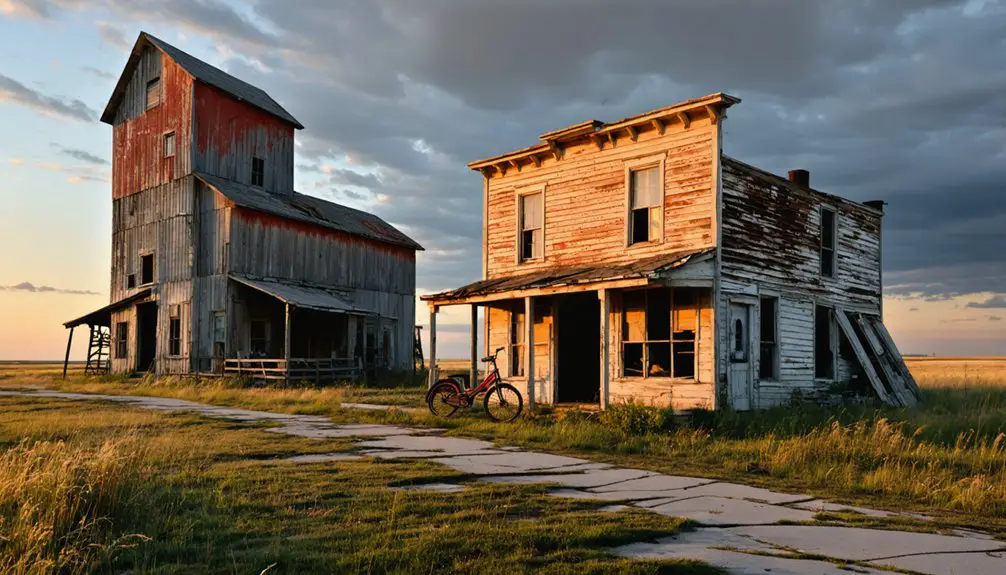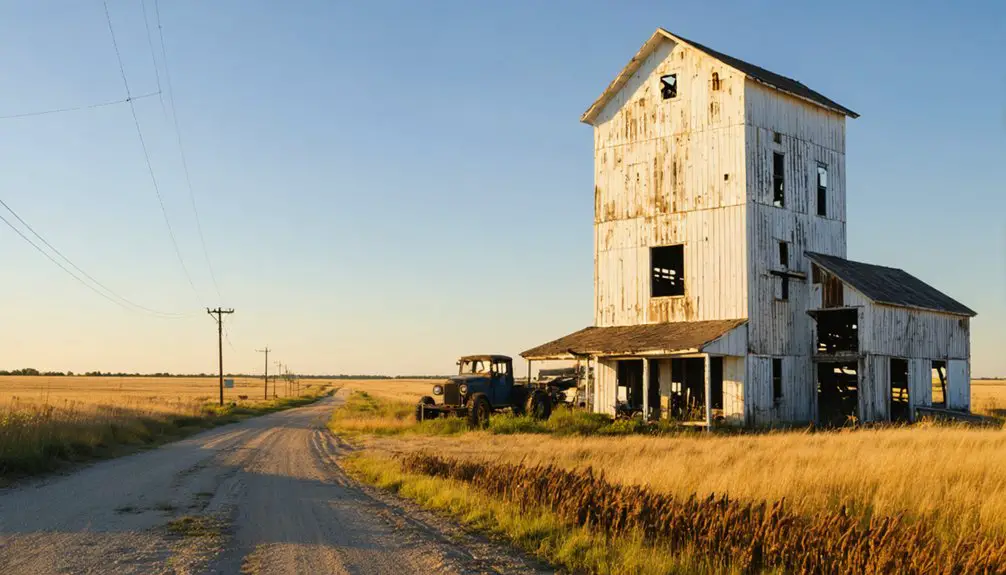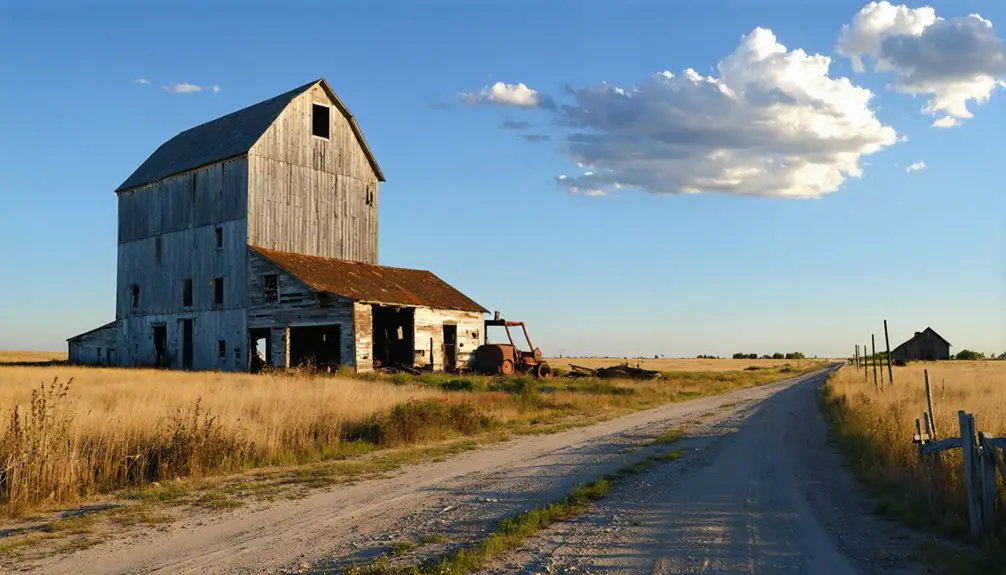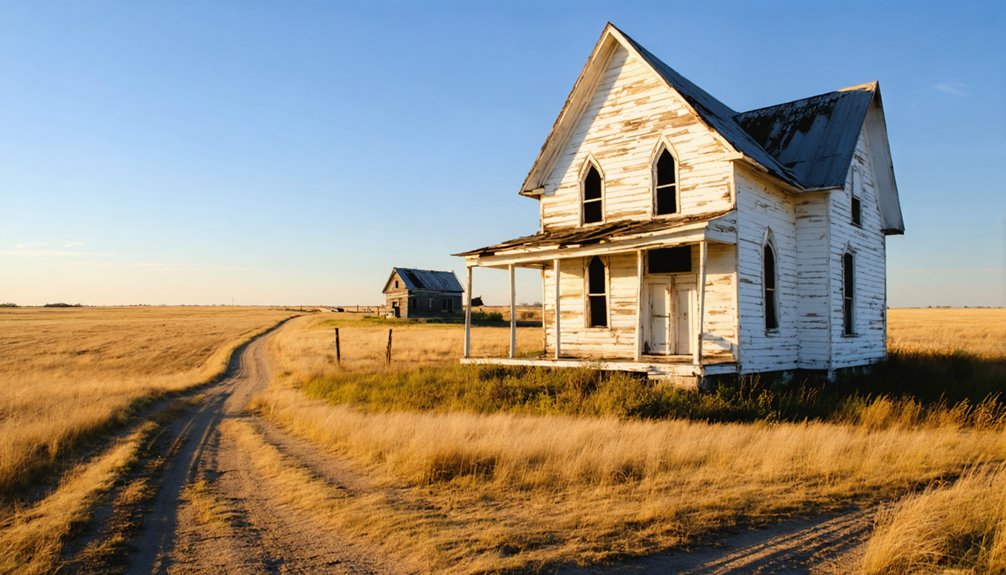
You’ll discover over 100 ghost towns across North Dakota’s landscape, from military outposts like Fort Abraham Lincoln to communities submerged beneath Lake Sakakawea’s waters. Some towns, like Arena and Sims, still feature standing structures including churches and homes, while others like Bluegrass and Omemee have vanished without a trace. The state’s railroad boom towns, such as Gascoyne and Griffin, preserve fascinating remnants of North Dakota’s pioneering past that await your exploration.
Key Takeaways
- North Dakota’s ghost towns include Arena, Sims, Crystal Springs, and Lincoln Valley, which still have standing structures despite abandonment.
- Several communities like Bluegrass, Omemee, and Charbonneau have completely vanished, leaving minimal or no physical traces behind.
- The creation of Lake Sakakawea submerged multiple towns including Elbowoods, Sanish, and Van Hook, displacing thousands of residents.
- Railroad-era ghost towns like Gascoyne and Griffin showcase remnants of North Dakota’s economic boom during railway expansion.
- Many ghost towns feature preserved historical structures such as churches, schools, and commercial buildings that tell stories of past communities.
The Legacy of Military Outposts and Historic Forts
North Dakota’s military history comes alive through its network of frontier forts, which played essential roles in westward expansion during the mid-to-late 1800s.
You’ll discover fort histories that span from Fort Abercrombie, the state’s first permanent military installation, to Fort Yates, the last to be abandoned in 1903. Each outpost’s military significance shaped the region’s development – Fort Abercrombie defended against Dakota warriors and protected important transportation routes, while Fort Abraham Lincoln under Custer’s command safeguarded railroad crews. The fort system included numerous military camps like Camp Hancock that supported temporary operations between 1872 and 1894.
From pioneering Fort Abercrombie to Fort Yates’ final days, these military outposts shaped North Dakota’s frontier through defense and protection.
Fort Rice served as a pivotal Missouri River stronghold, and Fort Totten, now the best-preserved post on the Northern Plains, protected reservation establishment. The abandoned Fort Lincoln was later repurposed as a World War II internment camp for Germans and Japanese.
While most structures were dismantled by settlers, you can still explore reconstructed blockhouses and restored buildings that stand as evidence to North Dakota’s frontier era.
Towns Lost Beneath Lake Sakakawea’s Waters
When the Garrison Dam’s construction concluded in 1956, Lake Sakakawea‘s rising waters submerged numerous thriving communities along the Missouri River Valley, forever changing North Dakota’s landscape.
You’ll find flooded heritage beneath the waters where Elbowoods once stood with its schools, hospitals, and stores, alongside towns like Sanish and Van Hook. The dam’s creation displaced 2,500 people, including 325 families from the Fort Berthold Indian Reservation. The fifth largest earthen dam in the United States transformed the region’s geography permanently.
The submerged memories include 30 square miles of forest and countless ancestral sites.
While many buildings were relocated to higher ground and 7,000 bodies were reinterred from local cemeteries, some graves remain untouched beneath the waters.
Today’s Lake Sakakawea stretches 200 miles where these communities once thrived, marking one of America’s largest man-made reservoirs. Residents who were displaced eventually settled in the city of New Town, establishing a new community.
Empty Towns With Standing Structures
Unlike the submerged towns beneath Lake Sakakawea, several abandoned communities across North Dakota still maintain their ghostly presence through surviving structures.
Among these ghost towns in North Dakota, you can find remnants of vibrant histories and stories waiting to be uncovered. Each abandoned place offers a glimpse into the past, with crumbling buildings and faded memories that echo the lives once lived there. Exploring these sites reveals the harsh realities of life in a changing landscape, where community and connection have faded over time.
You’ll find historic landmarks scattered across these forgotten places: Arena’s St. John’s Lutheran Church stands sentinel alongside two intact homes and a relocated schoolhouse.
In Sims, an active church persists among ruins while a hilltop cemetery watches over abandoned structures.
Griffin’s old Milwaukee boxcar sits among the empty landscape as one of the town’s few remaining structures.
Deisem’s Seventh Day Adventist Church remains its sole major remnant, with ghostly ruins of its general store and post office nearby.
Nanson’s four abandoned homes and outbuildings sit in stark isolation, while Crystal Springs showcases its hillside school, old church, and nationally registered fieldstone fountain.
These rural heritage sites paint a vivid picture of North Dakota’s pioneering past.
Lincoln Valley has been silent since the last resident moved out in the 1970s, though its old bar and ice cream parlor still remain.
Vanished Communities Without a Trace
While some abandoned towns maintain visible remnants of their past, other North Dakota communities have completely vanished from the landscape.
You’ll find Bluegrass in Morton County, 35 miles northwest of Mandan, where a former service station’s charred remains mark one of the last traces of this forgotten settlement that never topped 20 residents.
In Deisem, only a Seventh Day Adventist Church stands among ruins of a general store and post office hidden in tall grass.
Once-bustling Omemee, which peaked at 650 residents, has virtually disappeared by 2017, with just a pile of bricks remaining from the superintendent’s house.
Like Charbonneau, where two grocery stores once served the community, these deserted neighborhoods represent the complete erasure of communities that once dotted North Dakota’s prairies, soon to exist only in memory.
Like many ghost towns, Sanger persisted until its final demolition in 1985, marking the end of another historic North Dakota settlement.
Railroad Era Ghost Towns and Their Remnants
Throughout North Dakota’s railroad boom era, three major rail companies – the Milwaukee Road, Northern Pacific, and Great Northern – established dozens of small communities that would later become ghost towns.
You’ll find remnants of towns like Gascoyne, established in 1907, where commercial buildings still stand despite having only 16 residents today. The town’s coal mining operations supported the local economy until their closure in 1997.
Railroad expansion through Bowman County in 1906-1908 created settlements like Griffin, which peaked at 67 residents before declining in the 1930s. Several communities like Old Sanish and Elbowoods became submerged towns when Lake Sakakawea was created.
Town relocation became common as communities like Ludden moved entirely to align with railroad tracks, driven by the demand for wheat shipments.
While many towns vanished during the Great Depression amid dust storms and drought, you can still discover traces of this era through old structures like Schafer’s county jail and Sims’ abandoned railway stop.
Frequently Asked Questions
Are There Guided Tours Available to Explore North Dakota’s Ghost Towns?
Like footprints in time, you’ll find guided explorations through tour operators Photo Cascadia and CCO Photo, who lead professional photography tours to capture abandoned structures across the state.
What Safety Precautions Should Visitors Take When Exploring Abandoned Towns?
Wear proper safety gear including sturdy boots and bug spray. Stay alert for wildlife, avoid unstable structures, and don’t explore alone. Keep your phone charged and tell others your location.
Can Visitors Legally Collect Artifacts From North Dakota Ghost Towns?
Like a watchful guardian protecting treasures, you can’t legally collect artifacts without proper permissions. State law requires artifact preservation, and you’ll need landowner approval or risk violating legal regulations.
When Is the Best Season to Photograph North Dakota Ghost Towns?
You’ll get the best lighting and seasonal colors from September through November, when autumn foliage contrasts with weathered structures, humidity drops, and dramatic skies create moody backdrops for your photographs.
Do Any Ghost Towns Host Historical Reenactments or Cultural Events?
You won’t find ghost town festivals or reenactment groups in these locations. While some structures like Sims’ church remain active, there’s no documented evidence of organized historical or cultural events taking place.
References
- https://ghostsofnorthdakota892857007.wordpress.com/2015/10/30/true-ghost-towns-population-zero/
- https://northernsentry.com/2025/06/26/north-dakota-ghost-towns/
- https://www.onlyinyourstate.com/experiences/north-dakota/ghost-towns-nd
- https://us1033.com/a-look-at-some-real-life-north-dakota-ghost-towns/
- https://www.youtube.com/watch?v=8GO57Im_dss
- https://kids.kiddle.co/List_of_ghost_towns_in_North_Dakota
- https://www.youtube.com/watch?v=59hzueQkmok
- https://news.prairiepublic.org/show/dakota-datebook-archive/2022-05-07/fort-lincoln-the-second
- https://www.northamericanforts.com/West/nd.html
- https://www.ndstudies.gov/gr4/frontier-era-north-dakota/part-5-frontier-army/section-5-army-forts-1858-1864