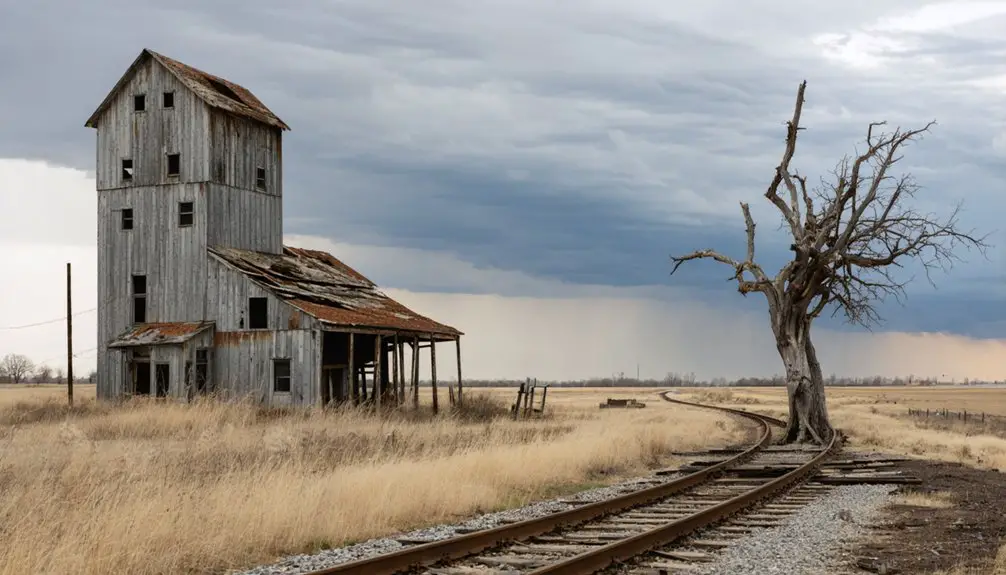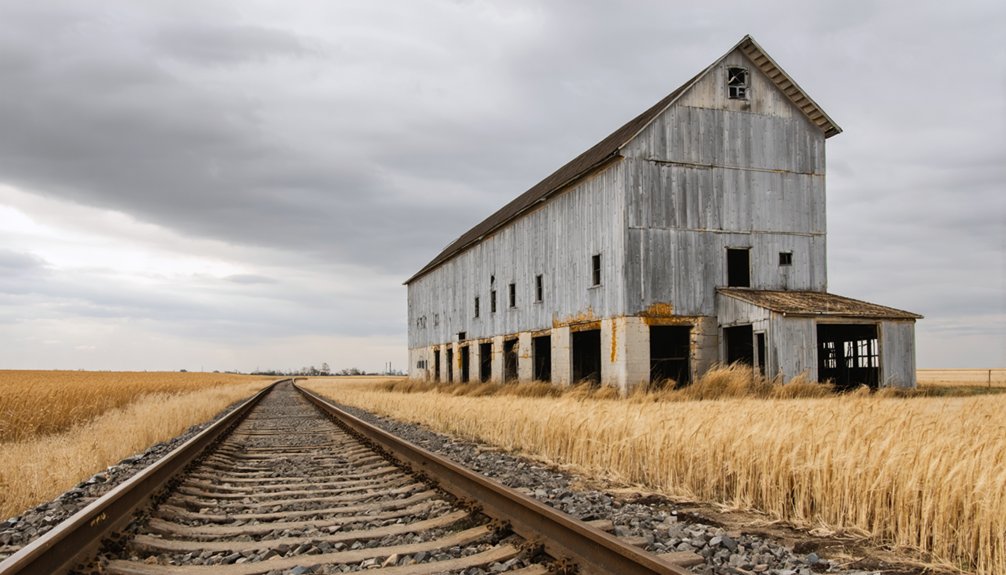
You’ll find Almon’s ghost town story in central Minnesota’s pioneer history, where it emerged as a promising settlement in the 1860s. The community thrived initially through ferry operations and Albee Smith’s hotel, which served as a post office and general store. When the Soo Line Railroad bypassed Almon for Kimball Prairie in 1886, the town’s decline began. By the early 1900s, the last residents had departed, leaving only traces of this frontier settlement’s ambitious past.
Key Takeaways
- Almon declined after the Soo Line Railroad bypassed the settlement in 1886, causing residents to relocate to nearby Kimball Prairie.
- The Meighen family acquired 2,000 acres of defaulted properties, effectively turning Almon into a company town.
- Loss of ferry revenue from the Bloomington Ferry Bridge’s completion in 1892 contributed to Almon’s economic decline.
- The last residents departed by the early 1900s, following the destruction of the town’s hotel by fire in 1905.
- The former town site has been completely converted to agricultural land, with expansive fields replacing the original settlement.
The Rise of a Pioneer Settlement
While the Northern Pacific Railroad’s exploration party traversed Becker County in the summer of 1869, their presence sparked the rapid development of what would become Almon.
The railroad’s pioneering spirit blazed through Becker County in 1869, laying the groundwork for Almon’s promising future.
As pioneers faced the challenges of establishing a foothold in this untamed territory, you’d find settlement strategies emerging through the efforts of early arrivals like David Beveridge and his companions, who established a shingle mill during the harsh winter of 1869-1870. Much like Lorenzo Merry’s cabin that marked the first settlement of Albert Lea, these early structures laid the groundwork for future growth.
The promise of railroad access in 1870 drew numerous settlers to the area, though their arrival was marked by both triumph and tragedy. Miss Nancy M. Comstock taught the first school outside the reservation in the fall of 1871, marking a significant milestone for the growing community.
The death of Almon W. Sherman at Oak Lake on December 31, 1869, stands as a reflection of the risks these early pioneers faced.
Despite the hardships, the community grew steadily, with settlers strategically positioning themselves along anticipated rail routes, shaping the foundation of Almon’s early development.
Early Days in Central Minnesota
Long before Almon’s pioneers arrived, central Minnesota’s rich landscape had sustained human civilization for over 8,000 years. As a prehistoric inhabitant, you’d have found Paleoindian bison hunters wielding stone projectile points across the plains.
By 700 BC, you’d have witnessed the creation of thousands of burial mounds dotting the terrain. These indigenous peoples relied on seasonal food gathering and maintained expansive territories to sustain their communities.
The land you’d later know as central Minnesota became a contested ground between indigenous tribes. You’d have seen the Cheyenne establishing villages along the Minnesota River valley in the 1700s, only to be driven out by the Dakota.
Later, you’d have watched the Ojibwe push into the region from the east, displacing the Dakota from areas like Mille Lacs. This dynamic shift in tribal territories continued until European fur traders entered the scene in the mid-1600s. The Red River trade brought significant economic activity to the region after 1847, with ox-drawn carts transporting furs and merchandise through the area.
Life During the Dakota Conflict
As tensions erupted in August 1862, you’d have witnessed the Dakota Conflict engulf central Minnesota after four young Dakota men killed five settlers in Acton Township during a dispute over stolen eggs.
The violence quickly spread through the Minnesota River valley, creating a dangerous no-man’s land in areas where Dakota and settler populations intermingled. You’d have seen desperate settlers fleeing north, east, and south, with many crossing the Mississippi River to escape the raids. Chief Little Crow led the devastating attack that sparked widespread violence across the region.
In nearby New Ulm, you’d have found over 2,000 settlers defending against two fierce sieges, using buildings like the Forster Building as strongpoints to shelter women and children. President Lincoln reviewed hundreds of Dakota trials and death sentences in the aftermath.
The fires from the August 23 attack devastated New Ulm and surrounding farms, forever changing the region’s landscape.
Economic Growth and Development
Since its initial platting in 1855, Almon’s economic foundation rested on a strategic ferry operation that served steamboat traffic along the Minnesota River.
You’d find Albee Smith’s hotel at the heart of local commerce, functioning as a post office and general store while providing lodging for travelers maneuvering the rapids. Local historians suggest the hotel’s role mirrored the Meighen General Store that once served Forestville’s community.
Like many early Hennepin settlements, Almon’s initial development mirrored the pattern of river towns that flourished before railroad dominance.
The town’s early growth faced economic challenges, from flood-prone land parcels to the devastating Panic of 1857 that drained settlers’ savings.
Transportation evolution ultimately sealed Almon’s fate – the 1892 completion of the Bloomington Ferry Bridge eliminated essential ferry revenue, while the rise of railroads diverted traffic from river routes.
When fire destroyed the hotel in 1905, you’d witness the final blow to this river town’s commercial significance, ending its brief era of transport-based prosperity.
The Heart of Community Living
The vibrant social fabric of Almon revealed itself through three closely-built churches, a bustling schoolhouse, and several commercial establishments that defined daily life in this mid-19th century riverside community.
You’d find families from Maine and other eastern states gathering for weekly church services, school events, and community gatherings at the general store or cheese factory. These settlers embraced shared traditions like barn-raisings and harvest assistance, reinforcing bonds through cooperative labor. Mail routes connected the town to neighboring settlements by 1863.
Your daily routines would’ve centered around the post office, where news and mail connected you to the broader world, while the blacksmith shop and mill served as informal meeting spots. During the Dakota Conflict of 1862, the town served as a crucial fortification point for local settlers seeking protection.
Religious ceremonies, agricultural fairs, and civic meetings anchored the town’s social calendar, creating a tight-knit community despite the challenges of frontier life.
Decline and Exodus to Kimball
Almon’s community fabric began unraveling in 1886 when the Soo Line Railroad established its main route through Kimball Prairie instead of Maine Prairie.
The railroad impact hit swiftly – passenger and freight services bypassed Almon entirely, and merchants soon found they couldn’t compete with Kimball’s rail-connected advantages.
You’d have witnessed a dramatic population shift as families uprooted their lives, physically moving their homes and businesses to Kimball.
The exodus accelerated as agricultural shipping concentrated around the new rail depot, and local institutions – from general stores to churches – followed their patrons to the burgeoning rail town.
Vanishing Into History
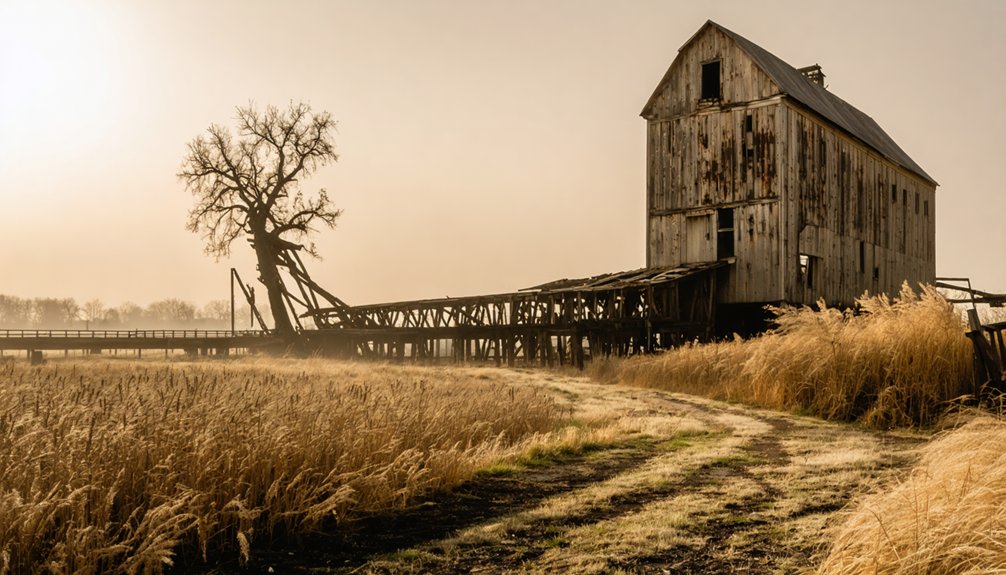
While passenger trains whistled through nearby Kimball Prairie, Almon’s decline accelerated into a rapid downward spiral during the 1870s and 1880s.
You’ll find the Meighen family’s influence grew as they acquired defaulted properties, eventually controlling 2,000 acres and transforming Almon into their company town.
The ghost town’s fate was sealed by these critical factors:
- Thomas Meighen’s shift to Preston banking left the store neglected
- Rural mail delivery eliminated reasons to visit
- The Great Depression halted potential land sales
- The last residents departed by the early 1900s
Today, you can explore Almon’s historical significance at Forestville/Mystery Cave State Park, where preserved buildings stand as silent witnesses to a once-thriving community’s rise and fall just one hour south of Rochester.
Modern Agricultural Landscape
Today’s agricultural landscape around Almon bears little resemblance to the small family farms that once dotted the area.
You’ll find expansive rectangular fields stretching across consolidated parcels of hundreds or thousands of acres, where modern farmers rotate corn and soybeans using GPS-guided equipment and precision farming techniques.
The remnants of early 20th-century farm infrastructure – weathered barns, old drainage tiles, and shelter belts – hint at the land’s evolution from wheat bonanza farms to today’s large-scale mechanized operations.
Current Farming Operations
The modern agricultural landscape surrounding the former Almon township showcases Minnesota’s robust farming sector, with Martin County emerging as a powerhouse in corn and soybean production.
You’ll find sustainable practices and crop diversity throughout the region’s operations, as farmers adapt to evolving market demands.
- Value-added corn production targets ethanol plants, pig operations, and beef feedlots
- Large-scale hog facilities operate with specialized management and capital investment
- Organic farming contributes to Minnesota’s top-10 national rankings in multiple categories
- Farm consolidation drives efficiency gains and higher net farm income
The area’s agricultural strength reflects in the projected $6.59 billion state farm income for 2025.
You’ll notice the transformation from small family farms to larger, more specialized operations that maximize production while maintaining environmental stewardship through programs like ARC and PLC.
Land Use Transformation
Dramatic land consolidation reshaped Almon’s landscape throughout the late 19th and 20th centuries, as small family plots merged into expansive agricultural holdings.
You’ll find that former village parcels disappeared as neighboring farms absorbed abandoned properties, converting streets and residential lots into continuous cropland. The transformation required significant modifications – workers removed old foundations, leveled terrain, and installed modern drainage systems where historic millponds once stood.
Today, you won’t recognize many traces of Almon’s original layout.
Agricultural practices have simplified the once-diverse landscape, replacing former gardens and shade trees with uniform crop rotations. The old town’s footprint now serves purely agricultural purposes, with only subtle variations in soil composition and drainage patterns hinting at the settlement that once thrived here.
Frequently Asked Questions
What Happened to the Graves and Cemeteries From Almon’s Original Settlement?
Like ghosts in the prairie wind, you’ll find no clear record of what happened to Almon’s grave markers and cemeteries – their fate remains undocumented in Minnesota’s historic cemetery preservation records.
Were Any Artifacts or Relics From the Ghost Town Preserved?
You won’t find documented evidence of artifact preservation from this site in major collections, though similar Minnesota ghost towns typically yield domestic items, structural remains, and personal relics worthy of preservation.
The true story of the settlement often goes unnoticed, leaving only whispers of the past. Exploring Grover’s abandoned history reveals the stories of those who once called it home, as well as the remnants of their lives scattered throughout the landscape. Each step through the overgrown paths unveils secrets waiting to be rediscovered, from forgotten structures to personal artifacts that tell a larger tale of the area’s legacy.
Did Any Original Almon Families Continue Living in Kimball?
While mountains of records hint at movement patterns, you can’t definitively confirm which Almon families became Kimball residents – though land deeds and census data suggest some families likely relocated nearby.
What Was the Peak Population of Almon During Its Boom Years?
You won’t find a definitive peak population figure for the boom years, as historical records are incomplete. While population trends suggest local significance, you’ll need primary sources to determine exact numbers.
Why Was the Specific Location Chosen for the Original Settlement?
You’ll find the settlement geography was strategically chosen near essential water sources and travel routes, while promising timber resources and arable farmland made it historically significant for pioneering settlers seeking economic opportunity.
References
- https://minnesotasnewcountry.com/this-story-of-a-central-minnesota-ghost-town-is-pretty-incredible/
- https://www.minnesotahistory.org/post/a-complete-guide-to-the-ghost-towns-of-hennepin-county
- https://www.youtube.com/watch?v=5bCG6B2rzZY
- https://www.fws.gov/story/ghost-town-carver-rapids
- https://thievesriver.com/blogs/articles/ghost-towns-in-minnesota
- https://quickcountry.com/minnesota-ghost-towns/
- https://en.wikipedia.org/wiki/List_of_ghost_towns_in_Minnesota
- https://freepages.rootsweb.com/~gtusa/history/usa/mn.htm
- https://www.forgottenminnesota.com/2017/12/05/2017-12-lost-highway/
- http://becker.mngenweb.net/pioneerhistory/ch16.htm