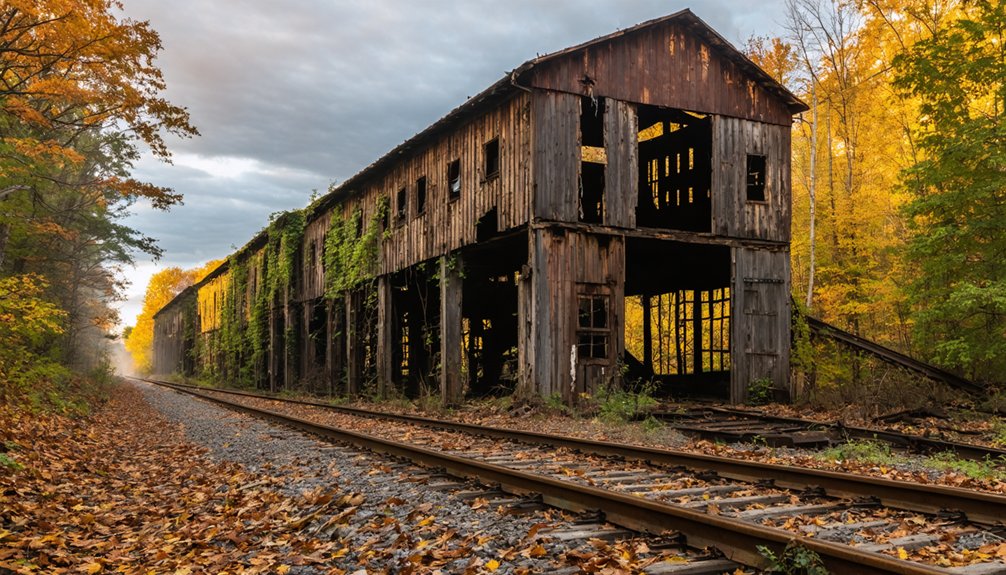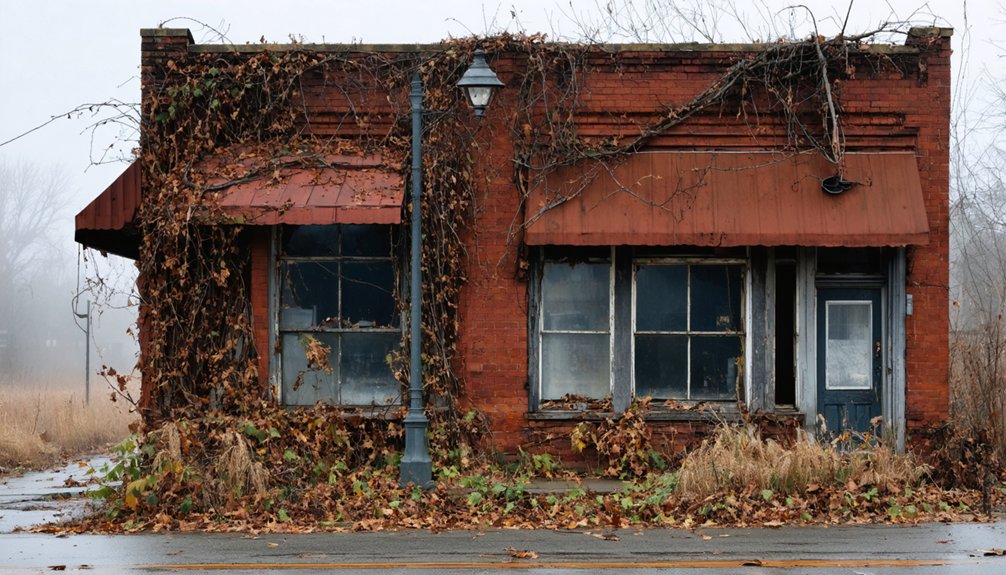
You’ll find over 40 documented ghost towns scattered across Indiana’s landscape, from abandoned mining settlements to submerged communities beneath reservoirs. Notable sites include English, with its historic Simpson Memorial Church, and Monument City, which emerges from Salamonie Lake during droughts. Southern Indiana features the most accessible ruins, including Tunnelton’s railroad remnants and Borden’s deteriorating Main Street. Indiana’s forgotten places hold fascinating stories of frontier ambition, economic shifts, and progress’s true cost.
Key Takeaways
- Indiana has over 40 documented ghost towns scattered across its landscape, with a high concentration in the southern region.
- Monument City is a submerged ghost town beneath Salamonie Lake that becomes visible during drought conditions.
- Southern Indiana features several accessible ghost towns including English, Marengo, and Greenville, which contain crumbling downtown ruins.
- Germantown and other settlements were intentionally flooded to create reservoirs for water management and flood control.
- Historic sites like Simpson Memorial Methodist Church in English and Story Inn offer preserved glimpses into Indiana’s abandoned communities.
The History Behind Indiana’s Lost Communities
While Indiana’s modern landscape features thriving cities and towns, the state’s history is marked by numerous abandoned settlements that paint a compelling picture of 19th-century frontier life.
You’ll find stories of lost settlements like Hindostan Falls, which grew to 1,200 residents by 1820 before a devastating disease outbreak led to its decline.
The state’s community decline often stemmed from changing economic conditions, as seen in the mining towns along Ghost Town Trail, where places like Wehrum once boasted 230 houses, a hotel, and various businesses.
Natural disasters contributed heavily to the abandonment of towns like English, which endured six major floods between 1959 and 1990.
Disease, shifting transportation routes, and depleted natural resources contributed to these towns’ abandonment.
Originally established in 1808 by Frederick Schultz, Hindostan Falls was strategically located along the stagecoach route between New Albany and Vincennes.
From Chatterton’s single remaining mailbox to Elizabethtown’s solitary cemetery, Indiana’s ghost towns serve as poignant reminders of ambitious frontier dreams that didn’t survive.
Notable Ghost Towns in Southern Indiana
Southern Indiana harbors some of the state’s most intriguing ghost towns, each with its own distinct historical significance.
In Crawford County, you’ll find English, where the Simpson Memorial United Methodist Church stands as a symbol of the past, surviving the devastating 1908 fire that consumed surrounding structures.
Tunnelton Tales unfold through its historic railroad tunnel and Underground Railroad connections, marked by the tragic 1882 Wilson gang massacre.
The dark history of Tunnelton’s underground passages echoes with whispers of escaped slaves and the violent fate of the Wilson gang.
Greenville preserves its heritage through its Christian church and Masonic lodge, while Fort Ritner’s deteriorating structures tell stories of a once-thriving community.
In Borden, you can explore Main Street’s haunting remains, where nature slowly reclaims abandoned buildings, offering a glimpse into the region’s forgotten chapters. These abandoned spaces serve as time capsules of communities that once thrived with life and activity.
Indiana contains approximately 41 ghost towns, scattered across its landscape, with many concentrated in the southern region.
These ghost towns in Indiana history offer a glimpse into the past and tell stories of communities that once thrived. As you explore these abandoned sites, you can find remnants of homes, schools, and businesses that reflect the state’s rich cultural heritage. Each town has its unique tale, revealing the reasons behind their decline and the passage of time.
Significant Drowned Towns Across the State
Throughout Indiana’s history, numerous towns have succumbed to the waters of man-made reservoirs, creating a network of submerged communities that tell compelling stories of sacrifice for flood control and water management.
During severe droughts, remnants occasionally visible reveal glimpses of Monument City beneath Salamonie Lake, with its Civil War memorial relocated before flooding in the 1960s. Germantown disappeared under nearly 1,800 acres of water by 1943 when Indianapolis expanded its water supply. Many families left behind memories and cherished homes as waters rose in the Salamonie valley.
The historical significance of these submerged communities continues to captivate, especially during droughts when foundations emerge from receding waters. While some towns like Elkinsville were condemned but never fully submerged, others like the settlements beneath Patoka Lake remain permanently underwater.
These lost communities represent a fascinating chapter in Indiana’s development, where progress demanded the sacrifice of entire towns.
Why Towns Became Abandoned in Indiana
Indiana’s ghost towns emerged from multiple complex forces that systematically dismantled once-thriving communities.
You’ll find that economic vulnerabilities, particularly dependence on single industries like steel mills or mines, left towns exposed when those sectors collapsed. When major employers shut down, the ripple effects devastated local businesses and triggered mass exodus of residents. Gary, Indiana exemplifies this pattern, as foreign steel competition in the 1970s decimated its industrial base.
Transportation shifts dealt another crucial blow to many communities. When railroads realigned their routes or new highways bypassed town centers, the loss of essential commercial traffic caused businesses to fold. Elizabethtown vanished by 1900 when railroad bypasses redirected commerce away from its once-promising commercial center.
Natural disasters, including floods and fires, sometimes delivered the final blow to struggling towns. Environmental factors like resource depletion in mining areas or soil exhaustion in farming communities forced residents to seek opportunities elsewhere, leaving their towns to fade into history.
Where to Explore Indiana’s Ghost Towns Today
Today’s adventurous explorers can discover more than 40 ghost towns scattered across Indiana’s diverse landscape, from the southern hills to the northern plains. Your ghost town exploration journey can take you through deteriorating structures, hidden cemeteries, and forgotten foundations that tell stories of Indiana’s past. Like the legendary mining towns of the Ghost Town Trail, many of these sites preserve important industrial heritage.
Among these haunting relics are several abandoned places in Indiana that captivate visitors with their eerie charm. Each site offers a glimpse into a bygone era, allowing explorers to connect with the stories of those who once filled these now-silent spaces. As you wander through these forgotten locations, you’ll uncover the remnants of life that once thrived, echoing the whispers of history in every crumbling wall.
Indiana’s ghost towns stand frozen in time, beckoning curious souls to uncover forgotten stories among their weathered ruins and silent streets.
- Visit Southern Indiana’s English, Marengo, and Greenville to photograph crumbling downtown ruins and historic Masonic lodges.
- Explore Monument City’s submerged foundations during low water seasons at Salamonie Reservoir.
- Trek through Hoosier National Forest to find Elkinsville’s remnant lanes and pioneer cemetery.
- Investigate Tunnelton’s abandoned sites tied to Underground Railroad history and unsolved mysteries.
- Experience paranormal tours at Whispers Estate in Mitchell or Story Inn’s haunted rooms in Brown County. The Story Inn’s most famous spectral resident is the Blue Lady apparition, known to leave the scent of cherry tobacco in her wake.
Bring your abandoned site photography gear and maps to document these fascinating pieces of Hoosier history.
Research and Documentation of Forgotten Places
You’ll find that historical records provide the most reliable foundation for ghost town research, with county archives, newspapers, and land documents revealing settlement patterns and abandonment causes.
When conducting field research, it’s crucial to follow proper documentation protocols, obtain necessary permissions, and use GPS coordinates to accurately map remaining structures and artifacts.
Modern digital mapping tools like ArcGIS have revolutionized how researchers track and share information about Indiana’s forgotten communities, creating extensive databases that combine historical data with current site conditions.
Historical Records Matter Most
While many ghost towns fade into obscurity, the historical records of Indiana’s abandoned settlements provide essential insights into the state’s development.
You’ll find meticulous documentation of these forgotten places carries immense historical significance through archival preservation efforts like Indiana Memory’s digital library and ArcGIS StoryMaps analysis.
- Lawrence County’s detailed plat records reveal precise founding dates, from Bono’s 1816 establishment to Guthrie’s 1866 inception.
- Original documentation of Hindostan Falls shows its rise to 1,200 residents and tragic cholera outbreak.
- Typewritten records preserve Anquilla’s brief existence in Clay County.
- Extensive mapping tracks 41 identified ghost towns, including two submerged settlements.
- The Pigeon Roost settlement’s tragic end remains documented through September 1812 accounts.
Field Research Best Practices
Field research of Indiana’s ghost towns demands strict adherence to established safety protocols and documentation standards. When you’re conducting field research, you’ll need to wear protective gear, travel with a partner, and carry essential safety equipment like first-aid kits and communication devices.
Before beginning your survey techniques, secure proper permissions from property owners and relevant authorities. You’ll want to document everything meticulously – from GPS coordinates to detailed photographs with scales.
Focus on non-invasive methods like walkover surveys and geophysical tools to map sites without disturbing them. If you encounter artifacts, leave them in place and photograph them with proper documentation.
Remember to assess weather conditions and terrain stability before entering any site, and always avoid structures that show signs of potential collapse.
Digital Mapping Shows Progress
Recent advances in digital mapping technologies have revolutionized the documentation of Indiana’s ghost towns, with interactive platforms now tracking approximately 41 abandoned settlements across the state.
You’ll find extensive digital resources that showcase these forgotten places through various mapping tools and databases:
- Geotab’s interactive maps reveal ghost town clusters within 25-50 mile radiuses, enabling regional exploration
- ArcGIS StoryMaps analyze abandonment patterns across Indiana’s 41 documented sites
- RootsWeb combines topographical maps with GNIS aerial photography for precise location data
- YouTube creators maintain collaborative Google Maps documenting their field research
- Digital atlases from Indiana Memory preserve historical township and property records
These mapping advances provide unprecedented access to Indiana’s ghost towns while establishing standardized documentation methods for future research.
Frequently Asked Questions
Are There Any Ghost Towns in Indiana That Are Completely Off-Limits?
Like a hidden treasure map with no X marks, you’ll find that Indiana’s ghost town regulations don’t completely restrict access to any abandoned sites, though some private properties require permission for preservation purposes.
Can You Legally Take Artifacts From Indiana Ghost Town Sites?
You can’t legally remove artifacts from Indiana ghost towns. State laws protect historic sites, and you’ll face legal consequences if caught. Private property requires owner permission for any artifact preservation efforts.
Which Indiana Ghost Towns Have Reported Paranormal Activity?
While some dismiss ghost stories, you’ll find documented paranormal sightings at Elizabethtown’s cemetery, Hindostan Falls’ riverside trails, Elkinsville’s empty buildings, and Mollie’s industrial ruins—all haunted locations with consistent reports.
Do Any Indiana Ghost Towns Still Have Original Structures Standing?
You’ll find several Indiana ghost towns with original structures intact, including Corwin’s grain elevator, Milton’s 1878 Methodist church, Hindostan Falls’ mill remains, and Teleton’s historic 1857 railroad tunnel.
What’s the Best Season to Photograph Indiana’s Abandoned Towns?
You’ll get your best shots in fall when combining early morning lighting techniques with vibrant foliage. The golden hour enhances architectural details, while autumn’s clear conditions provide ideal seasonal accessibility.
References
- https://wkdq.com/southern-indiana-ghost-towns/
- http://freepages.rootsweb.com/~gtusa/history/usa/in.htm
- https://www.onlyinyourstate.com/experiences/indiana/ghost-towns-in
- https://www.youtube.com/watch?v=45D4dbASJyE
- https://www.geotab.com/ghost-towns/
- https://www.atlasobscura.com/users/lendog666/lists/ghost-towns
- https://storymaps.arcgis.com/stories/9a3b3f4a63ba4031a46cb53907a0515c
- https://kids.kiddle.co/List_of_ghost_towns_in_Indiana
- https://www.discoversouthernindiana.com/blog/post/the-ghost-town-of-hindostan-falls-indianas-lost-jewel/
- https://indianacountyparks.org/our-trails/ghost-town-trail/ghost-town-trail-history/