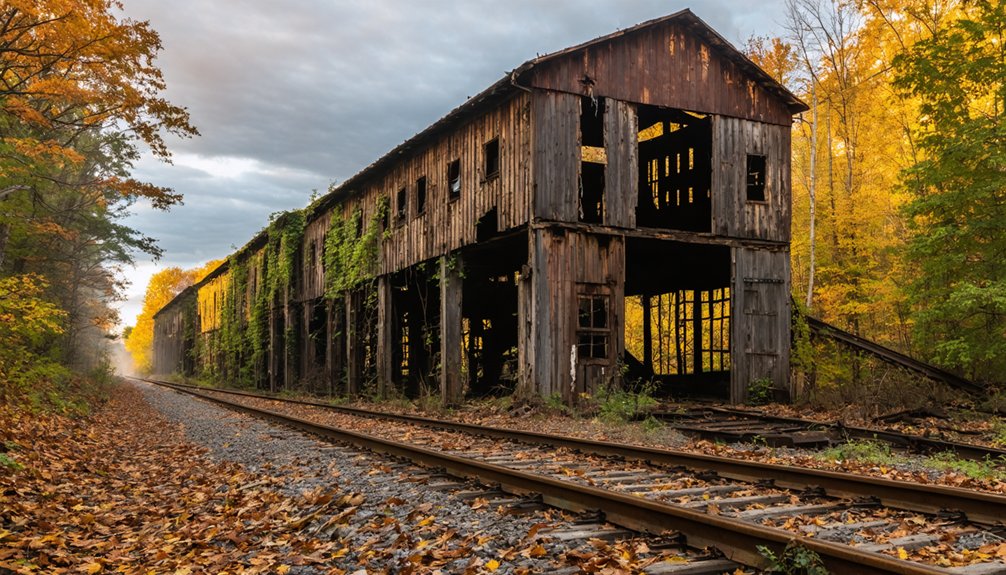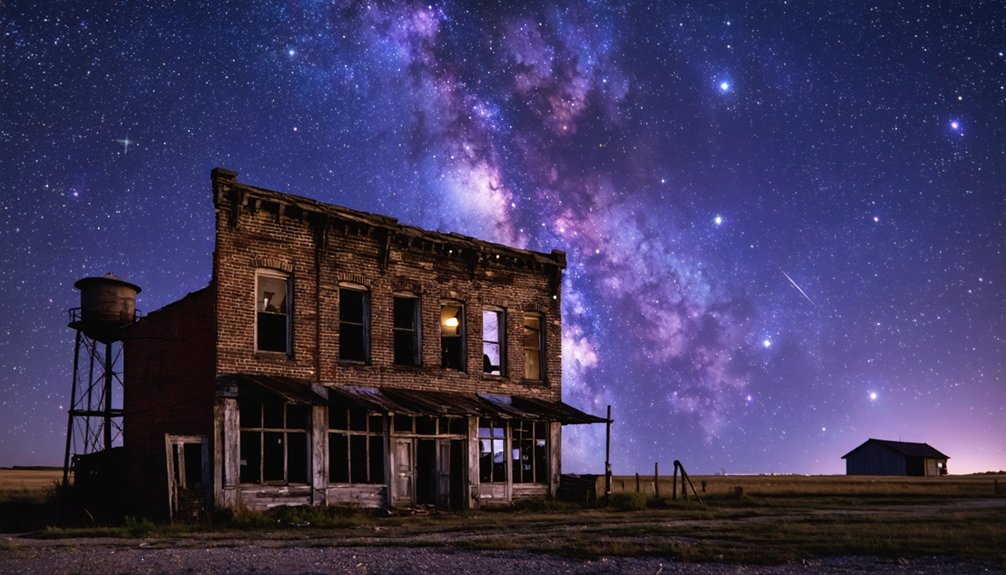
You’ll find prime astrophotography conditions at five Indiana ghost towns: Elkinsville, Monument City, Teleton, Hindostan Falls, and Granville. Each location offers Bortle 2-3 dark skies with minimal light pollution, perfect for capturing the Milky Way between May and August. Use a fast wide-angle lens (f/1.4-f/2.8) and sturdy tripod for best results. Scout locations during daylight to identify compelling structural elements as foreground anchors. These abandoned sites hold secrets that transform night sky images into haunting masterpieces.
Key Takeaways
- Elkinsville provides secluded settings and unobstructed views perfect for long exposure night sky photography with minimal light pollution.
- Monument City’s exposed foundations create compelling foreground elements for Milky Way compositions during summer months.
- Teleton’s Big Tunnel and ruins offer atmospheric urban exploration opportunities combined with dark sky conditions for astrophotography.
- Hindostan Falls enables photographers to capture stunning star reflections in the river while using historic mill holes as foreground elements.
- Granville’s rural isolation ensures pristine dark skies with Bortle Scale ratings of 2-3, ideal for capturing the Milky Way.
Top Ghost Town Locations for Night Sky Photography
While Indiana’s ghost towns offer compelling subjects for nighttime photography, their remote locations and minimal light pollution make them ideal for capturing the Milky Way and star trails.
These dark locations typically register between class 3-4 on the Bortle scale, providing excellent visibility of celestial objects.
You’ll find Elkinsville’s secluded setting perfect for long exposures, with its reclaimed natural areas providing unobstructed views of the night sky. The Warsaw Astronomical Society frequently conducts observing sessions in similar dark-sky conditions.
Monument City’s exposed foundations during low reservoir levels create unique foreground elements against stellar backgrounds.
For urban exploration enthusiasts, Teleton’s historic Big Tunnel and ruins provide atmospheric compositions beneath the stars.
Position your tripod at Hindostan Falls to capture star reflections in the river while incorporating the frontier-era mill holes.
Granville’s rural isolation offers pristine dark sky conditions, where you can frame ghost town legends against cosmic landscapes using wide-angle lenses.
Dark Sky Ratings and Light Pollution Considerations
Because accurate sky darkness measurements are critical for astrophotography planning, you’ll need to understand key metrics and rating systems when evaluating ghost town locations.
Focus on sites with Bortle Scale ratings of 2-3 for ideal Milky Way visibility and zenith brightness readings above 21.5 mag/arcsec². Use tools like LightPollutionMap and DarkSiteFinder to analyze VIIRS data and track light pollution trends near your target locations. Recent map updates show increasing light pollution across Indiana, making site selection even more crucial.
For pristine Milky Way photography, seek ghost towns with Bortle 2-3 darkness and monitor light pollution using specialized mapping tools.
Monitor SQM readings to identify the darkest nights, and check for artificial light sources that could interfere with your shots. David Lorenz’s atmospheric light models provide essential data for evaluating potential shooting locations.
LED and sodium lighting can affect narrowband imaging differently, so pack appropriate filters.
When scouting locations, look for natural barriers like tree lines that shield against light domes from nearby towns, ensuring the cleanest possible dark sky conditions for your ghost town shoots.
Seasonal Planning and Weather Conditions
You’ll find the Milky Way core most prominent during summer months between May and August, making this the prime season for capturing dramatic galactic compositions above ghost town structures.
Winter months offer exceptional atmospheric transparency and more predictable clear skies, though you’ll need to prepare your equipment for colder temperatures and potential snow conditions.
Historical sites like Anita, Indiana provide excellent foreground elements that complement nighttime photography, as these abandoned locations are now largely free from light pollution. Many sites feature abandoned buildings and structures that create striking silhouettes against the starlit sky.
For the clearest shots of both the winter and summer Milky Way, you’ll want to monitor moon phases and coordinate your sessions during new moon periods when deep-sky targets are most visible.
Summer Peak Milky Way
During Indiana’s prime Milky Way season from late March through August, photographers can maximize their ghost town shoots by targeting specific peak windows. The best viewing occurs between 00:00 and 5:00 for optimal detail and clarity.
You’ll find ideal Milky Way visibility during July 22-31, when the galaxy core remains visible throughout the night without moon interference. The June 25 and August 22 new moons deliver completely dark skies for capturing pristine star fields. Plan carefully as moonlight conditions vary throughout each month.
For summer photography excellence, position yourself to catch the Milky Way’s dramatic positioning shifts.
From June to August, you’ll witness the galactic core move from diagonal to vertical, perfect for framing abandoned structures. The southwest orientation in late summer aligns perfectly with Indiana’s southern sky views, while warmer nights let you shoot longer without battling cold conditions.
Winter Dark-Sky Clarity
Clear winter skies offer exceptional astrophotography conditions in Indiana ghost towns, with atmospheric transparency improving by 20-40% compared to summer months.
Winter clarity peaks during high-pressure systems, when cold continental air masses reduce humidity and atmospheric distortion. The dark-sky commitment of Beverly Shores enhances visibility through controlled outdoor lighting. The meteorite site in Mount Carmel Cemetery near Aberdine provides an intriguing foreground element for night sky compositions. You’ll experience improved seeing conditions of 1.5″-2.5″ and darker skies by 0.2-0.5 magnitudes at zenith during moonless nights.
- Arctic fronts deliver pristine atmospheric conditions with reduced water vapor, enabling deeper imaging of faint objects.
- Post-frontal periods offer multi-day clear windows ideal for stacking long exposures.
- Elevated sites away from river valleys help you avoid ground fog during temperature inversions.
Protect your equipment from frost using active dew heaters, and guarantee proper insulation for batteries, which can lose 50% capacity in sub-zero temperatures.
Plan alternate access routes, as winter road conditions may restrict ghost town site access.
Essential Camera Settings and Equipment
Capturing stunning astrophotography in ghost towns requires specialized equipment and precise camera settings to overcome the challenges of night photography.
You’ll need a wide-angle lens with a fast aperture (f/1.4-f/2.8), a sturdy tripod, and a remote release to eliminate vibration. Don’t forget your red-light headlamp to preserve night vision while working.
Set your camera to manual mode and shoot in RAW format. Start with ISO 1600-6400, depending on your camera’s capabilities.
Use the 500-rule to calculate maximum exposure time (500/focal length) to avoid star trails. Focus manually on the brightest star using live view, and lock your focus ring.
For best results, capture multiple short exposures for stacking rather than one long exposure. A star tracker will allow longer exposures without trails, especially useful for detailed Milky Way shots.
Legal Access and Safety Protocols
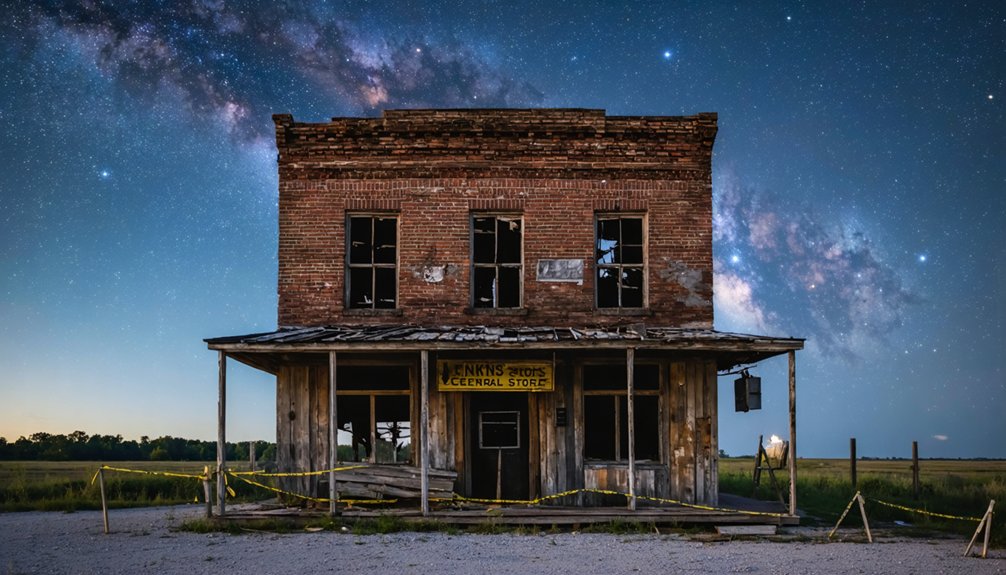
Before visiting any ghost town location for astrophotography, you’ll need to verify property ownership through county records and secure explicit written permission for private land access.
You’ll want to thoroughly document all permits, landowner approvals, and safety protocols in both digital and paper formats to show authorities if questioned during nighttime shoots.
For protection against liability and physical hazards, you should implement an extensive safety plan that includes structural assessments, emergency contacts, and detailed exit strategies.
Private Property Permissions
When photographing ghost towns for astrophotography, you’ll need explicit permission from property owners to access private sites legally. Indiana law strictly prohibits commercial use of ghost town locations without owner consent, and you’ll want to avoid potential squatter removal complications that could interrupt your shoot.
In addition to historical sites, exploring the best drone spots in Indiana can enhance your photography with stunning aerial views. Many of these locations offer breathtaking landscapes and unique perspectives that complement the eerie beauty of ghost towns. Always prioritize safety and adhere to local regulations while navigating these picturesque sites.
To protect yourself and your equipment while accessing ghost town sites:
- Document written permission from property owners, protecting you from trespassing claims.
- Verify the site isn’t under demolition orders through Neighborhood Services, which could compromise safety.
- Confirm your access agreement specifies nighttime photography rights, as standard daytime permissions may not cover astrophotography sessions.
Safe Exploration Guidelines
To guarantee a successful astrophotography session at ghost town sites, you’ll need to implement thorough safety protocols while maintaining strict legal compliance.
Verify site access through Indiana DNR listings and equip yourself with essential gear: GPS devices loaded with offline maps, satellite communicators for no-cell zones, and headlamps with red-light capability.
For safe ghost town exploration in rural areas, carry an extensive first-aid kit with snake bite treatments and establish regular check-in intervals with companions.
Monitor wildlife activity, especially during dawn and dusk hours when coyotes are active. Before entering any site, confirm legal access times, typically sunrise-to-sunset, and secure necessary permits for night photography.
Share your detailed itinerary and coordinates through apps like Find My for emergency response preparedness.
Composition Techniques for Abandoned Structures
Mastering composition techniques for abandoned structures requires a thoughtful balance between architectural geometry and natural decay.
The artful interplay of geometric precision and entropic forces defines compelling compositions of derelict spaces.
When photographing ghost towns at night, you’ll want to leverage composition balance through strategic framing techniques that emphasize both structural elements and the night sky.
- Position your camera using the rule of thirds, placing primary architectural subjects off-center to create negative space for star trails or the Milky Way.
- Frame interior shots through doorways and windows, using natural vignettes to layer your composition between terrestrial foreground and celestial background.
- Utilize leading lines from staircases, beams, and corridors to guide viewers’ eyes toward key astronomical features.
For ideal results, combine HDR bracketing with long exposures to capture both architectural details and star movements.
Remember to stabilize your setup with a robust tripod when shooting these extended nighttime sequences.
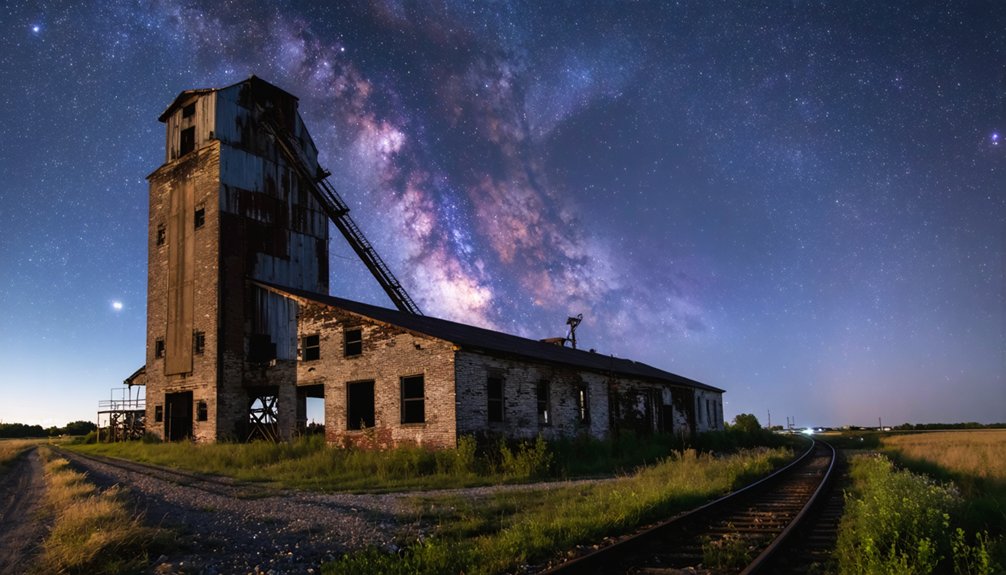
Indiana’s network of 41 documented ghost towns presents unique navigational challenges for astrophotographers seeking dark sky locations.
You’ll need to map your route carefully, as many access roads have deteriorated over time. Check historical society records before attempting ghost town exploration, since local infrastructure often lies abandoned beneath modern developments.
For ideal rural navigation, utilize the available Story Maps and trail guides that pinpoint specific locations like English, Youngs Creek, and Marengo.
You’ll find remnants of Main Streets and railroad corridors, now converted to trails in some areas. Watch for hazards in deteriorating structures and pitch-black tunnels like the 1,731-foot Big Tunnel.
The extensive trail network spans 46 miles, with detailed mileage charts guiding you through the Southern Indiana cluster of thirteen primary ghost towns.
Post-Processing Methods for Night Sky Images
After capturing your ghost town astrophotography shots, post-processing becomes the key to revealing stellar image quality.
Begin with image stacking in DeepSkyStacker to maximize signal-to-noise ratio, combining multiple light frames with dark, flat, and bias calibration frames. This essential step helps eliminate lens vignetting and combat urban light pollution.
Your technical workflow should include:
- Automatic Background Extraction to neutralize sky glow using PixInsight or Photoshop’s advanced masking
- Strategic noise reduction through Topaz DeNoise AI or Gaussian blur iterations
- Deconvolution processing for sharper nebulae and tighter stars
Fine-tune your results by applying targeted star reduction and histogram adjustments.
The combination of these techniques will transform your raw ghost town nightscapes into striking compositions that showcase both historic structures and the cosmos above.
Combining Historical Elements With Celestial Features
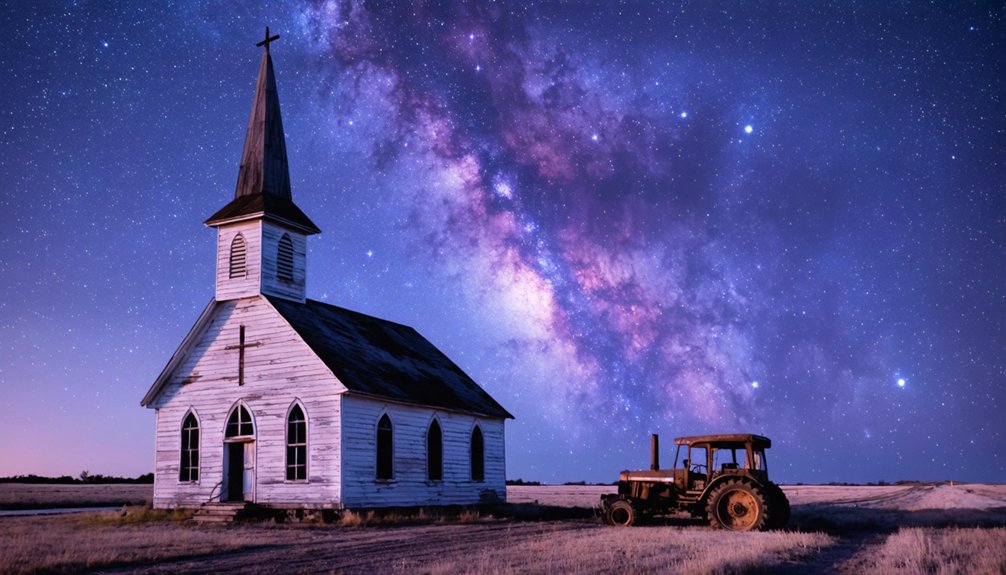
When composing ghost town astrophotographs, you’ll need to strategically position your wide-angle lens to merge architectural remnants with celestial elements above. Scout abandoned railbeds and tunnel portals during daylight to identify leading lines that’ll draw viewers through your frame toward the Milky Way’s core.
Hindostan Falls’ historic mill foundations create powerful geometric anchors against star trails.
To maximize historical significance while capturing celestial alignment, position your tripod near structural remnants that rise vertically, like solitary church ruins or cemetery monuments. These elements create stark silhouettes during long exposures.
Plan your shoots around new moons when targeting sites in Bortle 3-5 zones, and use natural terrain features to block light pollution from nearby cities, ensuring crisp star fields above your chosen ruins.
Frequently Asked Questions
Are There Guided Astrophotography Tours Available to Indiana Ghost Towns?
You’ll find limited formal guided tours, but you can join photography workshops through astronomy clubs, park ranger programs, or hire private guides who’ll arrange custom astrophotography sessions at ghost town sites.
Which Ghost Towns Have the Most Intact Buildings for Night Photography?
Milton and Tunnelton offer you the most intact structures for night landscapes. You’ll find Milton’s Methodist Church and Tunnelton’s Big Tunnel provide excellent foreground elements against starlit skies.
How Do Native American Sites Near Ghost Towns Affect Astrophotography Permissions?
You’ll need special permits near Native American heritage zones – tripods and lighting setups are strictly controlled. Site preservation requirements often limit access to designated trails and daytime hours for astrophotography equipment.
What Insurance Coverage Do I Need for Ghost Town Astrophotography?
Like a sentinel guarding ancient ruins, you’ll need extensive liability ($1M), equipment ($10K per item), vehicle ($300K), and health ($250K) coverage for exploring ghost towns with astrophotography gear.
Can Drones Be Used for Night Photography at Indiana Ghost Towns?
You’ll need Part 107 certification and Remote ID compliance for night drone photography, plus proper lighting. Cold temps affect battery life, so pack extras while following exposure techniques for sharp astrophotography shots.
References
- https://wkdq.com/southern-indiana-ghost-towns/
- https://darksky.org/places/beverly-shores-indiana-dark-sky-community/
- https://www.youtube.com/watch?v=3J6ZADuP0A4
- https://www.go-astronomy.com/dark-sky-parks-stargazing-state.php?State=IN
- https://www.potawatomiwildlifepark.com/darksky
- https://www.nps.gov/indu/stargazing.htm
- https://www.onlyinyourstate.com/trip-ideas/indiana/ghost-town-road-trip-indiana
- https://en.wikipedia.org/wiki/List_of_ghost_towns_in_Indiana
- https://www.youtube.com/watch?v=bRtNz6Ut3BM
- https://www.indianadunes.com/blog/post/our-guide-to-stargazing-in-the-indiana-dunes/