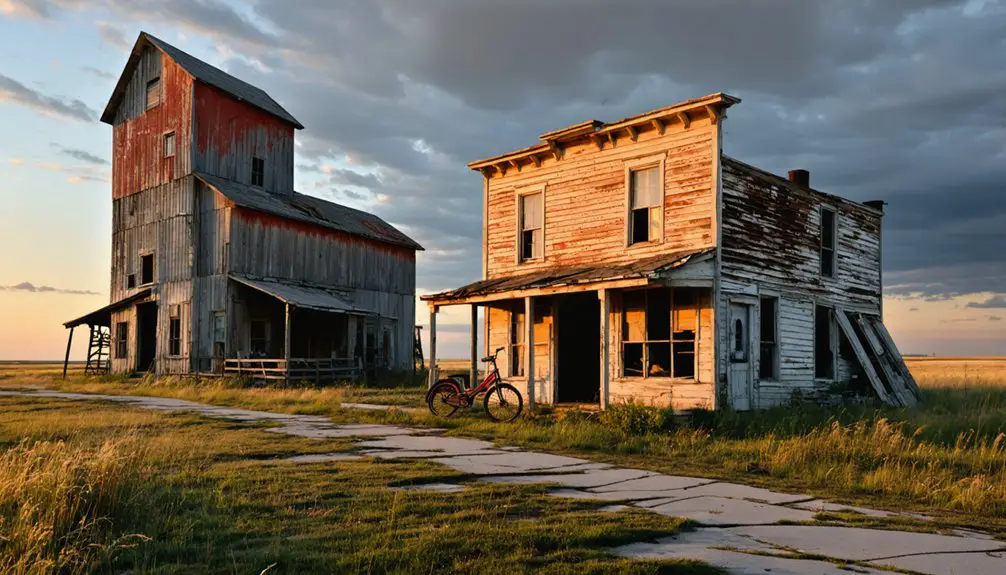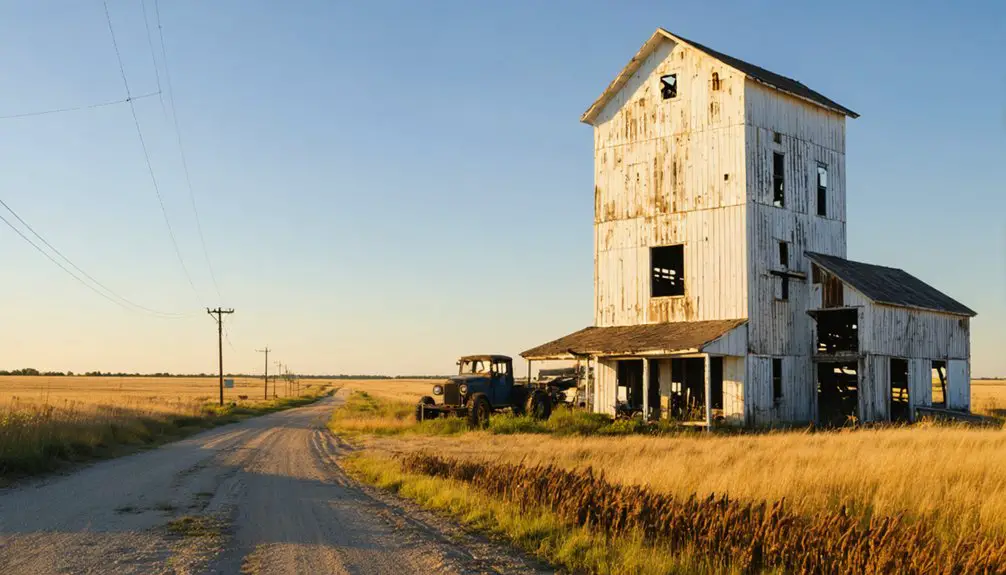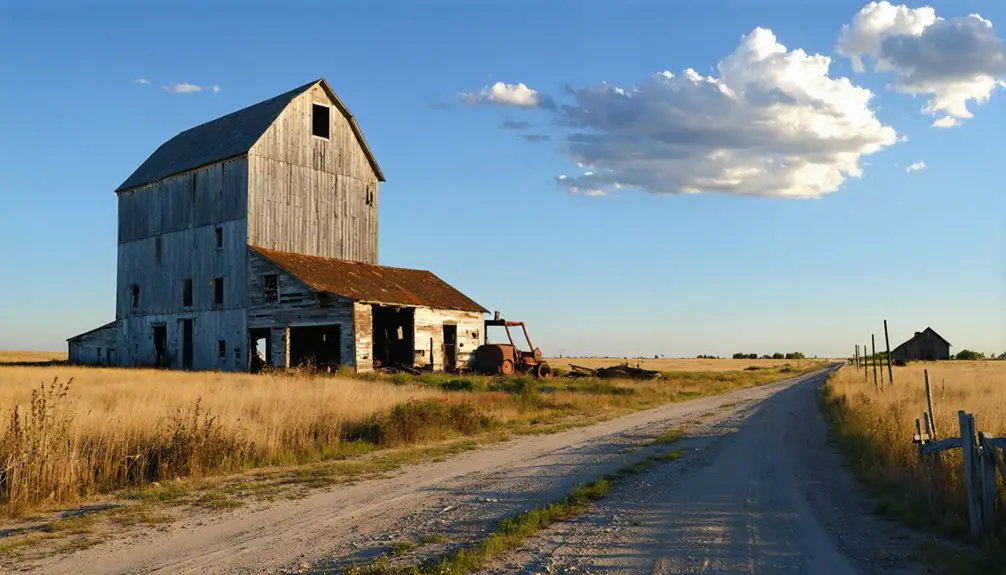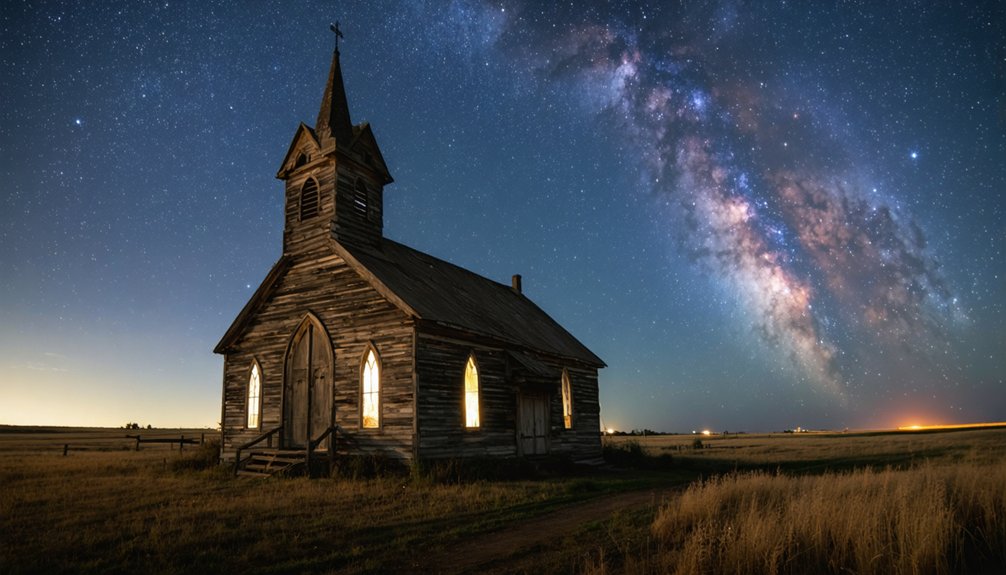
You’ll find exceptional astrophotography conditions in North Dakota’s ghost towns, particularly in Nanson, where Bortle 2-4 dark sky zones offer minimal light pollution. These abandoned sites, typically 20-50 miles from urban centers, feature compelling foreground elements like deteriorating structures and rusting machinery against pristine night skies. The prime shooting season runs late spring through early fall, with autumn providing crystal-clear viewing conditions. Discover how proper equipment and planning can maximize your ghost town night photography experience.
Key Takeaways
- Nanson offers exceptional dark sky conditions and complete freedom from artificial lighting, making it a premier location for astrophotography.
- Ghost towns 20-50 miles from urban centers provide Bortle 2-4 zone darkness levels ideal for capturing the Milky Way.
- North Dakota’s flat prairie terrain and low vegetation around ghost towns create unobstructed horizons perfect for night sky photography.
- Late spring through early fall provides optimal shooting conditions, with autumn offering particularly clear skies and extended dark hours.
- Abandoned structures and rusting machinery in ghost towns create compelling foreground elements for night sky compositions.
What Makes Ghost Towns Ideal for Night Sky Photography
While many locations offer dark skies for astrophotography, North Dakota’s ghost towns provide an exceptional combination of natural darkness and compelling foreground elements.
These remote sites typically sit 20-50 miles from urban centers, placing them in favorable Bortle 2-4 zones with minimal light pollution. The ghost town characteristics you’ll encounter – deteriorating structures, rusting machinery, and abandoned churches – create distinctive silhouettes against the night sky. Many of these sites are remnants of towns that were submerged by Lake Sakakawea. Several locations like Arena and Lark are easily accessible within an hour’s drive from Bismarck.
Far from city lights, North Dakota’s abandoned settlements offer pristine dark skies and haunting architectural forms perfect for nighttime compositions.
You’ll find these locations particularly advantageous for night photography due to their accessibility via secondary roads while maintaining vital distance from artificial lighting. The continental climate delivers clear, dry conditions ideal for capturing faint celestial objects, especially during late fall through early spring.
The flat prairie terrain and low vegetation guarantee unobstructed horizons, maximizing your compositional options for Milky Way alignment and panoramic shots.
Essential Equipment for Ghost Town Astrophotography
Three core equipment categories form the foundation for successful ghost town astrophotography: an imaging system, stabilization gear, and supporting accessories.
Your choice of camera types ranges from entry-level smartphones with manual controls to advanced DSLR/mirrorless systems and specialized cooled astro-cameras for deep-sky work. Proper lens selection proves critical for capturing both expansive ghost town scenes and detailed celestial objects. Using apps like NightCap or ProCam can maximize your smartphone’s low-light capabilities. An equatorial mount is essential for accurately tracking celestial objects as they move across the night sky.
- For wide-field shots, pair your camera with a 14-35mm lens and light pollution filter to reveal the Milky Way over abandoned structures.
- Mount your setup on a sturdy tripod with a star tracker to enable exposures up to 5 minutes at 100mm focal length.
- Deploy essential accessories like intervalometers, dew heaters, and external power supplies to maintain continuous operation throughout the night.
Planning Your Ghost Town Photo Adventure
When you’re photographing ghost towns after dark, you’ll need to prioritize both personal safety and equipment protection through careful advance planning and proper emergency gear.
Your essential checklist should include backup lighting, GPS units, emergency shelter, first aid supplies, and communication devices that function in remote areas without cellular coverage.
Consider using the Ghosts of North Dakota website to plot your exact locations in advance.
North Dakota’s prime ghost town astrophotography season runs from late spring through early fall when clear skies align with accessible road conditions, though winter shoots can yield dramatic results if you’re properly equipped for extreme cold.
Nanson offers exceptional dark sky conditions since there are no power lines or artificial lighting to interfere with star photography.
Safety After Dark
As midnight approaches in North Dakota’s ghost towns, photographers must systematically address multiple safety risks before pursuing their nocturnal shots. Your essential safety gear should include multiple light sources, thermal protection, and communication devices for remote locations where cell service is unreliable. Sturdy tripods become critical safety tools for maintaining balance while navigating dark, uneven terrain. With temperatures dropping to below freezing after dark, proper winter clothing is essential for extended shoots.
Wildlife awareness and structural hazards demand heightened vigilance after dark.
- Never explore alone – partner with fellow photographers to navigate hazardous terrain and monitor weather conditions that can rapidly deteriorate.
- Maintain constant situational awareness of rotting floors, unstable foundations, and concealed obstacles hidden by tall grass.
- Establish clear protocols with your group for emergency scenarios, keeping detailed location coordinates and maintaining regular check-ins with outside contacts.
Stay within designated safe zones and respect private property boundaries, even when capturing compelling nighttime compositions.
Essential Gear Checklist
Successfully capturing ghost town astrophotography requires specific gear optimization for both safety and image quality in North Dakota’s remote locations.
Pack your primary camera body like the Canon EOS R6 or Sony a7 III, along with fast wide-angle lenses such as the 50mm f/1.8 for maximum light gathering. You’ll need a reliable star tracker – the Sky-Watcher Star Adventurer or iOptron Sky Tracker mount paired with a sturdy tripod guarantees precise tracking. A Bahtinov mask helps achieve critical focus on bright stars for sharper images. For optimal image quality in low light conditions, consider using a refractor telescope like the Vixen FL55SS for detailed wide-field shots.
Don’t forget critical accessories: a headlamp for camera maintenance in darkness, lens cleaning supplies to combat dust, and the ASIAIR Plus controller for automated shooting sequences.
Power management is essential – bring the Celestron 7aH battery and dew heaters to prevent lens fogging in North Dakota’s cold nights. An intervalometer enables exposures beyond 30 seconds for capturing the Milky Way above abandoned structures.
Best Shooting Seasons
Planning ghost town astrophotography expeditions in North Dakota requires strategic seasonal timing to maximize image quality and shooting conditions. The region’s best viewing windows align with natural sky phenomena and weather patterns that enhance your chances of capturing stunning night sky compositions.
- Late summer (July-September) offers prime Milky Way core visibility and comfortable overnight temperatures, ideal for extended ghost town shooting sessions.
- Autumn (September-November) delivers superior atmospheric transparency and lower humidity levels, dramatically improving contrast for capturing faint celestial details.
- Winter provides the longest dark periods with exceptional sky clarity, though you’ll need to carefully manage gear in sub-zero temperatures and plan shorter exposure windows.
Consider targeting major meteor showers like the August Perseids or December Geminids, timing your shoots around new moon periods for maximum dark sky potential.
Top Dark Sky Locations Among North Dakota Ghost Towns
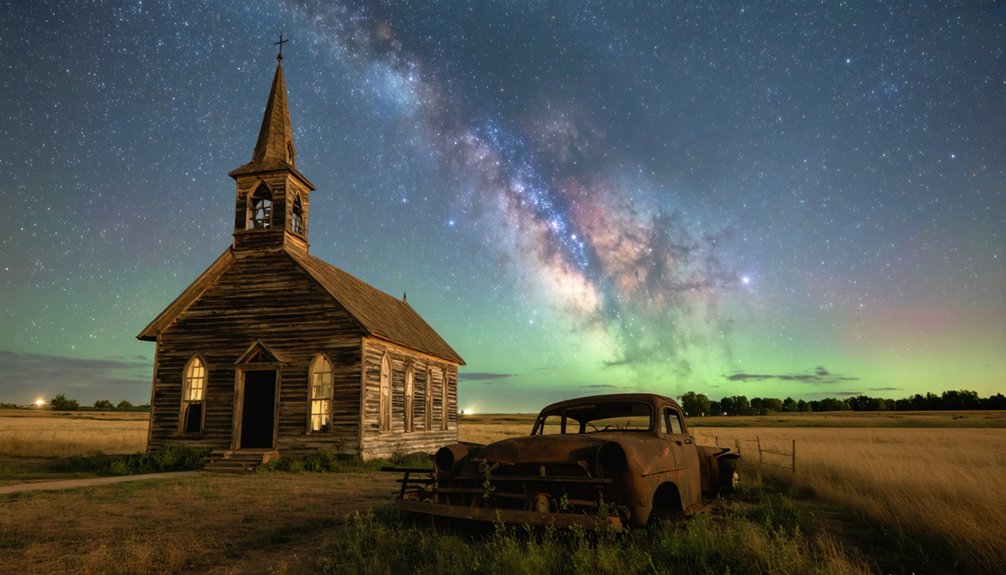
North Dakota’s most remote ghost towns offer exceptional dark sky viewing conditions for astrophotography, with several locations achieving Bortle 2-3 ratings.
Hidden amid North Dakota’s deserted towns lie some of America’s darkest skies, perfect for capturing the cosmos in stunning detail.
You’ll find prime shooting opportunities at Old Sanish and Elbowoods, now submerged beneath Lake Sakakawea, where surrounding state parks provide excellent vantage points for capturing the Milky Way.
Sims, with its historic Lutheran church, offers unobstructed prairie views near Theodore Roosevelt National Park’s dark skies.
Arena’s isolated fields northeast of Bismarck present clear horizons perfect for night photography, while Tagus’s position near Crow Flies High Butte delivers potentially Bortle 2 conditions.
These abandoned settlements, free from urban light pollution, connect ghost town history with pristine night skies, debunking myths that you need to travel to remote mountains for quality astrophotography.
Safety Tips for Night Photography in Abandoned Sites
While ghost towns offer extraordinary opportunities for astrophotography, shooting at night in abandoned locations requires meticulous safety protocols to mitigate potential hazards. Your night vision requires 30 minutes to fully adapt, so prepare your gear and scout locations during daylight hours.
Wildlife encounters are possible in these remote areas, making the buddy system essential for maintaining situational awareness.
- Pre-map your shooting locations using satellite imagery and mark stable ground zones, emergency exits, and potential hazards.
- Deploy GPS tracking devices and share your intended location with trusted contacts before entering abandoned sites.
- Utilize headlamps with red light settings to preserve night vision while maneuvering between composition points.
Remember to dress in protective layers and carry minimal equipment to maximize mobility through unstable terrain.
Best Seasons for Ghost Town Stargazing
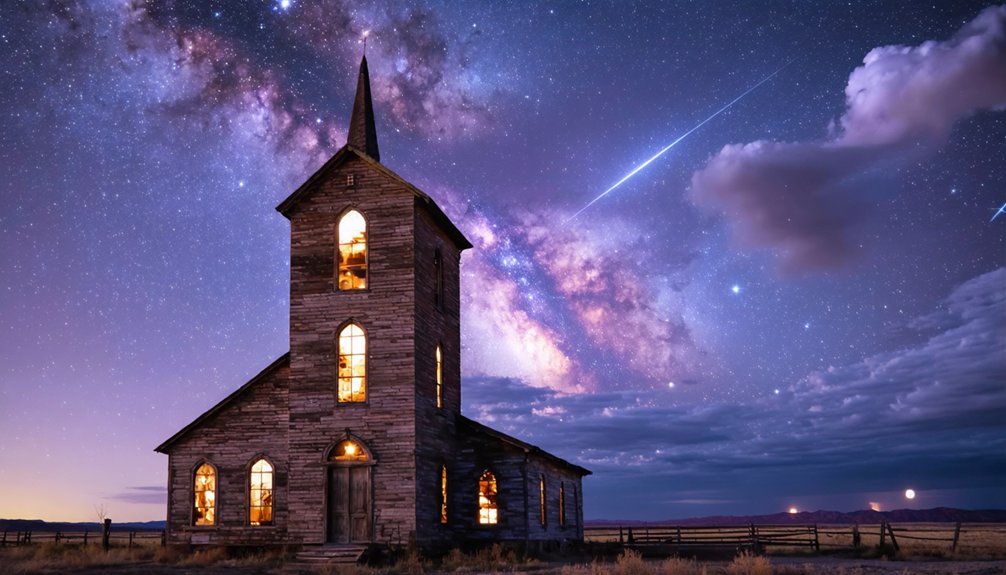
Each season in North Dakota presents distinct advantages for ghost town astrophotography, with summer offering premier conditions for celestial observation.
You’ll find ideal summer stargazing during the Perseid meteor shower from July through August, when you can capture up to 60 meteors per hour against abandoned town backdrops.
Autumn exploration yields crisp, clear skies perfect for Milky Way photography at sites like Wheelock and Arena.
Fall’s pristine skies create ideal conditions for capturing the Milky Way above North Dakota’s forgotten towns of Wheelock and Arena.
You’ll benefit from September’s extended dark hours and reduced atmospheric haze.
Winter delivers the longest nights and frequent Northern Lights displays, particularly visible from remote locations like Tagus.
Spring’s warming temperatures ease equipment handling, though you’ll have shorter windows for shooting.
For maximum flexibility, target Bortle 2-3 locations like Theodore Roosevelt National Park’s overlooks or Lake Sakakawea’s dark skies year-round.
Capturing the Milky Way Above Historic Ruins
Along Highway 12, Griffin Ghost Town‘s scattered ruins provide compelling foreground elements for Milky Way photography against North Dakota’s dark rural skies. The remote location’s minimal light pollution reveals starry nights in stunning clarity, while ghost town legends come alive through careful composition of weathered structures against the galactic core.
- Frame shots from the roadside using the historic wagon with its mysterious skull, positioning the Milky Way’s arc above.
- Light paint the dried lumber pile remnants and unoccupied buildings for dimensional depth in long exposures.
- Utilize the flat terrain and open valleys for unobstructed southern horizon views, maximizing galactic core visibility.
Technical considerations include respecting private property boundaries while capturing wide-angle perspectives of the ruins beneath the stars from Highway 12 access points.
Recommended Camera Settings and Techniques
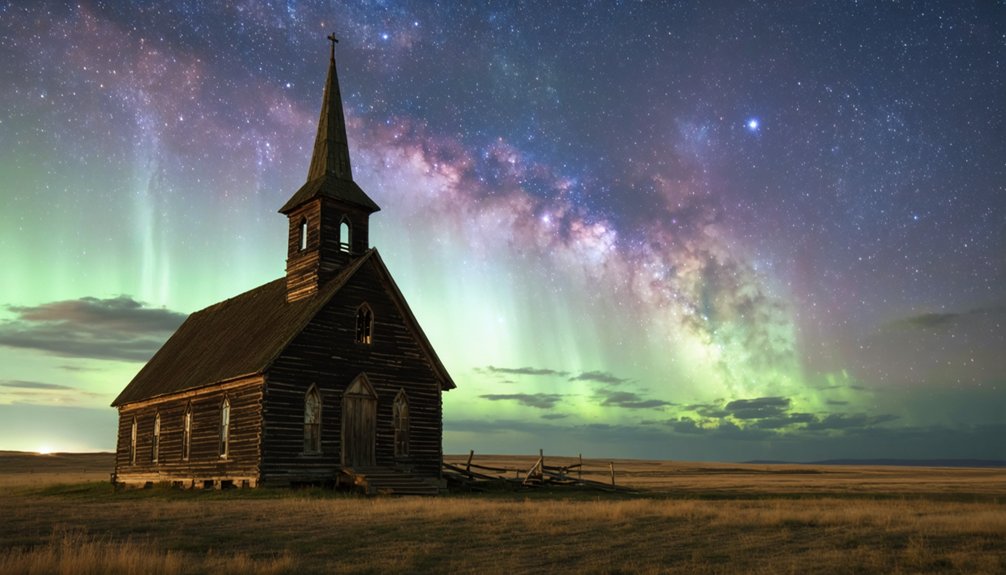
To capture stunning Milky Way photographs above North Dakota’s ghost towns, you’ll need precise technical settings that balance light gathering with star sharpness. Set your aperture as wide as possible (f/1.2-f/2.8) and start with ISO between 1600-6400, adjusting based on your sensor’s capabilities.
Calculate your maximum shutter speed using the 500 rule to prevent star trails.
For ideal camera techniques, shoot in RAW and use manual focus, finding infinity focus on a bright star through live view. Light paint ghost town structures using dim LED panels for 1-3 minutes with multiple passes.
Position yourself to minimize light pollution from nearby towns. Consider using a star tracker for deeper sky detail, capturing separate exposures for the foreground and sky to blend later in post-processing.
Permits and Access Guidelines for Ghost Town Photography
While North Dakota’s ghost towns offer incredible astrophotography opportunities, accessing these locations requires strict adherence to property rights and permit protocols.
You’ll need to secure proper permissions before exploring these historically rich sites, as most remain under private ownership. While no statewide filming permits are required, municipal locations demand paperwork filed one week in advance.
- Contact property owners directly for access to sites like Tagus, Griffin, and Trotters near Little Missouri National Grasslands
- Coordinate with the Division of Tourism for location scouting support and specific permitting needs
- Verify public domain status when using existing ghost town photographs, as many are freely available through the Ghosts of North Dakota photo library
Remember to check access guidelines for each location, as rules vary – from active church properties in Sims to completely abandoned sites like Lark.
Frequently Asked Questions
How Do Ghost Towns Compare to National Parks for Light Pollution Levels?
You’ll find ghost towns have highly variable light pollution levels due to oil field proximity, while national parks consistently maintain darker Bortle 2-3 skies with controlled artificial lighting and protected viewsheds.
Are There Guided Astrophotography Tours Available to These Ghost Town Locations?
Despite 37 documented ghost towns in North Dakota, you won’t find guided tours or photography workshops specifically for astrophotography. You’ll need to explore these remote locations independently for your night sky shots.
Photographing abandoned places in North Dakota offers a unique opportunity to capture the eerie beauty of these forgotten sites under the vast night sky. As you wander through the remnants of old buildings and rusted machinery, the contrast of the dark silhouettes against a backdrop of twinkling stars can create stunning compositions. Each location tells its own story, making it perfect for both seasoned photographers and those looking to begin their journey in capturing the wonders of the night.
Which Ghost Towns Have Cell Phone Coverage for Emergency Situations?
You’ll find reliable cell service availability near Divide County’s ghost towns with repurposed tower structures. For emergency communication options, stick to locations within Verizon’s 92% or AT&T’s 93% coverage zones.
Can You Legally Camp Overnight at These Ghost Town Sites?
While 85% of North Dakota’s ghost towns sit on private land, you’ll need explicit permission there. For public lands, check camping regulations and obtain overnight permits from relevant authorities.
What Wildlife Encounters Should Photographers Be Prepared for at Night?
You’ll encounter nocturnal behavior from white-tailed deer, coyotes, owls, bats, rodents, and potentially mountain lions. Monitor surroundings, secure equipment, and maintain distance from nighttime animals to prevent unwanted interactions.
References
- https://us1033.com/exploring-bismarck-ghost-towns-north-dakota/
- https://ghostsofnorthdakota892857007.wordpress.com/2015/10/30/true-ghost-towns-population-zero/
- https://www.go-astronomy.com/dark-sky-parks-stargazing-state.php?State=ND
- https://keyzradio.com/nosodak-ghost-town-north-dakota/
- https://www.youtube.com/watch?v=8GO57Im_dss
- https://www.onlyinyourstate.com/state-pride/north-dakota/never-completed-abandoned-place-nd
- https://www.ndtourism.com/north-dakota-northern-lights-and-stargazers-heaven
- https://en.wikipedia.org/wiki/List_of_ghost_towns_in_North_Dakota
- https://northernsentry.com/2025/06/26/north-dakota-ghost-towns/
- https://www.amyallender.com/north-dakota-ghost-towns/