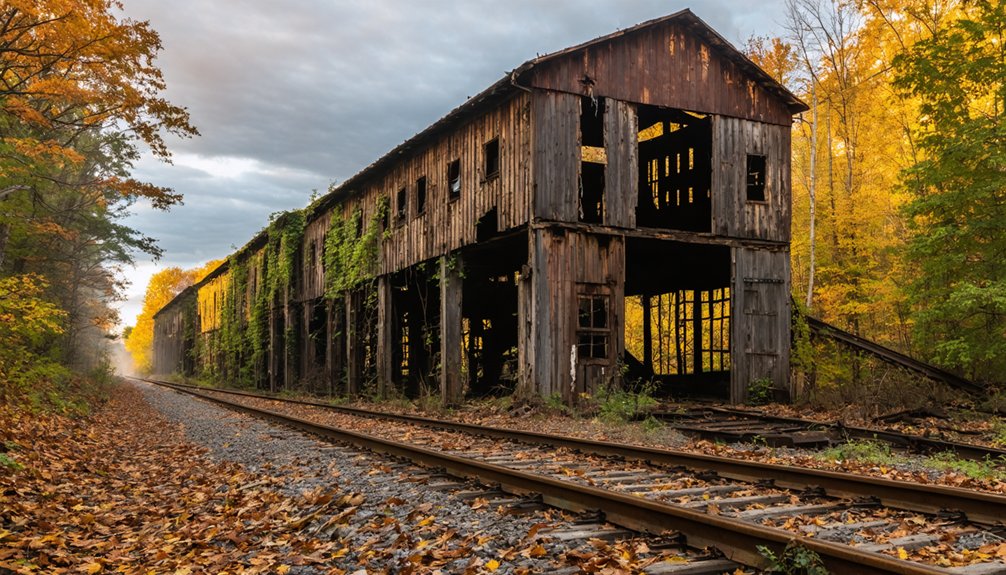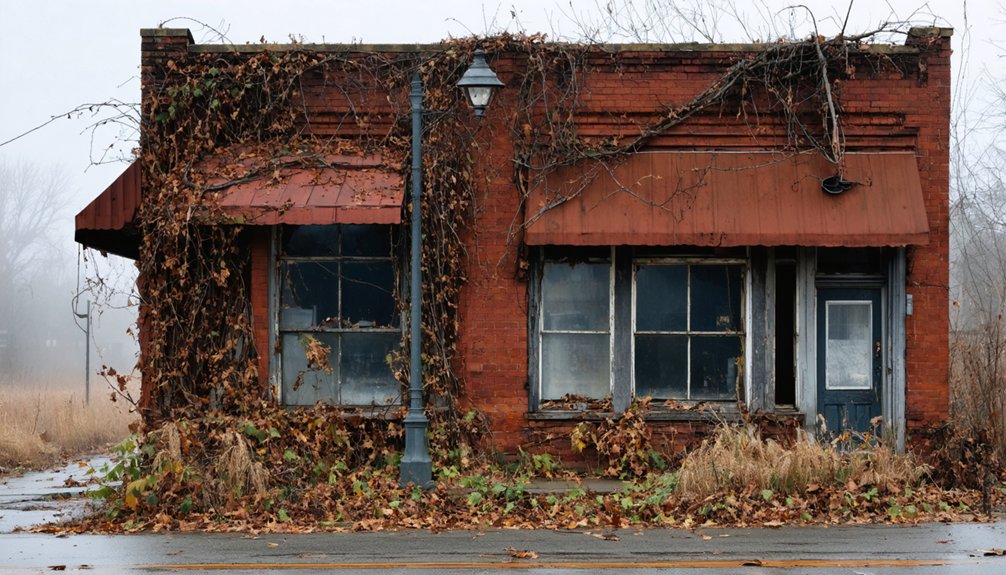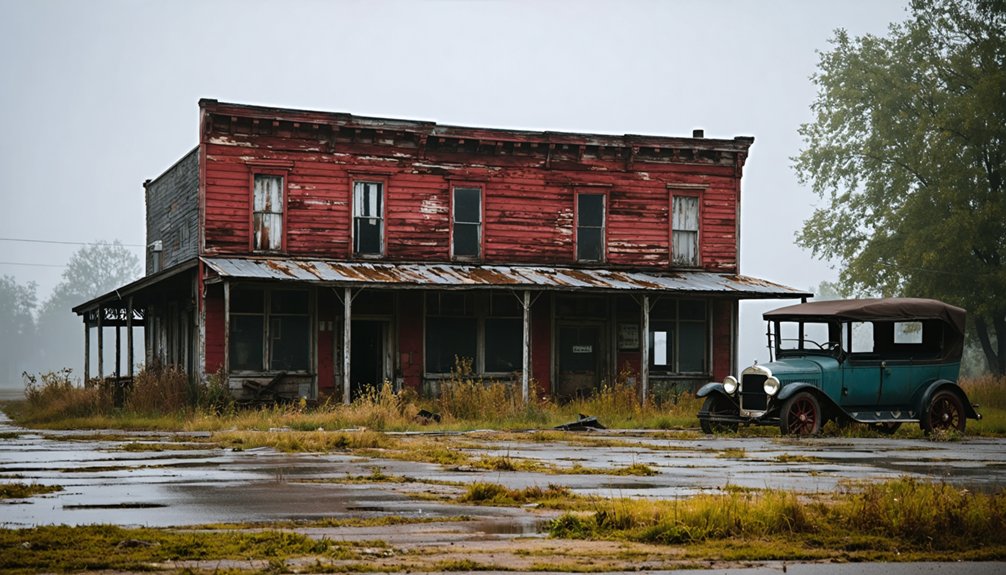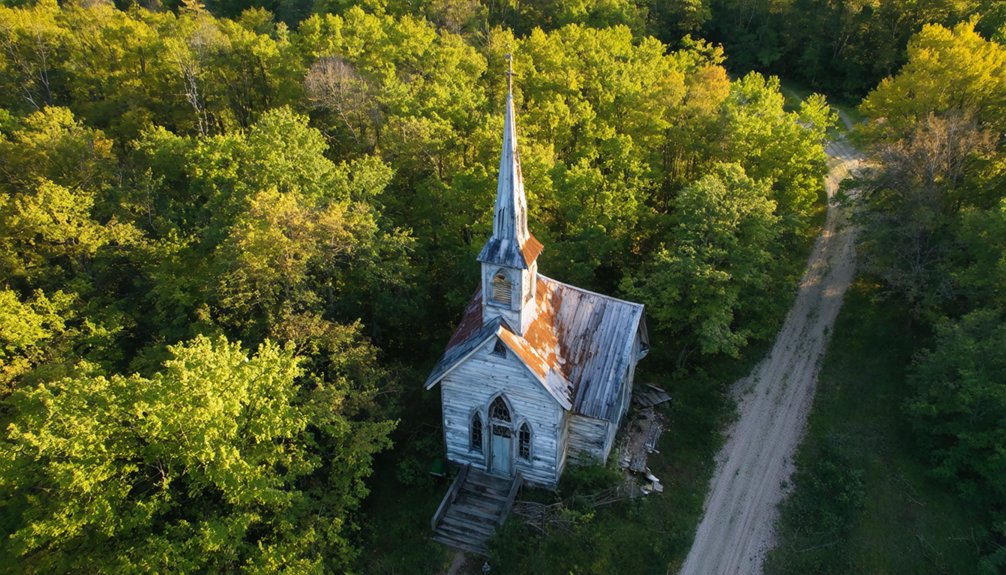
You’ll find Indiana’s richest drone photography opportunities at Gary’s urban ruins, featuring 142-foot church walls and striking architectural decay. The submerged structures of Elkinsville offer unique water-meets-stone compositions, while City West’s dune-swept remnants create compelling aerial perspectives. Capture ideal shots during golden hours (May-June, September-October) when temperatures moderate and lighting angles dramatize structural elements. These locations just scratch the surface of Indiana’s 100+ documented ghost towns waiting to be explored.
Key Takeaways
- Elkinsville offers submerged structures and a historic bridge, creating unique aerial perspectives for drone photography during optimal light conditions.
- Gary’s abandoned buildings, including its 142-foot church walls, provide dramatic urban decay shots perfect for architectural drone compositions.
- City West’s dune ruins offer stunning winter photography opportunities when low-angle sunlight creates dramatic shadows across the landscape.
- Brown County ghost towns feature spectacular fall foliage backgrounds, making September-October ideal for aerial documentation.
- Early morning flights before 9 AM provide the best lighting and stable conditions for ghost town drone photography across Indiana.
Where better to begin your aerial ghost town exploration than Indiana’s diverse collection of abandoned settlements? From Elkinsville’s submerged structures beneath Lake Monroe to Gary’s urban decay, you’ll discover remarkable vantage points showcasing historical significance.
Your drone can capture the haunting Elkinsville Bridge and cemetery headstones against Brown County’s forested backdrop, while Gary’s 142-foot church walls and hidden Union Station artwork offer striking aerial perspectives. Most structures were evacuated in 1964 for relocation as the area prepared for Lake Monroe’s creation. With over 100 documented locations across the state, Indiana’s ghost towns provide endless opportunities for aerial documentation.
For architectural diversity, hover above Teleton’s Big Tunnel entrance and the ornate Alfred Guthrie Mansion, then sweep across Millville Canal’s restored locks.
The Southern Indiana cluster provides unique compositional opportunities, from Greenville’s Masonic lodge to Saline City’s canal remnants. Each site reveals Indiana’s forgotten chapters through your lens, with unrestricted access to previously hard-to-document angles.
Essential Drone Equipment for Ghost Town Photography
When capturing ghost town aerial photography, your vital equipment starts with high-capacity batteries and reliable stabilization systems.
You’ll need multiple batteries to extend flight time, while three-axis gimbals guarantee smooth footage even in challenging wind conditions.
Your drone accessories should include ND filters to manage exposure in bright conditions, with ND16 filters particularly useful for capturing long exposures of deteriorating structures. Regular gear maintenance schedules will ensure optimal performance and longevity of your drone equipment.
High-speed microSD cards prevent recording interruptions during extended aerial shoots, while wide-angle lenses help capture expansive views of abandoned sites.
Don’t overlook protection gear – carrying cases and landing pads are essential for safe operations in rugged terrain. Consider adding the Hoodman Drone Aviator Hood to reduce screen glare when flying in bright conditions.
Pack extra propellers and cleaning kits to maintain reliability while pursuing unique aerial perspectives of Indiana’s forgotten settlements.
Legal Requirements and Permits for Aerial Documentation
You’ll need to register your drone with the FAA and display the registration number if it weighs more than 0.55 pounds, while also carrying proof of your Part 107 certification for commercial photography or TRUST certificate for recreational flights.
Before launching at ghost town sites, you must verify airspace restrictions through the B4UFLY app or FAA resources, particularly near airports or controlled zones where LAANC authorization may be required.
Securing written permission from property owners or land managers is essential, as many ghost towns exist on private land or state-managed properties that require special permits for aerial documentation. Motor-driven aircraft are prohibited on DNR properties except at specifically designated sites.
While not mandatory, obtaining drone liability insurance is strongly recommended to protect against potential damage or injury claims during ghost town photography sessions.
Drone Registration Requirements
Before capturing aerial footage of ghost towns, photographers must comply with the Federal Aviation Administration‘s drone registration requirements.
You’ll need to register your drone if it weighs over 0.55 pounds through the FAADroneZone portal. The registration process requires your drone’s make and model, contact information, and payment method. For recreational flights, one $5 registration covers all your drones for three years, while Part 107 operations require individual $5 registrations per drone. Failure to register can result in fines up to $10,000 for unregistered flights.
All pilots must maintain visual line of sight when operating their drones at ghost town locations. Remember that by 2025, your drone must be Remote ID compliant, either through built-in capability or an add-on broadcast module.
You’ll need to display your registration number on the exterior of your drone and carry proof of registration while flying. Only U.S. citizens or legal permanent residents aged 13 and older can register.
Flight Zone Restrictions
Aerial photography of ghost towns requires careful navigation of multiple airspace classifications and regulatory frameworks. Before launching your drone, you’ll need to verify flight zone restrictions and secure proper authorizations to avoid legal complications. All pilots must complete TRUST certification before flying recreationally over ghost towns.
- Check UAS Facility Maps for specific altitude limits around your ghost town location.
- Obtain LAANC authorization if the site falls within controlled airspace (Class B/C/D/E).
- Submit manual authorization through DroneZone if LAANC isn’t available (plan 90 days ahead).
- Maintain visual line-of-sight throughout your documentation flight.
- Verify local ordinances and secure any required DNR permits for state-owned ghost towns.
Remember that Indiana’s state parks and DNR properties generally prohibit drone operations without special permission.
You’ll need to stay below 400 feet in Class G airspace unless specifically authorized, and always check for active TFRs before capturing your historic architectural shots.
Consider joining the Indiana drone Facebook Group to connect with experienced pilots who can share location-specific insights and tips.
Property Owner Permissions
While documenting ghost towns from above requires technical expertise, securing proper property permissions stands as the critical first legal step.
You’ll need written consent agreements from property owners to avoid misdemeanor charges under Indiana law, even when flying in navigable airspace. Your documentation should clearly outline permitted flight boundaries, altitudes, and intended usage rights for the captured imagery.
For state-owned ghost towns, you’ll need specific DNR permits and approval from site managers before launch.
Don’t assume abandoned properties are exempt from property rights – all aerial photography of private land requires explicit permission.
Draft detailed consent forms that include model-release language and distribution rights to protect yourself from future legal disputes.
Remember that repeat violations can escalate to felony charges under Indiana drone statutes.
Weather Conditions and Best Times for Drone Flights
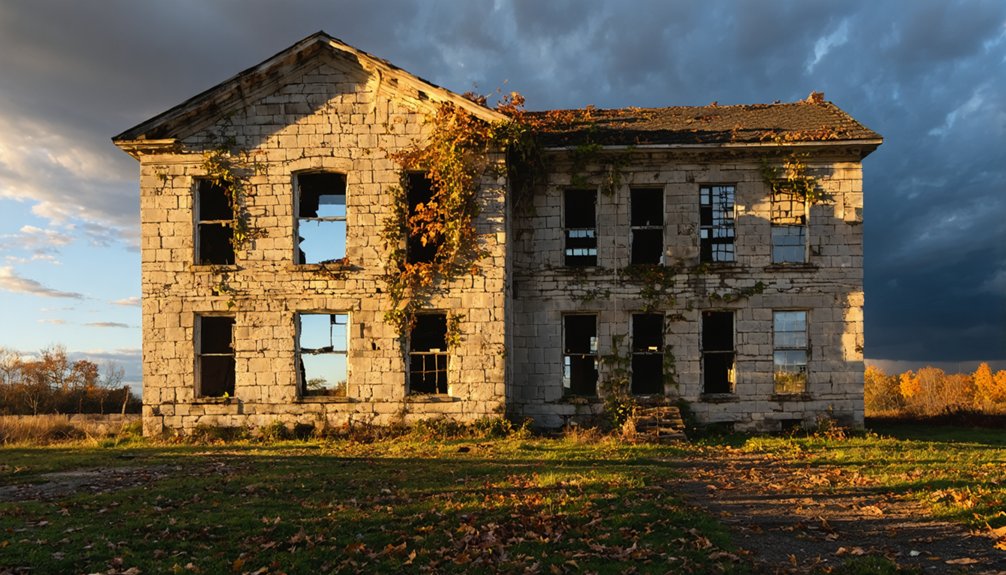
You’ll find ideal drone photography conditions during the golden hours of May-June and September-October, when moderate temperatures combine with dramatic lighting angles to create compelling architectural compositions.
Your flight planning should account for Indiana’s wind patterns, with sustained speeds typically ranging from 6-12 mph, and avoid the severe weather window of peak thunderstorm activity from May through July.
For technical stability and extended battery performance, schedule your ghost town documentation flights during early morning hours when thermal conditions remain stable and visibility typically exceeds the required 3-mile minimum for visual line-of-sight operations.
Seasonal Light Effects
Dramatic seasonal changes across Indiana’s ghost towns create distinct lighting conditions that can release your drone photography throughout the year.
Master these atmospheric effects to capture compelling aerial compositions in abandoned locations across the state.
- Fall’s peak foliage in Brown County intensifies contrast against Elkinsville’s skeletal structures, while diffused light enhances weathered textures.
- Winter’s low-angle sun at City West casts dramatic shadows across dune ruins, with Chicago’s skyline as backdrop.
- Spring’s soft light perfectly reveals Whitewater Canal’s 14-mile stretch and historic locks under gentle haze.
- Summer’s long days illuminate Teleton tunnel’s mysterious depths and architectural details.
- Dawn/dusk shifts in Gary disclose hidden artistic elements in decaying urban landmarks, from the Methodist Church to Union Station.
Master seasonal lighting patterns to release creative freedom and capture Indiana’s forgotten places from entirely new perspectives.
Weather Risk Mitigation
Before launching your drone at Indiana’s ghost towns, understanding weather-related risks becomes essential for both equipment safety and image quality. Monitor weather patterns closely, especially during spring and late summer when thunderstorms can create dangerous wind conditions.
Keep your flights within your drone’s wind limitations, typically 10-20 mph for consumer models, and reduce these thresholds by 25% for added safety.
Avoid flying in precipitation, fog, or when humidity exceeds 80%, as these conditions can damage equipment and compromise image quality.
In cold weather below 32°F, expect considerably shorter flight times and warm your batteries before launch. During summer heat waves, plan early morning shoots to avoid thermal shutdowns.
Always maintain a larger battery reserve when fighting headwinds or operating in extreme temperatures.
Peak Flight Hours
Successful ghost town drone photography hinges on identifying perfect flight windows throughout the day. For best flight times in Indiana’s abandoned settlements, you’ll want to leverage the calm conditions and dramatic lighting during early mornings and late afternoons.
Exploring the best ghost towns in Indiana can also reveal fascinating stories of the past, enhancing your photographic journey. Each abandoned location offers unique scenery and a glimpse into history, making them perfect subjects for drone photography. Be sure to plan your visits to capture the rich textures and haunting beauty these ghost towns have to offer.
As you navigate the ghost towns in Indiana cinema, you may find inspiration not only in the eerie landscapes but also in the legends that accompany these forsaken places. Each town, often featured in films or documentaries, tells a story that transcends time, inviting filmmakers and photographers alike to capture their essence. The interplay of light and shadow across these dilapidated structures can evoke a haunting atmosphere perfect for creative expression.
- Launch before 9 AM to capture crisp architectural details in the soft morning light
- Schedule afternoon shoots after 3 PM during the golden hour for atmospheric shots
- Skip midday flights between 10 AM-2 PM when harsh sunlight flattens textures
- Time your flights within 1-2 hours of sunrise/sunset for minimal turbulence
- Plan winter missions between 10 AM-2 PM to maximize limited daylight
Your best shooting conditions come when temperatures range 50-65°F with winds under 10 mph.
These parameters guarantee stable flights while maximizing battery life and image quality as you document Indiana’s historic ruins.
Architectural Highlights Through the Aerial Lens

Through strategic drone positioning, Indiana’s ghost towns reveal compelling architectural narratives from unique vantage points.
Aerial perspectives unveil forgotten stories in Indiana’s abandoned towns, where each weathered structure speaks volumes from above.
You’ll capture the haunting contrast of the 142-foot Gary Methodist Church‘s collapsed roof against the urban skyline, while Elkinsville’s hollowed-out 1800s structures create striking compositions amid Lake Monroe’s waterline.
The architectural decay of City West’s abandoned 22-room hotel tells a story of ambitious development frozen in time.
For historical preservation enthusiasts, your drone can document Millville’s restored canal locks and grist mill from angles impossible to achieve on foot.
In Teleton, you’ll find the 1,731-foot Big Tunnel and Alfred Guthrie Mansion offering dramatic aerial perspectives.
Frame these structures against Brown County’s natural foliage or Gary’s urban grid to emphasize the poignant intersection of human ambition and time’s relentless march.
Safety Guidelines for Ghost Town Drone Operations
Before launching your drone over a ghost town site, you’ll need to complete essential legal requirements including FAA registration, TRUST certification for recreational flights or Part 107 certification for commercial work, and verification of local permits.
Your equipment must be in peak condition with fully charged batteries, calibrated controls, and properly functioning safety features like return-to-home and obstacle avoidance systems.
You’ll need to carefully monitor weather conditions, maintaining awareness of wind speeds, precipitation risks, and visibility factors that could impact your flight safety and image quality.
Drone Flight Legal Requirements
When planning drone photography at ghost towns, you’ll need to navigate a complex framework of federal, state, and local regulations that govern unmanned aircraft operations.
Before launching your aerial photography mission, guarantee compliance with these critical requirements:
- Complete the FAA TRUST test and register drones over 250g, displaying registration numbers as required
- Equip your drone with Remote ID broadcasting capability unless flying in an approved FRIA
- Obtain Part 107 certification if conducting commercial photography or paid client work
- Stay within visual line of sight and under 400 feet AGL unless near structures
- Check local DNR permits, airspace restrictions, and municipal ordinances specific to ghost town locations
Remember that Indiana law prohibits unauthorized surveillance and wildlife harassment, while DNR rules restrict drone operations on state-managed lands except in designated areas.
Equipment Safety Precautions
Operating drones safely around ghost towns demands rigorous equipment protocols and heightened situational awareness.
You’ll need to register your drone with the FAA if it weighs over 0.55 pounds and keep proof of your Recreational UAS Safety Test completion on hand.
Essential drone maintenance tips include conducting pre-flight inspections and guaranteeing all components are secure before takeoff.
Implement smart battery management strategies by carrying spare batteries and monitoring power levels closely in these remote locations.
When exploring abandoned structures, maintain safe distances to prevent collision damage, and stay alert for potential aviation hazards or critical infrastructure.
Report any incidents to law enforcement and the FAA immediately.
Following community-based safety guidelines helps guarantee successful ghost town documentation while protecting both your equipment and these historic sites.
Weather Condition Monitoring
Successful drone photography at ghost towns hinges on meticulous weather monitoring and adherence to strict meteorological thresholds. Your seasonal weather patterns research should inform flight scheduling, particularly during Indiana’s challenging winter and spring conditions.
Leverage modern weather monitoring tools to protect your equipment and maintain safety standards.
- Check METAR/TAF reports within 20 miles of your ghost town location for wind and visibility conditions
- Monitor high-resolution radar for sudden thunderstorm development and microburst potential
- Track hourly temperature trends to avoid battery-draining cold conditions below 32°F
- Assess surface wind forecasts against your drone’s specific wind rating thresholds
- Review satellite imagery for precise cloud cover patterns over your shooting location
Remember to establish clear go/no-go criteria based on these measurements, and don’t hesitate to postpone flights when conditions approach safety limits.
Preserving History Through Aerial Photography
Through innovative drone photography, aerial documentation has revolutionized how we preserve ghost town history.
You’ll capture sweeping vistas that reveal hidden landscape relationships and structural patterns impossible to see from ground level, enhancing historical interpretation of these abandoned settlements.
When you conduct drone surveys, you’re creating precise time-stamped records that track structural decay, vegetation growth, and environmental changes.
Before launching your drone, verify you’ve secured necessary permissions from landowners and managing agencies, especially for sites within protected areas.
You’ll need Part 107 certification for commercial documentation work.
Remember to save your raw files with complete metadata and standardized naming conventions – these details matter for long-term archival value.
Consider partnering with local historical societies to share your aerial imagery while being mindful of site preservation concerns.
Technical Tips for Capturing Abandoned Structures
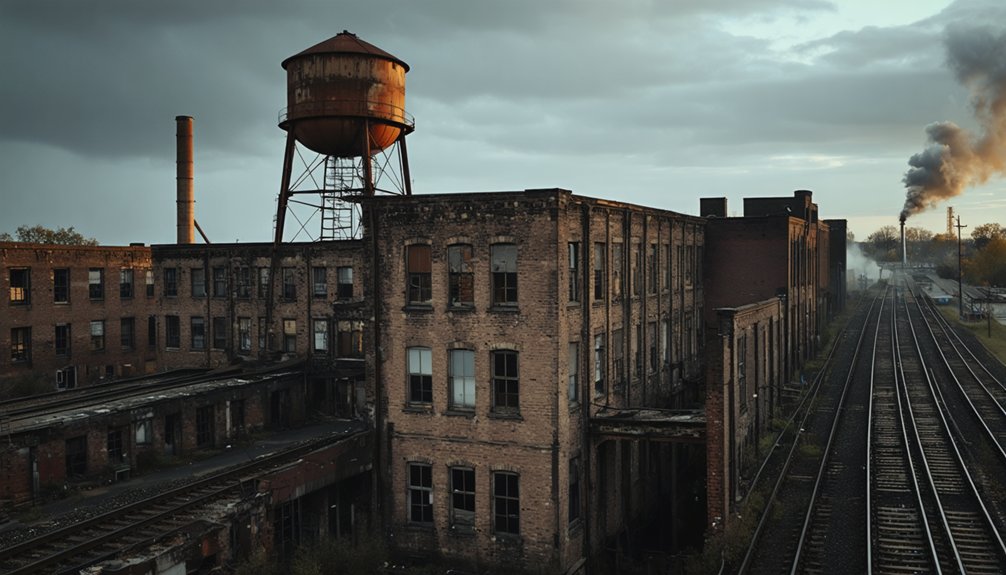
When capturing abandoned structures with your drone, mastering technical fundamentals becomes critical for producing compelling imagery. Your lighting techniques and composition strategies must work in harmony to reveal the haunting beauty of these forgotten places.
Consider these essential technical approaches:
Technical mastery in drone photography demands careful attention to lighting, positioning and safety protocols when documenting abandoned structures.
- Scout natural light conditions and time your shoots during golden hour for ideal illumination.
- Deploy your drone as a safety scout before entering unstable areas.
- Combine drone-mounted lights with long exposures for dramatic light painting effects.
- Capture bracketed exposures (3-7 shots) to preserve full dynamic range.
- Use wide-angle perspectives to emphasize vast, empty interiors.
Remember to monitor signal strength in confined spaces and maintain visual contact with your drone.
Creating Compelling Visual Stories of Forgotten Places
Moving beyond technical mastery, the art of visual storytelling transforms ghost town imagery from mere documentation into compelling narratives.
You’ll want to establish a clear visual protagonist – whether it’s a weathered church steeple or an overgrown Main Street – to anchor your forgotten narratives.
Structure your shots in a three-act sequence: start with context-setting drone pulls, develop through detailed architectural reveals, and resolve with dramatic aerial departures.
Time your shoots during golden or blue hour when long shadows emphasize decay and atmosphere.
Layer your story with human-scale elements like rusted vehicles or cemetery stones, creating emotional resonance without human presence.
Choose locations rich in history, where surviving markers tell deeper stories.
Apply subtle color grading to enhance mood – desaturated greens for nostalgia, cool shadows for dramatic tension.
Understanding Local Restrictions and Access Points
Before launching your drone at any ghost town location, you’ll need to navigate a complex web of federal, state, and local regulations that govern UAV operations.
Proper drone etiquette and historical preservation concerns demand careful attention to legal requirements and access permissions.
- You must complete the FAA’s TRUST test and register drones over 0.55 lbs.
- Check if the ghost town sits on DNR property, which requires special permits for drone photography.
- Verify airspace restrictions using the LAANC system, especially near airports.
- Obtain property owner permission if the site is on private land.
- Review local ordinances, as some Indiana cities have specific drone restrictions.
Remember to maintain visual line of sight while capturing these historic structures, and stay under 400 feet AGL unless you’ve secured specific waivers from the FAA.
Frequently Asked Questions
Which Ghost Towns Have Active Wildlife That Might Interfere With Drone Flights?
Playing it safe, you’ll face wildlife interactions at all four locations, but Elkinsville’s waterfowl near Lake Monroe and Gary’s urban birds pose the most challenging drone regulations to navigate.
Are There Local Historians or Guides Available for Background Information?
You’ll find local historian connections at Elkinsville’s historical society and guided tours through Gary Indiana Guides. Both offer detailed architectural insights and site access permissions for your drone photography needs.
How Do Seasonal Changes Affect the Visibility of Structural Remains?
You’ll find peak visibility assessment during leaf-off winter months, with structural remains clearly exposed. Summer’s dense canopy blocks 60-90% of ground features, while seasonal contrasts in vegetation affect your shot composition dramatically.
What Emergency Landing Sites Exist Near These Abandoned Locations?
You’ll find diverse emergency landing zones near these haunts – from Lake Monroe’s glassy surface and Gary’s concrete lots to the Dunes’ sandy stretches and Whitewater’s welcoming riverbanks.
Which Ghost Towns Offer Cellular Signal for Drone Control Apps?
You’ll find reliable cellular coverage for drone control near ghost towns along major highways and within 20 miles of cities like New Albany, while avoiding signal-dead zones in southern Indiana’s remote valleys.
References
- https://www.onlyinyourstate.com/trip-ideas/indiana/autumn-day-ghost-town-in
- http://freepages.rootsweb.com/~gtusa/history/usa/in.htm
- https://www.youtube.com/watch?v=Ll6esjuzhQM&vl=en-US
- https://www.youtube.com/watch?v=45D4dbASJyE
- https://www.radmanphotos.com/p/a-day-in-abandoned-gary.html
- https://www.youtube.com/watch?v=RdeirbeiLf4
- https://www.youtube.com/watch?v=xmjDRG3ywXE
- https://www.samys.com/c/Drone-Accessories/3/380.html
- https://dronevideos.com/real-estate-photography-equipment/
- https://dronelaunchacademy.com/resources/real-estate-photography-equipment-guide/