Indiana’s most fascinating ghost towns offer you glimpses into the state’s pioneer past. You’ll discover Hindostan Falls, once a thriving river settlement decimated by disease in the 1820s, and Monument City, a community now submerged beneath Salamonie Lake. Don’t miss Elkinsville’s abandoned structures near Lake Monroe or Fort Ritner’s historic railroad remnants. These haunting settlements, with their preserved cemeteries and crumbling foundations, hold countless untold stories of Indiana’s frontier life.
Key Takeaways
- Hindostan Falls, once Martin County’s largest settlement with 1,200 residents, offers visible remnants including 128 rock holes and historic mass graves.
- Monument City, submerged by the Salamonie Dam project, reveals foundations and roads during winter drawdowns of the reservoir.
- Elkinsville, flooded for Lake Monroe construction, features preserved cemeteries and scattered abandoned houses from its farming community past.
- Fort Ritner showcases the historic 1,730-foot “Big Tunnel” and Proctor Cemetery, with paranormal intrigue surrounding Henry Dixon’s unsolved murder.
- Aberdeen stands as a Level 4 ghost town with minimal remaining residents and numerous abandoned structures depicting Indiana’s historical development.
The Lost City of Hindostan Falls: A Pioneer Settlement Frozen in Time
While many ghost towns fade quietly into history, Hindostan Falls stands out as one of Indiana’s most dramatic examples of a pioneer settlement’s rise and fall. Founded in 1816 along the East Fork White River, this bustling town quickly became Martin County’s seat and the largest settlement in Daviess County.
The town flourished due to its strategic location on the stagecoach route between Vincennes and New Albany. Named after India by Captain Caleb Fellows, an English settler with connections to the British East India Company, Hindostan history reveals a thriving community of 1,200 residents until the “Great Sickness” struck between 1820-1828. Within four years, the epidemic claimed over half the population, with 138 deaths recorded in just three months.
You’ll find ghostly legends surrounding the abandoned town, from tales of buried gold to reports of restless spirits. Today, all that remains are 128 mysterious holes in flat rock and mass graves – silent testimonies to a once-prosperous settlement that nature has reclaimed.
Monument City: Indiana’s Underwater Ghost Town
The haunting tale of Monument City began in 1874 when Jacob Leedy and John Pilcher laid out their vision for a new settlement along the Salamonie River. This small but vibrant community, named to honor Civil War soldiers, grew to include a stone schoolhouse, general store, and about 20 homes.
You’ll find Monument City’s history took a dramatic turn in the 1960s when the Salamonie Dam project forced residents to abandon their homes. The town’s submerged architecture now lies beneath 30 feet of water, though you can glimpse its remains during winter drawdowns. In 1958, federal funding was allocated to construct the massive dam for flood control purposes. Local residents gather annually for community reunions to share memories and maintain connections to their lost hometown.
The relocation effort involved moving over 1,200 graves, yet some still remain underwater. During the 2012 drought, you could walk among exposed foundations, bricks, and gravel roads – ghostly remnants of this once-thriving community.
Exploring the Remnants of Historic Elkinsville
Similar to Monument City’s watery fate, another Indiana ghost town tells a compelling story of displacement and preservation. Founded in 1860 by William Elkin, Elkinsville thrived as a rural farming community until the U.S. Army Corps of Engineers acquired the land for Lake Monroe‘s creation between 1962-1964.
The town supported a thriving community with its post office until 1941, marking the beginning of its gradual decline.
The Browning Mountain area served as the heart of community life and gatherings.
Your ghost town exploration will reveal the old Elkinsville Bridge in its deteriorated state and a preserved town cemetery that beckons investigation. While most structures were claimed by the reservoir project, affecting hundreds of homes and numerous community buildings, Elkinsville’s history endures through its remaining traces.
You’ll find hollow remnants of abandoned houses scattered throughout the area, standing as silent witnesses to a once-vibrant community that flourished for nearly a century before succumbing to progress.
Fort Ritner: Traces of a Vanished Railroad Hub
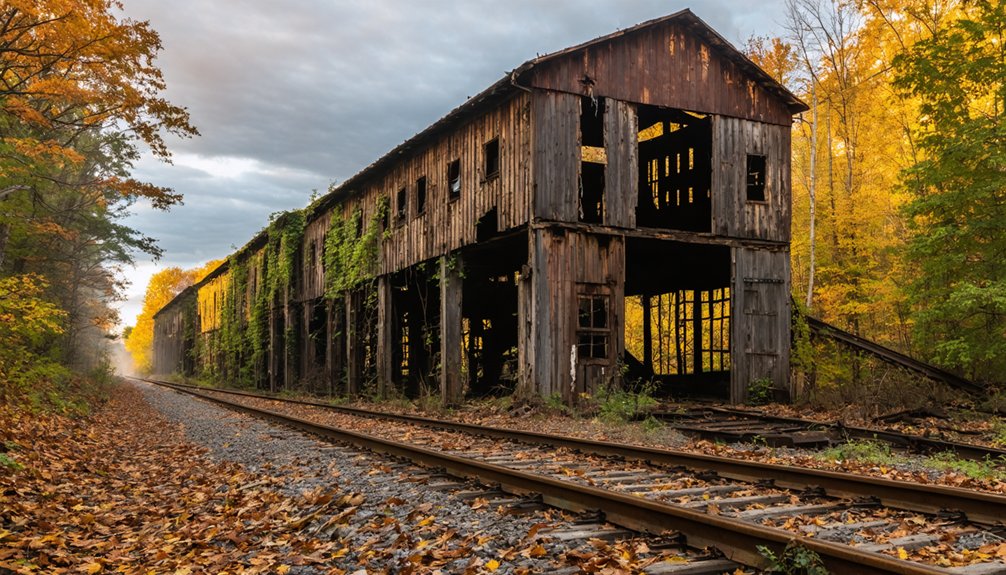
You’ll discover Fort Ritner’s most impressive remnant in the 1,730-foot “Big Tunnel,” which still bears its original inscription and stands as Indiana’s longest railroad tunnel when completed in 1857.
The town was officially platted in 1857, coinciding with the tunnel’s completion.
As you explore the ghost town’s railroad infrastructure, you can trace the path of the Ohio & Mississippi Railroad‘s ambitious engineering feat that included two tunnels designed to bypass the White River. The tunnel’s unique curved design prevents visitors from seeing from one end to the other.
While many of Fort Ritner’s original structures have vanished, including one of its two 1859 hotels, the surviving tunnel and hidden cemetery serve as silent witnesses to this once-bustling railroad hub’s historical significance.
Railroad Infrastructure Remnants
Remnants of Indiana’s railroad heyday still echo through Fort Ritner‘s abandoned infrastructure, where the Ohio & Mississippi Railroad once established an essential hub in 1857.
You’ll discover fascinating railroad history through the architectural marvel of Big Tunnel, which sliced through solid rock to create a 1,750-foot passage that revolutionized regional transportation. The town thrived as a commerce center where early merchants Holland established successful trading operations. A devastating steam locomotive fire in 1907 destroyed many of the town’s original buildings.
- The tunnel’s original architecture featured a distinctive curve that kept its interior perpetually dark.
- Between 1898-1909, engineers reinforced the structure with brick lining and an arched design.
- The tunnel’s length was reduced to 1,730 feet during modifications to prevent rockfalls.
- You can still spot the historic “Big Tunnel” inscription above the arch, though only one of the original tunnels remains.
Hidden Cemetery Discovery
Nestled near Dixon Chapel in the remnants of Fort Ritner, Proctor Cemetery holds the key to one of Indiana’s most compelling ghost town mysteries.
You’ll find hidden graves of the Dixon family, including the particularly significant marker of Henry Dixon, adorned with a Pythian emblem that hints at secret society connections.
The cemetery’s discovery has drawn paranormal investigations focused on Henry Dixon’s unsolved 1903 murder near Big Tunnel.
His grave, surrounded by family members including his widow Mary and three children, has become a focal point for investigators who report intense emotional and physical responses.
The site’s connection to both the vanished railroad hub and unexplained phenomena makes it a vital piece in understanding Fort Ritner’s transformation from bustling community to Level 4 ghost town.
Marengo’s Cave Country Legacy
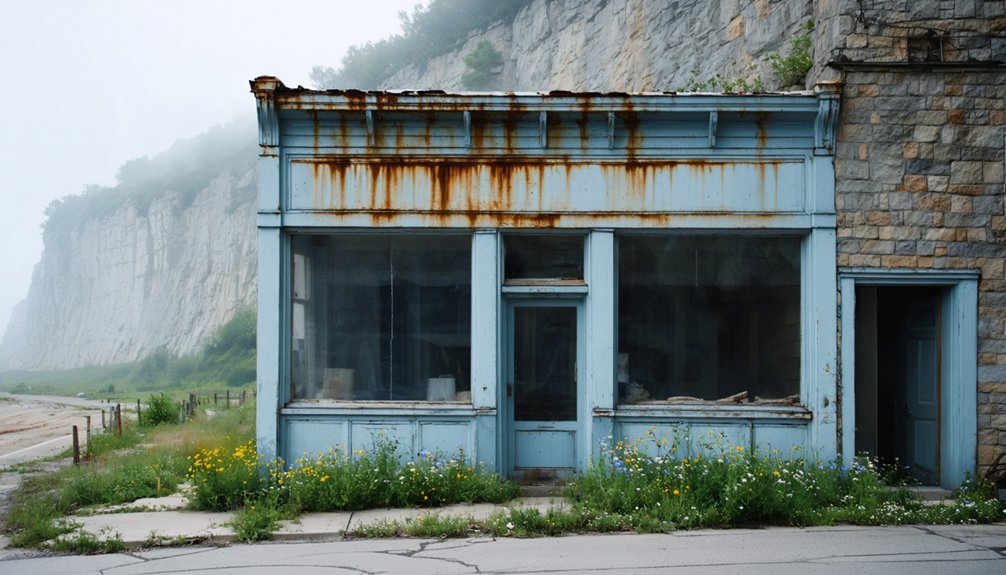
Deep within southern Indiana’s karst landscape, Marengo Cave stands as a tribute to the region’s rich geological heritage since its discovery by the Hiestand siblings in 1883.
The cave’s geological significance spans over a million years of formation, making it a premier destination for cave exploration enthusiasts.
A million years of nature’s patient artistry has sculpted Marengo Cave into an underground marvel for modern adventurers.
- You’ll find over 5 miles of documented passageways across 7 acres, including the state’s largest underground chamber discovered in 1992.
- You’re witnessing active cave formation through two parallel underground streams.
- You’ll explore the famous Signature Hall, where early tourists left their marks using torch soot.
- You’re experiencing what the U.S. National Park Service calls a “textbook example” of middle-stage cave development.
Today, Marengo Cave remains Indiana’s most visited natural attraction, drawing over 75,000 visitors annually to its limestone corridors.
Southern Indiana’s Most Haunting Abandoned Communities
Throughout southern Indiana’s rural landscape, you’ll discover an intriguing collection of abandoned settlements that chronicle the state’s tumultuous past.
The ghost town legends of Hindostan Falls tell a tragic tale of a frontier community devastated by cholera and yellow fever in the 1820s, where 138 souls perished in just three months.
You’ll find Tunnelton’s abandoned structures particularly compelling, with its Underground Railroad heritage and the infamous Wilson gang Massacre of 1882. These haunting remnants include the empty 1957 Tunnelton High School and scattered storefronts slowly succumbing to time.
Aberdeen, now classified as a Level 4 ghost town, offers only concrete steps and foundations as silent witnesses to its once-vibrant Scottish roots, while fewer than 50 residents remain in this historic settlement.
Preserving Indiana’s Ghost Town Heritage
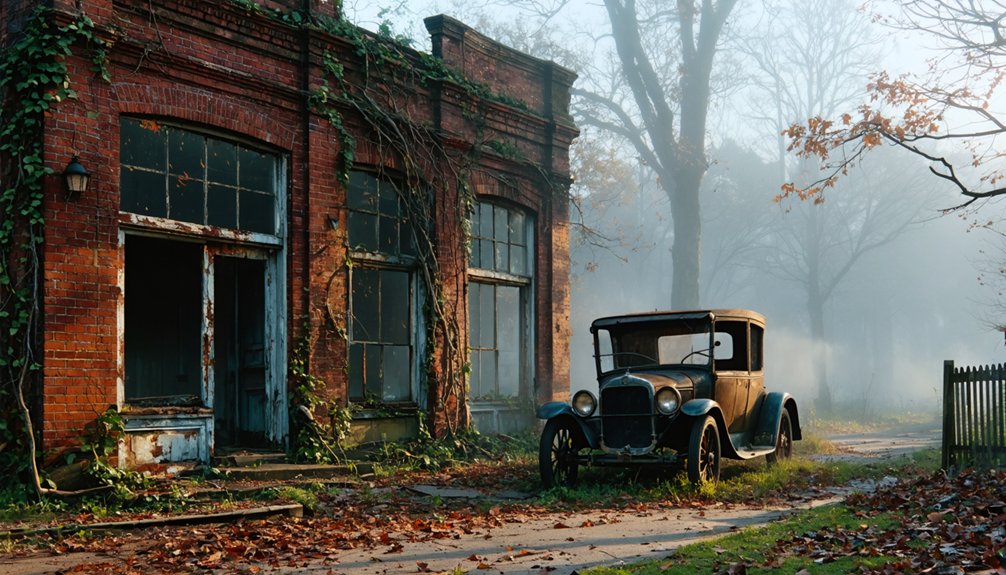
As these historic ghost towns fade into memory, Indiana has commenced on an ambitious preservation initiative through the development of the Ghost Town Trail system.
Among the abandoned towns of Indiana history, remnants of vibrant community life can still be felt in the crumbling facades and overgrown streets. Each ghost town tells a story of resilience and change, inviting visitors to explore the echoes of the past. As the trail system expands, it offers a unique opportunity to connect with these forgotten places and understand their significance in the broader narrative of the state.
You’ll discover how this heritage preservation project, initiated in 1991, has transformed abandoned railroad corridors into vibrant recreational spaces while protecting the region’s industrial legacy.
- The trail system’s 32-mile main stem connects Blairsville to Ebensburg, following the paths where coal-mining communities once thrived.
- Your journey through history is managed by a cooperative partnership between county conservation authorities.
- You’ll experience nationally recognized trails, ranked 7th among America’s best hiking paths.
- You’re invited to participate in preservation efforts through volunteer opportunities, maintaining these historic corridors for future generations.
The Ghost Town Trail exemplifies how heritage preservation can blend recreational development with historical significance.
Frequently Asked Questions
Are Camping Permits Required to Visit Indiana’s Ghost Town Sites?
Want unrestricted access to history? You’ll need camping permits if you’re staying overnight at ghost towns within state parks, but dispersed camping in national forests near ghost towns doesn’t require permits or fees.
What Wildlife Dangers Should Visitors Watch for When Exploring Ghost Towns?
During wildlife encounters, you’ll need to watch for venomous snakes in debris, kissing bugs in structures, and ticks in overgrowth. Take safety precautions against coyotes and mountain lions at dusk.
Do Any Ghost Towns Host Guided Historical Tours or Events?
You’ll find guided tours at Indiana’s ghost towns through Chaos Haunted & Historical Tours, Ghost City Tours, and Summit City Ghosts, with special historical events commonly held at New Harmony and Madison.
Can Metal Detecting Be Legally Done at Indiana Ghost Towns?
You’ll need the property owner’s written permission to metal detect at ghost towns, as they’re private property. Federal and state metal detecting regulations still apply for historical artifact preservation.
Which Ghost Towns Are Wheelchair Accessible or Suitable for Limited Mobility?
In the most accessible ghost town ever, Goblesville offers wheelchair ramps and accessible trails you’ll appreciate. You can also explore Indiana State Sanatorium’s commercial building and join New Harmony’s ghost walks using rental carts.
References
- https://wkdq.com/southern-indiana-ghost-towns/
- http://freepages.rootsweb.com/~gtusa/history/usa/in.htm
- https://everafterinthewoods.com/these-deserted-ghost-towns-in-indiana-are-full-of-forgotten-stories/
- https://www.youtube.com/watch?v=45D4dbASJyE
- https://storymaps.arcgis.com/stories/9a3b3f4a63ba4031a46cb53907a0515c
- https://en.wikipedia.org/wiki/List_of_ghost_towns_in_Indiana
- https://kids.kiddle.co/List_of_ghost_towns_in_Indiana
- https://www.onlyinyourstate.com/state-pride/indiana/untold-story-hindostan-falls-in
- https://www.discoversouthernindiana.com/blog/post/the-ghost-town-of-hindostan-falls-indianas-lost-jewel/
- http://exploresouthernindiana.blogspot.com/2011/10/haunting-of-hindostan-falls.html