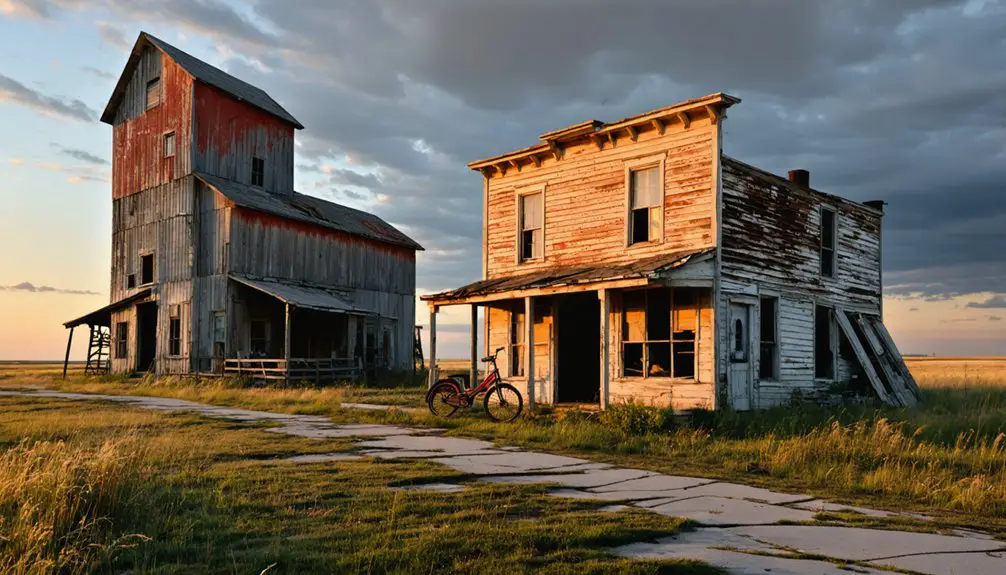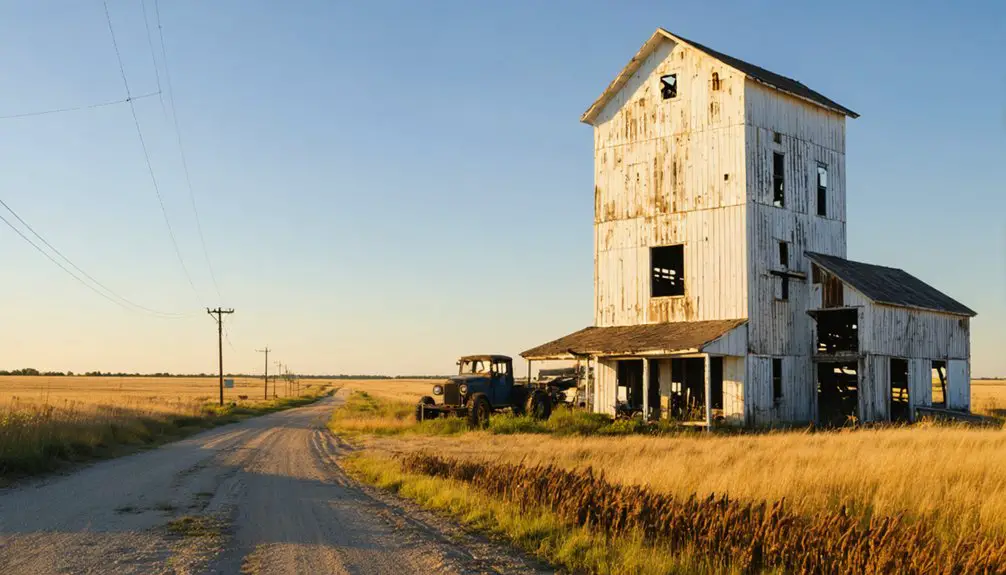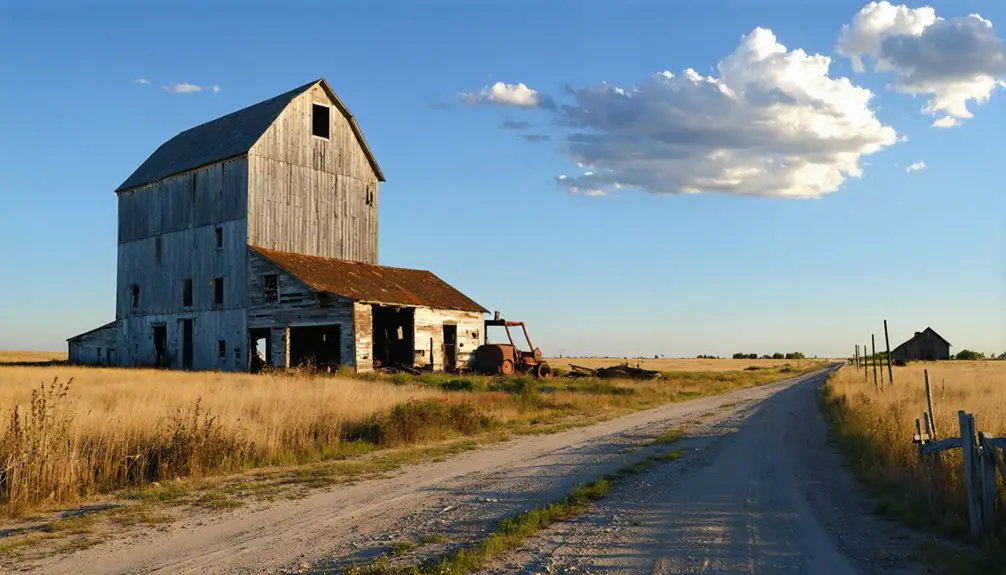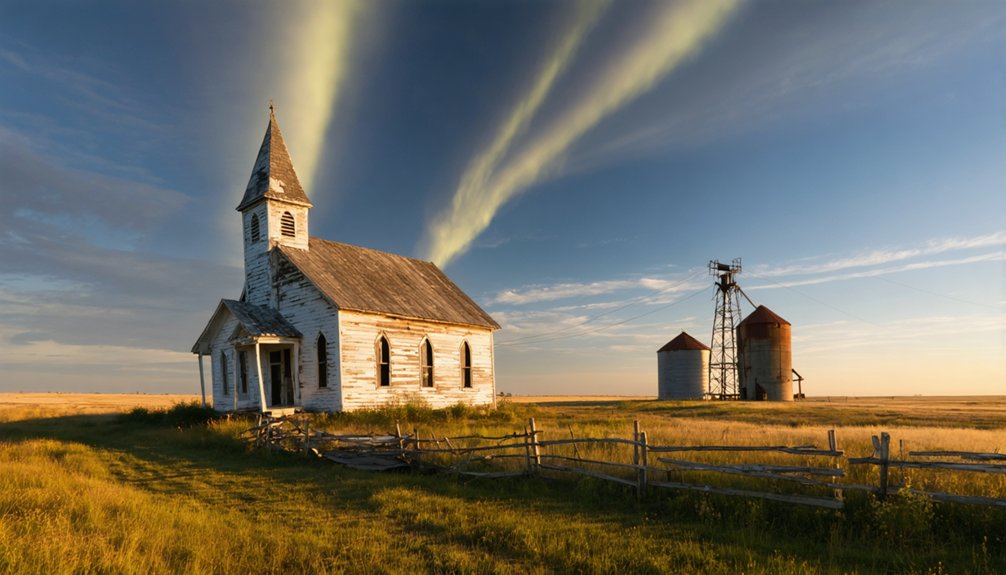
You’ll discover over 100 ghost towns scattered across North Dakota’s prairies, each telling unique stories of pioneer life. Must-see sites include Charbonneau, with its preserved 1913 schoolhouse, and San Haven’s eerie abandoned sanatorium. Don’t miss Sherbrooke’s stone ruins where President McKinley once stayed, or Old Sanish’s underwater remnants beneath Lake Sakakawea. From railroad boomtowns to submerged settlements, these forgotten places hold fascinating secrets waiting to be uncovered.
Key Takeaways
- San Haven offers a haunting exploration of a former tuberculosis sanatorium with underground tunnels and abandoned buildings dating from 1912.
- Wheelock features over 100 abandoned structures from its railroad heyday, including hotels and stores from the early 1900s.
- Sherbrooke preserves historic ruins including the Sherbrooke House Hotel where President McKinley stayed, with archaeological significance from the 1880s.
- Charbonneau stands as one of North Dakota’s 18 true ghost towns, with preserved structures including a school and grain elevator.
- Sanish’s underwater remains beneath Lake Sakakawea tell a unique story of a town relocated due to dam construction.
Charbonneau: A Railroad Legacy Lost to Time
While many ghost towns dot North Dakota’s landscape, Charbonneau stands out as one of the state’s most intriguing abandoned railroad settlements. Founded in 1913 by the Great Northern Railroad, this McKenzie County town quickly grew to 125 residents by 1920, showcasing the profound railroad impact on western settlement.
Founded as a railroad settlement in 1913, Charbonneau emerged as one of North Dakota’s most fascinating ghost towns.
You’ll find it nestled between Watford City and the Montana border, named after the creek honoring Lewis & Clark’s interpreter, Toussaint Charbonneau. A small hilltop cemetery overlooks the remnants of this once-thriving community. The town once boasted vibrant businesses, including a hotel, boarding house, general store, and creamery.
The town’s ghost town resilience is evident in its surviving structures – the school, post office, and grain elevator still stand as silent sentinels of a bygone era.
Though the post office closed in the 1960s and Montana-Dakota Utilities pulled out by 1965, Charbonneau remains one of just 18 true ghost towns in North Dakota with existing buildings.
Griffin’s Rise and Fall Along the Great Northern Line
Another proof of the Great Northern Railway’s profound influence lies in Griffin, a settlement that emerged during James J. Hill’s ambitious railway expansion through North Dakota.
Griffin’s geography placed it strategically along the Great Northern’s westward push, as the company laid an impressive 3.5 miles of track per day toward Minot in 1885.
You’ll find that Griffin’s economy initially thrived from the railway’s aggressive settlement promotion, which brought waves of German and Scandinavian immigrants to the area.
The town’s fortunes were tied directly to Hill’s vision of creating successful farming communities along his railroad.
Like many settlements, Griffin benefited from the Great Northern’s practice of selling homesteads to newcomers and providing transportation for both passengers and agricultural products to Minneapolis markets.
The railway operated special agencies in Germany to promote these North Dakota settlements and arrange affordable passage for immigrant families.
Following Hill’s motto that men must live their great adventure, the railway actively encouraged pioneers to establish new lives in frontier towns like Griffin.
Ludden: From Bustling Hub to Quiet Village
You’ll find Ludden’s historical footprint just north of the South Dakota border, where Finnish immigrants established a thriving railroad trading center in 1886.
Like many abandoned sites in the territory, harsh environmental conditions and isolation contributed to the town’s eventual decline.
The town’s initial growth was fueled by its strategic location along the railroad and the influx of pioneer settlers who transformed the surrounding prairie into productive farmland.
Similar to the projects documented by Ghosts of North Dakota, these abandoned structures serve as vital historical records of the region’s past. While the original commercial district has largely faded into prairie grass, Ludden’s abandoned structures still tell the story of its shift from a bustling agricultural hub to a quiet reminder of North Dakota’s frontier heritage.
Historic Railroad Trading Center
In the spring of 1883, a modest structure built by Towns and McKay marked the beginning of Ludden’s journey from “Batching Spring” to a thriving railroad hub.
As the Northern Pacific Railroad expanded through the region, you’d have witnessed rapid settlement patterns transform this spot just half a mile from the South Dakota border into a bustling trade center.
You’ll find Ludden’s strategic importance in its role as a crucial supply station, where local farmers provided essential provisions to railroad camps.
The arrival of S.L. Kemmerer in 1886 and his establishment of the Ludden Bank turned this railroad stop into a commercial powerhouse.
With grain elevators dotting the skyline and trains connecting to eastern markets, Ludden became the lifeline for regional farmers and merchants seeking their slice of Dakota Territory prosperity. The town’s railroad depot became a focal point of daily life, with telegraph messages and orders being transmitted between headquarters and train engineers. Like many small railroad towns, Ludden faced economic hardship during the Great Depression era, leading to a significant population decline.
Population Rise and Fall
Ludden’s path from railroad hub to ghost town status tells a remarkable story of demographic shifts spanning more than a century.
You’ll find that after its 1886 founding, the town maintained stability until reaching its peak of 41 residents in 1990.
Population trends showed promise in the early 2000s, when the count rose 44.83% from 29 to 42 residents between 2000-2014, outpacing North Dakota’s average growth rate.
However, recent years have brought dramatic changes to this once-bustling community. By 2020, you’d have counted only 15 residents, with numbers stabilizing at 17 in 2024. The town’s 100% White population reflects its limited demographic diversity.
Despite its small population, the community maintains a relatively high economic standard with a median household income of $114,688.
Today’s demographic snapshot reveals an aging population with a median age of 67.4, transforming this former trading center into one of North Dakota’s quietest villages.
Modern-Day Ghost Features
Today, you’ll find Ludden as a haunting reminder of North Dakota’s pioneer past. The village’s abandoned structures stand as silent sentinels in Dickey County, just a half mile from the South Dakota border.
The quiet atmosphere that now dominates the landscape is a stark contrast to its early days as a frontier settlement.
While precise building counts aren’t documented, several core structures from the original settlement remain, including remnants dating back to the first shack built in Lovell Township.
The site’s historical significance is preserved through its designation as a Dickey County Historical Site, though no recent preservation efforts have been undertaken.
You can still explore this authentic ghost town, which maintains its diminished form with minimal inhabitants, a dramatic shift from its peak population of fewer than 50 residents in the 1910s.
Sherbrooke’s Stone Foundations Tell Tales
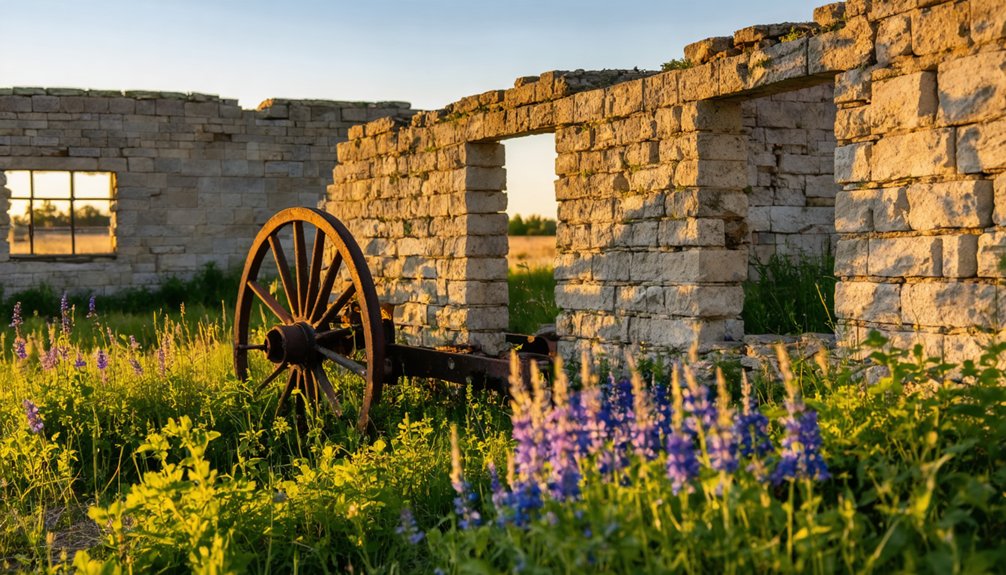
You’ll find numerous stone foundations scattered throughout Sherbrooke’s townsite, with the most prominent ruins dating back to the community’s 1881 establishment.
The weathered remains include what researchers believe was the Sherbrooke House Hotel, where President William McKinley stayed in 1896, along with several other significant structures featuring field stone construction typical of late 19th-century North Dakota buildings.
While most wooden structures have long since collapsed, the enduring stone foundations continue to reveal archaeological treasures, including embedded artifacts and charred timbers that document the town’s decline through devastating fires in 1916 and 1920.
Historic Ruins Remain Standing
Standing as silent witnesses to a once-thriving county seat, Sherbrooke’s weathered stone foundations reveal the remnants of a prosperous prairie town that served as Steele County’s administrative center from 1885 to 1919.
Today, you’ll discover archaeological insights through scattered ruins that paint a picture of historical significance, from the legendary Sherbrooke House Hotel where President McKinley once stayed to the last inhabited residence of Arlene Carpenter.
- Field stone foundations mark former commercial and residential structures
- The iconic Sherbrooke House Hotel’s remains include historic bed frames
- A pink-colored house stands defiantly against nature’s invasion
- An abandoned Studebaker with suicide doors rusts in nearby fields
- Building remnants showcase brick and stone construction techniques
Abandoned Government Buildings Endure
While decades of harsh prairie winters have battered Sherbrooke’s government buildings, their stone foundations persist as evidence of the town’s former status as Steele County’s seat of power.
You’ll find these abandoned structures scattered along the nameless gravel road off Highway 6, where stone walls and partially collapsed two-story buildings tell tales of the town’s historical significance before its decline in 1919.
As you explore the site where President McKinley once visited, you’ll discover the sturdy remains of what was once a thriving governmental hub.
The foundations of former civic buildings stand defiant against time, though they’re slowly being reclaimed by nature.
These enduring stone remnants serve as silent witnesses to Sherbrooke’s fall from prominence after losing its county seat status to Finley.
Underwater Memories: Old Sanish and Elbowoods
Hidden beneath the waters of Lake Sakakawea lies the former town of Sanish, a once-thriving community that met its fate when the Garrison Dam construction began in the 1950s.
Beneath Lake Sakakawea’s depths, Sanish stands frozen in time, a testament to progress’s price in 1950s North Dakota.
For underwater archaeology enthusiasts, this submerged piece of history reveals itself when water levels drop, exposing foundations of what was once a bustling town of 450 residents.
- Founded in 1915 as a Max branch line endpoint
- Peaked at 54 businesses before the flood
- Boy Scouts preserved historical items and relocated the cemetery
- Residents evacuated to form New Sanish and New Town by 1954
- Original townsite completely submerged by April 1953
This historic preservation story reminds us of the sacrifices made for progress, as both the townspeople and Three Affiliated Tribes were forced to abandon their homes for the dam’s construction.
San Haven: From Healing Center to Haunting Ruins

Deep within North Dakota’s Turtle Mountains, the haunting ruins of San Haven tell a complex story of healing and heartbreak. Built in 1912 as a tuberculosis sanatorium, this sprawling complex later transformed into a facility for the developmentally disabled, housing over 400 patients at its peak.
You’ll find a haunting history behind every broken window and crumbling wall. The facility closed in 1987 due to inadequate care, leaving behind underground tunnels, abandoned buildings, and over 1,000 unmarked graves.
Today, its eerie explorations draw urban adventurers despite tragic incidents, including a fatal elevator shaft fall in 2001. The decaying structures, still owned by the Turtle Mountain Band of Chippewa, stand as silent witnesses to both medical progress and institutional failure, while reported apparitions and unexplained sounds keep local law enforcement at a distance.
Wheelock’s Journey From Boom to Bust
In eastern Williams County, the ghost town of Wheelock stands as another haunting memorial to North Dakota’s boom-and-bust legacy. Through economic fluctuations, this once-thriving railroad town showcased remarkable community resilience, growing from prairie roots in 1901 to a bustling hub of 115 residents by 1930.
- Established along the Great Northern Railroad, Wheelock quickly grew into an affluent community.
- Featured essential businesses including a hotel, bank, lumber yard, and general store.
- Reached its peak in the 1930s before facing gradual decline.
- Disincorporated in 1994 with only 23 residents remaining.
- Today, over 100 abandoned structures tell tales of its past, including tragic stories of murders.
You’ll find Wheelock 19 miles northeast of Williston, where a solitary schoolhouse and scattered farm buildings remain as silent witnesses to this once-vibrant community’s rise and fall.
Hidden Prairie Treasures: Lesser-Known Ghost Towns

Scattered across North Dakota’s sprawling prairies, several lesser-known ghost towns beckon adventurous explorers beyond the state’s famous abandoned settlements.
Temple’s Legacy in Williams County reveals its final traces through a solitary church and documented galleries of vanishing structures in the oil patch.
You’ll discover Freda’s Charm in Grant County, where a crumbling train depot stands amid tall grass just southwest of Mandan.
In Arena, St. John’s Lutheran Church towers as a sentinel 35 miles northeast of Bismarck, while Sims boasts its still-active Scandinavian church where Laura Bush once visited.
For the truly intrepid, Nanson offers complete isolation near the Canadian border, with four abandoned homes standing sentinel in a landscape devoid of modern infrastructure.
Frequently Asked Questions
Are Ghost Towns in North Dakota Safe to Visit Year-Round?
You shouldn’t visit year-round due to extreme weather conditions. From blizzards to flash floods, you’ll need serious safety precautions. Stick to summer and early fall for your ghost town adventures.
Can Visitors Legally Collect Artifacts From North Dakota Ghost Towns?
You can’t legally collect artifacts without authorization – strict legal regulations protect ghost town sites. You’ll need written permission from private landowners or permits for federal/state lands to guarantee artifact preservation.
Which Ghost Towns Offer Guided Tours or Visitor Facilities?
You’ll find guided experiences through Photo Cascadia’s ghost town tours and Fargo Ghost Adventures’ walking tours. SimsChurch welcomes visitors, while PocketSights offers self-guided tours of Westfield and Hull with basic visitor amenities.
Are Any North Dakota Ghost Towns Reportedly Haunted?
Footsteps echo through San Haven Sanatorium’s crumbling halls, where haunted legends thrive. You’ll find paranormal investigations at Sims Church with its organ-playing Gray Lady and Fort Abraham Lincoln’s restless spirits.
What Permits Are Needed to Photograph Ghost Towns Commercially?
You’ll need to contact North Dakota’s Division of Tourism for commercial photography regulations, though no general permit is required. For private ghost town properties, you’ll need the landowner’s explicit permission.
References
- https://freepages.history.rootsweb.com/~gtusa/usa/nd.htm
- https://writinforthebrand.com/booming-settlement-to-ghost-town-whispers-of-the-living-history-of-charbonneau/
- https://northernsentry.com/2025/06/26/north-dakota-ghost-towns/
- https://www.youtube.com/watch?v=-E2DA6Ryd1g
- https://ghostsofnorthdakota892857007.wordpress.com/2017/03/28/the-story-of-how-ghosts-of-north-dakota-began/
- https://www.youtube.com/watch?v=8GO57Im_dss
- https://digitalhorizonsonline.org/digital/collection/uw-ndshs/id/16241/
- https://everafterinthewoods.com/these-forgotten-ghost-towns-in-north-dakota-are-eerily-fascinating/
- https://ghostsofnorthdakota892857007.wordpress.com/2017/07/31/charbonneau-a-ghost-town-named-for-a-man-with-no-particular-merit/
- https://ghostsofnorthdakota892857007.wordpress.com/2017/05/20/charbonneau-nd/