You’ll find North Dakota’s ghost towns offer excellent adventures for you and your dog, from Arena’s German immigrant ruins near Bismarck to Dogtooth’s molar-shaped buttes perfect for prairie walks. Sims provides Scandinavian heritage exploration around its restored Lutheran church, while Omemee’s railroad remnants create fascinating scavenger hunts. Charbonneau Creek offers off-leash territory in surrounding grasslands, and Dog Den Butte features historic trails with legendary ghost dog folklore. These weathered settlements hold countless stories waiting to unfold.
Key Takeaways
- Arena, Dogtooth, Sims, Omemee, and Charbonneau offer dog-friendly exploration with abandoned structures and rich immigrant history.
- Charbonneau Creek provides off-leash territory for dogs in surrounding grasslands for adventurous free running.
- Little Missouri National Grassland spans over 1 million acres with six designated trails for leashed dog exploration.
- Totten Trail Historic Inn offers overnight stays with dogs while exploring restored military quarters and freight routes.
- Bring water and supplies as services are unavailable, and avoid posted buildings for safety reasons.
Arena: Eerie Charm Near Bismarck
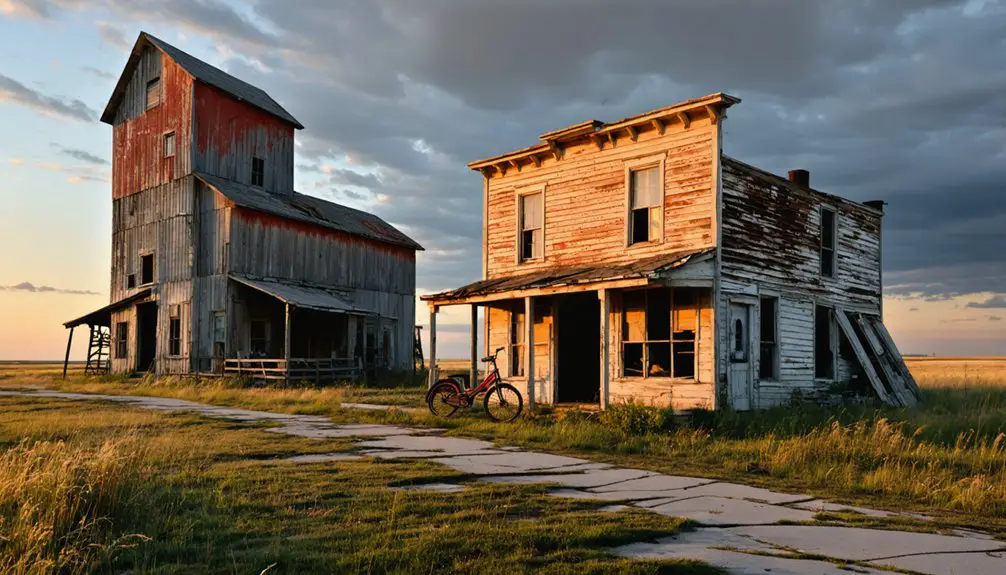
As you drive thirty-five miles northeast of Bismarck across North Dakota’s rolling prairie, Arena emerges like a weathered photograph from another era.
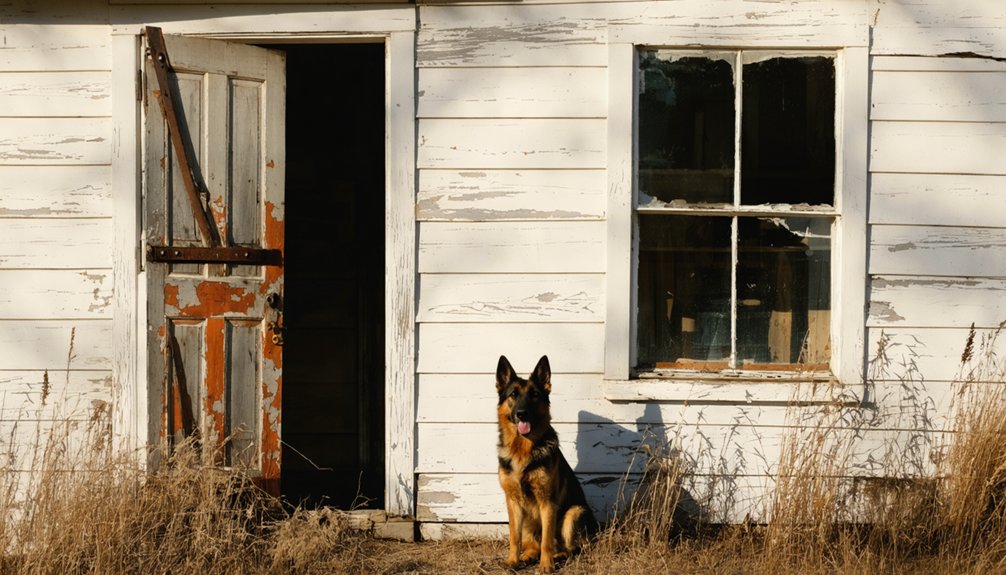
You’ll discover arena history dating back to 1906, when the Patterson Land Company founded this agricultural community in a natural basin surrounded by hills. Your dog can roam freely among the abandoned structures that tell stories of German immigrants and peak prosperity around 1920.
Your dog can explore freely among abandoned structures that whisper tales of German settlers and a thriving 1920s agricultural community.
St. John’s Lutheran Church stands as the town’s most photographed sentinel, its foundation slowly crumbling against harsh prairie elements.
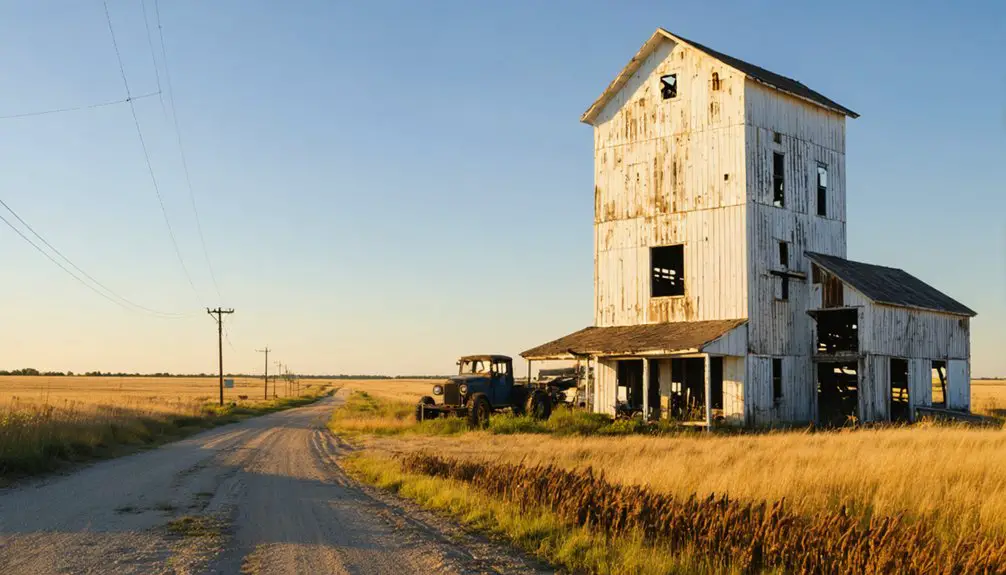
You’ll find grain elevators reaching skyward like monuments to vanished dreams, while a small yellow house marks the last inhabited dwelling. The town’s post office was discontinued in 1996, marking the end of Arena’s official presence. The Northern Pacific Railroad once brought life to Arena when it built the Pingree-Wilton line through town in 1910.
The open plains offer endless exploration for adventurous spirits seeking authentic ghost town experiences.
Dogtooth: Prairie Walks Among Molar-Shaped Buttes
From Arena’s crumbling church and grain elevators, your ghost town adventure continues fifty miles southeast to Grant County, where Dogtooth offers a completely different prairie experience.
as you explore the abandoned buildings in dogtooth, you’ll encounter remnants of a bygone era, with graffiti telling stories of the past. the eerie silence is occasionally broken by the rustling of leaves, adding to the haunting atmosphere. each structure presents a unique glimpse into the history of this remote area, inviting you to imagine what life was once like here.
Here, you’ll discover why this 1876 railroad settlement earned its memorable name from two distinctive buttes resembling canine molars.
Dogtooth history reveals a familiar North Dakota story—railroad prosperity followed by route changes and abandonment by mid-century. The town was established as a railroad station serving the expanding transportation network across the territory. The post office opened in 1900, marking the community’s peak period of activity.
Today, these geological features provide natural landmarks for exploring open prairie with your dog, though you’ll find little remaining infrastructure.
- Plan self-sufficiently – Bring water and waste bags from Raleigh
- Verify land access – Check ownership before exploring the buttes
- Consider seasonal conditions – Mud and crops affect walkability
- Navigate by landmarks – Use the distinctive molar-shaped formations for orientation
While Dogtooth challenges you with wide-open prairie exploration, Sims draws you into North Dakota’s most haunting ghost town experience just thirty-five miles west of Mandan.
You’ll discover fascinating Sims history as you walk your dog through this Scandinavian settlement founded in 1883, where coal mining once sustained 1,000 residents. Today, only the restored Lutheran church remains active, holding services every other week. The town sits along the Old Red Old 10 Scenic Byway, making it easily accessible for visitors exploring the area.
When the Northern Pacific Railroad arrived in 1879, early settlers established their initial businesses and shelters using repurposed boxcars before permanent structures could be built. The legendary Gray Lady adds supernatural intrigue to your visit. This spirit reportedly haunts the old parsonage, where a pastor’s wife died in the 1930s.
She’s driven away multiple ministers, mysteriously playing the church organ and opening windows. You’ll find the parsonage standing adjacent to the church, though the Gray Lady supposedly rests during service days, making those times perfect for peaceful exploration.
Omemee: Remote Railroad Remnants in Bottineau County
Hidden in Bottineau County’s remote farmland, Omemee offers you and your dog one of North Dakota’s most archaeological ghost town experiences, where a once-thriving railroad junction has nearly vanished into prairie soil.
Omemee history reveals a boom-to-bust cycle spanning just decades. Founded in 1887, this settlement peaked at 650 residents by 1906 when both Great Northern and Soo Line railroads converged here.
Railroad significance created a bustling hub with grain elevators, hotels, and an opera house lining Main Street. The town originally was intended as county seat of Bottineau County, enhancing its early prospects. During its heyday, the community also supported a local newspaper that documented daily life in this thriving agricultural center.
Today, you’ll find mostly vacant lots and sink spots where buildings once stood. Most structures were bulldozed between 2010-2013, leaving archaeological traces.
- Explore former hotel sites where artifacts like medicine bottles still emerge
- Walk abandoned railroad grades with your unrestrained companion
- Photograph remnant foundations marking vanished businesses
- Search loose soil for early 1900s relics
Dog Den Butte: Historic Trail Views and Ghost Dog Legends
You’ll find Dog Den Butte rising from the glaciated plains of McLean County, where the historic Totten Trail once carried mail carriers and military escorts between frontier forts.
As you stand on this ice-thrust landmark that guided 18th and 19th-century travelers, you’re walking where Colonel de Trobriand searched for murdered mail carriers in 1868 and where David Thompson noted its navigational importance. The butte witnessed the Battle of Grand Coteau in July 1851, when Metis hunters formed a defensive circle with their carts against attacking Sioux warriors.
Local folklore warns that snarling ghost dogs still guard this windswept butte, their supernatural presence tied to the violent frontier deaths that stained these rolling prairies with blood. The summit provides unobstructed views across the boundary between the Glaciated Plain and Missouri Coteau, making it clear why early explorers valued this geological formation as a crucial navigation point.
Totten Trail History
As you stand atop Dog Den Butte, the sweeping Dakota prairie stretches endlessly before you, revealing the same vista that guided weary travelers along the historic Totten Trail more than 150 years ago.
This overland route connected southern Minnesota to western Montana’s goldfields, serving as Dakota Territory’s essential east-west corridor during the 1860s-1870s. The Totten Trail’s historical significance extends beyond simple transportation—it represented freedom of movement across an untamed frontier, protected by Fort Totten‘s garrison from 1867-1890.
Experience the Trail’s Legacy:
- Explore Fort Totten State Historic Site with fifteen preserved military structures and interpretive programs
- Stay overnight at Totten Trail Historic Inn in restored officer quarters
- Follow historical markers documenting freight and mail routes from 1879-1882
- Discover wagon ruts and trail alignments still visible across the prairie landscape
Snarling Ghost Dog Legend
The butte’s echo-prone ravines and shadowed gorges create perfect conditions for mysterious sounds that fuel ghost dog sightings.
Real wolf dens and prairie dog colonies likely sparked misidentifications, but frontier journals consistently describe protective spirits haunting this strategic overlook where travelers once sought safety along the dangerous Totten Trail.
Charbonneau: Grasslands Gateway West of Watford City
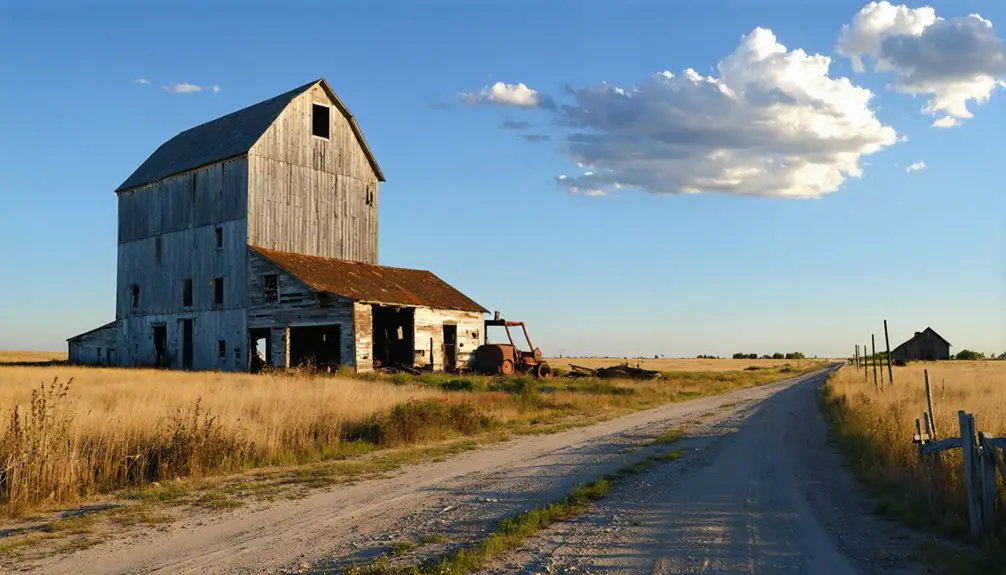
You’ll discover Charbonneau’s weathered buildings rising from the vast North Dakota grasslands like monuments to a forgotten railroad era, where your dog can explore the remnants of grain elevators and the old schoolhouse that once served 125 residents.
The endless prairie surrounding this 1913 Great Northern Railroad town offers perfect off-leash territory for adventurous dogs who love wide open spaces and the freedom to run alongside Charbonneau Creek.
As you wander through structures named for Lewis and Clark’s guide Toussaint Charbonneau, you’ll find this ghost town provides both historical intrigue and unlimited grassland adventures for dogs who crave boundless exploration.
Historic Settlement Exploration
Fifteen minutes west of Watford City, where the grasslands stretch endlessly toward Montana, you’ll discover Charbonneau—a ghost town that whispers stories of railroad ambition and frontier dreams gone quiet.
Founded in 1913 along the Great Northern Railroad, this settlement once housed 125 residents before declining into abandonment by the 1960s.
Your ghost town explorations here reveal a complete frontier community frozen in time, with surviving structures including the schoolhouse, post office, and grain elevators standing as silent sentinels.
Historical anecdotes emerge from every weathered board—like the Methodist minister who held a funeral for the town cat, attended by local schoolchildren in a touching display of community spirit.
Essential Exploration Tips:
- Respect private property boundaries throughout your visit
- Avoid entering posted buildings for safety reasons
- Bring your leashed companion for grassland adventures
- Pack water—services don’t exist in this isolated location
Grasslands Dog Walking
Beyond Charbonneau’s weathered buildings, the Little Missouri National Grassland unfolds like an endless canvas of mixed-grass prairie, where your leashed dog can experience one of America’s most pristine wilderness areas.
Six designated grasslands trails wind through badland buttes and ponderosa stands, offering everything from short interpretive loops to multi-mile adventures connecting with the Maah Daah Hey Trail.
You’ll navigate packed earth, loose talus, and rolling plateaus where bighorn sheep and elk roam freely.
Dog friendly regulations require leashes near wildlife and livestock, but dispersed recreation areas welcome off-trail exploration for experienced navigators.
Check seasonal access conditions—spring thaw transforms dirt roads into impassable mud.
Your freedom-seeking companion will thrive in this 1,033,271-acre playground of untamed grassland.
Frequently Asked Questions
Are There Any Veterinary Clinics Near These Ghost Towns for Emergencies?
You’ll find veterinary services scattered like precious gems across North Dakota’s vast landscape. Emergency preparedness means planning 30-90 minute drives to Bismarck, Minot, or Williston for true emergencies from remote ghost towns.
What Time of Year Is Best for Visiting Ghost Towns With Dogs?
Late summer through early fall offers the best seasons for exploring with your dog. You’ll find stable road conditions, comfortable temperatures between 45-75°F, and reduced tick exposure while avoiding harsh winter weather considerations.
Do I Need Special Permits to Bring Dogs to These Locations?
No Instagram-worthy permits needed! You’re free to explore ghost towns with your leashed companion. Standard dog regulations apply—keep them controlled and clean up waste. These abandoned places welcome responsible pet policies without bureaucratic hassles.
Are There Any Poisonous Plants Dogs Should Avoid in These Areas?
Yes, you’ll encounter toxic plants that threaten dog safety in ghost towns. Watch for water hemlock near wells, poison hemlock along fence lines, and colorful pokeweed berries that’ll tempt curious pups exploring freely.
What Essential Supplies Should I Pack When Exploring Ghost Towns With Pets?
Pack plenty of provisions for pet safety adventures: first-aid kit, extra water, paw protection, emergency contacts, and restraints. Your packing checklist should include maps, waste bags, and weather gear for exploring freely together.
References
- https://us1033.com/exploring-bismarck-ghost-towns-north-dakota/
- https://northernsentry.com/2023/03/10/slice-of-life-snarling-ghost-dogs-of-dog-den-butte/
- https://en.wikipedia.org/wiki/Dogtooth
- https://cool987fm.com/any-ghost-towns-near-bismarck-nd-must-have-plenty/
- https://www.bringfido.com/blog/dog-friendly-gold-mines-and-ghost-towns/
- https://www.gopetfriendly.com/blog/north-dakotas-top-pet-friendly-attraction-knife-river-indian-villages/
- https://www.quincyvagell.com/arena/
- https://www.legendsofamerica.com/arena-north-dakota/
- https://www.youtube.com/watch?v=JrbLsH8cdps
- https://carynschulenberg.com/2025/09/a-natural-horse-arena/