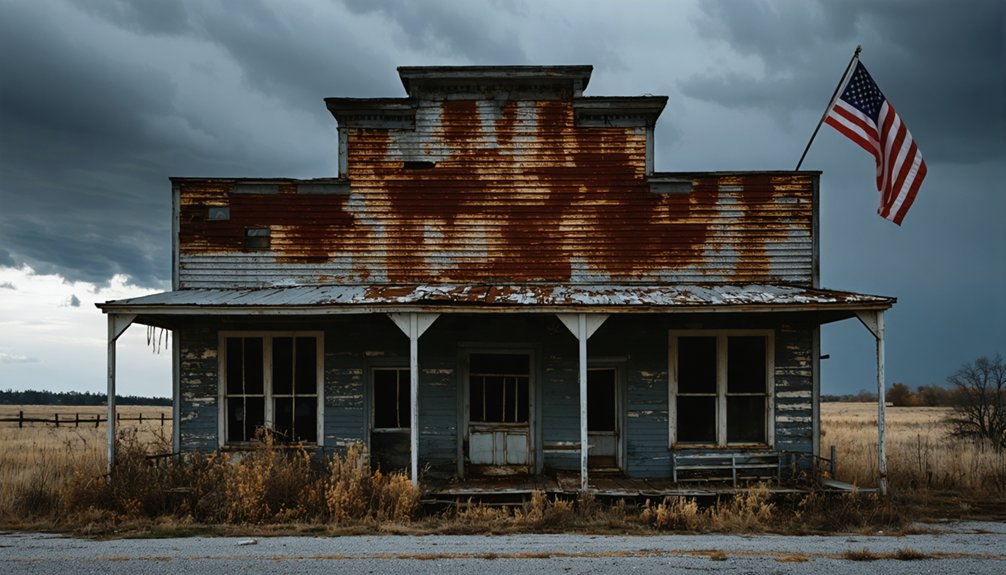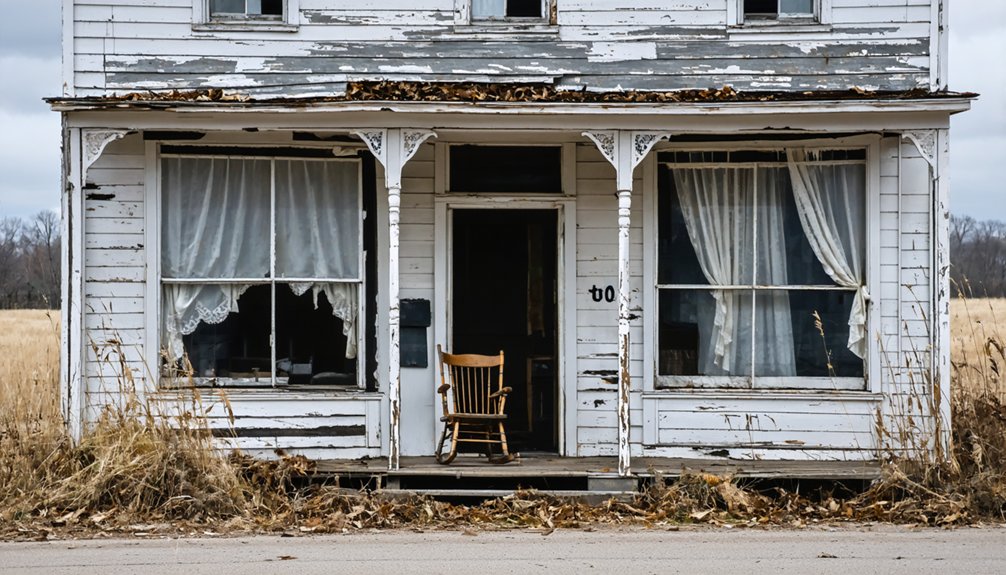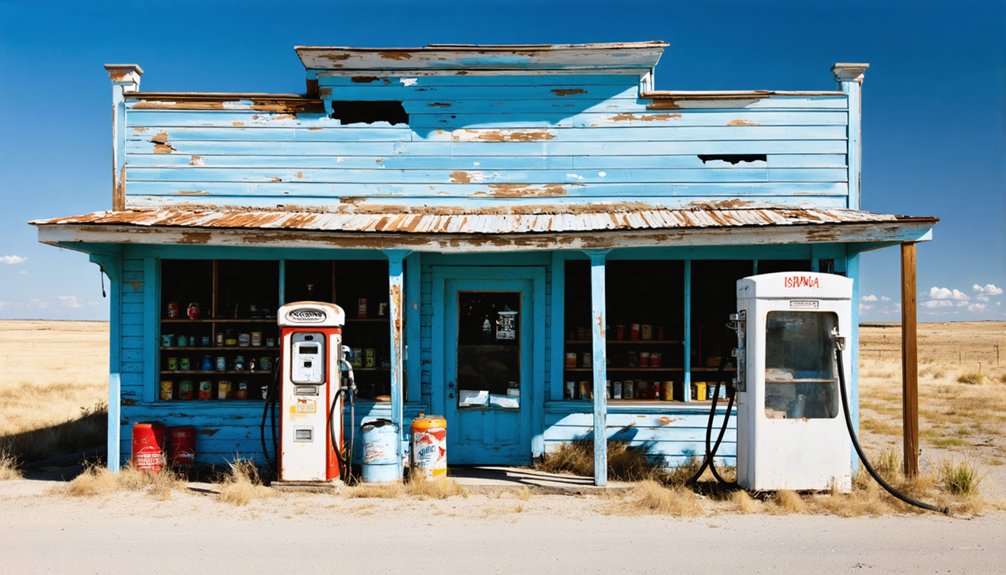
Midwestern ghost towns reveal America’s economic cycles through abandoned mining settlements, railroad junctions, and agricultural communities. You’ll find Michigan’s copper boom remnants, Kansas’s 240+ deserted towns, and Illinois’s forgotten railroad outposts scattered across the heartland. These sites now attract both historians documenting their cultural significance and paranormal enthusiasts seeking spectral encounters. Modern preservation efforts transform these forgotten places into protected landmarks where physical remnants tell compelling stories of boom-and-bust prosperity. The following exploration uncovers what lies beyond their weathered façades.
Key Takeaways
- The Midwest contains hundreds of abandoned towns, with Michigan documenting 73 ghost towns and Kansas over 240.
- Economic obsolescence from depleted mining resources created ghost towns like Minnesota’s Elcor and Michigan’s Central.
- Paranormal interest has transformed abandoned settlements into popular tourist destinations with documented ghostly encounters.
- Historic structures like the Wolf Hotel and abandoned institutions like Eloise Psychiatric Hospital attract ghost hunters.
- Preservation efforts include National Register listings, while digital platforms like “Ghosts of North Dakota” document vanishing histories.
The Rise and Fall: Economic Cycles Behind Midwestern Abandoned Towns

While the American Midwest is often associated with vibrant agricultural communities and industrial centers, its landscape is equally dotted with the skeletal remains of once-thriving towns that have succumbed to economic obsolescence.
These ghost town economies followed predictable boom-bust patterns. You’ll find their origins primarily in late 19th century resource extraction—coal, iron, and precious metals created explosive growth cycles that attracted laborers and businesses.
The mining legacy remains visible in abandoned structures built during periods of perceived permanence. When mineral veins depleted or commodity prices collapsed, these single-industry towns faced existential crises. Michigan’s Upper Peninsula contains numerous old mine shafts that serve as reminders of this industrial past.
The hubris of permanence stands frozen in these abandoned towns, monuments to the fleeting nature of extraction economies.
Unlike more resilient communities with diversified economies, boomtowns lacked sustainable foundations beyond extraction. Agricultural towns faced similar fates when mechanization reduced labor needs.
Transportation access often determined which settlements persisted and which were surrendered to time.
Forgotten Places: Most Fascinating Ghost Towns Across the Heartland
You’ll encounter numerous abandoned mining settlements across Michigan’s Upper Peninsula, where remnants of copper and iron operations stand as evidence to boom-and-bust cycles that once defined the region.
Former railroad junction towns like Tedens in Illinois reveal how transportation networks shaped settlement patterns, with remaining structures offering glimpses into 19th-century Midwestern commerce. Kansas, with over 240 ghost towns, presents a similar legacy of abandoned settlements that tell stories of agricultural challenges and changing economic landscapes. Michigan features 73 ghost towns documented by EagleEyeExplorer, most being former logging or railroad communities abandoned after resource depletion.
These forgotten communities have increasingly attracted paranormal enthusiasts and history buffs, transforming these once-thriving economic hubs into tourism destinations where visitors seek both historical insights and reported supernatural phenomena.
Unearthed Historical Mining Communities
Across the forgotten landscapes of America’s Midwest, historical mining communities stand as silent monuments to the region’s once-thriving extractive industries.
You’ll find Minnesota’s Elcor and Manganese represent classic boom-bust narratives of mining heritage, where entire communities vanished after resource depletion.
Michigan’s Upper Peninsula reveals similar patterns of economic dependency at sites like Central, with its solitary Methodist church, and Mandan, which disappeared virtually overnight in 1913.
Unlike their western counterparts Kennicott and St. Elmo, most Midwestern ghost towns remain unpreserved.
They’re marked by subtle traces—foundation stones, apple trees planted by long-gone residents, and dangerous mine shafts requiring your caution when exploring. Minnesota’s Taconite Harbor stands as another compelling example with visible industrial remnants of its mining past.
The Keweenaw Peninsula is particularly rich with ghost towns that emerged during the copper boom of the late 1800s and early 1900s.
These abandoned communities tell a compelling story about resource extraction‘s temporary prosperity and the fragile nature of single-industry economies.
Vanished Railroad Junction Towns
Railroad junctions once served as the connective tissue of America’s Midwestern economy, creating bustling communities that have largely disappeared from modern maps. Fayette, Michigan and Walton Junction exemplify these vanished towns, both thriving in the late 1800s before declining as transportation needs evolved.
While Fayette’s economy centered on iron smelting with a unique six-mile private railroad, Walton Junction’s population could swell to ten times its normal size on weekends. Fayette’s strategic location provided ideal conditions for iron production with its deep harbor and abundant limestone resources.
Similarly, Neoga, Illinois flourished as a key stop on the Council Bluffs and St. Louis Railway until a devastating 1890 train wreck contributed to its demise. The Wabash Trace Nature Trail now preserves the memory of these lost communities, with the trail having been formally dedicated in 1999 after the railroad’s abandonment.
These settlements, along with Thurmond and Corinne, represent critical nodes in America’s railroad history—places where economic opportunity materialized suddenly, then vanished just as quickly when technological change rendered them obsolete.
Paranormal Hotspots Attract Visitors
The paranormal zeitgeist sweeping across America’s heartland has transformed forgotten settlements into unexpected tourist destinations, with search data revealing an 86% increase in “ghost city near me” queries over the past year alone.
You’ll discover the Midwest’s rich tapestry of ghost sightings extends from Oklahoma’s 290 ghost towns to Illinois’ historically haunted structures.
As you explore these forgotten haunted villages in the Midwest, you may encounter chilling tales passed down through generations. Each village holds its own secrets, drawing paranormal enthusiasts and curious travelers alike. The eerie atmosphere and historical richness create an unforgettable experience for those brave enough to visit.
The Glenn House in Cape Girardeau exemplifies this phenomenon, where documented accounts of children’s sobbing and mysteriously moving objects attract paranormal enthusiasts.
Similarly, North Dakota’s Custer House and Minnesota’s Anoka State Hospital have become focal points for visitors seeking supernatural encounters.
This “terror tourism” continues expanding as conferences like Cape Girardeau’s Midwest Conference on the Unknown provide platforms for exploring haunted legends.
The region’s violent frontier past—featuring steamboat explosions, Civil War skirmishes, and mining disasters—provides the historical foundation for today’s paranormal experiences.
Texas stands out among Midwestern states with its impressive number of reported paranormal activities, leading the nation with the most ghost sightings documented in cities like Austin and Houston.
Iowa offers visitors a uniquely calming experience with fewer ghost stories compared to its neighboring Midwestern states, making it an ideal destination for those seeking paranormal exploration without overwhelming encounters.
Echoes of the Past: Paranormal Hotspots in Deserted Midwest Locations
As you explore the Midwest’s abandoned asylums, you’ll encounter the eerie phenomenon of disembodied voices and unexplained footsteps echoing through deteriorating corridors once filled with patients.
The region’s forsaken mines harbor their own spectral residents, with numerous reports of phantom miners still laboring in the darkness, often accompanied by the ghostly sounds of pickaxes and unexpected cold spots.
These paranormal manifestations, documented through EMF readings and EVP recordings, offer compelling evidence that some former inhabitants of these locations may have never truly departed. Just as in the Historic Wolf Hotel, many visitors report seeing apparitions and experiencing strange encounters with shadowy figures during their explorations of these forgotten places.
Whispering Asylum Corridors
What haunting tales might emerge when abandoned healthcare institutions fall silent, their corridors left to whisper stories that few remain to hear?
The Midwest preserves these narratives in places like Indiana State Sanatorium, where over 120,000 square feet of historic buildings and extensive steam tunnels harbor ghostly apparitions and unexplained noises.
You’ll find similar haunted hallways at Eloise Psychiatric Hospital, operational for nearly 150 years before closing in 1982.
The Outagamie County Asylum represents the darker side of mental health history, where individuals were committed for conditions now understood differently.
Today, only a stone bridge and cemetery remain, with storyboards honoring those once forgotten.
These institutions offer more than ghostly whispers—they provide essential windows into our evolving understanding of medical treatment and human dignity.
Abandoned Mine Hauntings
Deep beneath the Midwestern landscape, abandoned mine shafts harbor more than just structural remnants of industrial prosperity—they contain lingering echoes of those who toiled and sometimes perished within their depths.
When you explore these 19th-century excavations, you’ll encounter more than dangerous structural conditions. The Horton Mine in Michigan’s Keweenaw Peninsula exemplifies these ghostly encounters, where EVP recordings capture unexplained voices and footsteps.
Mining legends persist around these sites, amplified by their unique physical properties—mineral deposits influence electromagnetic fields while stope zones create temperature fluctuations and acoustic anomalies.
What you might attribute to supernatural phenomena often has environmental explanations: iron deposits affect EMF readings, while timbering creates eerie echoes.
Yet countless investigators document apparitions of miners, unexplained shadow figures, and equipment manipulation that defy conventional explanation.
Preserving History: How Ghost Towns Become Cultural Heritage Sites
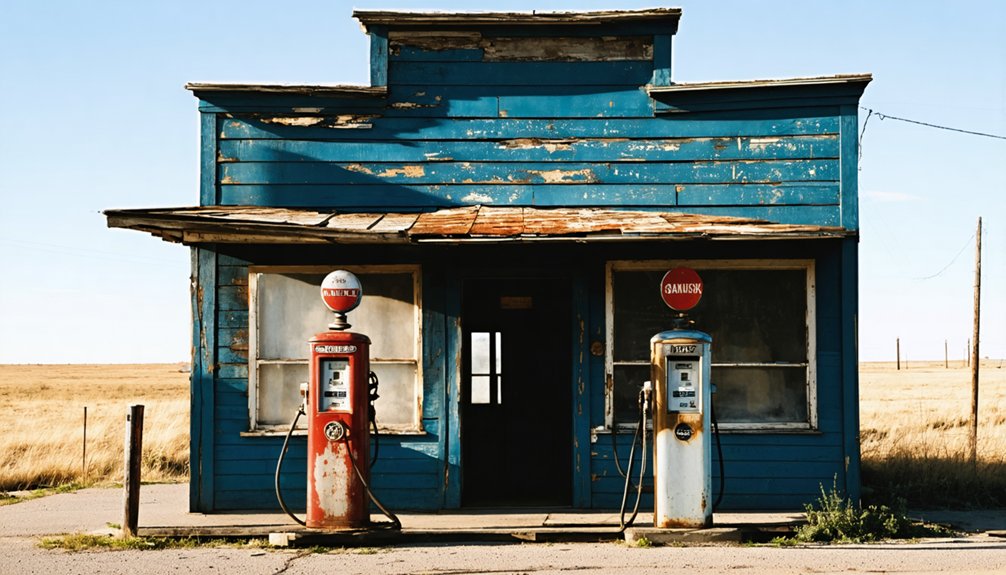
The transformation of abandoned Midwest settlements into protected cultural landmarks represents a complex intersection of legal frameworks, community advocacy, and historical preservation efforts.
You’ll find many ghost towns safeguarded through National Register listings, providing significant legal protection and incentives for cultural preservation. State and local governments frequently designate these sites as historic districts to maintain their heritage significance.
When you visit places like Ha Ha Tonka Castle, now a Missouri state park, you’re experiencing successful adaptive reuse.
These preservation efforts balance structural stabilization with historical authenticity through specialized restoration techniques. Tourism development generates important funding while documentation efforts—including photographs, maps, and oral histories—guide restoration priorities and enrich visitor experiences.
Despite ongoing challenges like limited funding and environmental remediation needs, community volunteers remain essential to sustaining these irreplaceable historical assets.
Digital Footprints: Ghost Towns in Modern Media and Online Documentation
Modern digital technologies have fundamentally transformed how Midwest ghost towns are documented, preserved, and experienced by the public. Platforms like “Ghosts of North Dakota” have democratized access by releasing photo libraries into the public domain, while digital storytelling through podcasts captures oral histories and sociocultural contexts often missing from written accounts.
You’ll find YouTube channels and social media accounts attracting thousands of followers with urbex footage of abandoned structures, generating unprecedented community engagement through comments and viewer requests. These platforms showcase everything from 150-year-old churches to forgotten cemeteries, with engagement metrics demonstrating sustained public interest.
Meanwhile, digital archives and museum resources contribute scanned historical documents, helping reconstruct narratives of places like Griffin, North Dakota—stories that might otherwise vanish without active conservation efforts. This digital ecosystem guarantees these fascinating historical remnants remain accessible to anyone seeking them.
Physical Remnants: What Survives in the Midwest’s Abandoned Communities

Physical traces of abandoned communities across the Midwest present a remarkable archaeological tableau where past human activity meets natural reclamation processes.
When you explore these sites, you’ll encounter architectural decay that tells stories of bygone industries and lives suddenly interrupted. The preservation of cultural artifacts varies dramatically across different ghost towns:
- Fully furnished homes in Michigan’s Keweenaw Peninsula containing period-appropriate beds and antique radios
- Industrial remnants including directional blast walls of powder houses and mining shafts
- Weathered tombstones with ethnic inscriptions revealing community demographics
- Structures being gradually reclaimed by forest vegetation and seasonal weather impacts
- Commercial establishments like general stores and blacksmith shops standing as evidence to once-thriving economic centers
Nature’s persistent reclamation creates a unique juxtaposition between human endeavor and wilderness—a physical timeline of abandonment frozen in various stages of return to earth.
Frequently Asked Questions
Are Midwest Ghost Towns Legally Accessible to Visitors?
Like moths drawn to forgotten flames, you’ll find many Midwest ghost towns legally accessible through guided tours, public parks, and museums, though legal access regulations vary by location and ownership status.
Can I Metal Detect or Collect Artifacts in Abandoned Towns?
You can’t legally metal detect or collect artifacts in abandoned towns without proper permits. Metal detecting regulations prohibit removal of historical items, and artifact preservation ethics require leaving history undisturbed for all to appreciate.
What Safety Precautions Should Explorers Take When Visiting Ghost Towns?
After one explorer suffered a ceiling collapse in Michigan’s abandoned structures, you’ll need sturdy footwear, first aid kits, companions, and survival gear. During urban exploration, always prepare for wildlife encounters and structural hazards.
Do Any Ghost Towns Hold Seasonal Festivals or Reenactments?
Yes, you’ll find abundant ghost town festivals and seasonal reenactments across the Midwest, including Bannack Days in Montana, Civil War reenactments at Wolcott Mill, and Victorian holiday celebrations at Old Cowtown in Kansas.
Which Ghost Towns Can Be Visited During Winter Months?
Several Upper Peninsula ghost towns offer winter exploration opportunities: Central with Miners Cottage rentals, Freda via the Covered Road, White City, Cliff Mine ruins, and Delaware—all requiring specialized transportation for ghost town accessibility.
References
- https://thetravelingwildflower.com/hauntedplacestovisit/
- https://www.visitkeweenaw.com/things-to-do/museums-history/ghost-towns/
- https://twifc.substack.com/p/what-are-the-midwests-coolest-ghost
- https://khak.com/creepiest-abandoned-places-midwest-tours/
- https://boingboing.net/2024/03/10/discover-the-midwests-mysterious-abandoned-spots-from-spooky-silos-to-deserted-airports.html
- https://www.geotab.com/ghost-towns/
- https://en.wikipedia.org/wiki/Lists_of_ghost_towns_in_the_United_States
- https://www.youtube.com/watch?v=lfj6aeZEVJY
- https://jrap.scholasticahq.com/api/v1/articles/9543-the-economics-of-ghost-towns.pdf
- https://www.youtube.com/watch?v=vgPqtEJqOrM