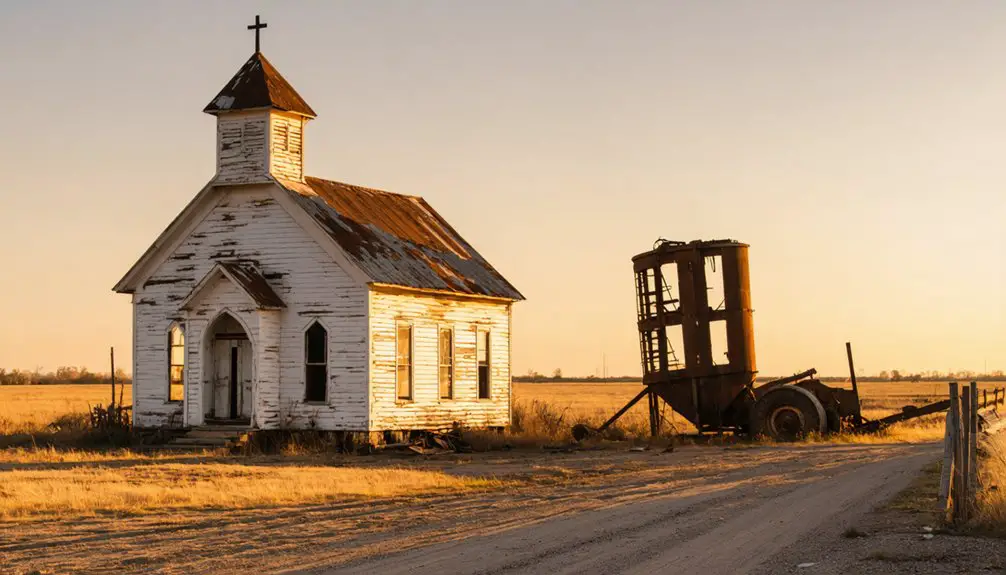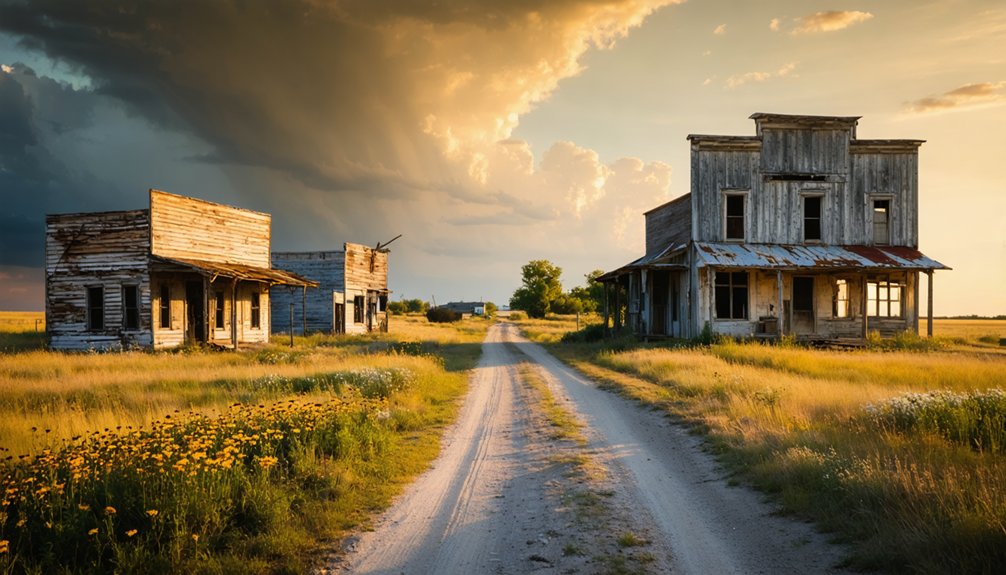
To visit Bookertee, Oklahoma, use GPS coordinates 35.3673194°N, 96.0833361°W and anchor your trip in nearby Weleetka, where you’ll want to fuel up before heading out. Expect open land, minimal signage, and a railway line as your main visual marker — no storefronts or historical signs remain. This forgotten all-Black town sheltered orphaned children after the 1921 Tulsa Race Riot and published its own newspaper. Its quiet landscape holds far more history than it first reveals.
Key Takeaways
- Bookertee sits near Weleetka in Okfuskee County, Oklahoma; use GPS coordinates 35.3673194°N, 96.0833361°W and fuel up in Weleetka beforehand.
- No buildings, signs, or markers remain; the railway line and open land are the only visible references on-site.
- Bookertee was an all-Black town, likely named after Booker T. Washington, embodying post-Civil War self-determination and community resilience.
- The town sheltered roughly 50 orphaned children after the 1921 Tulsa Race Riot, serving as a refuge during regional racial violence.
- Extend your route by pairing Bookertee with nearby Black towns: Boley, Clearview, Chilesville, and Rusk, using Weleetka as your geographic hub.
What Was Bookertee, Oklahoma?
Though little remains of it today, Bookertee was a historically all-Black town in Oklahoma, most likely named after Booker T. Washington. Situated near Weleetka in what’s now considered Okfuskee County, this settlement formed part of a remarkable network of self-determined Black communities across the state.
You’ll find no bustling main street here anymore, but local legends speak to a town that once supported civic institutions and even its own weekly newspaper, the *Bookertee Searchlight*, in 1919.
Preservation efforts have kept its story alive despite the near-total disappearance of its physical structures. When you understand what Bookertee represented — freedom, community, and resilience during a turbulent era — visiting its site carries a meaning that no standing building could fully capture.
Where Is the Bookertee Site Located Today?
If you’re plotting your route, you’ll want to aim for the Weleetka area in Okfuskee County, near coordinates 35.3673194°N, 96.0833361°W.
Nearby communities like Weleetka and Clearview serve as practical anchor points to orient your drive through this stretch of central-eastern Oklahoma.
Once you reach the site, the railway cutting through the land stands as the clearest surviving landmark of what Bookertee once was.
Coordinates And County Placement
Pinpointing Bookertee on a modern map takes a little digging, since historical sources don’t fully agree on its exact county placement. Some records list it under Muskogee County, while others place it firmly in Okfuskee County near Weleetka. Coordinates near 35.3673194°N, 96.0833361°W give you a workable starting point if you’re orienting yourself independently.
That county ambiguity doesn’t diminish the site’s value to historical preservation efforts — it actually reflects how rural Black communities were often underrepresented in official documentation. When you visit, you’re participating in community preservation simply by acknowledging the site’s existence.
Anchor your route around Weleetka, use the coordinates as a guide, and treat this stop as a quiet but meaningful marker of a community that shaped Oklahoma’s forgotten history.
Nearby Anchor Communities
Because Bookertee left almost no visible footprint, nearby communities serve as your practical anchors when planning a visit. Weleetka sits closest to the site and gives you a recognizable reference point for navigation. From there, you can orient yourself toward the coordinates and survey the surrounding landscape on your own terms.
Clearview deserves a stop on the same route. It’s one of Oklahoma’s surviving all-Black towns and carries deep significance for cultural preservation in the region. Pairing Clearview with Bookertee strengthens your trip’s purpose, transforming scattered coordinates into a connected path of historic storytelling.
Boley, another thriving Black town with preserved architecture and active community life, rounds out the corridor naturally. These anchor communities don’t replace Bookertee’s story — they extend it.
Railway As Landmark Reference
When almost nothing remains of a town, the railway becomes your most reliable landmark. At Bookertee, that’s exactly what you’ll find. The tracks running through the site are the clearest surviving feature of a community that urban decay and time have otherwise erased. No buildings, no signs, no preservation efforts have marked this ground in any meaningful way.
Use coordinates near 35.3673194°N, 96.0833361°W to orient yourself. The surrounding landscape is largely undeveloped, so the railway line gives you something concrete to anchor your visit. Think of it less as a destination and more as a geographical reference point.
You’re standing where a thriving Black community once operated a newspaper and built lives. The tracks remain. Everything else exists only in the historical record.
Why Bookertee Matters in Oklahoma’s Black Town History
Though it’s easy to overlook a town that no longer exists on any map, Bookertee’s story sits at the heart of Oklahoma’s remarkable Black town movement. Alongside Boley, Clearview, and Chilesville, Bookertee represented something powerful — a community built on self-determination after the Civil War and Reconstruction-era treaties reshaped the region.
You’re looking at a place that supported its own weekly newspaper, the *Bookertee Searchlight*, in 1919.
After the Tulsa Race Riot, its school sheltered roughly 50 orphaned children — proof that this town extended its reach far beyond its own borders.
Community remembrance and cultural preservation make stops like this worth your time. Bookertee reminds you that freedom wasn’t just declared — it was built, neighborhood by neighborhood, across Oklahoma’s open land.
How Bookertee Sheltered Children After the Tulsa Race Riot
When you research Bookertee’s past, one detail stands out above the rest: after the 1921 Tulsa Race Riot left hundreds of Black families devastated, roughly 50 orphaned children found refuge here.
The town’s school stepped into an unexpected role, absorbing those children at a moment when the surrounding region was still reeling from one of the worst episodes of racial violence in American history.
That single act reveals that Bookertee wasn’t just a self-contained community — it was a lifeline that extended well beyond its own borders.
Tulsa’s Aftermath Reaches Bookertee
After the Tulsa Race Riot devastated Greenwood in 1921, Bookertee’s school opened its doors to roughly 50 orphaned children left in the massacre’s wake. That act of collective care tells you something essential about this community’s character.
Bookertee wasn’t just surviving — it was actively protecting Black life when the outside world refused to.
When you visit today, you’re engaging in heritage tourism that carries real weight. These children weren’t statistics; they were futures preserved by a town that had almost nothing to spare.
Cultural preservation means remembering choices like this one — quiet, determined, and largely unrecorded.
Bookertee’s willingness to absorb that grief and responsibility reveals a community defined by solidarity. That story deserves your attention far more than any roadside marker ever could.
Fifty Orphans Find Refuge
The year 1921 left Greenwood in ash and silence, and the children it orphaned needed somewhere to go. Bookertee answered. The town’s school opened its doors to roughly fifty orphaned children displaced by the Tulsa Race Riot, absorbing them into a community already committed to Black self-determination.
That act of refuge wasn’t just charity — it was cultural preservation in motion. Bookertee refused to let the riot claim an entire generation.
When you research this stop for your road trip, you’ll find this story sits at the heart of community storytelling around the site. No monument marks it today, but the history holds. Knowing this before you arrive transforms a quiet stretch of Oklahoma land into something far more profound.
A School’s Unexpected Role
Before the smoke cleared over Greenwood in 1921, Bookertee’s school had already become something it was never designed to be — a haven. When the Tulsa Race Riot left roughly 50 children without families or shelter, this small-town institution stepped forward. It absorbed those kids into a community already familiar with resilience built from nothing.
That decision tells you something important about Bookertee’s character. Community resilience wasn’t a slogan here — it was a daily practice. The school’s response also reflects a deeper commitment to cultural preservation, protecting Black children and their futures when larger systems had failed them completely.
As you plan your route, let that history settle. You’re not just visiting a ghost town. You’re standing where ordinary people made extraordinary choices under impossible pressure.
What the *Bookertee Searchlight* Reveals About the Town’s Civic Life
- A platform for community resilience during a turbulent post-WWI era
- Evidence of literate, politically aware residents demanding independent media
- A communication network connecting Bookertee to broader Black Oklahoma
- Proof that civic infrastructure existed well beyond basic survival needs
- A documented historical record researchers can still trace today
That newspaper didn’t just report news — it reflected a people who refused to be overlooked.
What Can You Actually See at Bookertee Now?
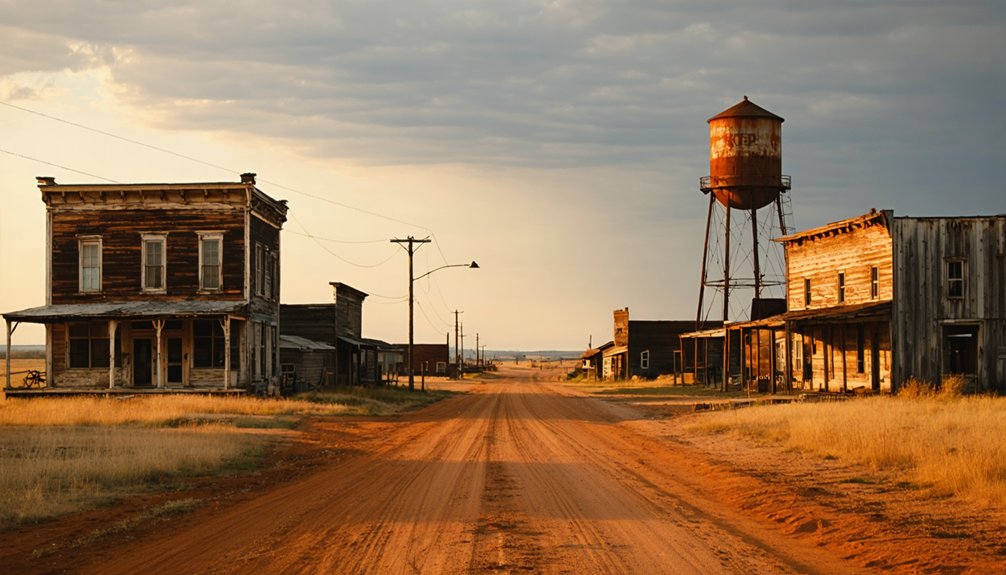
When you arrive at the site where Bookertee once stood, don’t expect a welcome sign, a preserved storefront, or even a historical marker — most sources agree that virtually nothing remains of the original settlement.
Nothing remains of Bookertee — no welcome sign, no storefront, no marker. Just absence where a settlement once stood.
What you’ll find is open land and a railway line cutting through the landscape, the one tangible thread connecting the present to a once-thriving community. It’s a stark scene, but that’s exactly why cultural preservation matters here.
The absence itself tells a story. Heritage tourism doesn’t always mean walking through restored buildings — sometimes it means standing in a quiet field and letting history settle over you.
Bring your own research, your curiosity, and a willingness to see significance in what’s no longer visible.
How to Reach the Bookertee Site From Weleetka
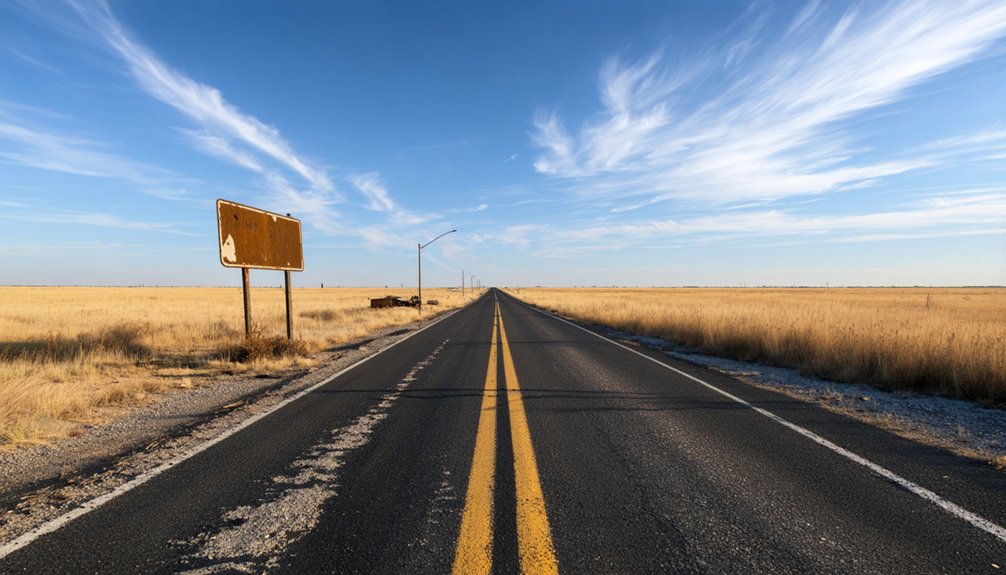
Weleetka serves as your most practical jumping-off point for reaching the Bookertee site, sitting just a few miles from the coordinates most often cited for the former settlement — roughly 35.3673°N, 96.0833°W in Okfuskee County. You’ll want to plan this stop as part of a broader heritage tourism route through central-eastern Oklahoma.
Before you head out, keep these essentials in mind:
- Use GPS coordinates rather than street addresses — no active town markers exist
- Fuel up in Weleetka before departing
- Expect undeveloped land and minimal signage
- Bring a printed map as a backup for rural navigation
- Pair your visit with nearby Clearview to deepen your cultural preservation experience
The railway line remains your clearest visual reference once you’re on-site.
Should You Visit Bookertee Respectfully as a Heritage Site?
Once you’ve navigated to the site, how you show up matters just as much as the fact that you did. Bookertee isn’t a theme park — it’s a place where real people built lives, institutions, and community identity against significant odds.
Respectful tourism here means walking lightly, avoiding disturbance of the land, and resisting the urge to treat absence as emptiness.
Cultural preservation depends on visitors who engage with intention. Read about the *Bookertee Searchlight* before you arrive. Acknowledge the families who called this town home.
Don’t treat the railway remnant as a photo prop without context.
You have the freedom to explore Oklahoma’s forgotten corners, but that freedom carries responsibility. Honor the story, not just the coordinates.
Which Other Black Ghost Towns Belong on a Bookertee Road Trip?
Once you’ve paid your respects at Bookertee, you can extend your trip by weaving in other historic all-Black towns that shaped Oklahoma’s unique heritage. Boley, Clearview, Chilesville, and Rusk all sit within the broader central and eastern Oklahoma corridor, making them natural additions to your route.
Anchoring your drive around Weleetka gives you a practical starting point from which you can connect these sites into a single, meaningful journey through vanished and surviving Black communities.
Nearby Black Ghost Towns
Because Bookertee doesn’t stand alone in Oklahoma’s Black town history, pairing it with nearby vanished communities turns a single heritage stop into a genuinely meaningful road trip.
Each town carries its own story of cultural preservation and, in some cases, ongoing economic revival efforts worth witnessing firsthand.
Add these stops to your route:
- Boley – One of Oklahoma’s most recognized all-Black towns, still partially active today
- Clearview – A neighboring community with deep roots in Black settlement history
- Chilesville – A quieter stop that reinforces the region’s dense heritage layer
- Rusk – Another vanished Black community worth marking on your map
- Weleetka area – Use it as your geographic anchor when traveling between sites
Together, these stops transform your drive into a corridor of remembered lives.
Planning Your Regional Route
How you sequence your stops matters as much as which towns you choose — so anchor your route around Weleetka, which sits closest to Bookertee’s documented coordinates and connects naturally to the surrounding cluster of Black settlement sites.
From Weleetka, push west toward Clearview, then north to Boley, letting the landscape tell its story mile by mile. Both towns carry stronger visible infrastructure, which helps you balance historical preservation work with the quieter, reflective stops like Bookertee itself.
Rusk and Chilesville round out the circuit if you’re committed to deeper community memory research. Keep your driving days manageable — these sites reward slow travel, not rushing.
Build in time to read historical markers, photograph the railway remnants, and sit with what each vanished town actually represents.
How to Build a Full Bookertee and Black Town Route in Oklahoma
Pairing Bookertee with other historic Black towns turns a single ghost-town stop into a genuinely meaningful road trip through Oklahoma’s overlooked history. Cultural preservation drives every mile of this route, and the historical significance compounds as you move between communities that refused to be forgotten.
Build your route around these anchors:
- Bookertee – ghostly railside stop near Weleetka; bring your own context
- Boley – one of Oklahoma’s most recognized all-Black towns, still active
- Clearview – close to Bookertee, easy to pair on the same day
- Chilesville – adds depth to the regional Black settlement story
- Rusk – rounds out the eastern Oklahoma leg of your journey
Travel between these towns using Highway 56 and nearby county roads to keep the drive cohesive.
Frequently Asked Questions
Is There an Official Historical Marker at the Bookertee Site?
Like a faded photograph, Bookertee’s historical significance isn’t captured by an official marker. No confirmed monument exists there. You’ll find preservation efforts lacking, so you’re fundamentally reading the land itself for its powerful, untold story.
What Is the Best Time of Year to Visit Bookertee?
Spring and fall offer you the best seasonal weather for exploring Bookertee’s quiet landscape. You’ll find softer light and comfortable temperatures that maximize your photography opportunities, capturing the railway remnants and open terrain in their most evocative, atmospheric glory.
Are There Guided Tours Available for Oklahoma Black Town Ghost Towns?
Like buried treasure waiting to be uncovered, formal guided tours are rare, but you’ll find historical preservation groups and local organizations offering tourism opportunities that help you explore Oklahoma’s Black town ghost towns meaningfully.
Can Visitors Access the Bookertee Site on Foot Safely?
You can visit Bookertee’s site on foot, but take safety precautions since little remains beyond the railway. Walking accessibility is limited, so wear sturdy shoes, stay alert, and embrace the freedom of exploring this hauntingly open, undeveloped landscape.
Are There Nearby Hotels or Campgrounds for Overnight Stays?
Weleetka’s modest lodging lets you base camp freely. Explore local dining options at nearby diners, enjoy nearby outdoor activities like fishing, then wake up and drive straight to Bookertee’s railway remnants on your own schedule.
References
- https://en.wikipedia.org/wiki/Bookertee
- https://www.kosu.org/local-news/2014-05-23/ghost-towns-all-black-oklahoma-towns
- https://gateway.okhistory.org/ark:/67531/metadc1779215/
- https://oktttp.genealogyvillage.com/ghost_towns/ghost_towns.htm
- https://en.wikipedia.org/wiki/Category:Ghost_towns_in_Oklahoma
- https://okmag.com/blog/havens-for-freed-slaves/
- https://www.okhistory.org/publications/enc/entry?entry=OK005
- https://www.travelok.com/articles/okfuskee-county-genealogy-resources
- https://www.okhistory.org/publications/enc/entry?entry=FR008
- https://gateway.okhistory.org/ark:/67531/metadc1779221/