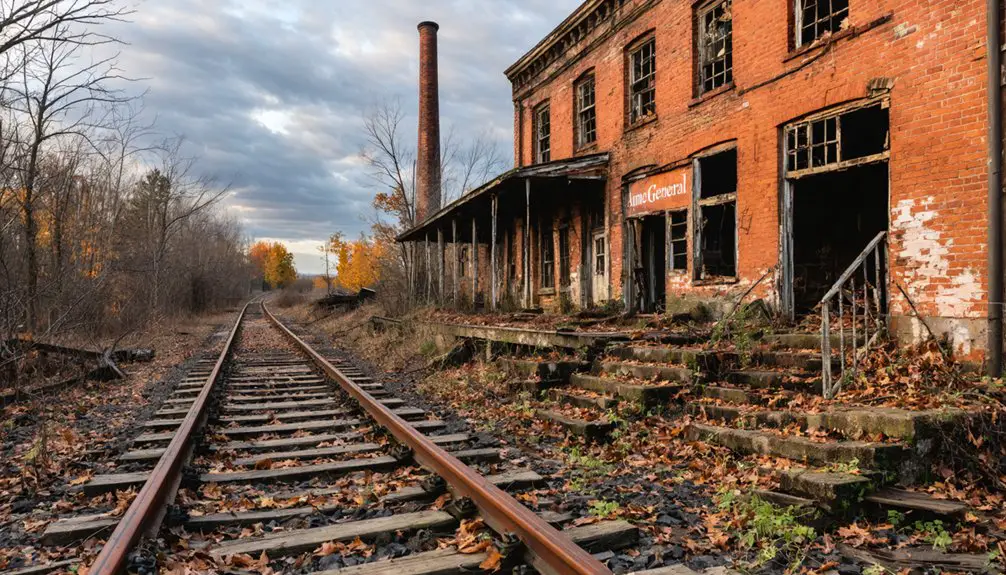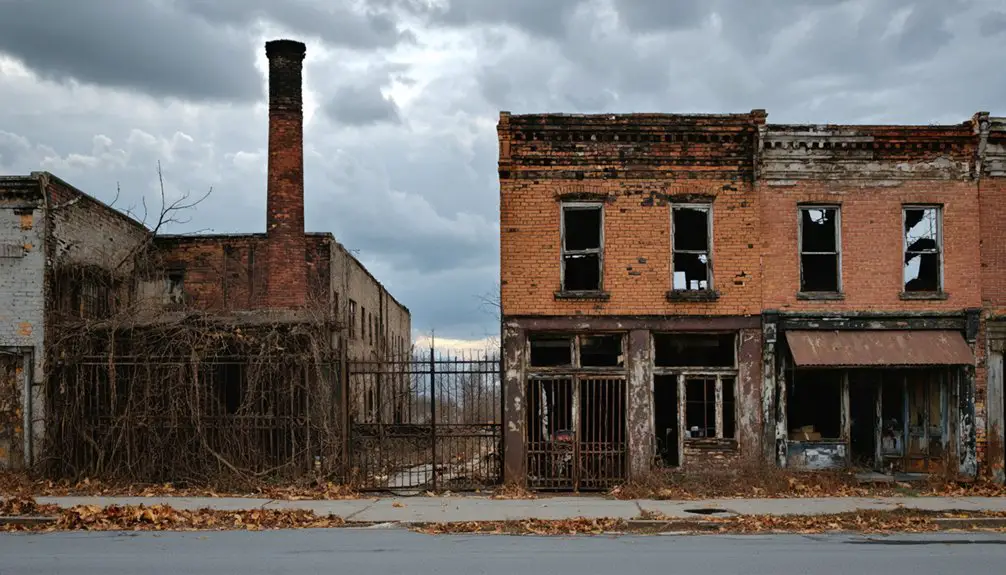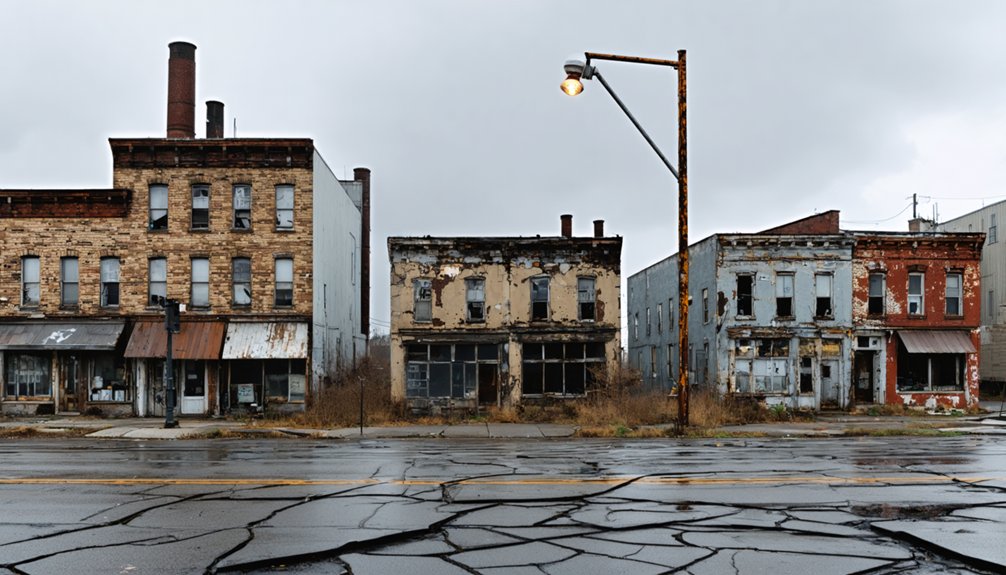
Clairton, Pennsylvania isn’t a fully abandoned ghost town, but it’s haunting enough to make the drive worthwhile. Once home to 25,000 residents, it’s now under 6,800, with boarded storefronts, vacant lots, and industrial remnants frozen in time. You can reach it from Pittsburgh via PA-837, pairing it with Centralia for a full-day Pennsylvania ghost town experience. Stick to public streets, respect the residents still living there, and you’ll uncover layers of history that go much deeper than what you see from the road.
Key Takeaways
- Clairton is accessible year-round via PA-837 from Pittsburgh, offering scenic Monongahela River views before arriving at its weathered post-industrial landscape.
- Standard 2WD vehicles navigate Clairton’s roads easily; no permits or off-road equipment are required for exploring the area.
- Key sights include boarded storefronts, vacant lots, derelict buildings, and industrial remnants reflecting the steel industry’s 1980s collapse.
- Stay safe by remaining on public streets, avoiding condemned buildings, respecting residents, and observing boundaries near contaminated industrial sites.
- Pair Clairton with Centralia for a full-day itinerary covering Pennsylvania’s most compelling industrial and environmental decline destinations.
Why Clairton Qualifies as a Ghost Town Worth the Drive
Clairton isn’t a ghost town in the strictest sense — no sudden disaster emptied it overnight — but what you’ll find there’s perhaps more haunting than a town frozen in time. Once home to 25,000 residents at its peak in the late 1950s, Clairton now holds fewer than 6,800.
The steel industry’s collapse didn’t just take jobs — it took the population with it.
What remains is a compelling portrait of urban decay: boarded storefronts, vacant lots, and industrial remnants that tell the story of a community that never recovered. Unlike fully abandoned towns, Clairton still breathes. People live there, and that contrast between active life and visible decline makes it worth the drive.
You’re not visiting a museum — you’re witnessing ongoing history.
How Steel Industry Collapse Hollowed Out Clairton
At its peak, the steel industry didn’t just employ Clairton — it defined it. When regional mills collapsed in the early 1980s, foreign competition and aging facilities wiped out the economic foundation holding the city together. Thousands of jobs vanished almost overnight, triggering a population freefall from 25,000 residents in the late 1950s to fewer than 6,800 by 2010.
Industrial decline didn’t stop at unemployment. Toxic chemicals left behind in former mill soil made redevelopment nearly impossible, locking entire blocks into long-term vacancy. Without tax revenue or investment, the city couldn’t fund demolition of condemned properties, and urban decay spread visibly across downtown storefronts, abandoned bars, and derelict commercial buildings.
What you’ll see driving through Clairton today is the physical record of that collapse — still unresolved decades later.
The Rise and Fall of Lincoln Way
Before the steel industry defined Clairton’s fate, a small Black community had already carved out its own self-sufficient world along Lincoln Way. Denied service by segregated neighboring towns, residents built a bustling enclave of large families, mutual support, and shared purpose.
Decline came gradually. Younger generations left for better opportunities, older residents passed or moved into care, and the street slowly emptied. Urban decay crept in as homes sat vacant, eventually condemned beyond saving.
Historical preservation wasn’t prioritized, and by 2018, demolition crews had removed the last standing structures.
When you visit today, Lincoln Way no longer exists as a drivable street. No buildings remain. What was once a thriving community survives only in historical accounts, making it a sobering stop on your road trip through Clairton.
What You’ll See Driving Through Clairton Today
Driving through Clairton today, you’ll find a town that wears its history on its sleeve — boarded storefronts, vacant lots, and derelict commercial buildings line the downtown streets near the old steel mill. The urban decay here isn’t subtle. Entire blocks sit frozen mid-collapse, telling the story of a steel-dependent economy that never recovered from the industry’s 1980s collapse.
You’ll notice industrial remnants scattered throughout the landscape, reminders that this borough once housed 25,000 residents fueled by coke and steel production.
Where Lincoln Way once stood, only cleared ground remains — the demolition of its final structures by 2018 erased a neighborhood rather than preserving it.
Despite the decline, Clairton isn’t abandoned. Residents still live here, making it a rare, living portrait of post-industrial America.
Downtown Clairton’s Abandoned Storefronts and Derelict Buildings
As you drive through downtown Clairton, you’ll pass block after block of boarded storefronts and shuttered bars that once served a thriving steel-town population. The streetscape tells the story of a community that lost its economic engine and never fully recovered.
Leaving behind the commercial areas, you can see the hollow buildings frozen in mid-decline. Push a little closer toward the old mill site, and the derelict industrial structures reinforcing that atmosphere become even harder to ignore.
Boarded Storefronts Along Downtown
Walking through downtown Clairton, you’ll find boarded storefronts and shuttered bars lining streets that once served thousands of steelworkers and their families. The urban decay here isn’t subtle — plywood covers windows, paint peels from facades, and entire blocks sit frozen in visible decline.
These aren’t just empty buildings; they’re industrial relics of a community that peaked near 25,000 residents in the late 1950s before steel’s collapse gutted the local economy. You can move freely through the area, taking in the raw, unfiltered atmosphere without crowds or barriers.
The streets remain accessible by standard vehicle, making exploration straightforward. Each boarded storefront tells a version of the same story — a workforce that vanished, taking the businesses that depended on it along.
Derelict Buildings Near Mill
Closer to the old steel mill, the commercial decay takes on a heavier, more industrial character. You’ll notice derelict buildings that once supported a thriving workforce — supply shops, diners, and service businesses that fed off mill paydays.
Industrial decay has hollowed them out completely, leaving behind crumbling facades and broken windows that frame empty interiors. Urban abandonment here feels less like neglect and more like erasure, as if the economy simply packed up and left overnight.
Walking or driving through this stretch, you’re seeing the direct aftermath of the early 1980s steel collapse, when dozens of regional mills shuttered and communities like Clairton lost their economic core.
It’s raw, unfiltered history that no museum could replicate.
Why Clairton’s Contaminated Industrial Land Still Shapes the City
Decades after the steel mills shut down, contaminated soil continues to strangle Clairton’s recovery. Industrial pollution left toxic chemicals embedded deep in former mill land, and that environmental contamination has effectively frozen large portions of the city in place.
Developers won’t touch poisoned ground without costly remediation, so vacant lots stay vacant and condemned buildings stay standing. You’ll notice this walking or driving through — entire blocks sit idle, not because nobody cares, but because cleanup carries a price tag most small municipalities can’t afford.
That environmental burden compounds every other challenge Clairton faces: shrinking tax revenue, population loss, and limited outside investment. As a road-trip visitor, you’re seeing the full picture — not just economic collapse, but land itself pushing back against any easy comeback.
Best Times of Year to Visit Clairton
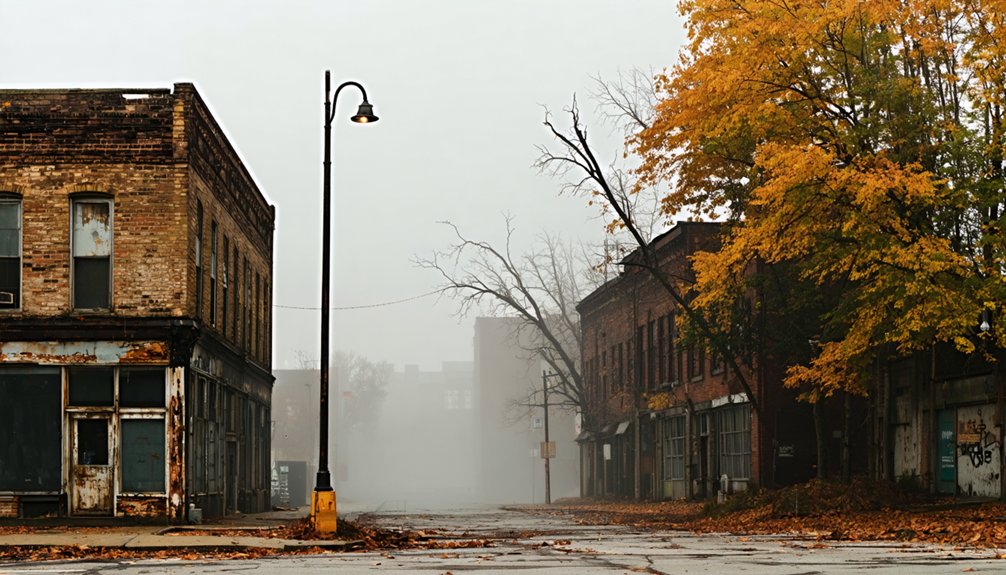
Spring, summer, and fall give you the best conditions for exploring Clairton, when dry roads and longer daylight hours make it easier to move through the borough and take in its abandoned storefronts, vacant lots, and industrial remnants.
Winter visits aren’t impossible since Clairton’s flat riverside terrain is accessible by standard 2WD, but snow and ice can limit your mobility and obscure the visual details that make the area worth photographing.
If you’re pairing Clairton with a broader Pennsylvania ghost-town itinerary that includes Centralia, a late spring or early fall trip keeps the weather manageable across both stops.
Ideal Visiting Seasons
When planning your visit to Clairton, you’ll want to aim for spring, summer, or fall, when milder weather makes outdoor exploration far more comfortable. Walking through areas of urban decay becomes far more rewarding when you’re not battling snow or ice on unfamiliar streets.
Spring offers soft light that highlights the texture of weathered buildings, while summer gives you the longest daylight hours to take in Clairton’s industrial heritage at your own pace.
Fall adds dramatic color contrast against the rusted metal and crumbling brick that define the landscape.
Winter visits aren’t impossible since Clairton is accessible by standard 2WD vehicle year-round, but cold temperatures and reduced visibility can limit how freely you move through the area and absorb its layered history.
Weather and Road Conditions
Clairton’s road conditions stay navigable year-round for standard 2WD vehicles, so you won’t need anything beyond a typical car to reach the borough and move through its streets.
However, each season shapes your experience differently when exploring urban decay and areas near environmental hazards.
- Spring: Mild temps reveal emerging decay without summer overgrowth blocking views.
- Summer: Long daylight hours maximize exploration time, though humidity can feel heavy near industrial zones.
- Fall: Crisp air and stripped foliage expose abandoned structures most dramatically.
- Winter: Ice and snow create slick side streets and reduce visibility around derelict buildings.
- Rain (any season): Wet conditions near contaminated former mill areas make staying on paved surfaces essential.
Choose spring or fall for the sharpest, most unobstructed views of Clairton’s decline.
How to Get to Clairton on a Standard Road Trip Route
Sitting about 13 miles south of Pittsburgh along the Monongahela River, Clairton is straightforward to reach by standard 2WD vehicle, so you won’t need anything special to make the drive.
From Pittsburgh, head south on PA-837, a route that hugs the Monongahela and delivers scenic overlooks of the river valley before dropping you directly into town.
The drive itself sets the mood, shifting from urban Pittsburgh into a quieter, visibly weathered landscape.
You can easily build a flexible itinerary around the trip, stopping for local dining along the way before exploring Clairton’s abandoned storefronts and former industrial corridors.
No special permits or off-road equipment are required, making this an accessible detour for anyone already touring southwestern Pennsylvania’s industrial heritage corridor.
Pair Clairton With Centralia on a Pennsylvania Ghost Town Trip
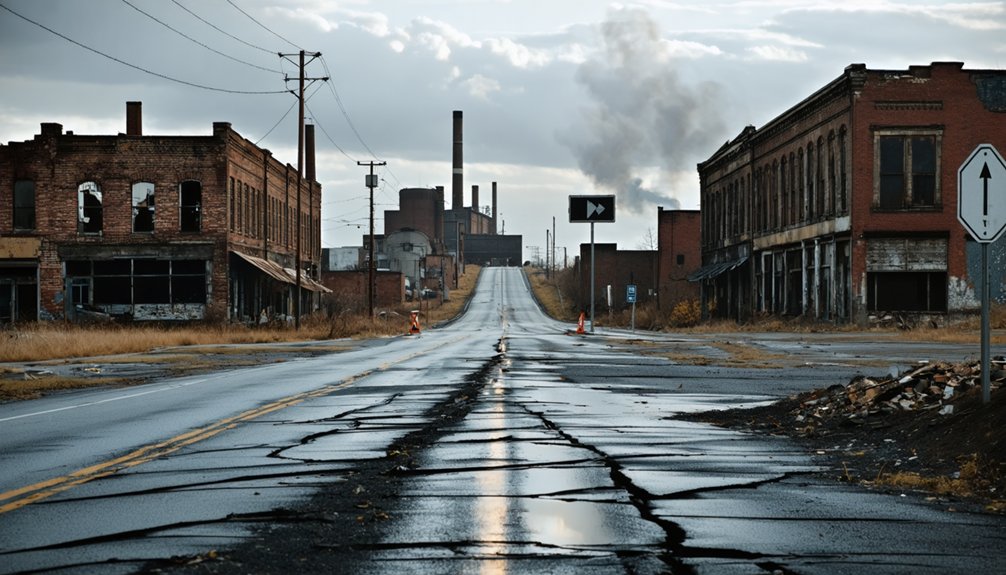
If you’re building a Pennsylvania ghost town itinerary, pairing Clairton with Centralia makes for a compelling two-stop road trip through the state’s industrial and environmental collapse. Both towns tell stories of communities hollowed out by forces beyond their control, giving your urban exploration purpose and context.
Here’s what makes the pairing work:
- Clairton represents industrial decay driven by steel collapse and economic abandonment
- Centralia shrank from 1,000 residents in 1980 to just five by 2020 due to an underground mine fire
- Each town offers a distinct visual atmosphere for exploration
- Together, they cover different chapters of Pennsylvania’s post-industrial decline
- Both are reachable by standard 2WD vehicle, keeping logistics simple
Plan your route, give yourself a full day, and move freely between two of Pennsylvania’s most haunting destinations.
How to Visit Clairton Without Getting Into Trouble
Once you’ve mapped out your two-stop itinerary, knowing how to move through Clairton respectfully and safely makes the difference between a worthwhile visit and an avoidable problem. Stick to public streets, photograph from sidewalks, and never enter condemned or boarded buildings.
Clairton’s residents still live and work here, so treat the borough like any active community, not an open-air museum.
Read historical markers when you find them, since they ground the visual decay in real context. Support local dining before you leave, because spending money locally matters in economically strained towns.
Keep your visit during daylight hours, stay aware of your surroundings, and respect posted boundaries near former industrial sites.
Common sense and basic courtesy will carry you through without incident.
Frequently Asked Questions
Are There Any Guided Tours Available in Clairton?
You won’t find formal guided tours in Clairton, but you can explore independently, connecting with community events and historical preservation efforts that locals actively support, revealing the town’s layered industrial past and abandoned neighborhoods on your own terms.
Is Photography Legally Permitted Near Clairton’s Abandoned Buildings?
You’ll find no specific photography permit policies blocking public shots of Clairton’s streets. However, respect abandoned building regulations — don’t trespass on private property. You’re free to capture decay beautifully from public roads and sidewalks.
Are There Restaurants or Gas Stations Open in Clairton?
You’ll find some open gas stations and local cuisine spots still operating in Clairton. Don’t count on abundant roadside amenities, but enough remain to fuel your adventure before you explore the borough’s haunting, industrial decay.
Does Clairton Have Any Hotels or Lodging Nearby?
You won’t find local accommodations or lodging options directly in Clairton, but nearby Pittsburgh offers you plenty of choices. Stay there, then drive south along the Monongahela River to freely explore Clairton’s hauntingly abandoned streets at your own pace.
Is Clairton Safe for Solo Travelers or Families With Children?
Clairton’s raw decay contrasts with its resilient community spirit, making it manageable for solo travelers and families. Stay alert to safety concerns, stick to main streets, and you’ll find family friendly activities woven into its industrial history.
References
- https://www.abandonedamerica.us/lincoln-way
- https://www.instagram.com/reel/DSBYVEzgcLV/
- https://en.wikipedia.org/wiki/Centralia
- https://www.abc27.com/digital-originals/history-of-centralia-a-pennsylvania-ghost-town/
- https://www.reddit.com/r/pittsburgh/comments/10016n3/mysterious_abandonment_of_lincoln_way/
- https://www.ghosttowns.com/states/pa/clairton.html
- https://www.ebaumsworld.com/articles/the-mystery-of-lincoln-way-a-ghost-street-in-clairton-pennsylvania/87415826/
- https://middleageschmo.wordpress.com/2016/02/05/the-ghost-street-of-clairton-pennsylvania-usa/
- http://drforgot.blogspot.com/2011/
- https://en.wikipedia.org/wiki/List_of_ghost_towns_in_Pennsylvania