You won’t find crumbling walls or rusty derricks at Curry, Texas — you’ll find water. The entire townsite lies submerged beneath Hubbard Creek Reservoir, swallowed long after its 1920s oil boom went bust. Founded in 1881 by J. C. Curry, this once-thriving community of 300 vanished twice: first economically, then literally. Pull up to the reservoir’s edge and you’re standing above a drowned Texas dream. There’s much more to this strange, silent story.
Key Takeaways
- Curry, Texas, founded in 1881, experienced a brief oil boom in the 1920s before its population of 300 rapidly abandoned it by 1930.
- The entire townsite now lies submerged beneath Hubbard Creek Reservoir, leaving no visible ruins or structures to explore above water.
- Visitors can access public shoreline points near Breckenridge, using boat ramps and pull-offs for scenic views and historical reflection.
- During droughts, low water levels occasionally reveal remnants of Curry, fueling persistent ghost stories and adding mystery to visits.
- Research should specify Stephens County to avoid confusing this Curry with similar-named ghost towns in Milam or Kendall County.
What Happened to Curry, Texas?
Curry, Texas had a straightforward rise and fall: founded in 1881 and named after settler J. C. Curry, the town spent decades as a quiet Stephens County settlement.
Then oil arrived in the 1920s, pushing the population to roughly 300 and fueling a school, a carbon plant, and several businesses.
By 1930, the oil was gone, and so was the reason to stay. Residents scattered, buildings emptied, and Curry faded from the map.
The final blow came when Hubbard Creek Reservoir submerged what little remained. Today, you won’t find crumbling storefronts or weathered signs — just water.
Local legends and ghost stories swirl around the lost townsite, but the reservoir keeps most secrets buried beneath its surface.
Can You Still Visit the Curry, Texas Ghost Town?
If you’re hoping to walk the old streets of Curry, you’ll need to reset your expectations — the townsite is almost certainly underwater.
Hubbard Creek Reservoir likely swallowed what remained of the settlement, leaving no preserved downtown to explore.
You can still visit the reservoir area, but you’re coming for the story and the scenery, not a ghost town you can wander through.
Submerged Townsite Reality
Unlike most ghost towns where you can walk crumbling streets and peek through broken windows, Curry offers a different kind of haunting—its townsite is almost certainly submerged beneath Hubbard Creek Reservoir. The water swallowed what the oil boom left behind, erasing any chance of wandering through its former school or carbon plant.
You won’t find local folklore painted on roadside signs or ghost stories echoing through abandoned doorways here. Instead, you’re standing at a reservoir’s edge, gazing over water that hides an entire community’s rise and fall.
That invisibility is precisely what makes Curry compelling. The town doesn’t haunt you through decay—it haunts you through absence. Knowing something real once existed beneath that surface makes the silence feel deliberately weighted.
Hubbard Creek Reservoir Access
Hubbard Creek Reservoir doesn’t lock you out entirely—it just redefines what visiting means. The water covering Curry’s former streets hasn’t erased the story; it’s preserved it beneath the surface, sparking local legends about the submerged boomtown below.
You can still reach the reservoir’s edges and absorb the eerie reality that a living community once stood where bass now swim.
Make your visit count by exploring these access points:
- Hubbard Creek Reservoir shoreline for sweeping views over the submerged townsite
- Stephens County historical resources for maps and documented preservation efforts
- Nearby boat ramps offering water-level perspectives across the reservoir
- Local county offices where staff can point you toward regional ghost-town documentation
You won’t walk Curry’s streets, but you’ll feel their absence powerfully.
Setting Visitor Expectations
Before you load the car and set the GPS for Stephens County, you need to know what Curry, Texas actually offers a visitor today: almost nothing you can touch, and everything you can imagine.
The original townsite is likely submerged beneath Hubbard Creek Reservoir, so don’t expect a walkable main street or preserved storefronts. What you’ll find instead is open water, wide Texas sky, and the quiet weight of a place that oil built and time erased.
Local legends and ghost stories fill the silence that the reservoir can’t drown. You’re visiting an idea as much as a location.
Come prepared for reflection, not restoration. The freedom here isn’t in exploring ruins — it’s in standing at the water’s edge and piecing together what once was.
How Curry Got Its Name and When It Was Founded
When you trace Curry’s origins, you land on 1881, the year settlers planted the town’s roots in Stephens County, Texas.
The name itself honors J. C. Curry, an early settler whose presence left a permanent mark on the regional map.
It’s a small but meaningful detail — a single family name quietly shaping how generations would identify this patch of North Texas land.
J.C. Curry’s Legacy
Though the town itself has long since vanished beneath the waters of Hubbard Creek Reservoir, its name still carries the story of the man who started it all. J.C. Curry arrived in Stephens County in 1881, and his presence left a mark that outlasted the oil, the buildings, and the town itself.
His cultural significance lives on through the name alone — a quiet form of town preservation in memory.
When you explore this region, remember:
- J.C. Curry founded the settlement in 1881
- The town was named directly in his honor
- No monument marks his contribution today
- His legacy survives only through historical records and ghost-town lists
That’s the haunting power of a lost place — the name endures even when everything else disappears.
Founding Year Revealed
One year — 1881 — is all it takes to trace Curry’s origins back to its roots. That’s when settler J. C. Curry staked his claim in Stephens County, Texas, lending his name to a small but determined community carving itself out of the Texas landscape.
You won’t find elaborate local legends or dramatic ghost town myths surrounding its founding. The story is straightforward: a man arrived, a town took his name, and life pushed forward.
What makes 1881 significant isn’t ceremony — it’s the quiet start of a settlement that would later explode with oil-boom energy and then vanish beneath still water.
Knowing the founding year anchors your road trip in real history, giving you a sharper lens through which to appreciate everything Curry became — and lost.
Naming A Texas Town
Curry got its name the old-fashioned Texas way — a settler showed up, put down roots, and the land took his identity. J. C. Curry founded this Stephens County settlement in 1881, and that name stuck through boom, bust, and eventual submergence.
Here’s what shaped Curry’s identity from day one:
- J. C. Curry claimed the land and gave the town its permanent name
- 1881 marks the official founding year, long before oil changed everything
- Stephens County ground once supported this community, now likely beneath water recreation territory
- Hubbard Creek Reservoir transformed the site into wildlife habitat and open water rather than walkable history
You’re not visiting a preserved streetscape — you’re visiting a story swallowed by time and water.
The 1920s Oil Boom That Built Curry’s Brief Boomtown
When oil was discovered beneath Stephens County in the 1920s, it transformed the quiet settlement of Curry almost overnight. Roughnecks, business owners, and fortune-seekers poured in, pushing the population to around 300. A school opened, a carbon plant fired up, and other businesses took root along what had been a modest ranching community.
But that freedom felt borrowed. The oil supply wasn’t endless, and once it exhausted itself in the 1930s, economic decline hit fast and hard. There was no second act for Curry.
Town abandonment followed swiftly, leaving behind empty structures and fading memories. What the oil boom built in years, the bust dismantled in months. You’re not visiting a town that faded slowly — you’re tracing the ghost of one that collapsed.
Why Curry Collapsed and Disappeared Underwater
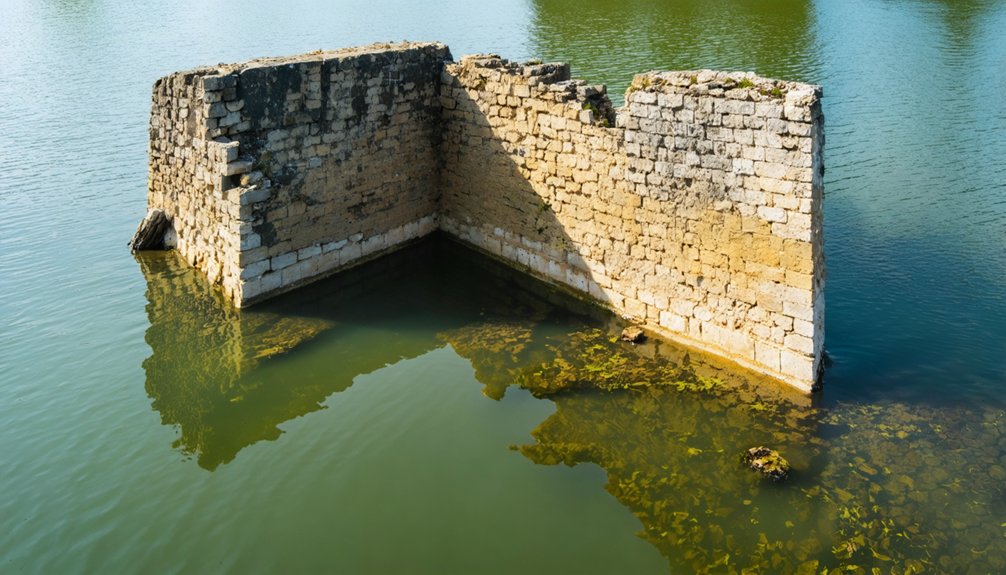
After the oil gave out in the 1930s, Curry didn’t just fade — it vanished in two stages. First came urban decay, as businesses shuttered and residents scattered once the petroleum money dried up.
When the oil dried up, Curry didn’t fade gracefully — it collapsed, then disappeared entirely.
Then came the water.
Hubbard Creek Reservoir eventually swallowed what remained of the townsite, erasing any physical trace you might’ve explored. Today, oral histories are fundamentally all that survive alongside sparse historical records.
Before you chase this ghost, know what buried it:
- Oil exhaustion triggered immediate economic collapse
- Residents left rapidly rather than gradually
- Remaining structures succumbed to abandonment and decay
- Rising reservoir waters permanently submerged the townsite
You’re not visiting ruins here — you’re standing at the edge of a lake that holds an entire community beneath its surface.
Historical Markers and Shoreline Clues Near the Submerged Site
Though the original townsite lies beneath Hubbard Creek Reservoir, you’re not entirely without physical reference points. Drive the reservoir’s shoreline and scan for subtle terrain shifts where land meets water — eroded embankments and shallow flats sometimes hint at buried foundations below.
Stephens County historical resources and roadside markers offer context about the region’s oil-boom era, grounding Curry’s story in documented fact rather than speculation.
Local legends and ghost stories circulate around submerged Texas towns, and Curry’s no exception. Locals occasionally mention eerie low-water moments when drought drops the reservoir’s level, briefly exposing remnants of what once stood. Whether those accounts are reliable or embellished, they add atmosphere to your visit.
Treat the shoreline itself as your artifact — a boundary marking where a living, breathing oil town vanished permanently underwater.
How to Reach Hubbard Creek Reservoir From Curry, Texas
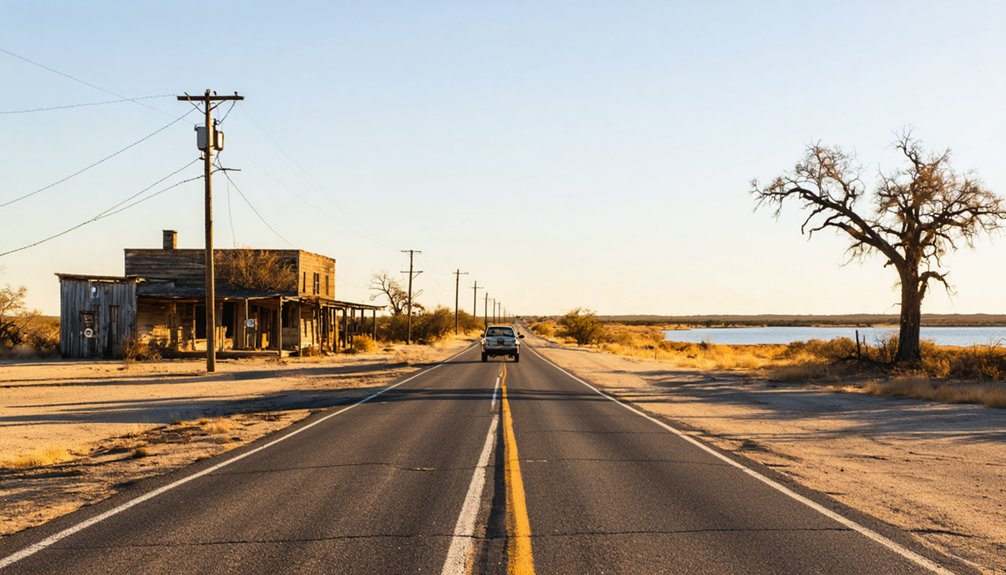
Since Curry’s original townsite is almost certainly underwater, Hubbard Creek Reservoir isn’t just a side stop — it’s your primary destination. Head toward Breckenridge, the Stephens County seat, and follow local roads southwest toward the reservoir’s public access points.
Shoreline pull-offs at these access points let you scan the water with the knowledge that a vanished oil boomtown lies somewhere beneath. Once you arrive, orient yourself along the bank and let the sheer scale of the lake reframe what you’ve read about a town of 300 that oil built and exhaustion erased.
Route From Curry
Because the original townsite of Curry likely rests beneath the water, Hubbard Creek Reservoir isn’t just a nearby landmark—it’s the closest you’ll get to standing over what was once a small but lively oil-boom community.
From the Curry area, head toward Breckenridge, then follow local roads southwest to reach the reservoir’s shoreline.
Once you’re there, you’ll find room to roam freely:
- Wildlife viewing opportunities along the banks, where birds and deer frequent the water’s edge
- Quiet fishing spots that reward patience and solitude
- Open water views that hint at the submerged history below
- Nearby Breckenridge diners serving local cuisine worth stopping for before or after your visit
Let the reservoir’s stillness remind you that Curry’s story runs deep—literally.
Reservoir Arrival Tips
Once you’ve accepted that Curry’s original streets likely sleep beneath still water, reaching Hubbard Creek Reservoir becomes the natural next move on your itinerary. Head east on US-180 from Breckenridge, and you’ll reach the reservoir’s western shores within minutes. Pull over wherever the water opens up before you — that’s your quiet reckoning with what time and petroleum economics can do to a place.
The reservoir rewards patience. Bring a telephoto lens for wildlife photography along the grassy shoreline edges, where herons and waterfowl move freely. Scattered picnic spots near the public access points let you settle in, eat, and sit with the story you’ve just followed across Stephens County‘s backroads.
No velvet ropes, no admission fee — just open Texas sky and submerged history beneath calm water.
Don’t Confuse This Curry With Other Texas Ghost Towns
Texas actually has more than one ghost town carrying the Curry name, so knowing your county matters before you hit the road. Each settlement carries its own cultural significance and faces unique preservation challenges.
- Stephens County Curry: Founded 1881, oil-boomed in the 1920s, now submerged beneath Hubbard Creek Reservoir.
- Milam County Curry: Operated two segregated schools serving 60 students by 1903, abandoned by 1941.
- Currey’s Creek, Kendall County: Established 1850, once held 100-plus residents during early Texas settlement.
Key distinction: Only Stephens County Curry sits underwater, making it a genuinely lost townsite.
When you’re planning your route, always specify Stephens County in your research. You’ll avoid wrong turns and arrive understanding exactly which forgotten oil town you’re chasing.
Other Stephens County Ghost Towns Worth the Detour
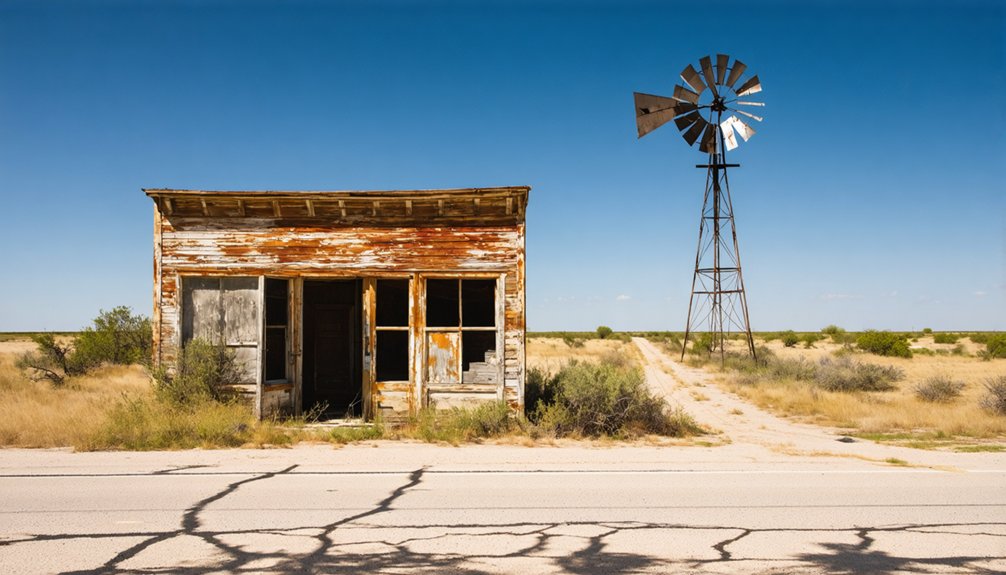
Stephens County holds more forgotten history than just Curry, and once you’re already tracing oil-boom ghosts through the region, it’s worth stretching your itinerary to catch the other abandoned settlements scattered across this stretch of North Texas.
Each forgotten community carries its own collapsed economy, its own faded ambitions, and its own ghost stories passed down through generations of locals who remember when these places still appeared on maps.
Some sites fuel urban legends about buried oil money or vanished families, adding an eerie layer to your exploration.
You won’t find restored storefronts or tourist signage at most of these stops, just open land, crumbling foundations, and silence.
That rawness is exactly what makes a Stephens County ghost-town road trip feel genuinely untamed rather than curated.
Best Time of Year to Road Trip Through Stephens County
Timing your Stephens County road trip well makes a genuine difference in what you’ll experience on the road and at the reservoir’s edge. Each season offers something distinct for history seekers and modern recreation enthusiasts alike.
Timing your Stephens County visit right transforms a simple drive into something far more memorable.
- Spring (March–May): Mild temperatures make long drives comfortable. Low reservoir levels occasionally expose historical artifacts near the shoreline.
- Fall (September–November): Crisp air, lighter crowds, and golden light reward photographers documenting the submerged ghost town’s surroundings.
- Summer (June–August): Peak modern recreation season at Hubbard Creek Reservoir. Expect boat traffic and busy shorelines.
- Winter (December–February): Quietest season, stripped-down landscapes reveal the reservoir’s geography clearly. This season is ideal for reflective, solitary exploration.
Avoid summer if you’re chasing history over recreation. Spring and fall deliver the sharpest balance of access, atmosphere, and discovery.
Frequently Asked Questions
Is There an Entry Fee to Access Hubbard Creek Reservoir?
Like freedom itself, access is open — you’ll find no entry fee at Hubbard Creek Reservoir. You’re free to explore its wildlife habitats and embrace historical preservation efforts surrounding this breathtaking, submerged ghost town landscape.
Are There Campgrounds or RV Hookups Near Hubbard Creek Reservoir?
You’ll find campgrounds and RV hookups near Hubbard Creek Reservoir, where you can set up basecamp, soak in scenic lake views, and explore the region’s historical ghost towns under wide-open Texas skies.
What County Road Numbers Lead Closest to the Submerged Townsite?
No specific county road numbers are confirmed to lead you directly to Curry’s submerged townsite. You’ll want to check road condition updates locally, seek historical landmarks near Hubbard Creek Reservoir’s shoreline, and chase those untamed, watery edges yourself.
Can You Fish or Boat Directly Over the Former Curry Townsite?
You can boat and fish over Curry’s submerged streets — 300 souls once thrived here. Cast your line above abandoned town relics and let Curry ghost stories drift up through Hubbard Creek Reservoir’s mysterious depths.
Are There Any Museums in Stephens County Dedicated to Oil Boom History?
You’ll want to explore the Stephens County Historical Museum in Breckenridge, where oil boom artifacts and ghost town legends breathe life into the region’s wild petroleum past, connecting you directly to vanished places like Curry.
References
- https://en.wikipedia.org/wiki/Curry
- https://www.texasescapes.com/TexasTowns/Curry-Texas.htm
- https://en.wikipedia.org/wiki/List_of_ghost_towns_in_Texas
- https://texasescapes.com/CentralTexasTownsNorth/ScurryTexas/ScurryTexas.htm
- https://www.tshaonline.org/handbook/entries/curry-tx-stephens-county
- https://www.ghosttowns.com/states/tx/tx_ghst_twns_sect1345.doc
- https://www.facebook.com/groups/1784294158550093/posts/4220820501564101/