Planning a ghost town road trip to Hawkeye, Kansas means chasing a place that’s more memory than landmark. Tucked into Cook Township, Decatur County, Hawkeye once had a beating civic heart — a post office that ran from 1879 to 1896 — before the prairie quietly swallowed it whole. You won’t find crumbling storefronts or weathered facades. You’ll find tall grass, open sky, and silence. Stick around, and you’ll discover everything you need to make this journey unforgettable.
Key Takeaways
- Hawkeye, a ghost town in Decatur County, Kansas, operated a post office from 1879 to 1896 before declining into open prairie.
- No structures or foundations remain; visitors experience silent, grass-covered land where the landscape itself tells Hawkeye’s story.
- Access requires county plat maps and GPS coordinates, as gravel roads and limited signage make navigation challenging.
- Visit during spring or October for mild temperatures, avoiding extreme summer heat; base yourself in nearby Oberlin for lodging.
- Combine Hawkeye with nearby ghost towns like Bassetville, Hooker, and Shibboleth for a fuller Decatur County road trip experience.
What Is Hawkeye, Kansas and Why Does It Matter?
Tucked into the quiet prairie of Cook Township in Decatur County, Hawkeye, Kansas is a ghost town that’s faded into little more than a memory — a place where a post office once operated from 1879 to 1896, and where the rhythm of pioneer life briefly took hold before disappearing into the grass.
You won’t find grand historical architecture or well-preserved storefronts here. What you’ll find instead is open land, silence, and the faint pull of local legends tied to a settlement that rose and quietly dissolved within a single generation.
That’s exactly what makes Hawkeye matter. It’s an honest snapshot of frontier ambition — unpolished and unadorned. For travelers chasing real history rather than curated experiences, Hawkeye offers something rarer: the freedom to imagine a world that’s genuinely gone.
Hawkeye’s Post Office Years: 1879 to 1896
When you trace Hawkeye’s brief life, the post office tells the clearest story — it opened in 1879, giving the settlement its first real pulse of civic identity.
For seventeen years, that small operation connected residents to the wider world, marking Hawkeye as a functioning community worth finding on a map.
When the post office closed in 1896, the town’s reason for existing quietly disappeared with it.
Post Office Opens 1879
Hawkeye’s post office opened in 1879, and that single detail anchors everything we comprehend about the town’s active years. Before that first postal window opened, Hawkeye existed only as scattered ambition on the Kansas prairie. The post office made it official — a real place where settlers sent letters, received news, and felt connected to something larger than isolation.
You’re chasing that version of Hawkeye when you drive out here. Strip away the historical myths, and what remains is straightforward: a community formed, a post office opened, and people built lives around both.
Preservation challenges have erased most physical evidence, leaving the 1879 date as your clearest entry point. That year gives you something solid to hold while the prairie wind reminds you how much has already disappeared.
Seventeen Years Of Service
From 1879 to 1896, Hawkeye’s post office kept this small Cook Township settlement tethered to the wider world for seventeen years. Every letter that passed through its window carried someone’s ambition, grief, or news from distant kin. That’s seventeen years of community memory built one delivery at a time.
When the post office closed in 1896, Hawkeye lost its clearest connection to the outside. Without that anchor, the town’s purpose quietly unraveled. You can feel that absence when you research the site today — historical preservation efforts haven’t left much to find, and the townsite retains little of what once stood.
That silence, though, is exactly what draws you here. Hawkeye doesn’t perform its history; it simply holds it.
Closure Signals Town’s Decline
The 1896 closure of Hawkeye’s post office didn’t just end mail delivery — it pulled the thread that held the town together. Once a post office shuts down, commerce follows. Residents who’d built lives around that small hub began drifting toward more connected towns, leaving Cook Township quieter with each passing season.
Today, Hawkeye stands as one of Kansas’s understated historical landmarks, a place where the prairie reclaimed what settlers once carved out. Preservation efforts here are minimal — the land simply absorbed the town back into itself. But that rawness is exactly what draws you.
You’re not chasing restored facades or guided tours. You’re chasing the feeling of standing where a community once breathed, thrived briefly, then quietly disappeared into the northwestern Kansas wind.
What Remains at the Hawkeye Townsite Today?
Like so many prairie settlements that flickered briefly and then went dark, Hawkeye doesn’t offer dramatic ruins or weathered storefronts to photograph—it’s a site where the land has quietly reclaimed what settlers once built.
You won’t find historical myths confirmed here through crumbling architecture or visible foundations. Preservation efforts never took hold, leaving little trace of the post office that once anchored daily life between 1879 and 1896.
What you’ll find is open sky, tall grass, and the particular silence that northwestern Kansas does better than anywhere else. That emptiness carries its own weight.
You’re standing where people once sorted mail, traded goods, and built futures that didn’t last. Bring a county map, set your expectations honestly, and let the landscape do the storytelling.
How to Find Hawkeye in Cook Township, Decatur County
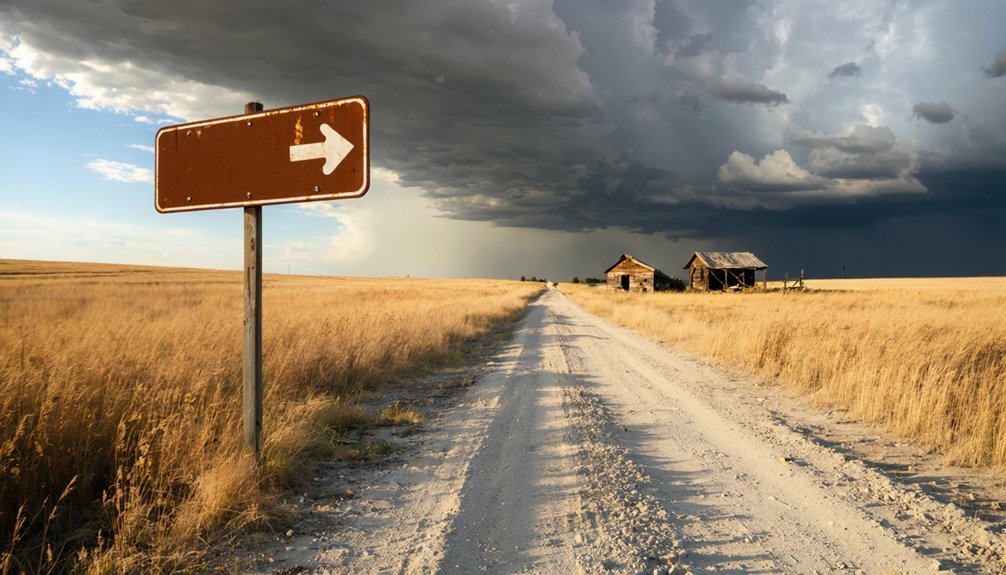
Traveling to Hawkeye means orienting yourself around Cook Township in Decatur County, a stretch of northwestern Kansas where gravel roads outnumber paved ones and GPS signals can outpace GPS accuracy.
Pull out a county plat map before you leave — digital tools sometimes miss these forgotten corners entirely. Decatur County’s open prairie holds its secrets quietly, and Hawkeye sits among them without signage or historical architecture to announce itself.
You’re steering by coordinates and instinct here. Local legends may surface if you stop at a nearby farmstead and ask questions; longtime residents sometimes carry memories that no published record preserves.
Embrace that uncertainty as part of the journey. You came for the freedom of wide-open land and vanished history, and Hawkeye delivers exactly that.
Other Decatur County Ghost Towns Worth the Drive
Once you’ve walked Hawkeye’s quiet ground, Decatur County rewards you with an entire constellation of vanished towns worth chasing down the same gravel roads. Bassetville, Hooker, Shibboleth, Vallonia, and Sheffield each carry their own historical myths — pioneer hopes that burned briefly then dissolved into prairie silence.
Lund, Stephen, Jackson, and Decatur itself round out a county-wide circuit that demands little more than a reliable map and an open afternoon. Don’t expect modern preservation efforts or interpretive signs at most stops. These sites return control to you, the traveler, letting raw landscape and personal research shape the experience.
Cross-reference county records before you go, verify road conditions, and embrace the freedom of discovering places history nearly forgot entirely.
Planning a Northwest Kansas Ghost Town Route
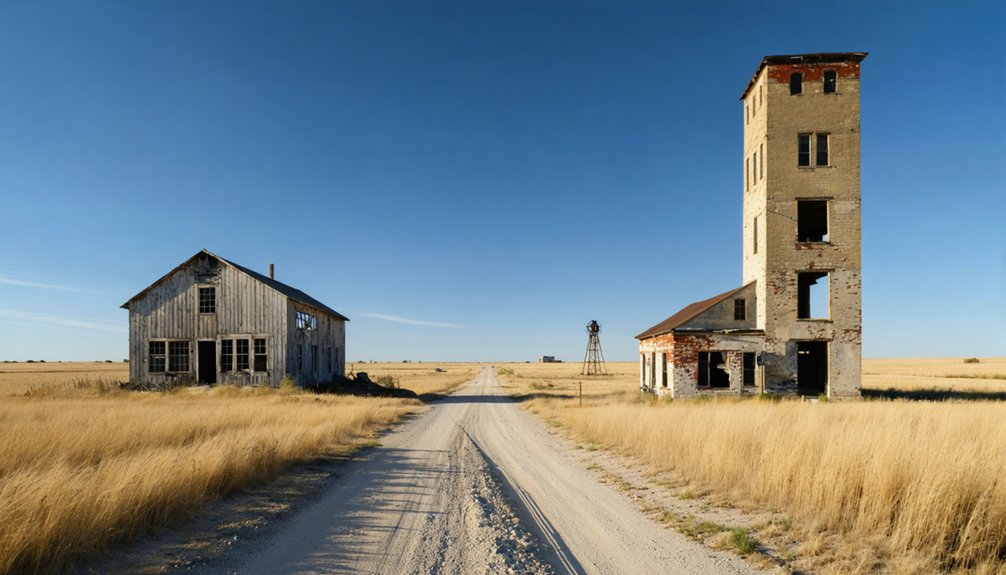
Decatur County is just the beginning. Northwest Kansas stretches wide and quiet, holding dozens of forgotten settlements between its fence lines and rolling prairie.
You can build a route that moves from one ghost town to the next, covering sites like Bassetville, Lund, and Shibboleth in a single day’s drive.
Each stop adds another chapter to the region’s story of pioneer ambition and gradual disappearance.
Ghost town preservation matters here, even when nothing stands above the grass, because the historical significance of these places lives in the land itself.
Pull your maps before you leave, mark your coordinates, and give yourself extra time.
The best discoveries often happen on the gravel roads between the destinations you planned.
Best Time of Year to Visit Kansas Prairie Ghost Towns
Spring’s mild temperatures make it the ideal window for tracing Hawkeye’s faint outline across Cook Township’s open ground, before summer turns the prairie into a punishing stretch of heat and glare.
You’ll want to avoid July and August, when temperatures routinely climb past 100°F and turn a reflective afternoon among old townsites into an endurance test.
Come October, the shortgrass prairie shifts into warm amber tones that frame every crumbling foundation and forgotten fence post with a quiet, elegiac beauty.
Spring Offers Mild Temperatures
When spring arrives on the Kansas prairie, the air carries that particular mix of cool wind and warming soil that makes a long drive through ghost-town country feel almost ceremonial. Temperatures settle into the fifties and sixties, letting you walk abandoned townsites without summer’s punishing heat pressing down on you.
You’ll move at your own pace, reading the land for clues that historical preservation efforts sometimes miss entirely. Hawkeye, Kansas asks you to slow down and listen—community storytelling lives in the silences between what’s documented and what’s disappeared.
Spring wildflowers push through the cracked earth near old foundations, coloring the emptiness. The open roads stay quiet, and that quiet belongs entirely to you.
Avoid Summer Heat Extremes
Summer on the Kansas prairie doesn’t ease into discomfort—it arrives with authority, pushing afternoon temperatures past the point where open-site exploration stops feeling worthwhile and starts feeling dangerous. Hawkeye offers no tourist infrastructure—no shade structures, no water, no refuge. You’re exposed.
Skip June through August and protect both yourself and your focus on historical preservation:
- Midday heat regularly exceeds 100°F across northwestern Kansas
- Dehydration sets in faster at open, shadeless townsites
- Haze dulls photography, flattening the prairie’s dramatic horizons
- Rural roads offer zero amenities between ghost-town stops
- Summer crowds thin elsewhere, but comfort disappears entirely here
Your freedom to roam these forgotten places depends on arriving when the land lets you linger—not when it drives you back to your vehicle within minutes.
Fall Colors Frame Prairie
Fall transforms the Kansas prairie into something that rewards the ghost-town traveler in ways no other season can match. Amber grasses stretch toward wide skies, and the cooler air sharpens your focus on every detail — a crumbling foundation, a fence line swallowed by goldenrod, the quiet weight of local legends tied to land nobody tends anymore.
You’ll notice what summer’s haze obscures: subtle changes in terrain that hint at where historical architecture once stood. September through October keeps the days warm enough for comfortable exploring while the crowds that haunt state parks stay home.
You move freely, camera ready, imagination working. The prairie speaks differently in fall — less about survival, more about memory. That’s exactly the right mood for chasing a ghost town like Hawkeye.
Where to Sleep and Eat Near the Hawkeye Townsite
Since Hawkeye leaves little more than open prairie to greet you, you’ll want to anchor your road trip in a nearby town that can offer a bed and a hot meal. Oberlin, the Decatur County seat, gives you the closest reliable nearby lodging and local dining options worth exploring.
Hawkeye offers little beyond open prairie, so anchor your trip in nearby Oberlin for lodging and a solid meal.
- Book a room at a small Oberlin motel to keep your mornings unhurried.
- Fuel up at a local diner before heading out on gravel roads.
- Pack a cooler for stretches where local dining options disappear completely.
- Check county maps the night before so you’re never guessing at crossroads.
- Ask locals about road conditions, since prairie tracks shift after rain.
Oberlin sits close enough to make Hawkeye a comfortable half-day detour.
What to Pack for a Northwest Kansas Ghost Town Trip
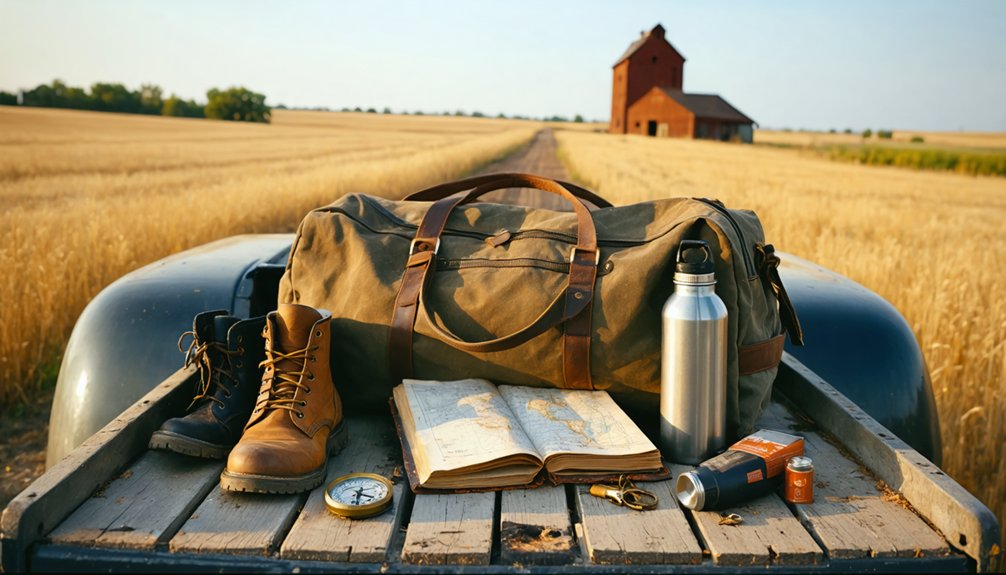
Packing well makes the difference between a satisfying prairie ramble and a frustrating one. Northwest Kansas offers wide skies and thin shade, so bring sun protection, water, and sturdy boots for uneven ground.
Carry a detailed county map alongside your phone — cell coverage fades fast out here. A notebook serves historical preservation efforts when you jot coordinates, conditions, and observations at each townsite.
Pack a camera for documenting remnants that won’t last another decade. Bring small bills for any local diner or supply stop, since community engagement with nearby towns keeps rural economies breathing.
Pack patience, too. Sites like Hawkeye offer atmosphere over spectacle, rewarding travelers who slow down, read the silence, and let the prairie tell what the buildings no longer can.
How to Research Decatur County Ghost Towns Before You Go
Before you chase down a single Kansas ghost town, start with Decatur County’s historical records to confirm what actually stood where — postal histories, like Hawkeye’s 1879–1896 post office, anchor a site in real time.
From there, map your stops across the county’s broader ghost-town network, plotting Hawkeye alongside Bassetville, Shibboleth, and the others to build a route worth driving.
Always verify your sources before you go, because crowdsourced lists vary and some sites leave little more than quiet prairie where a whole town once breathed.
Start With County Records
Doing your homework before you hit the road will save you from staring at an empty field and wondering if you’ve found the right spot. Decatur County records hold threads of historical preservation that connect you to local legends most travelers never uncover.
Start your research here:
- Visit the Decatur County courthouse for township plat maps tied to Cook Township
- Request postal history records confirming Hawkeye’s 1879–1896 active period
- Cross-reference Kansas State Historical Society databases for settlement documentation
- Search county deed records to trace land ownership changes after the town faded
- Contact local genealogical societies who often hold unpublished notes on vanished communities
These sources ground your trip in documented history rather than guesswork, giving every empty prairie mile genuine meaning.
Map Your Ghost Towns
Once you’ve pulled those county records, you’re ready to lay out the full picture of what Decatur County’s ghost-town landscape actually looks like.
Plot Hawkeye alongside Bassetville, Hooker, Shibboleth, Vallonia, and the other vanished settlements scattered across the county. You’ll quickly see how close these sites sit to one another, making a single day’s drive surprisingly productive.
Mark each stop using topographic maps alongside modern road maps, since land use changes over generations can shift access points entirely. Cross-reference your findings with historic preservation databases to confirm which townsites retain any documented remnants worth locating.
Some spots offer nothing but open prairie, yet that emptiness carries its own quiet weight. Knowing what you’re heading toward, even when it’s nearly nothing, transforms the drive into something intentional.
Verify Sources Before Visiting
Chasing ghost towns rewards the careful researcher far more than the impulsive traveler, so you’ll want to verify every source before you load the car. Local legends surrounding places like Hawkeye can blur into fiction fast, and preservation efforts often leave sparse documentation behind.
Cross-reference these reliable starting points:
- Kansas State Historical Society records for postal history and township boundaries
- Decatur County courthouse documents for plat maps and land records
- University of Kansas digital archives for pioneer-era newspaper mentions
- Ghost-town databases cross-checked against county records, not accepted alone
- Regional preservation efforts organizations that catalog standing remnants versus vanished sites
Hawkeye’s post office closed in 1896, and little remains today. Knowing exactly what you’re driving toward saves disappointment and sharpens that irreplaceable feeling of standing where a forgotten world once breathed.
Frequently Asked Questions
Is a Permit or Landowner Permission Needed to Visit Hawkeye’s Townsite?
Before you set foot on those forgotten prairie grounds, check carefully — private property rules may apply, and visitor restrictions could stop you cold. Always confirm landowner permission before you chase Hawkeye’s vanishing past.
Are Any Historical Photographs of Hawkeye, Kansas Available to View?
You’ll want to explore historical archives and photograph collections at the Kansas State Historical Society, where faded images of forgotten prairie towns might quietly resurrect Hawkeye’s vanished streets, storefronts, and the freedom of an untamed frontier past.
Does Decatur County Offer Any Official Ghost Town Driving Tour Maps?
No official Decatur County ghost town driving tour maps exist, but you’ll craft your own freedom-fueled route through forgotten tourist attractions, chasing ghost town history across windswept prairie where pioneer dreams quietly dissolved into silence.
Were Any Other Kansas Ghost Towns Also Named Hawkeye?
Like searching for Brigadoon, you won’t find another Kansas ghost town sharing that name. Hawkeye stands alone among historic landmarks and local legends, a singular prairie whisper that’s uniquely yours to discover and claim.
Can Metal Detecting or Artifact Collecting Be Done at Hawkeye Legally?
You’ll need to verify land ownership before following metal detecting regulations or artifact collecting guidelines at Hawkeye. Private land requires permission, and federal laws protect historical artifacts, so research carefully before you dig into those whispering prairie secrets.
References
- https://legendsofkansas.com/kansas-ghost-town-list/
- https://en.wikipedia.org/wiki/List_of_ghost_towns_in_Kansas
- https://michael-hankins.com/2023/05/23/hawkeye-kansas/
- https://www.youtube.com/watch?v=KBXINX0xqnU
- https://www.wikiwand.com/en/map/Hawkeye
- https://www.youtube.com/watch?v=alC1wDdSVvg
- https://www.youtube.com/watch?v=VPZtNoncnig