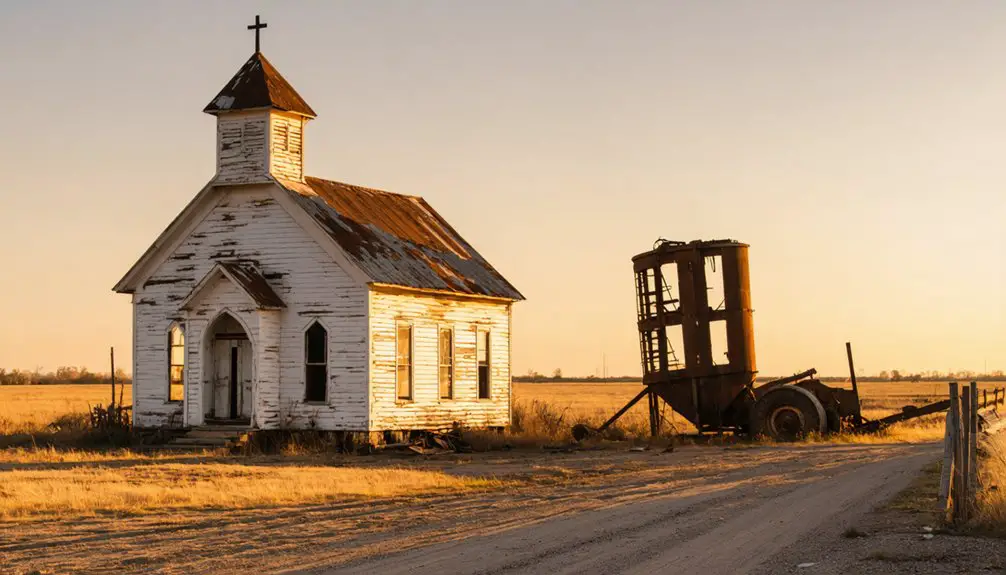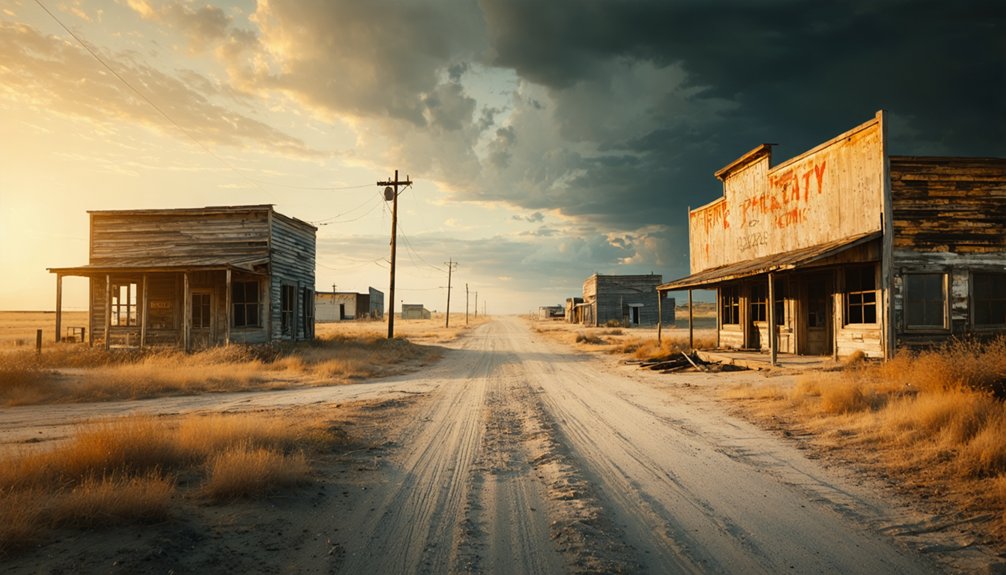
Start your road trip in Frederick, fuel up, and head ten miles southeast on Oklahoma Highway 54 toward Hollister — a town of 35 souls that drought, economic collapse, and outmigration nearly erased entirely. Founded in 1907, Hollister’s crumbling high school entrance, abandoned homes, and a ghost-quiet Ford Ranchero tell stories time forgot. There are no tourist signs, just open plains and raw history waiting. Stick around — there’s far more to uncover.
Key Takeaways
- Hollister, Oklahoma, is located ten miles southeast of Frederick via Highway 54, accessible through flat farmland and abandoned grain elevators.
- Key sights include the high school entrance columns, foundation ruins, abandoned homes, vintage signage, and a remarkably intact 1971–1972 Ford Ranchero.
- No tourist signs exist, so carry a paper map, offline GPS maps, and written mile-marker directions from Frederick before departing.
- Pack sturdy boots, hard hats, gloves, a first aid kit, and more water than expected due to Oklahoma’s intense heat.
- Tillman County hosts several other ghost towns sharing similar histories, making Hollister an ideal starting point for a broader regional road trip.
How Hollister, Oklahoma Became a Ghost Town
Hollister, Oklahoma didn’t fade quietly — it followed the brutal pattern that swallowed dozens of southwest Oklahoma towns whole. Founded in 1907, it briefly thrived before economic forces and the Dust Bowl era stripped it bare.
Hollister didn’t fade — it was stripped bare, swallowed by the same brutal forces that claimed dozens of southwest Oklahoma towns.
By 1912, it already carried ghost town status on paper, even as stubborn residents held on.
You’ll find no formal preservation efforts here — just concrete columns standing like sentinels where a 1922 high school once shaped young minds until 1968.
Local legends whisper through the ruins, carried by descendants who watched their hometown exhale its last breath.
The population that once filled these streets now numbers just 35. Hollister doesn’t ask for your sympathy. It simply stands, raw and unapologetic, daring you to witness what time and economics leave behind.
What’s Left to See in Hollister, Oklahoma?
When you arrive in Hollister, the most striking remnant you’ll encounter is the old high school’s entrance structure, where columns and a doorway stand defiantly while foundation ruins, a basement, and a boiler room stretch out behind them.
You’ll also find abandoned homes scattered across the townsite, their roofs long collapsed and walls reduced to rubble, offering a raw portrait of a community that simply stopped.
Keep your eyes open for a surprising find: a 1971 or 1972 Ford Ranchero sitting on the grounds in remarkably good condition, a ghost in its own right among the decay.
Historic School Entrance Remains
Though little remains of Hollister’s 1922 high school, the columns and entrance structure still stand as a striking reminder of the town’s ambitions. Classes ran here until 1968, and the building itself has since been demolished, but this school architecture refused to fully surrender. The entrance preservation effort — whether intentional or simply the result of stubborn construction — left you with something genuinely worth seeing.
Step behind the standing columns and you’ll find foundation remains, a basement cavity, and a boiler room still visible beneath the open sky. It’s an eerie, honest portrait of what once was. You’re standing where students walked daily, where community life centered itself.
Bring your camera, watch your footing, and take a moment to let the silence speak.
Abandoned Homes And Structures
Beyond the school entrance, the rest of Hollister tells its story through collapsed rooflines, rubble piles, and homes that haven’t seen a living occupant in decades. You’ll wander past structures surrendering to Oklahoma’s harsh seasons, their walls bowing inward, their windows long gone. Residential decay here isn’t subtle — it’s raw and unfiltered, exactly what draws road trippers chasing authentic American abandonment.
Keep your eyes open for vintage signage clinging to weathered wood, quiet proof that commerce and community once thrived here.
An abandoned 1971 or 1972 Ford Ranchero sits remarkably intact among the ruins, a jarring contrast to everything crumbling around it. Watch your footing — unstable foundations and debris make exploration risky.
Hollister doesn’t sanitize its history; it leaves everything exposed for you to interpret.
Forgotten Ford Ranchero Sighting
Sitting among Hollister’s crumbling ruins, an abandoned 1971 or 1972 Ford Ranchero defies the decay surrounding it. Its condition remarkably intact for a vehicle left to Oklahoma’s brutal climate. Vintage vehicles like this one rarely survive rural landscapes so unforgiving, making this discovery genuinely striking.
Nobody knows exactly why it’s here or who left it behind. That mystery is part of the appeal. You’re standing in a ghost town where time stopped, and this Ranchero became part of the stillness — not hauled away, not stripped for parts, just forgotten alongside everything else Hollister lost.
When you spot it, take your time. It’s a rare, tangible artifact connecting you directly to whoever last drove these Oklahoma backroads, now silent and unclaimed.
How to Get to Hollister From Frederick?
Getting to Hollister from Frederick is a straightforward ten-mile drive southeast along Oklahoma Highway 54, cutting through the flat, wind-swept farmland that once sustained entire communities now swallowed by time. You won’t find tourist signs guiding you there — that’s part of the freedom.
Before you leave Frederick, grab local cuisine from whatever’s still open downtown, fuel your tank, and listen for community stories from anyone old enough to remember when Hollister actually hummed with life.
Once you’re rolling southeast, the landscape tells its own story — abandoned grain elevators, forgotten fence lines, fields reclaiming what people once built. Keep your eyes sharp; Hollister doesn’t announce itself.
You’ll arrive carrying supplies, curiosity, and the quiet understanding that some roads lead somewhere history refused to bury completely.
Staying Safe at Hollister’s Abandoned Buildings
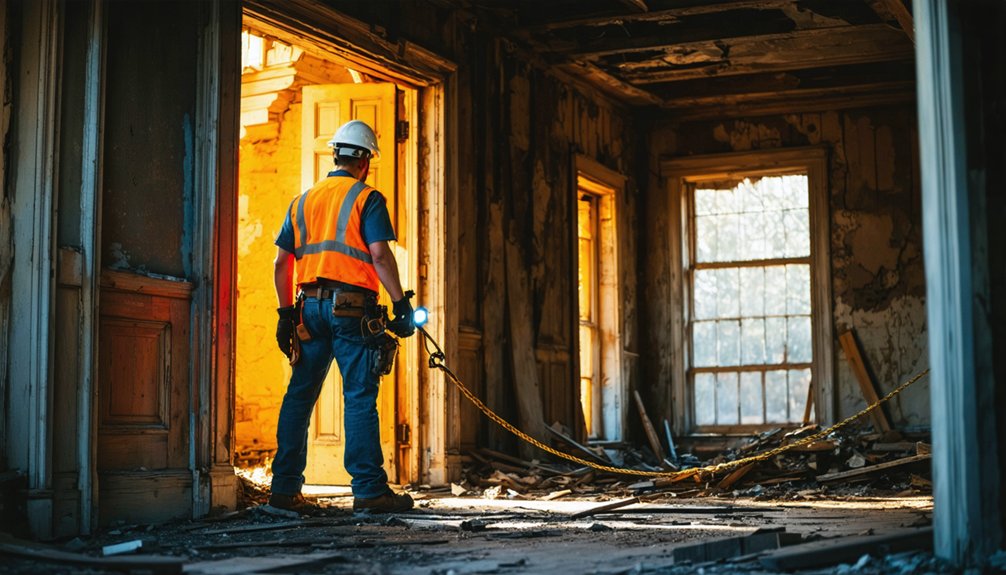
Hollister’s abandoned structures carry history in their bones, but those bones are brittle — enter any building here and you’re negotiating with decades of neglect, Oklahoma weather, and zero maintenance. Roofs have collapsed, floors have rotted, and rubble piles hide beneath overgrown brush. Urban exploration demands respect for what’s already broken.
The old high school’s columns still stand as a monument to 1922 craftsmanship, but behind that entrance, the foundation, basement, and boiler room present real hazards. Preservation challenges mean nobody’s reinforced anything recently — you’re on your own out here.
Wear sturdy boots, watch every step, and never enter structurally compromised buildings alone. Southwest Oklahoma’s isolation means emergency response takes time. Explore freely, but explore smart — Hollister’s story deserves witnesses who make it home.
What to Pack Before Visiting Hollister, Oklahoma?
Before you set foot among Hollister’s crumbling ruins and weathered remnants, you’ll need to pack smart for a place where the nearest services sit ten miles away in Frederick.
Load your bag with essential safety gear — sturdy boots, a hard hat, and work gloves — to navigate unstable structures safely, and bring enough food and water to sustain yourself through a full day of exploration in southwest Oklahoma’s unforgiving heat.
Finally, don’t leave without reliable navigation and communication tools, since unmarked roads and minimal signage make GPS and a fully charged satellite communicator your best allies in this remote Tillman County landscape.
Essential Safety Gear
Packing the right gear transforms a visit to Hollister from a reckless wander into a purposeful exploration of Oklahoma’s vanishing past. Southwest Oklahoma’s unpredictable climate demands weather preparedness, and wildlife encounters with snakes or insects near crumbling structures are genuinely possible. Go ready.
- Sturdy boots with ankle support for *steering* rubble and unstable foundations
- First aid kit sized for remote locations, far from Frederick’s services
- Weather layers protecting against sudden temperature swings and wind exposure
- Flashlight or headlamp for exploring darkened basements and the boiler room remnants
- Water and snacks since no services exist along this rural Highway 54 corridor
Hollister rewards the prepared traveler with raw, unfiltered history — crumbling walls, silent lots, and a 1971 Ford Ranchero frozen in time.
Food And Water Supplies
Since no gas stations, convenience stores, or restaurants exist along this stretch of Highway 54, you’ll need to stock up in Frederick before heading southeast toward Hollister. Grab local cuisine from one of Frederick’s diners — something hearty that honors the agricultural roots of this vanished community.
Pack more water than you think you’ll need. Southwest Oklahoma‘s heat is unforgiving, and you’re ten miles from the nearest resupply point.
Bring water purification tablets as backup, since rural water sources aren’t reliable or safe. Think of the settlers who built Hollister in 1907 with far fewer resources than you’re carrying today. They carved a community from this landscape; you’re simply passing through its echo.
Pack smart, stay self-sufficient, and respect the freedom that genuine off-grid exploration demands.
Digital maps fail in places like Hollister, where cell towers are as absent as the residents who once filled its streets. So you’ll want a downloaded offline map of Tillman County loaded before you leave Frederick.
Cell coverage disappears fast on Oklahoma Highway 54, and you’re ten miles from town with no services nearby.
Pack these before rolling out:
- Paper map of southwest Oklahoma as your analog backup
- GPS device that functions without cell coverage
- Portable battery pack to keep devices charged
- Two-way radio or satellite communicator for genuine emergencies
- Written directions from Frederick, mile-marker to mile-marker
Hollister demands self-sufficiency. The same isolation that swallowed its population makes preparation your most valuable navigation tool.
Ghost Towns Near Hollister Worth Adding to Your Route
Hollister doesn’t stand alone in its quiet abandonment — Tillman County holds several other ghost towns worth threading into your route as you cut through southwest Oklahoma’s weathered plains. Each forgotten settlement carries its own weight of local ghost stories and collapsed dreams.
Hollister isn’t the only ghost town haunting Tillman County — the whole region carries its weight of collapsed dreams.
You’ll find communities that once thrived on cotton and cattle, now reduced to foundation slabs and rusting fence lines. Unlike abandoned mining sites further west, these towns died slower deaths — strangled by drought, economic collapse, and outmigration after the 1950s.
Frederick serves as your natural base for resupplying between stops. Keep your tank full, mark your coordinates ahead of time, and treat every crumbling structure as historically significant.
Southwest Oklahoma rewards the curious traveler willing to chase roads that most people simply pass.
Frequently Asked Questions
What Is the Best Time of Year to Visit Hollister?
Spring and fall offer the best visiting months for Hollister’s haunted landscape. You’ll find seasonal weather mild enough to explore crumbling ruins freely, avoiding summer’s brutal Oklahoma heat and winter’s unpredictable plains storms.
Are There Any Entry Fees or Permits Required to Visit Hollister?
Imagine pulling up freely, no tollbooth in sight. You don’t need permits or entry fees to explore Hollister’s historical preservation remnants and local folklore. Just drive Oklahoma Highway 54 and wander where forgotten stories await you.
Is Photography Allowed at Hollister’s Abandoned Structures and Ruins?
You’ll find no official photography restrictions at Hollister’s abandoned ruins, but respect abandoned safety boundaries — unstable structures demand caution. Capture history’s haunting remnants freely, honoring the forgotten souls who once called this ghost town home.
Can Visitors Legally Enter the Abandoned Buildings in Hollister?
You can’t freely enter abandoned buildings without risking trespassing regulations — property ownership still applies, even in ghost towns. Respect those boundaries, but Hollister’s haunting exterior ruins offer plenty of adventurous exploration and discovery without crossing legal lines.
Are There Any Guided Tours Available for Hollister Ghost Town?
No tour companies offer guided trips through Hollister’s ghost town history — you’re free to explore independently. Chart your own adventurous course along Highway 54, uncovering forgotten stories on your own terms, answering only to your curiosity.
References
- https://en.wikipedia.org/wiki/List_of_ghost_towns_in_Oklahoma
- https://www.youtube.com/watch?v=_Dx4Y-Php4M
- https://www.okhistory.org/publications/enc/entry?entry=GH002
- https://www.travelok.com/articles/oklahomaghosttowns
- https://www.okhistory.org/publications/enc/entry?entry=HO016
- https://kids.kiddle.co/List_of_ghost_towns_in_Oklahoma