
Planning a ghost town road trip to Minneapolis, South Dakota means chasing unpaved Black Hills backroads to a raw, barren site northeast of Rochford along Silver Creek. You’ll find scattered industrial ruins, rusted equipment fragments, and earthwork depressions left behind by shallow mines and an ore-processing mill. Cell service is unreliable, so download offline maps and pack sturdy boots, extra water, and a first-aid kit. There’s much more to uncover about this remote Pennington County treasure.
Key Takeaways
- Minneapolis SD sits in Pennington County’s Black Hills, approximately 1 mile northeast of Rochford, featuring scattered industrial ruins along Silver Creek.
- Download offline maps before visiting, as cell service is unreliable and unpaved roads with minimal signage make navigation challenging.
- Nearby ghost towns Mystic, Pedro, and Addie Camp form a convenient half-day exploration loop through the Black Hills region.
- Pack sturdy boots, a first-aid kit, extra water, and a camera, as the remote site lacks facilities, trails, and signage.
- Exploration is entirely self-guided; observe rusted equipment, earthwork depressions, and industrial debris without removing any artifacts from the site.
What Is Minneapolis, South Dakota?
While most people think of Minneapolis as Minnesota’s bustling twin city, South Dakota has its own Minneapolis — a ghost town tucked into Pennington County, about 1 mile northeast of Rochford along Silver Creek. This forgotten settlement grew around shallow mines and an ore-processing mill, making its cultural significance tied directly to Black Hills mining history.
Today, the site sits barren, stripped of the activity that once defined it. You won’t find preserved buildings or visitor centers here — just open land near Richards Spring. Preservation challenges have left little trace of the original settlement, so you’ll need to approach this stop as a historical ruins experience rather than a traditional tour.
It’s raw, it’s real, and it rewards curious, independent explorers.
Where Minneapolis SD Sits in the Black Hills
You’ll find Minneapolis, South Dakota tucked inside Pennington County, roughly 1 mile northeast of the small community of Rochford along rural backroads that wind through the Black Hills.
Silver Creek runs through the area, giving the landscape a natural anchor point that once supported the settlement’s mining and milling operations.
Knowing these geographic markers helps you navigate confidently toward a site that most standard maps won’t highlight.
Pennington County Location Details
Tucked into the Black Hills of Pennington County, South Dakota, Minneapolis sits roughly 1 mile northeast of Rochford along Silver Creek. This placement puts you deep in terrain shaped by mining ambition and rugged geographic features that defined the region’s boom era.
Richards Spring marks a nearby natural landmark worth noting as you navigate the area. The county itself holds several abandoned settlements, making Minneapolis one stop in a broader cluster of ghost towns worth exploring.
Local history here centers on shallow mines and ore milling rather than civic development, so don’t expect preserved buildings or marked trails. Instead, you’re stepping into a raw, industrial past written into the landscape itself.
Knowing this county context sharpens your understanding of what shaped the site and why it matters.
Near Rochford’s Rural Roads
Rochford’s rural roads give you the clearest path into Minneapolis, South Dakota’s ghost-town landscape, with the site sitting just a mile northeast along Silver Creek. You’ll follow unpaved backroads through Black Hills terrain that hasn’t changed much since miners worked shallow ore deposits nearby. Richards Spring serves as a useful landmark once you’re steering the final stretch.
Tourist accessibility here is minimal by design — no signage, no visitor center, no curated trail. What you’re reaching is a barren former industrial site where historical preservation exists only in the landscape itself. That rawness is exactly what draws independent travelers.
You’re reading the land on your own terms, piecing together a mining settlement’s story through creek banks, scattered remains, and the quiet that surrounds Rochford’s outer edges.
Silver Creek Geographic Context
Silver Creek runs through the Black Hills as more than a navigation marker — it’s the geographic backbone that shaped why Minneapolis, South Dakota existed at all. Water access drove historical mining operations, and the creek gave early settlers the practical foundation they needed to build shallow mines and run a processing mill.
You’re standing at a site where geography and industry locked together for a specific purpose, then dissolved when that purpose ended.
Ghost town preservation here isn’t about restored buildings or maintained walkways. It’s about reading the landscape itself. The creek still flows near Rochford, roughly a mile southwest of where Minneapolis once operated. That water tells the real story — why people came, what they extracted, and why nothing permanent remained once the ore ran out.
The Shallow Mines and Mill That Built Minneapolis SD
Although it’s little more than a memory now, Minneapolis SD once hummed with the activity of shallow mines and an ore-processing mill that gave the settlement its reason to exist. Workers pulled ore from the earth here, feeding a mill that transformed raw rock into something worth hauling out of the Black Hills.
That mining history shaped every structure, every path, and every decision made at this site. Today, you’re walking through industrial ruins that tell a story of ambition meeting hard geology.
The shallow nature of the mines hints at early extraction limits that likely contributed to the town’s decline. When you visit, you’re not just seeing an empty landscape — you’re reading the physical evidence of a community that lived and died by its ore.
How to Reach the Site From Rochford
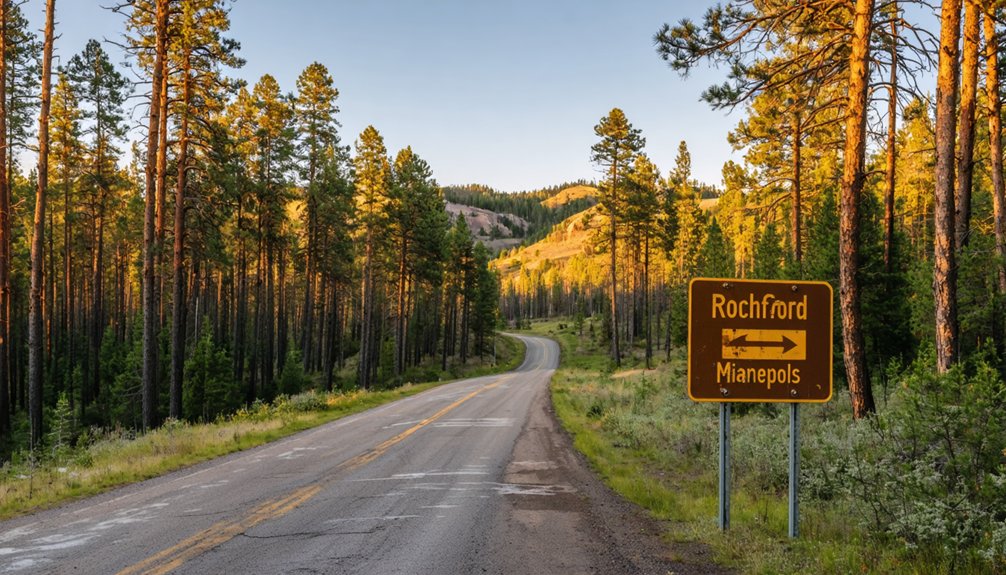
You’ll want to start your approach from Rochford, the closest named landmark to the site.
From there, head northeast roughly one mile to reach the former townsite of Minneapolis, South Dakota.
Silver Creek runs through the area and serves as a natural navigation marker once you’re close to the ground.
Starting Point: Rochford
Rochford serves as your practical jumping-off point for reaching the Minneapolis ghost town site, which sits roughly 1 mile northeast along Silver Creek. This small community gives you a reliable navigation anchor before you head into rural terrain with limited visitor facilities nearby.
Before leaving Rochford, check these three things:
- Fuel up — services thin out quickly once you leave town
- Download offline maps — cell coverage along Silver Creek can drop unexpectedly
- Note the historical preservation context — Minneapolis was an active mining and milling operation, so approach it as an industrial ruin, not a restored landmark
Rochford’s proximity keeps your drive short, but the site’s barren status means you’re arriving for history and landscape, not amenities.
Northeast One Mile
Once you leave Rochford’s small cluster of buildings behind, the drive northeast to Minneapolis covers just about 1 mile along Silver Creek — short in distance but a real shift in atmosphere. The road pulls you away from any remaining signs of modern life and deposits you into terrain that once hummed with ore extraction and milling activity.
You won’t find street signs pointing the way, so use Richards Spring as your nearby landmark to confirm you’re closing in on the right location. Expect a barren site where preservation challenges have claimed most visible structure.
Any historical artifacts you spot deserve your eyes, not your hands — this ground holds what little remains of a working mining settlement, and that fragile record disappears fast without collective respect from visitors.
Silver Creek Navigation
Getting to Minneapolis from Rochford means letting Silver Creek do most of the navigational work. Head northeast roughly one mile, keeping the creek as your constant landmark. The terrain opens up where historical mining activity once shaped this now-silent valley. Ghost town ruins don’t announce themselves, so staying creek-side keeps you oriented.
Follow these three navigation anchors:
- Start in Rochford — your last reliable service point before heading into open country.
- Track Silver Creek northeast — the waterway runs directly toward the former settlement site.
- Watch for Richards Spring — this nearby landmark confirms you’re closing in on the old townsite.
You’re not following road signs here. You’re reading the land, which is exactly the kind of freedom this road trip rewards.
What Survives at Minneapolis SD Today

That said, the land itself tells the story. Historical artifacts like rusted equipment fragments, earthwork depressions, and scattered debris occasionally surface for sharp-eyed explorers.
Silver Creek still runs nearby, anchoring the geography exactly as it did when the settlement operated. You’re free to read the terrain on your own terms, piecing together the industrial past without a guided script or a gift shop slowing you down.
A One-Day Pennington County Ghost Town Loop
Minneapolis SD doesn’t have to stand alone on your itinerary. Pennington County holds several ghost towns within driving range, making a focused loop both practical and rewarding. Visitor facilities are sparse throughout this corridor, so pack water, snacks, and a printed map before you leave Rochford.
- Mystic – The strongest historical preservation in the area, with National Register recognition and visible remnants worth photographing.
- Pedro – A former town that once supported its own newspaper, giving you genuine boom-era backstory to explore.
- Addie Camp – A quieter mining-origin stop that rounds out the route without demanding extra mileage.
String these stops together and you’ve built a half-day Black Hills ghost-town circuit that rewards curiosity at every turn.
Four Ghost Towns Near Minneapolis SD Worth the Detour

While Minneapolis SD anchors your ghost-town itinerary, four nearby stops deserve a place on your route for the extra mileage they’ll cost you.
Addie Camp shares Minneapolis’s mining origin and carries real historical significance as another Pennington County casualty of boom-and-bust cycles.
Farmingdale sits abandoned, its preservation challenges evident in what little remains.
Pedro once supported a population and even a newspaper, making it a richer storytelling stop.
Mystic earns its place through stronger historical recognition, including a National Register listing that sets it apart from the others.
Each town adds a distinct layer to your Black Hills narrative.
Together, they transform a single-site visit into a full regional loop that rewards curiosity and honest exploration of South Dakota’s forgotten industrial past.
What to Bring for Minneapolis SD’s Remote, Barren Site
Because Minneapolis SD carries a “barren” status with limited services nearby, you’ll want to pack thoughtfully before leaving Rochford behind. This remote Black Hills site rewards prepared explorers who respect both the terrain and its mining history.
Minneapolis SD’s “barren” status means smart packing before leaving Rochford — preparation unlocks this remote Black Hills treasure.
- Navigation tools – Download offline maps before you go. Cell service near Silver Creek is unreliable, and you don’t want to miss the northeast turn from Rochford.
- Safety precautions gear – Pack a first-aid kit, sturdy boots, and extra water. Abandoned mine terrain hides uneven ground and structural hazards.
- Documentation equipment – Bring a camera to photograph historical artifacts responsibly. Never remove anything; capturing images preserves the record without disturbing what remains.
Pack smart, move carefully, and you’ll experience Minneapolis SD exactly as it deserves — on its own raw, unfiltered terms.
Frequently Asked Questions
Is a Permit Required to Visit Minneapolis, South Dakota’s Ghost Town Site?
no permit’s confirmed as required. You’re free to explore this barren historical preservation site near Rochford, but always respect private land boundaries while capturing your photography opportunities amid the ruins.
Are There Any Guided Tours Available Near the Minneapolis SD Area?
You won’t find formal guided tours at this barren site, but nearby Mystic and Rochford connect you to historical landmarks, local legends, and Black Hills tour operators who’ll fuel your adventurous ghost-town exploration freely.
What Is the Best Time of Year to Visit Minneapolis SD?
You’ll love visiting in late spring or early fall when seasonal weather stays mild for exploring barren ruins. Summer’s local festivals near Rochford add vibrant energy, making your ghost town adventure feel truly alive and free.
Is the Minneapolis SD Site Accessible for People With Mobility Limitations?
The Minneapolis, SD site likely isn’t wheelchair friendly, as it’s a barren, rural ghost town. You won’t find accessibility features like paved paths here, so plan accordingly if mobility limitations affect your adventure.
Can You Camp Overnight Near the Minneapolis, South Dakota Ghost Town?
You can camp near this historical preservation site, with Rochford’s surrounding Black Hills offering rugged overnight options. Set up camp, then wake early to seize stunning photography opportunities among the ghost town’s atmospheric, freedom-inviting ruins.
References
- https://en.wikipedia.org/wiki/List_of_ghost_towns_in_South_Dakota
- https://www.youtube.com/watch?v=_0WNYsFLSLA
- https://b1027.com/creepiest-coolest-ghost-towns-in-south-dakota-iowa-minnesota/
- https://www.minnesotahistory.org/post/a-complete-guide-to-the-ghost-towns-of-hennepin-county
- https://en.wikipedia.org/wiki/Category:Ghost_towns_in_South_Dakota
- https://en.wikipedia.org/wiki/List_of_ghost_towns_in_Minnesota
- https://www.ghosttowns.com/states/sd/sd.html
- https://www.youtube.com/watch?v=Naciyj05E1Y