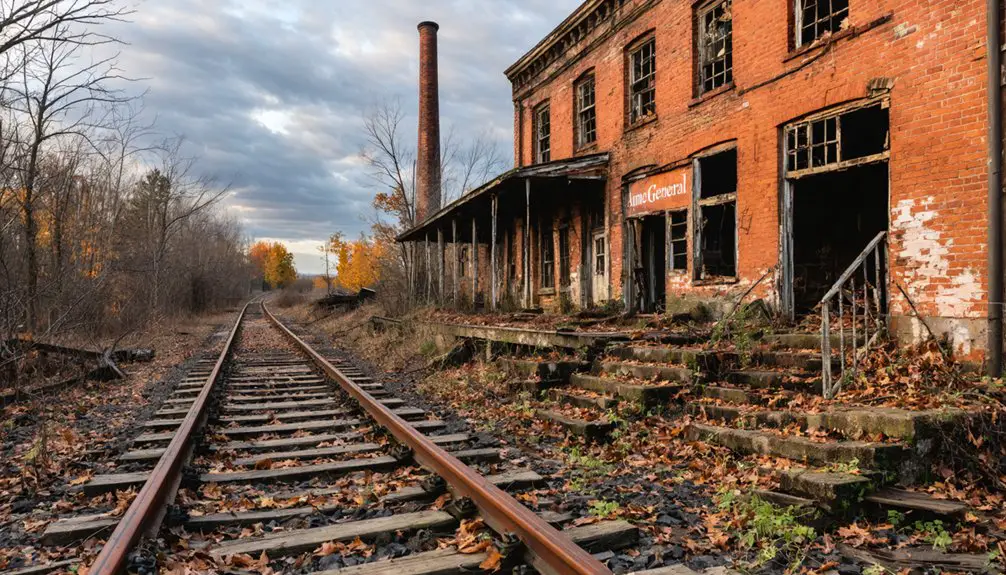
You’ll find Nesbit Run where Pennsylvania’s coal country swallowed its own history whole. Start at Dilltown’s western trailhead and work your way east along the 36-mile Ghost Town Trail, pausing at buried company towns like Wehrum and industrial ruins at Vintondale. Pack sturdy boots, a headlamp, and printed maps—cell service gets thin out here. These smoke-stained bones of forgotten communities have more stories to tell than any roadside marker ever could.
Key Takeaways
- Nesbit Run serves as a potential final stop on the Ghost Town Trail, which spans 36 miles through western Pennsylvania’s coal country.
- Begin your road trip at Dilltown’s western trailhead, which offers parking, interpretive signage, and a limestone surface for easy exploration.
- Key stops include Wehrum’s buried company town foundations, Vintondale Eliza Furnace ruins, and Twin Rocks along the trail corridor.
- Pack sturdy boots, offline GPS maps, headlamps, gloves, and dust masks for safe exploration of remote, abandoned industrial sites.
- Ebensburg serves as the eastern terminus at the highest elevation, offering downtown amenities and overnight accommodations for road trippers.
Pennsylvania Ghost Towns Worth Driving To
Pennsylvania’s coal country left behind more than just empty buildings — it left entire towns frozen in time, and several are absolutely worth the drive.
Pennsylvania’s coal country didn’t just leave behind empty buildings — it left entire towns frozen in time.
You’ll find Centralia still smoldering, its cracked roads and eerie silence feeding decades of haunted legends that draw curious travelers from every direction.
Concrete City in Luzerne County stands as a crumbling monument to company-owned ambition, its concrete shells now tangled in urban legends about workers who never really left.
The Ghost Town Trail stretches 36 miles through western Pennsylvania, threading past Wehrum, Armerford, and Bracken — settlements that collapsed when coal did.
Each stop rewards you with raw, unfiltered history.
You’re not just sightseeing; you’re reclaiming forgotten stories that corporate decline and time tried to bury permanently.
The Ghost Town Trail: 36 Miles of Abandoned Coal History
If you’re already exploring Pennsylvania’s abandoned coal country, the Ghost Town Trail deserves a dedicated stop on your itinerary. Established in 1991 on the former Ebensburg and Black Lick Railroad right-of-way, this 36-mile rail trail threads through the ghosts of communities that once hummed with industrial life.
You can pick up the trail at several key access points — Dilltown, Wehrum, Vintondale Eliza Furnace, Twin Rocks, Nanty Glo, and Ebensburg — each one a doorway into a different chapter of western Pennsylvania’s coal-era past.
Trail History And Origins
Stretching 36 miles through the coal-scarred hills of western Pennsylvania, the Ghost Town Trail follows the former Ebensburg and Black Lick Railroad right-of-way — a corridor that once carried the weight of an entire industry. Established in 1991, the trail transformed abandoned rail lines into accessible history, making historical preservation a living practice rather than a museum exercise.
When you walk or ride this route, you’re moving through layers of local legends — stories of company towns that rose fast and fell faster, of workers who built communities only to watch industry abandon them.
The railroad that once hauled coal out of these hills now carries curious travelers in. That shift matters. It means the past stays reachable, and you can explore it on your own terms.
Key Access Points
The trail’s six main access points give you a practical framework for breaking 36 miles into manageable pieces — each one a former hub where coal-country life once ran on a tight industrial schedule.
Historical preservation efforts keep these entry points navigable for urban exploration enthusiasts ready to move freely through forgotten landscapes.
- Dilltown — western trailhead, ideal starting point
- Wehrum — sits atop a buried company town
- Vintondale Eliza Furnace — industrial ruins anchor the stop
- Twin Rocks — mid-trail access with strong historical character
- Nanty Glo — eastern corridor entry near active community edges
- Ebensburg — eastern terminus, highest elevation point
Each stop drops you directly into a chapter of coal-country collapse worth reading on foot.
Key Access Points on the Ghost Town Trail
You can step onto the Ghost Town Trail at three distinct entry points, each carrying its own layer of forgotten history. Dilltown offers a quiet western gateway.
Wehrum pulls you directly into the ruins of a once-thriving coal settlement.
Ebensburg anchors the eastern end with connections to the region’s industrial past.
Choose your starting point based on how deep into the coal country silence you’re willing to go.
Dilltown Entry Point
Nestled in Indiana County, Dilltown serves as one of the most popular entry points along the Ghost Town Trail, and it’s easy to see why. Hidden histories and local legends breathe life into every mile you’ll cover from here, connecting you to Pennsylvania’s coal-era past.
Pack light and move freely using these essentials:
- Parking: A dedicated lot sits right at the Dilltown trailhead
- Trail surface: Crushed limestone makes cycling and walking accessible year-round
- Distance: You’re positioned near the trail’s midpoint, allowing flexible exploration in either direction
- Nearby amenities: Dilltown offers basic facilities before you head into more remote stretches
- Historical markers: Interpretive signage near the entry point contextualizes the abandoned settlements ahead
Start here, and let the landscape tell its own story.
Wehrum Historic Access
Once a thriving coal company town, Wehrum now stands as one of the Ghost Town Trail‘s most historically resonant access points, where the silence itself feels like testimony. You’ll find the parking area manageable and the trail entry straightforward, but don’t rush past what surrounds you.
Wehrum’s story is urban decay made visible — foundations swallowed by vegetation, grade lines where rail cars once rolled, earth shaped by human ambition and then reclaimed.
Historical preservation efforts along this stretch help you read the landscape rather than simply walk through it.
You’re free here in a way paved destinations rarely allow. Wehrum doesn’t perform its history; it simply holds it. Bring water, wear sturdy shoes, and give yourself enough time to actually listen.
Ebensburg Trail Connection
From Wehrum, the trail stretches eastward toward Ebensburg, the anchor point at the Ghost Town Trail‘s far end where rail history and small-town Pennsylvania converge. Historical preservation efforts here give you tangible connections to the Ebensburg and Black Lick Railroad’s 1991 conversion. Local legends of coal-era workers linger along every mile.
Plan your Ebensburg connection around these highlights:
- Trail terminus access sits near downtown Ebensburg, offering parking and restrooms
- Railroad corridor markers document the original right-of-way history
- Cambria County heritage shapes the surrounding cultural landscape
- Seasonal trail conditions affect eastern segments more than western ones
- Nearby accommodations make Ebensburg a practical overnight base
You’re not just finishing a trail here — you’re closing a loop through Pennsylvania’s vanished industrial world.
Centralia: Pennsylvania’s Most Visited Ghost Town
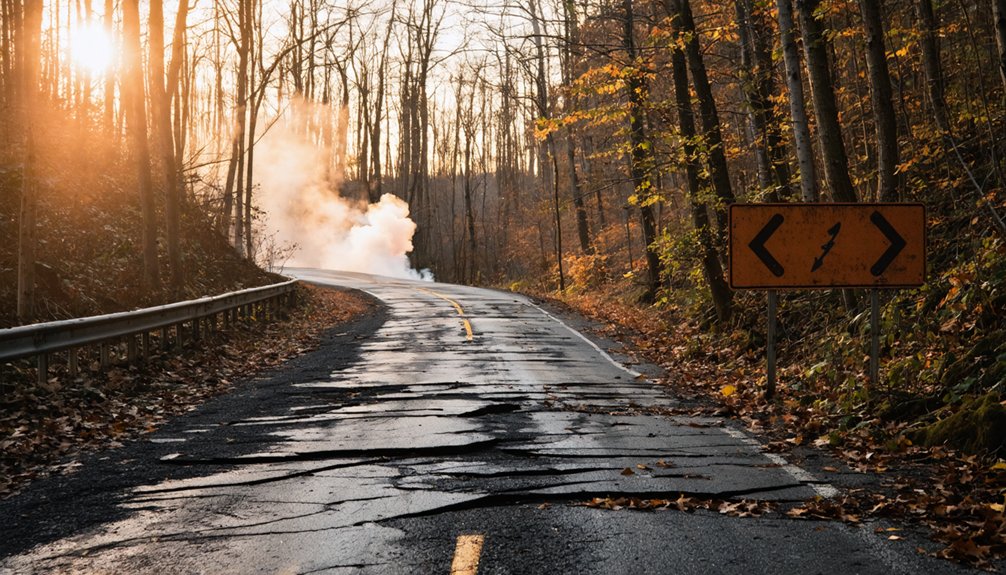
Though it once thrived as a busy coal town of roughly 1,000 residents, Centralia, Pennsylvania had dwindled to just five people by 2020—a haunting collapse triggered by an underground mine fire that’s been burning since 1962.
You’ll find urban legends woven into every cracked street and condemned structure here, stories that outlasted the families who once called this place home. The smoke still rises from ground vents, making Centralia feel less like history and more like a warning.
Historical preservation efforts have documented what remains, giving you a rare window into industrial America’s fragile promise. Add Centralia to your road trip as a sobering counterpoint to the Ghost Town Trail—it’s proof that some abandonments aren’t chosen, they’re forced.
Concrete City and Other Company Towns Left Behind
Built in 1911 as company housing for railroad coal employees, Concrete City in Luzerne County stands as one of Pennsylvania’s most striking monuments to industrial ambition—and its limits. When the company abandoned it, freedom came at a cost—entire communities simply disappeared.
Built in 1911, Concrete City promised stability—then vanished, taking entire communities with it.
You’ll find urban exploration here feels like reading a forgotten chapter of American labor history:
- Concrete City’s reinforced structures defied demolition attempts
- Company towns erased individual ownership by design
- Historical preservation efforts remain inconsistent across sites
- Workers had little agency over housing or community futures
- Abandonment followed swiftly once industrial profits dried up
These places remind you that prosperity was always conditional. Walking through what remains, you’re not just exploring ruins—you’re confronting the fragile agreements that once held entire communities together.
How to Route Your Pennsylvania Ghost Town Road Trip
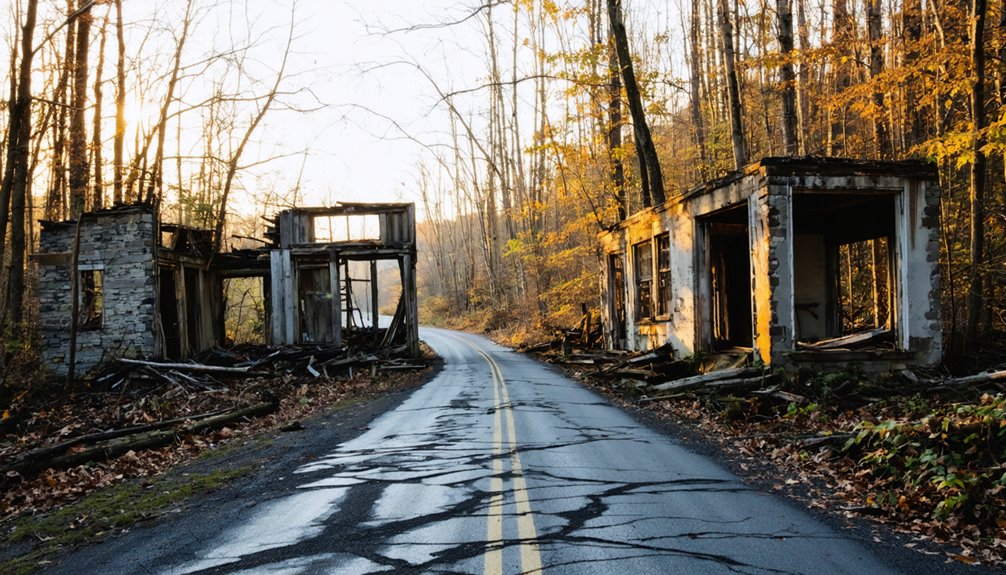
Planning this route means anchoring your journey around the Ghost Town Trail, a 36-mile rail corridor in western Pennsylvania that runs between Black Lick and Ebensburg on the former Ebensburg and Black Lick Railroad right-of-way. Start at Dilltown, then push through Wehrum and Vintondale, where ghost stories cling to crumbling foundations like old smoke. Each access point reveals another layer of coal-era collapse.
From there, drive east to Centralia, where urban legends about the underground fire have outlasted nearly every resident. Swing through Concrete City before researching whether Nesbit Run fits your final stop — it’s not yet confirmed as a documented ghost town, so verify before you go.
This route rewards curiosity, independence, and a willingness to find history where roads quietly end.
Gear and Supplies for Abandoned Site Exploration
Before you walk into any abandoned Pennsylvania coal town, you’ll want the right gear — because these sites don’t forgive carelessness. Whether you’re documenting decay for historical preservation or chasing dramatic photography tips along the Ghost Town Trail, preparation separates a great experience from a dangerous one.
- Sturdy boots with ankle support for uneven, debris-scattered ground
- Headlamp and backup batteries — interiors swallow daylight fast
- Wide-angle and macro lenses to capture both sweeping ruins and intimate details
- Gloves and a dust mask to protect against coal residue and aged materials
- Printed maps or offline GPS since cell service disappears in hollow country
Pack light, move deliberately, and respect what remains. These places carried real lives — your curiosity owes them that much.
Staying Safe at Pennsylvania’s Abandoned Pennsylvania Ghost Towns
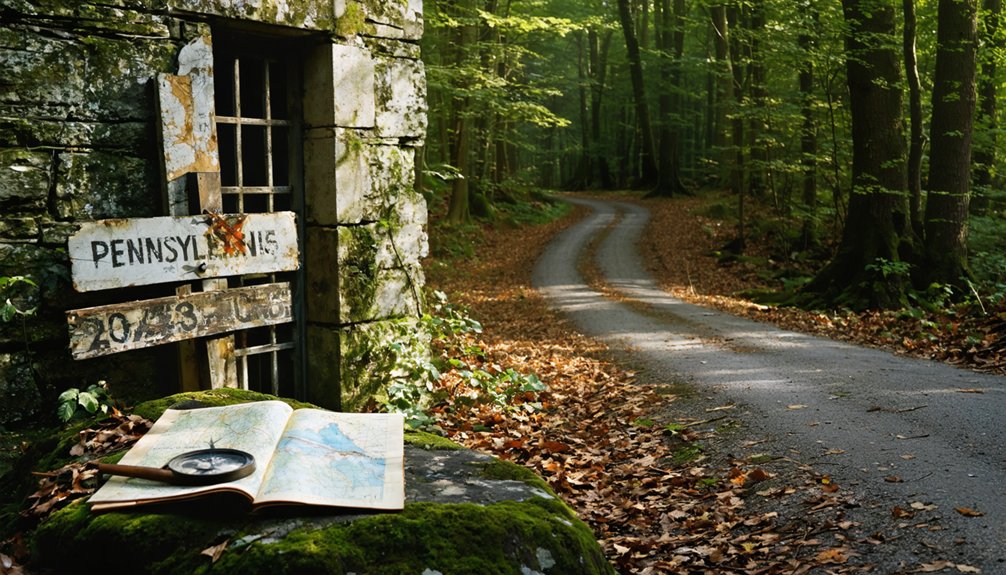
Safety at abandoned coal towns isn’t a suggestion — it’s the difference between a story you tell and one told about you. Pennsylvania’s ghost towns carry real hazards beneath their romantic exteriors — rotting floorboards, unstable mine shafts, and compromised air quality are legacies of industrial collapse.
Respect historical preservation by observing without disturbing. Don’t enter structures that show visible decay. Don’t pocket artifacts; removal destroys the record these places silently hold.
Your safety precautions should include telling someone your itinerary, carrying a charged phone, and wearing sturdy boots with ankle support. Sites along the Ghost Town Trail offer safer access than off-trail ruins.
Freedom means knowing which risks are worth taking — and at Centralia or Wehrum, structural collapse isn’t one of them.
Frequently Asked Questions
Is Nesbit Run Confirmed as an Official Ghost Town in Pennsylvania?
No, you can’t confirm Nesbit Run as an official Pennsylvania ghost town. Its historical preservation status remains unclear, tourist restrictions are undefined, and you’d do better anchoring your nostalgic journey around documented, freely explored abandoned coal communities nearby.
What Is the Best Time of Year to Visit Pennsylvania Ghost Towns?
Late spring and early fall let you walk sun-dappled, forgotten streets where history breathes freely. You’ll find ideal conditions for historical preservation photography and visitor safety, avoiding winter’s dangerous terrain and summer’s obscuring overgrowth.
Are Children Allowed to Explore Abandoned Sites Along the Ghost Town Trail?
Yes, you can bring children, but take safety precautions seriously—unstable structures and haunted legends make these nostalgic coal-era ruins unpredictable. Supervise kids closely, stay on marked trail sections, and let curiosity roam freely within safe boundaries.
Do Any Pennsylvania Ghost Towns Charge an Entrance or Parking Fee?
You’ll find most historic sites don’t charge fees, though some parking areas might. Centralia’s free to roam, letting you chase haunted legends without barriers — just bring respect for the nostalgic, crumbling freedom these forgotten places silently offer.
Can You Legally Take Artifacts or Souvenirs From Abandoned Pennsylvania Ghost Towns?
Don’t let temptation fool you — artifact legality is clear: you can’t legally take items from abandoned sites. Souvenir restrictions protect these historic remnants, so carry only memories and photographs from Pennsylvania’s ghost towns.
References
- https://en.wikipedia.org/wiki/List_of_ghost_towns_in_Pennsylvania
- https://www.atlasobscura.com/things-to-do/pennsylvania/ghost-towns
- https://en.wikipedia.org/wiki/Centralia
- https://en.wikipedia.org/wiki/Concrete_City
- https://en.wikipedia.org/wiki/Lists_of_ghost_towns_in_the_United_States
- https://www.youtube.com/watch?v=3Nt682Q8ymk&vl=en
- https://www.barnesandnoble.com/w/the-big-book-of-pennsylvania-ghost-stories-mark-nesbitt/1103279046
- https://books.google.com/books/about/The_Forgotten_Mines_and_Coal_Towns_of_Th.html?id=jDBfDwAAQBAJ
- https://en.wikipedia.org/wiki/Ghost_Town_Trail
- https://www.youtube.com/watch?v=ktXMDPxcXUo