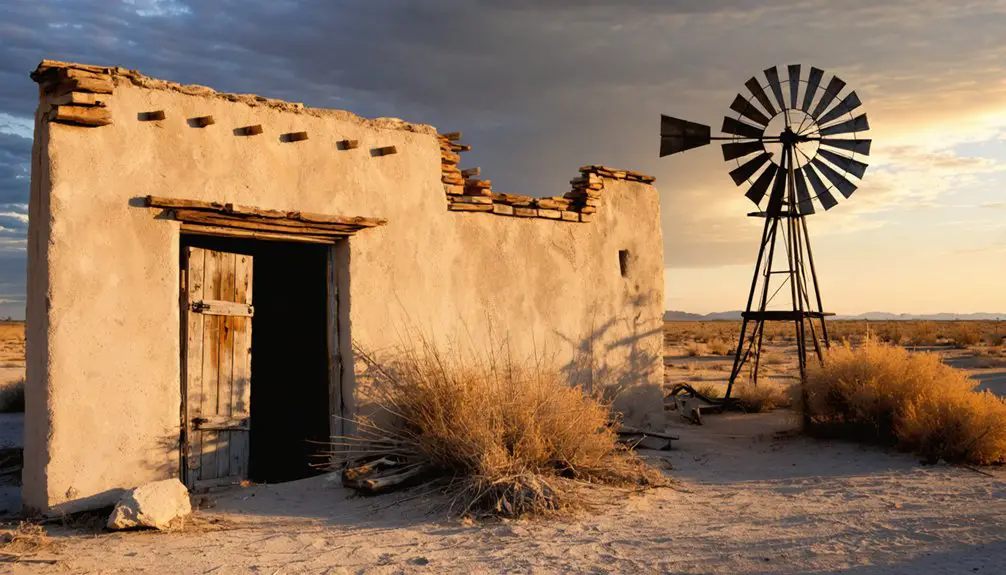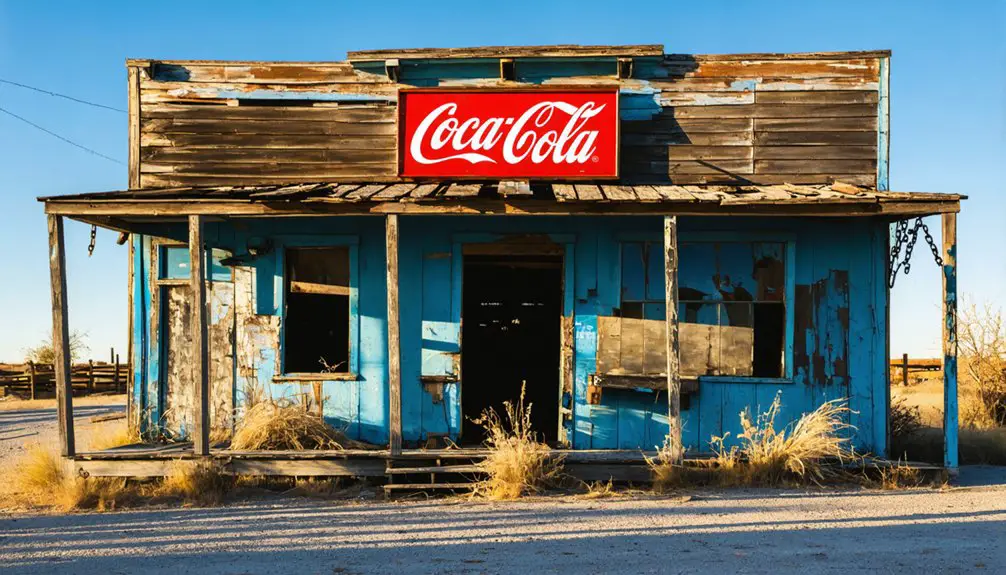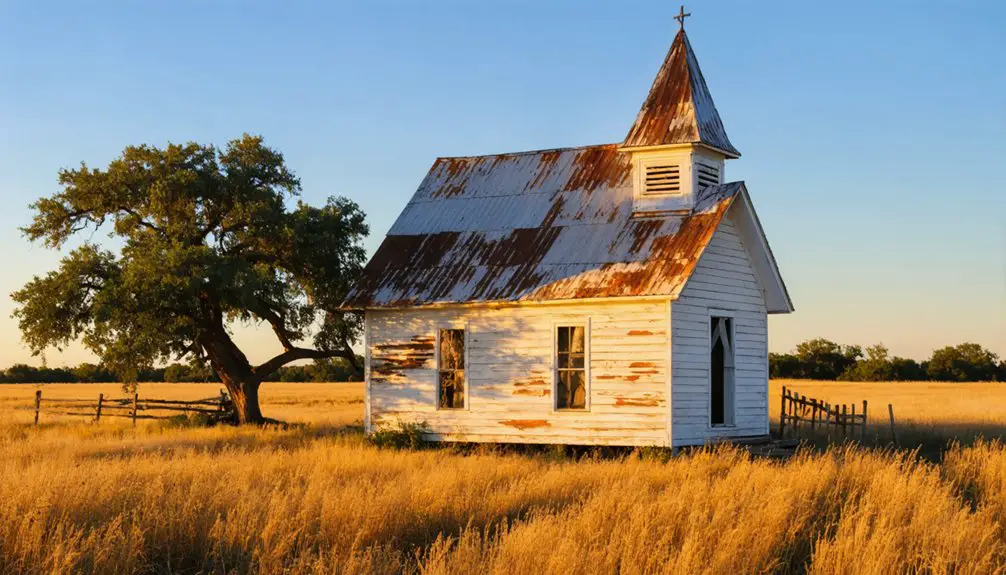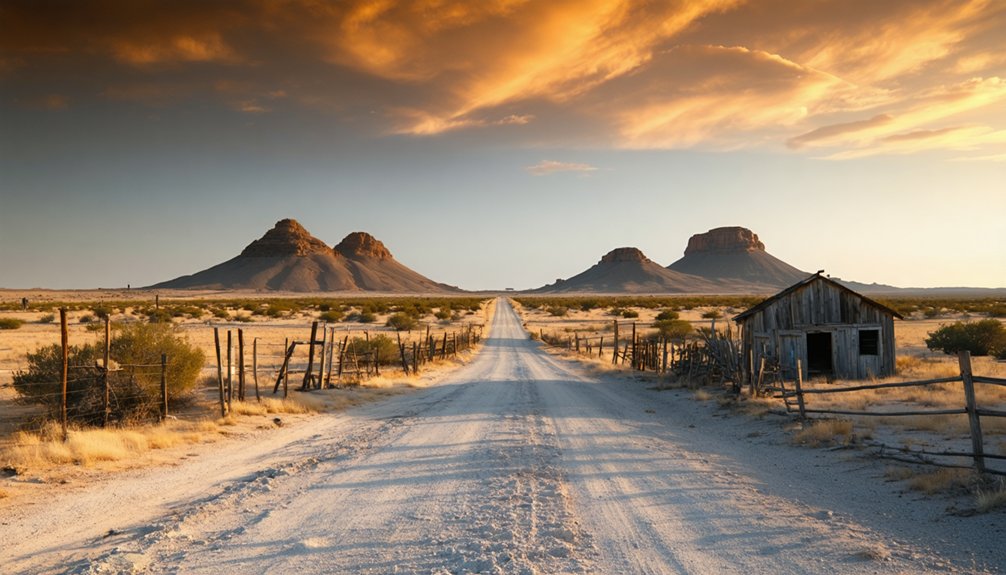
Planning a ghost town road trip to Medicine Mound, Texas means driving into southeastern Hardeman County along Farm to Market Road 1167, where open ranchland and four sacred Comanche mounds dominate the horizon. You’ll explore a compact site featuring the Hicks-Cobb General Store museum, original historic structures, and multiple historical markers. Fuel up and eat in Quanah before heading out, since services near the site are scarce. There’s far more to this haunting landscape than first meets the eye.
Key Takeaways
- Medicine Mound is located in Hardeman County along FM 1167, accessible from Quanah, Vernon, Chillicothe, or Childress.
- Fuel up and eat in Quanah beforehand, as services near the ghost town site are extremely limited.
- Highlights include the Hicks-Cobb General Store museum, W.W. Cole Building, historical markers, and the four iconic mounds.
- Visit in spring or fall at sunrise or sunset for the best photography and comfortable temperatures.
- Extend your trip by adding nearby ghost towns like Clairemont, Swenson, and Roby for a full regional circuit.
How to Get to Medicine Mound, Texas
Medicine Mound sits in southeastern Hardeman County, Texas, along Farm to Market Road 1167, with FM 91 connecting nearby routes. You can approach from Quanah, Chillicothe, Vernon, or Childress, all offering straightforward drives across open ranchland. The site stays marked on maps and local signage, so navigation’s simple once you’re on the road.
Plan your base in Quanah for the best access to nearby accommodations and local dining before heading out. It’s close enough for a morning departure and an easy return.
If you’re coming from the south, Vernon works well as an overnight stop too. Either way, fuel up and grab a meal before you go — services thin out considerably as you close in on Medicine Mound.
What You’ll Actually See When You Arrive at Medicine Mound
Once you pull up to Medicine Mound, you’ll find a compact ghost-town site rather than a sprawling historic district. The open ranchland sets a rugged tone, and local legends about Comanche ceremonies still echo across the landscape. Wildlife sightings, including hawks and deer, add life to the quiet surroundings.
Medicine Mound greets visitors with rugged ranchland, Comanche legends, and the quiet company of hawks and deer.
Here’s what you’ll encounter on-site:
- Hicks-Cobb General Store – now a regional history and cultural museum
- W.W. Cole Building – one of the few surviving original structures
- Historical markers – covering the town, store, WPA sanitation project, and cemetery
- The four Medicine Mounds – a sacred Comanche landscape visible from the road
- Photography opportunities – dramatic plains views ideal for capturing the atmosphere
Explore freely, but respect private property boundaries surrounding the area.
Why the Comanche Considered These Four Mounds Sacred
As you stand near the mounds, you’re looking at land the Comanche treated as one of the most spiritually significant landscapes in the southern plains.
They believed the four hills held powerful healing energy, drawing people here to perform ceremonies and ritual medicine practices.
You can almost sense that history in the stillness — these weren’t just hills to the Comanche, they were sacred destinations where the physical and spiritual worlds met.
Mounds As Sacred Landscape
Rising from the flat Texas plains without warning, the four Medicine Mounds didn’t just mark the landscape for the Comanche — they defined it spiritually. This sacred landscape carried deep cultural significance, functioning as a living ceremonial space rather than a simple geographic feature.
The Comanche recognized these mounds for specific spiritual purposes:
- Healing rituals took place among the mounds, drawing people seeking spiritual and physical restoration
- The tallest mound held the greatest ceremonial importance and remains visually commanding today
- Vision quests connected individuals to spiritual guidance within this protected space
- Tribal gatherings reinforced community bonds through shared sacred experience
- Natural medicine harvested nearby gave the mounds their enduring name
When you visit, you’re standing inside a landscape the Comanche never treated casually.
Comanche Spiritual Practices Here
The sacred geography meant nothing without the living practices that gave it power. The Comanche traveled to these four mounds to pray, seek visions, and gather medicinal plants from the surrounding land. You’re standing where healers once worked and warriors once prepared for battle. These weren’t casual stops — they were deliberate pilgrimages tied to deeply held Native traditions passed across generations.
Sacred sites like these functioned as living connections between the Comanche people and the spiritual world they navigated daily. The tallest mound carried the greatest significance, drawing those seeking guidance or healing. When you visit today, that history still shapes the atmosphere.
The land holds memory even when the people who gave it meaning were forcibly removed from it.
Healing Rituals And Ceremonies
Healing wasn’t incidental to the Comanche’s connection to these mounds — it was the entire point. The healing ceremonies performed here carried deep spiritual significance, drawing warriors, elders, and medicine men seeking restoration beyond what ordinary land could offer.
Visitors today stand where these rituals once unfolded:
- Medicine men led prayers and chants directed toward the mounds’ concentrated spiritual power
- Sick or wounded tribal members traveled considerable distances specifically for healing ceremonies
- Sacred plants gathered near the mounds factored directly into ceremonial treatments
- Vision-seeking and fasting amplified the spiritual significance of each healing session
- Smoke, song, and ritual movement transformed the landscape into a living sanctuary
You’re walking ground that once functioned as a hospital, a church, and a courthouse — all at once.
What Killed Medicine Mound’s Railroad Economy?
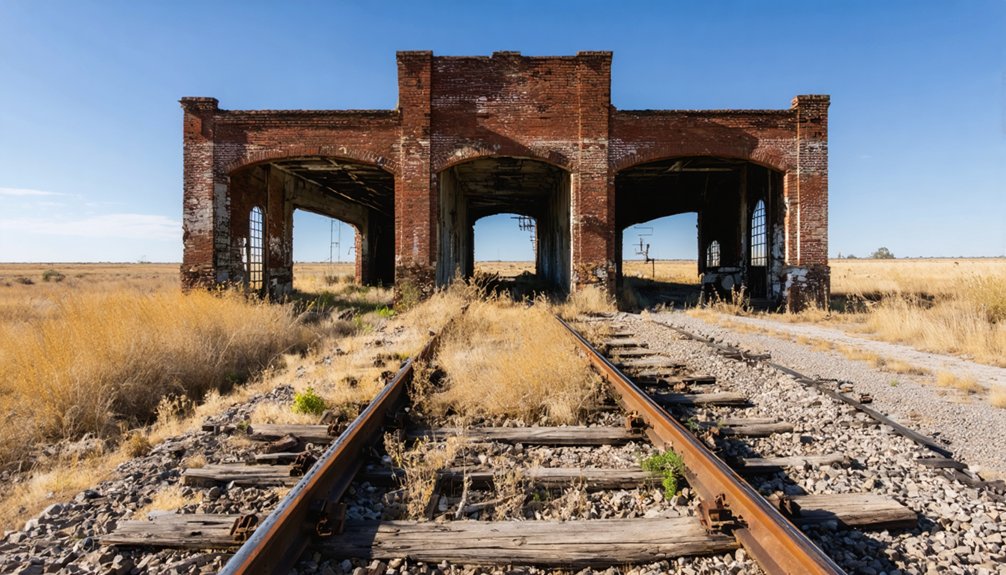
Medicine Mound’s railroad economy didn’t collapse from a single blow — it unraveled under two devastating forces hitting back to back. The Great Depression gutted what local folklore had long celebrated as a thriving railroad hub, draining businesses and pushing residents out.
Then, in 1933, fire tore through nearly the entire town, erasing what economic decline had already weakened. You can imagine standing there watching roughly 22 businesses reduced to ash and memory.
A community that had peaked at over 500 residents simply couldn’t recover from that combination. People left, money dried up, and the railroad’s promise faded into the plains.
When to Visit Medicine Mound and What the Drive Demands
Timing your visit to Medicine Mound makes a real difference in what you’ll experience on the road and at the site. Spring and fall deliver the clearest skies and cooler temperatures, ideal for photography tips like golden-hour shots of the four mounds.
Approach from Quanah or Childress along FM 1167 for the smoothest drive.
Plan your stop around these essentials:
- Visit October through April to avoid brutal summer heat
- Arrive at sunrise or sunset for dramatic mound photography tips
- Fill your tank before leaving Quanah, as fuel stops are sparse
- Check local dining options in Quanah before heading out, since Medicine Mound has none
- Allow two to three hours to explore the museum, markers, and landscape fully
Other Ghost Towns to Pair With a Medicine Mound Visit
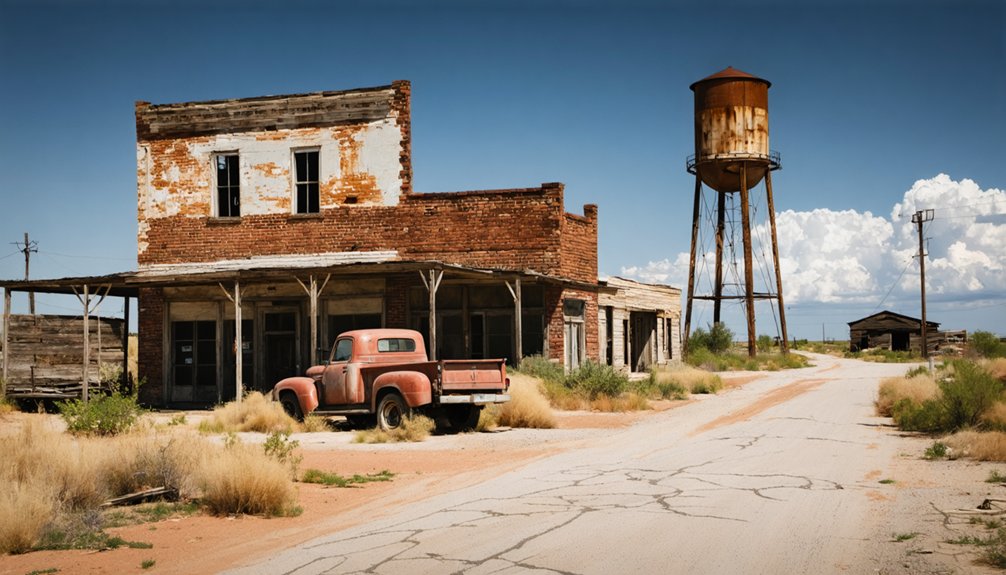
Because the Texas Panhandle and Rolling Plains hold dozens of forgotten towns within a few hours of each other, you can easily turn a Medicine Mound stop into a full ghost town circuit.
The Texas Panhandle hides dozens of forgotten towns close enough to chain into one unforgettable ghost town road trip.
Nearby Clairemont, once the seat of Kent County, offers crumbling historic architecture and local legends tied to a courthouse that time abandoned.
Swenson and Roby sit within reasonable driving distance and reward curious travelers with quiet streets and weathered storefronts.
Northward, you’ll find remnants near the Caprock Escarpment where ranching communities quietly faded after rail lines shifted.
Each stop carries its own collapsed economy and stubborn survivors in brick and wood.
String these locations together on a single route and you’ll cover serious ground across one of Texas’s most overlooked historical corridors.
Frequently Asked Questions
Is There an Admission Fee to Visit the Medicine Mound Museum?
The knowledge doesn’t confirm an admission fee, so you’ll want to call ahead. Once there, you’ll uncover ghost town history and local legends inside the Hicks-Cobb museum, where surviving walls whisper Medicine Mound’s remarkable past.
Can Visitors Access or Hike the Medicine Mounds Themselves?
Want to explore sacred ground? The Medicine Mounds sit on private property, so you’ll need to respect hiking regulations. View their historical significance from the roadside, letting the Comanche’s cherished landscape inspire your adventurous spirit freely.
What Is the Peak Population Medicine Mound Ever Reached?
You’ll find Medicine Mound reached its peak population of around 500 to 522 residents in the late 1920s, a period rich with historical significance, bustling businesses, and archaeological findings that reveal a thriving, freedom-loving frontier community.
Are Restrooms or Facilities Available at the Medicine Mound Site?
Don’t let uncertainty stop you — park amenities are minimal at Medicine Mound’s compact ghost-town site. Follow visitor guidelines and plan ahead by bringing your own supplies, ensuring you’re free to explore comfortably without interruption.
When Did Medicine Mound’s Last Operating Business Finally Close?
You’ll find that Medicine Mound’s last operating business finally closed in 1966, sealing its historical significance forever. Local legends whisper of a once-thriving community that you can still explore through its remarkable surviving structures today.
References
- https://en.wikipedia.org/wiki/Medicine_Mound
- https://www.texasescapes.com/TexasTowns/Medicine-Mound-Texas.htm
- https://texashighways.com/culture/history/the-comanche-medicine-mounds-remain-a-spiritual-refuge-for-the-storied-tribe/
- https://www.facebook.com/groups/873928379320499/posts/8886575308055726/
- https://maps.roadtrippers.com/us/quanah-tx/nature/medicine-mound-ghost-town
- https://www.youtube.com/watch?v=WVKyB1yesQA
- https://www.redriverhistorian.com/post/long-gone-medicine-mound-texas
- https://1dustytrack.blogspot.com/2015/04/medicine-mound-texas-ghost-town.html
- https://adventuresofthecrazytrain.com/2014/12/04/the-town-of-medicine-mound-texas-population-0/