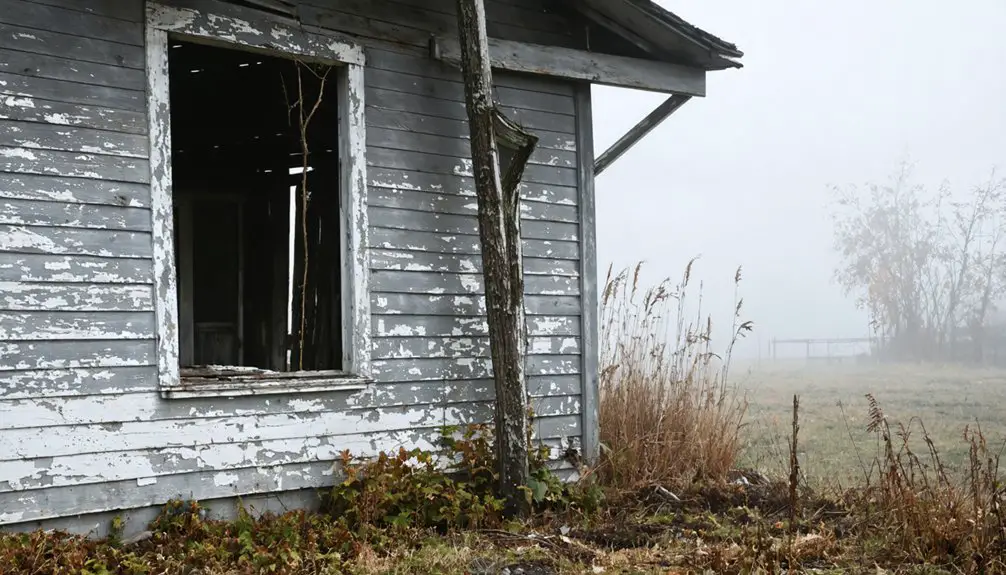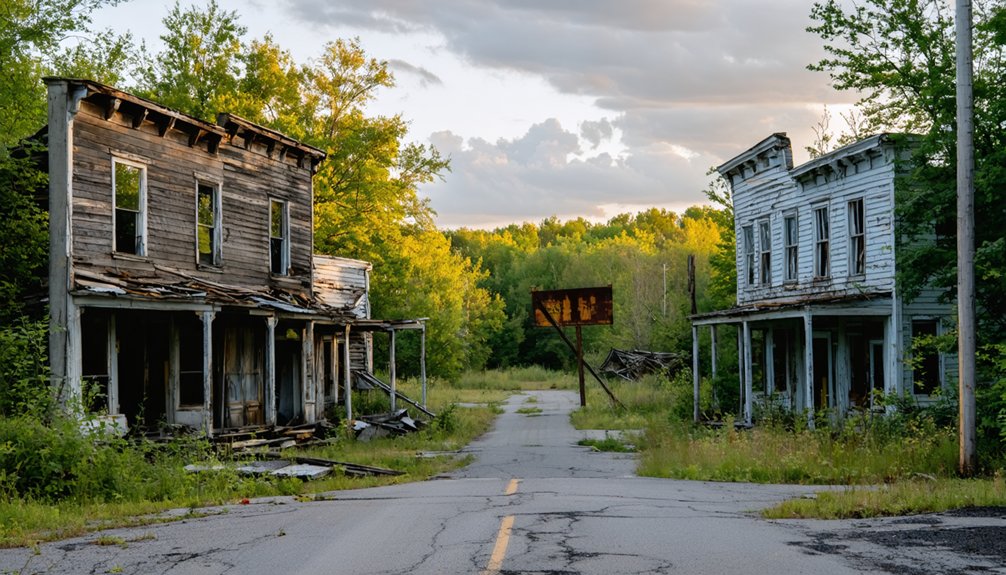
Planning a ghost town road trip to Springvale, Michigan means heading deep into the northern woods of Emmet County, where a once-thriving lumber town sits abandoned since 1916. Built entirely by the Cobbs & Mitchell Lumbering Company across 32,000 acres of timberland, Springvale collapsed when its forests were stripped bare. Today, you’ll find crumbling foundations, towering chimneys, and forest-swallowed ruins waiting to be explored. Keep going to uncover everything you need to plan your trip.
Key Takeaways
- Springvale is a ghost town in Emmet County, northern Michigan, abandoned in 1916 after Cobbs & Mitchell depleted its 32,000 acres of timberland.
- Use GPS directed toward Emmet County, turn onto unpaved forest roads, park where roads narrow, then explore the ruins on foot.
- Visit between late spring and early fall for the best access, with summer offering the longest daylight hours for exploration.
- Bring offline maps, a physical compass, sturdy boots, long sleeves, and water to safely navigate the dense northern Michigan woods.
- Combine your trip with nearby attractions like Sleeping Bear Dunes, Petoskey State Park, and Cross Village’s iconic Legs Inn roadhouse.
What Was Springvale, Michigan?
Once a thriving lumber town in northern Michigan, Springvale rose to prominence in the late 1800s under the Cobbs & Mitchell Lumbering Company, which controlled 32,000 acres of timberland and built an entire community to support its workforce — complete with worker housing, stores, and a railroad.
At its peak, it hummed with activity, processing timber that fueled regional growth. But by 1916, the trees were gone. The mill closed, the railroad pulled out, and residents scattered, leaving Springvale to fade into forest silence.
Today, it’s a ghost town within Emmet County, where foundation stones and standing chimneys carry community stories from a vanished era. For those drawn to historical preservation and forgotten places, Springvale offers a raw, unfiltered glimpse into Michigan’s lumber past.
How Did Cobbs & Mitchell Build an Entire Town From Scratch?
When you explore Springvale’s history, you’ll quickly realize that Cobbs & Mitchell didn’t just harvest timber — they built an entire self-sustaining community from the ground up.
The company controlled a staggering 32,000 acres of timberland, giving them the resources and authority to dominate northern Michigan’s lumber economy throughout the late 1800s.
To support their massive workforce, they constructed roads, housing, and rail lines, fundamentally creating a functioning town where nothing had existed before.
Controlling 32,000 Timber Acres
Before the first nail was driven or the first log hauled, Cobbs & Mitchell Lumbering Company had already secured 32,000 acres of prime Michigan timberland — and that staggering land control gave them the foundation to build an entire community from scratch.
That kind of territorial dominance wasn’t accidental. They strategically locked down northern Michigan’s densest forests, giving themselves virtually unlimited raw material and unchallenged economic authority.
When you walk Springvale’s ruins today, you’re witnessing historical preservation at its most raw — nature slowly reclaiming what industry once commanded.
The same dense forests that fueled Cobbs & Mitchell’s empire now offer wildlife observation opportunities you won’t find anywhere near a crowded tourist trap.
You’re free to explore this forgotten landscape exactly as it stands — unfiltered, untamed, and unapologetically honest.
Building Essential Worker Infrastructure
How does a lumber company transform raw wilderness into a functioning town? Cobbs & Mitchell did exactly that, engineering urban development from nothing but forest and ambition. You’d have walked streets they built, shopped in stores they stocked, and slept in housing they constructed.
They created everything workers needed to survive and thrive:
- Worker housing — rows of modest homes carved from surrounding timber
- Company stores — supplying food, tools, and daily essentials
- Roads — connecting remote wilderness to civilization
- Railroad lines — moving lumber efficiently to outside markets
This self-contained world hummed with purpose until industrial decline silenced every hammer and rail car. What once represented remarkable human ingenuity now sleeps beneath Michigan’s northern forests, waiting for curious travelers like you.
Dominating Local Lumber Economy
Building infrastructure was only half the battle — controlling the economy that infrastructure supported was the other. Cobbs & Mitchell didn’t just build Springvale; they owned it. With 32,000 acres of timberland under their control, they dictated wages, housing, and commerce across the entire region.
Workers bought goods from company stores, lived in company homes, and traveled on company-built rail lines.
You’ll find that local folklore paints this arrangement as both oppressive and oddly cohesive — a self-contained world where one firm held every key.
Historical preservation efforts today help you understand just how total that dominance was. Walking among Springvale’s remaining foundations, you’re essentially stepping through the skeleton of a privately ruled economy that collapsed the moment its timber ran out.
Why Did Springvale Collapse Into a Ghost Town by 1916?
Once the trees were gone, Springvale had nothing left to stand on. By 1916, the economic collapse was swift and total. You can almost feel the silence that replaced the roaring sawmills.
When the last tree fell, Springvale fell with it — and by 1916, the silence was deafening.
Here’s how the collapse unfolded:
- Timber depleted — 32,000 acres stripped bare, leaving no raw materials behind.
- Mill shuttered — Without timber, the primary operation ceased completely.
- Railroad pulled out — No industry meant no reason to maintain the line.
- Residents scattered — Families abandoned homes overnight, accelerating urban decay.
What remained was a skeleton town frozen in time. If you’re craving a place that radiates raw, unfiltered history, Springvale’s collapse tells you everything about what happens when a single industry controls a community’s fate.
What Ruins and Remnants Can You Still Find There?

What’s left of Springvale isn’t much, but it’s enough to spark your imagination. As you wander through the dense northern Michigan woods, you’ll discover foundation stones marking where buildings once stood, partial walls clinging to industrial sites, and towering chimneys rising above the tree line like silent sentinels.
These remnants tell a powerful story without saying a word. Archaeological findings reveal the town’s layout, giving you a real sense of how workers once lived and labored here.
You can trace the ghost of a community that timber built and timber destroyed.
Historical preservation efforts may eventually protect these fragile traces, but right now, you’re free to explore them raw and unfiltered. Springvale rewards the curious traveler willing to push past the trees.
Where Exactly Is Springvale Located in Northern Michigan?
You’ll find Springvale tucked within Emmet County’s dense northern forests, placing it squarely in Michigan’s wild Upper Peninsula borderlands. To reach it, you’ll need to navigate remote, forested roadways that wind through thick woodland — so a reliable vehicle and a solid map are non-negotiable.
The isolation that swallowed this ghost town whole is the same rugged terrain you’ll push through to discover it.
Emmet County Forest Location
Tucked within the dense forests of Emmet County in northern Michigan, Springvale sits near the Upper Peninsula border, surrounded by towering trees that have long reclaimed what was once a thriving lumber community. Timber depletion and industrial decline left this place frozen in time, making it a hauntingly beautiful destination for explorers craving something off the beaten path.
Picture yourself traveling remote forest roads and discovering:
- Foundation stones half-buried beneath decades of fallen leaves
- Partial walls rising ghostlike from the forest floor
- Towering chimneys piercing the forest canopy above
- Silent ruins whispering stories of a vanished workforce
You’ll feel the weight of history pressing through every crumbling structure, rewarding your curiosity with an unforgettable glimpse into Michigan’s forgotten past.
Accessing Remote Forested Roads
Finding Springvale means committing to a journey through remote forested roads deep within Emmet County, where GPS signals weaken and paved surfaces give way to gravel and dirt tracks threading through dense northern Michigan woodland. You’ll want detailed paper maps alongside your digital navigation, because technology fails where timber once thrived.
Local legends describe travelers stumbling upon foundation stones completely by accident, rewarded for their persistence with glimpses of a forgotten world.
Historical preservation efforts remain minimal here, meaning the landscape stays raw and unfiltered — exactly what freedom-seekers crave.
Pack provisions, fuel up beforehand, and inform someone of your route. The forested roads demand respect but reward curiosity.
Springvale doesn’t advertise itself; you earn the discovery through deliberate navigation and a willingness to embrace genuine wilderness exploration.
How Do You Actually Get to Springvale Through the Forest?
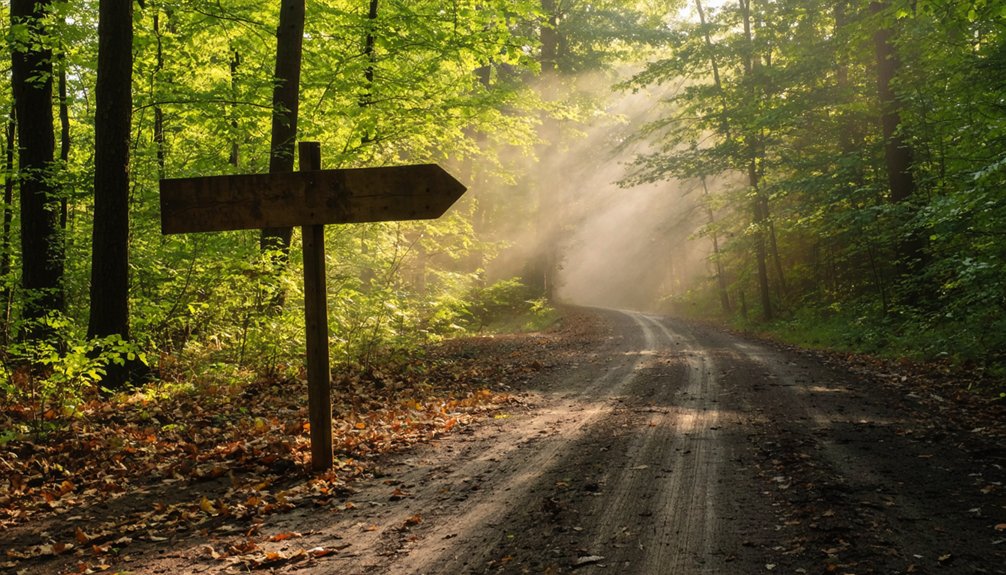
Reaching Springvale means traversing forested roadways deep within Emmet County in northern Michigan, so a reliable vehicle with decent ground clearance is a smart call before you head out.
You’ll navigate narrow, tree-lined paths where the timber industry once ruled, discovering historical artifacts scattered beneath the undergrowth.
Follow these steps to find your way:
- Set your GPS toward Emmet County in northern Michigan near the Upper Peninsula border.
- Turn onto unpaved forest roads where dense tree canopies block direct sunlight.
- Watch for subtle clearings that signal former building foundations beneath overgrown brush.
- Park where roads narrow completely, then continue on foot through towering pines.
You’re fundamentally retracing the footsteps of workers who built an entire community from raw wilderness.
When Is the Best Time of Year to Visit Springvale?
Once you’ve mapped your route through Emmet County’s forest roads, knowing *when* to make that drive matters just as much as knowing *how*. Late spring through early fall gives you the clearest access — river crossings become manageable, and the dense canopy hasn’t yet blocked natural light from illuminating the ruins.
Summer offers long days perfect for exploring foundation stones and towering chimneys without rushing. Avoid early spring when snowmelt swells river crossings into genuine obstacles. Fall brings stunning color but shorter windows before frost sets in.
Winter closes off most forest roads entirely. For timber preservation enthusiasts, late summer visits reveal the most structural detail in remaining walls and industrial sites. Pack light, arrive early, and let Springvale’s silence tell its story on your terms.
What Other Attractions Are Near Springvale, Including Sleeping Bear Dunes?

Springvale doesn’t stand alone as a destination — the surrounding region packs in enough natural and historical landmarks to justify a multi-day road trip. You’ll find yourself surrounded by experiences that blend historical preservation with raw natural beauty:
- Sleeping Bear Dunes National Lakeshore — Climb massive sand dunes overlooking Lake Michigan’s brilliant blue expanse.
- Emmet County Heritage Sites — Uncover local folklore through small museums preserving northern Michigan’s logging-era stories.
- Petoskey State Park — Collect iconic Petoskey stones along rocky shorelines framed by towering hardwoods.
- Cross Village’s Legs Inn — Experience hand-carved folk art inside a legendary roadhouse built from driftwood and stone.
Each stop deepens your understanding of the region’s layered history while rewarding your hunger for open roads and genuine discovery.
How Do You Explore Springvale’s Ruins Without Getting Lost?
Finding Springvale’s overgrown ruins demands preparation, since dense northern Michigan forest swallows landmarks fast and trails blur into undergrowth without warning. Download offline maps before leaving cell service behind, and carry a physical compass as backup. Mark foundation stones and partial walls as waypoints on your GPS device so you can navigate between sites confidently.
Wear sturdy boots and long sleeves to push through thick undergrowth safely. Bring water, because remote forested roadways offer nothing once you’re deep inside the tree line.
When you encounter historical artifacts like chimney remnants or crumbling walls, photograph them without disturbing placement. Ongoing preservation efforts depend on visitors leaving everything exactly as found. Respecting these silent structures guarantees future explorers experience the same haunting, authentic glimpse into Springvale’s forgotten lumber past.
Frequently Asked Questions
Is There an Entrance Fee to Visit Springvale’s Ghost Town Ruins?
You’ll find no entrance fee to explore Springvale’s ghost town ruins! Visitor guidelines support historical preservation while granting you complete freedom to wander the haunting foundation stones, partial walls, and towering chimneys of this forgotten Michigan lumber community.
Are Guided Tours Available for Exploring Springvale’s Historical Remains?
No official guided exploration exists for Springvale’s historical preservation site, but you’re free to roam its haunting ruins independently. You’ll discover towering chimneys, crumbling foundations, and silent walls whispering stories of Michigan’s fascinating lumber past.
Can Visitors Legally Remove Artifacts or Stones From Springvale’s Ruins?
Like a library book that belongs to everyone, you can’t take what isn’t yours. Artifact removal from Springvale’s ruins faces strict legal restrictions — respect these silent stones, letting them whisper their stories for future explorers.
Is Camping Permitted Overnight Near Springvale’s Abandoned Town Site?
You’ll want to check local camping restrictions before pitching your tent near Springvale’s haunting ruins. Overnight permits may be required within Emmet County’s forested boundaries, so plan ahead and embrace your adventure responsibly!
Are Springvale’s Forested Trails Accessible for Wheelchair Users and Strollers?
Can you truly explore freely? Springvale’s rugged, forested trails lack formal accessibility features, making trail difficulty high for wheelchair users and stroller navigation. You’ll encounter uneven terrain, dense woods, and remote pathways that challenge mobility-restricted adventurers profoundly.
References
- https://en.wikipedia.org/wiki/Category:Ghost_towns_in_Michigan
- https://chandlertownshipmichiganmemories.weebly.com/railroad-cobbs–mitchell–camps.html
- https://en.wikipedia.org/wiki/List_of_ghost_towns_in_Michigan
- https://books.google.com/books/about/Ghost_Towns_of_Michigan.html?id=3dzhAAAAMAAJ
- https://kids.kiddle.co/List_of_ghost_towns_in_Michigan
- https://midland.migenweb.org/midcities.html
- https://ghost-towns.close-to-me.com/states/michigan/
- https://wmmq.com/13-michigan-ghost-towns/
- https://www.ghosttowns.com/states/mi/mi.html
- https://www.nps.gov/slbe/learn/historyculture/ghosttowns.htm