Planning a ghost town road trip to Stull, Kansas starts with knowing where it sits — about 7 miles west of Lawrence and 10 miles east of Topeka, right off North 1600 Road in Douglas County. You’ll find a weathered cemetery, quiet rural landscapes, and a legend rooted in a 1974 college newspaper story rather than supernatural fact. It’s an easy detour from I-70 that delivers genuine atmosphere and history, and there’s plenty more to uncover about this quietly infamous stop.
Key Takeaways
- Stull, Kansas, sits about 7 miles west of Lawrence and 10 miles east of Topeka, easily accessible via rural backroads near I-70.
- The cemetery is the primary historical attraction, originally settled by Pennsylvania Dutch immigrants in 1857 and formerly named Deer Creek.
- The infamous “Seven Gateways to Hell” legend originated from a 1974 college newspaper Halloween fiction story mistaken for fact.
- The quiet, weathered landscape offers solitude and introspection, with nature reclaiming remnants of the once-thriving frontier community.
- Allocate about an hour for exploration, respect private property boundaries, and pair the visit with stops in Lawrence or Topeka.
Stull, Kansas: The Ghost Town Behind the Legend
Although most people know Stull, Kansas for its eerie folklore, the real story starts long before any ghost stories took hold.
Pennsylvania Dutch immigrants settled here in 1857, calling it Deer Creek before renaming it after postmaster Sylvester Stull.
That humble origin feels worlds away from the local legends that would eventually put this crossroads on the map.
Where Stull Sits Between Lawrence and Topeka
You’ll find Stull sitting at the crossroads of North 1600 Road and East 250 Road in Douglas County, Kansas.
It is placing it roughly 7 miles west of Lawrence and just 10 miles east of the Topeka city limit.
That position makes it a natural midpoint stop if you’re already traveling along the northeastern Kansas corridor.
Whether you’re heading out from Lawrence or cutting over from Topeka, you can reach Stull without adding much distance to your route.
Location Along Kansas Roads
Tucked between Lawrence and Topeka along the rural backroads of Douglas County, Stull sits roughly 7 miles west of Lawrence and 10 miles east of the Topeka city limit, making it an easy detour on a Kansas road trip. You’ll find it at the intersection of North 1600 Road and East 250 Road, a quiet rural crossroads that carries more weight in local folklore than its size suggests.
Getting there’s straightforward. You can roll through on your way between the two cities without adding much time to your drive. The open Kansas landscape sets the tone well before you arrive, easing you into the rural history and eerie atmosphere that draws curious travelers to this unincorporated community year after year.
Distance From Lawrence
Lawrence makes the most natural jumping-off point for a visit to Stull, sitting just 7 miles to the east. You can leave downtown Lawrence, head west on North 1600 Road, and reach the crossroads in under 15 minutes. That kind of easy access makes Stull a perfect detour rather than a dedicated haul.
If you’re coming from Topeka, you’ll cover roughly 10 miles from the city limit, making Stull a convenient midpoint stop between the two cities. That position between Lawrence and Topeka is exactly what makes it such a natural fit for a regional road trip.
You’re not just chasing folklore tourism here — you’re moving through real local history with every mile. The drive itself sets the mood before you ever arrive.
Nearby Topeka Access
Sitting almost exactly between Lawrence and Topeka, Stull gives road trippers a natural midpoint to break up the drive along this stretch of Douglas County. You’re only 10 miles from Topeka’s eastern city limit, making it effortless to add Stull to any regional route.
Here’s why this access point works in your favor:
- You can approach from Topeka heading east on a short, scenic rural drive.
- The crossroads setting drops you right into Stull’s historical context immediately.
- Local legends surrounding the cemetery hit differently when you’re standing at the actual site.
- You can loop back toward Topeka or continue east to Lawrence without backtracking.
This freedom to move in either direction makes Stull a flexible, low-effort stop worth claiming.
The “Seven Gateways to Hell” Legend Explained
No evidence supports any supernatural claims tied to the site. What you’ll actually find is a quiet, rural Kansas crossroads — atmospheric, historically interesting, and far more grounded in real history than ghost story sensationalism.
The 1974 College Newspaper Story That Started the Myth
Most legends need a starting point, and Stull’s has a surprisingly mundane one. A 1974 college newspaper ran a Halloween fiction piece, and readers took it seriously. That single story launched decades of urban legends.
Every legend needs an origin. Stull’s began with a 1974 college fiction piece mistaken for fact.
Here’s how the myth evolved:
- A student writer crafted a spooky fictional tale about Stull’s cemetery
- Readers spread it as fact rather than seasonal fiction
- The story mutated into the “Seven Gateways to Hell” narrative over time
- Folklore tourism eventually turned a rural Kansas crossroads into a curiosity destination
You’re now chasing a myth built on a college prank. That’s actually part of the adventure. Stull’s legend isn’t rooted in documented history — it’s rooted in imagination, which makes your road trip stop even more intriguing.
What Remains at Stull Today
After decades of decline, only a handful of structures remain scattered across Stull’s rural crossroads, and you’ll find it’s more empty Kansas sky than dramatic ruins. Don’t expect a preserved historic district or marked trails — Stull resists that kind of polish.
What you get instead are raw rural landscapes stretching in every direction, a quiet intersection, and the weathered bones of a community that quietly faded.
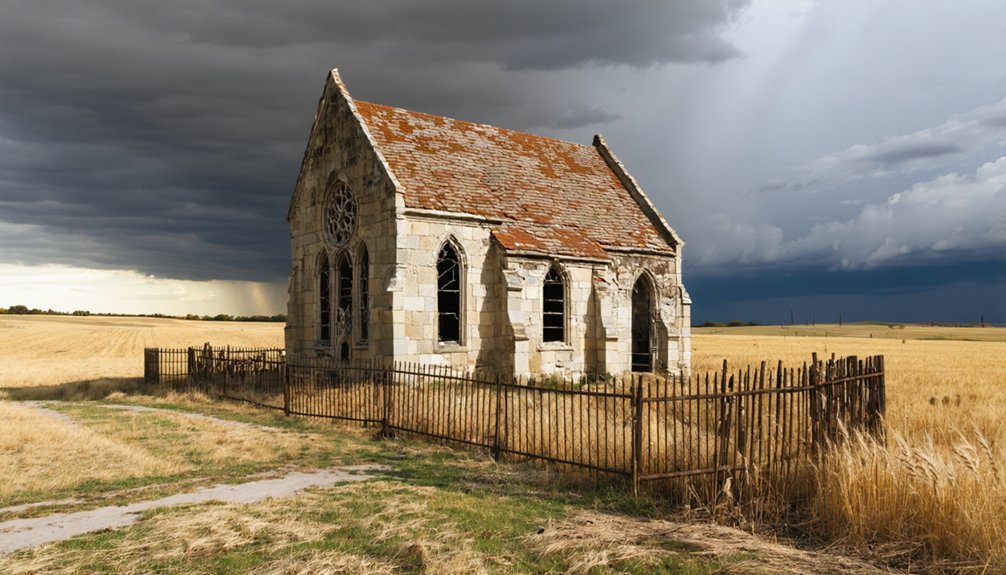
The cemetery still stands and draws the most attention, but historical preservation here is minimal and intentional. Nature has largely reclaimed what people left behind.
You’re fundamentally reading the land itself. If you approach Stull as a place to feel rather than photograph extensively, you’ll leave with something more valuable than ruins — a genuine sense of Kansas frontier solitude.
How to Add Stull to a Kansas Road Trip
Stull sits almost exactly halfway between Lawrence and Topeka on Kansas’s I-70 corridor, which makes it one of the easiest ghost town detours you’ll find on any regional road trip. Drop off the interstate, follow the rural roads, and soak in the rural charm before moving on.
Here’s how to work it in:
- Exit I-70 and head toward North 1600 Road and East 250 Road.
- Explore the crossroads and photograph what remains of the settlement.
- Research the local legends beforehand so the history hits harder when you’re standing there.
- Pair the stop with a visit to nearby Lawrence or Topeka for a fuller day.
You won’t need more than an hour, but Stull delivers atmosphere that lingers well past the drive home.
Pairing Stull With Lawrence and Topeka
Because Stull sits just seven miles west of Lawrence and ten miles east of Topeka, you’d be leaving easy wins on the table if you didn’t fold both cities into your route.
Stull sits just seven miles from Lawrence and ten from Topeka — skipping both would be leaving easy wins behind.
Lawrence brings energy and history, with a strong local community and impressive historical preservation efforts along Massachusetts Street. Grab a meal, explore the shops, and get a feel for authentic Kansas culture before heading west toward Stull’s quiet crossroads.
After your stop, push east into Topeka to visit the Kansas State Capitol or Brown v. Board of Education National Historic Site.
This corridor gives you a full day of contrast, moving from urban landmarks to rural folklore and back again. It’s an efficient, rewarding stretch of highway that rewards curious, independent travelers.
Visiting Stull Cemetery Without Crossing a Line
The cemetery itself is the reason most people make the turn off the highway, but visiting it comes with a clear expectation: you’re a guest, not a ghost hunter.
Stull’s local folklore draws curious travelers, but the land and nearby residents deserve real respect.
Follow these four rules before you arrive:
- Stay on public roads and don’t cross onto private property
- Skip the visit if you’re planning to trespass after dark
- Keep rural photography respectful — no staged dramatic scenes near headstones
- Leave everything exactly as you found it
The crossroads atmosphere delivers plenty on its own.
You don’t need to break any boundaries to feel the weight of this quiet, weathered place.
The story is already written into the landscape.
Frequently Asked Questions
What Was Stull Originally Called Before It Was Renamed?
You’ll find that Stull was originally called Deer Creek! Before town folklore and local ghost stories put it on the map, this adventurous Kansas settlement carried that name until postmaster Sylvester Stull inspired its memorable rename.
Who Was Sylvester Stull and Why Was the Town Named After Him?
Sylvester Stull served as the town’s only postmaster, earning him a permanent place in local folklore. You’ll find his name woven into Stull’s haunted legends, immortalizing this one man across nearly 170 years of Kansas history.
What Year Was the Stull Settlement First Founded?
You’ll find Stull’s local history dates back to 1857, when settlers first founded the community. Long before haunted legends took hold, adventurous pioneers carved this small Kansas settlement out of the frontier wilderness, sparking a story that’s still unfolding.
Which Immigrant Group Originally Settled the Stull Area in Kansas?
Like roots running deep, Pennsylvania Dutch immigrants originally shaped Stull’s historical settlement in the mid-19th century. You’ll find their cultural influences woven into this Kansas community’s fascinating origin story, connecting you to its adventurous pioneer past.
What Are the Exact Road Coordinates for Finding Stull Today?
You’ll find Stull’s ghost town history and haunted legends at North 1600 Road and East 250 Road in Douglas County, Kansas — just seven miles west of Lawrence, where adventure and folklore collide!
References
- https://en.wikipedia.org/wiki/Stull
- https://www.onlyinyourstate.com/experiences/kansas/stull-ks
- https://medium.com/@micah_campbell/stairway-to-perdition-stull-kansas-4d6a9dc36e01
- https://www.snopes.com/articles/464019/stull-portal-to-netherworld/
- https://medium.com/@mortal_cyn/the-devils-joke-bd94b493d080