Planning a ghost town road trip to Texanna, Oklahoma starts with heading east off U.S. 69 onto Texanna Road for about 7–8 miles through quiet McIntosh County. You’ll find a Cherokee settlement founded in 1839 that once supported five general stores, two schools, and two churches by 1882. Today, a still-standing church and scattered foundations are all that remain. Stick around, because there’s far more to this forgotten town’s story than first meets the eye.
Key Takeaways
- Texanna, Oklahoma, founded in 1839 by Cherokee settlers, offers a meaningful ghost town experience rich in frontier and Native American history.
- Access the site via U.S. 69, heading east on Texanna Road for approximately 7–8 miles toward Porum Landing on Lake Eufaula.
- Key remnants include a standing church and store, home, and school foundations, providing tangible connections to Texanna’s thriving 19th-century community.
- Visit during spring or fall for moderate temperatures and scenic landscapes, avoiding summer heat and humidity for a more comfortable experience.
- Combine ghost town exploration with nearby Lake Eufaula activities like boating and fishing for a complete and rewarding full-day trip.
What Makes Texanna Worth a Ghost Town Stop?
Although Texanna won’t dazzle you with dramatic ruins or a ghost-town movie set, it earns its place on Oklahoma’s heritage trail through sheer historical depth. Cherokee settlers founded this community in 1839 beside an everlasting spring.
By 1882 it supported five general stores, two churches, a cotton gin, and a grist mill. That’s a fully functioning frontier economy, now reduced to foundations, one church, and an unoccupied business.
What you’re reading in that surviving historical architecture isn’t decay — it’s a timeline. Modern preservation efforts, however modest, have kept enough visible to reward a curious traveler.
You’ll piece together the story yourself, which is exactly what freedom-minded road trippers prefer. Texanna doesn’t hand you the narrative; it makes you earn it.
How Cherokee Settlers Founded Texanna in 1839
When you trace Texanna’s origins, you land in 1839, when a band of Cherokee settlers arrived in what’s now McIntosh County and chose this spot as home. They built their community around an “everlasting” spring, a reliable water source that made the location practical for long-term settlement.
That early foothold grew steadily, and by 1882 the community had developed two schools, two churches, a grist mill, a cotton gin, and five general stores.
Cherokee Arrival In 1839
Before European towns were platted across Oklahoma, a band of Cherokee settlers put down roots here in 1839, drawn by a spring they described as “everlasting.” They built their community around that water source.
What grew from it was remarkably substantial for a frontier settlement—two schools, two churches, a grist mill, a cotton gin, and five general stores had all taken shape by 1882.
Their settlement patterns reflect deliberate community-building rooted in cultural heritage:
- A reliable water source anchored the entire founding
- Agriculture drove early economic life through the gin and mill
- Education arrived early with two functioning schools
- Commerce expanded quickly with five general stores
- Spiritual life was formalized through two established churches
Texanna wasn’t accidental—it was intentional, organized, and built to last.
The Everlasting Spring Settlement
A band of Cherokee settlers chose this patch of eastern Oklahoma for one reason: water. In 1839, they built their community around a spring locals described as “everlasting,” a source reliable enough to anchor permanent settlement. That dependable water supply made community reconstruction possible, drawing families, farmers, and traders to the same ground.
You’re fundamentally walking through a decision made nearly two centuries ago whenever you visit Texanna today. That spring shaped everything that followed, from the grist mill to the cotton gin to the five general stores operating by 1882.
While historical artifacts from that founding era are scarce now, the landscape itself carries the memory. The settlers didn’t just find water here; they built an entire world around it.
Early Community Growth
By 1882, the Cherokee settlement at Texanna had grown into something remarkably self-sufficient. You can picture a thriving rural community shaped entirely by Indigenous heritage and determined hands. The historical architecture that once defined this place reflected real ambition.
The settlement included:
- Two schools
- Two churches
- A grist mill
- A cotton gin
- Five general stores and one drug store
That’s an impressive footprint for a rural Oklahoma community in the 1880s. Settlers here didn’t wait for a railroad boom or oil rush to build something worth keeping. They cultivated it from scratch, starting with that spring and expanding outward.
Understanding this growth makes your visit feel less like tourism and more like bearing witness to what a free, self-determined community actually looked like.
Why Texanna Declined After Its 1882 Peak
Like many Oklahoma settlements that flourished before statehood, Texanna followed a familiar arc of rise and decline. After its 1882 peak, the community lost ground to the same forces that emptied hundreds of similar towns across the state — highway bypasses, urbanization, and shifting economic patterns pulled residents toward larger centers.
Without a railroad connection or a resource boom to sustain it, Texanna couldn’t compete. Local legends suggest the community held on longer than most, sustained by deep Cherokee roots and tight-knit families.
But population kept dropping, and the businesses eventually closed.
Today, historical preservation efforts have kept the story alive, even if the buildings haven’t all survived. What remains gives you enough to piece together what this community once meant to the region.
How to Get to Texanna, Oklahoma
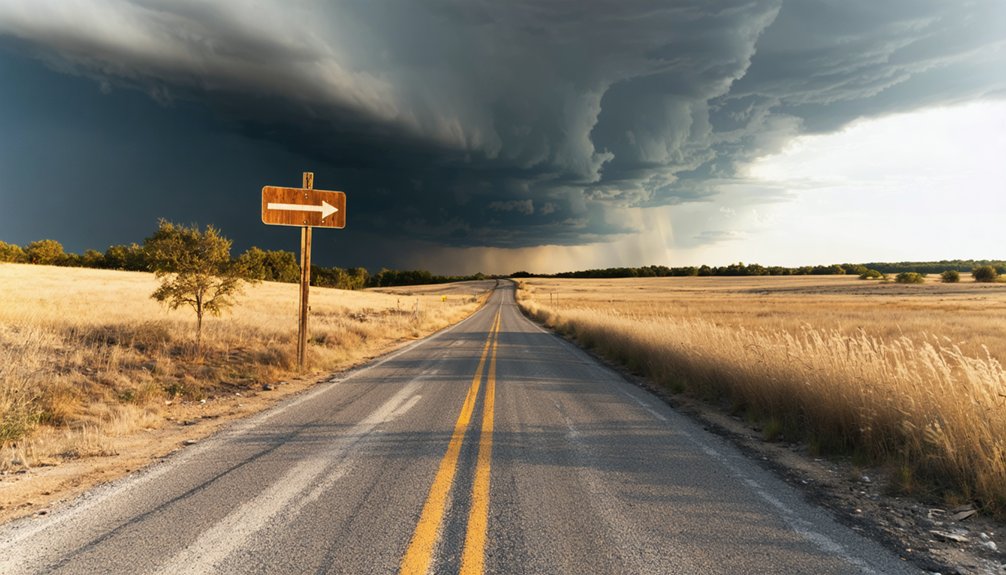
To reach Texanna, start on U.S. 69 and head east along Texanna Road for 7 to 8 miles.
The route is 2WD-accessible, so you won’t need a truck or SUV to make the drive.
You’ll know you’re close when you approach Porum Landing on Lake Eufaula, putting the historic site within easy reach.
Starting From U.S. 69
Once you’re on U.S. 69, getting to Texanna is straightforward — head east on Texanna Road and drive about 7 to 8 miles until the landscape starts telling a quieter story.
The route is 2WD-accessible, so no specialized vehicle is needed. As you roll east, you’re following a path tied to historical preservation efforts and local legends rooted in Cherokee settlement dating back to 1839.
Watch for these markers along the way:
- Texanna Road turnoff directly from U.S. 69
- Flat, open terrain shifting toward the lake region
- Proximity to Porum Landing on Lake Eufaula
- Reduced traffic as you move away from the highway
- Subtle roadside signs of a once-active rural community
The drive itself sets the tone before you even arrive.
Traveling Texanna Road East
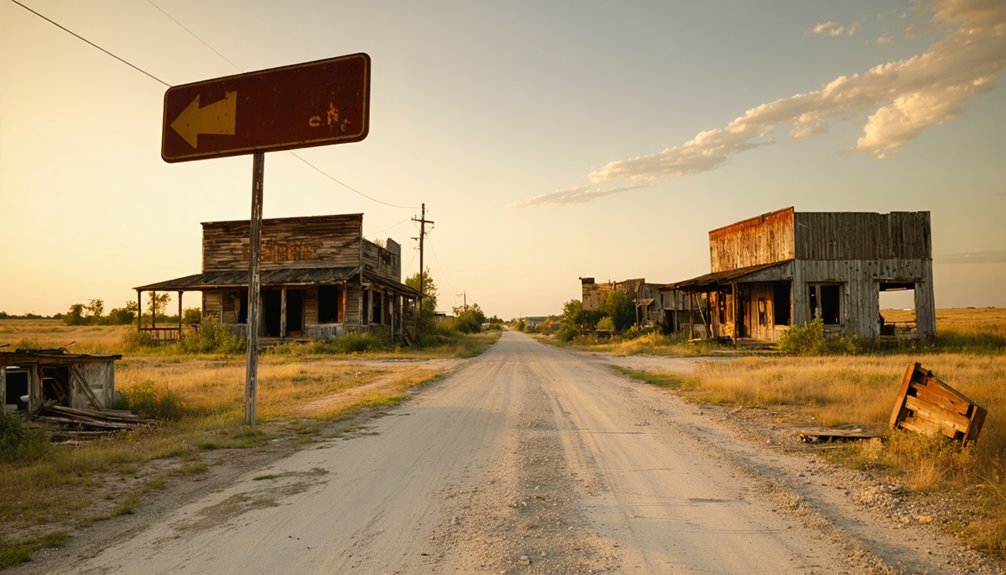
As you turn east onto Texanna Road from U.S. 69, the highway noise fades quickly behind you and the landscape opens into something slower and older. You’ll travel roughly seven to eight miles through quiet McIntosh County terrain before the remnants of Texanna come into view.
The road is 2WD-accessible, so any standard vehicle handles it fine. As you drive, recognize that this corridor carries real cultural significance — you’re tracing a route toward a Cherokee settlement dating to 1839.
The historical preservation visible at the site ahead isn’t just scattered rubble; it’s a readable record of a working 19th-century community. Keep your eyes open as you approach, because the shift from modern road to historic ground happens gradually and rewards attention.
Arriving Near Porum Landing
Porum Landing on Lake Eufaula sits close enough to Texanna that pairing the two makes natural sense for your road trip. Once you’ve traveled Texanna Road east, you’ll notice the landscape shift as the lake’s presence shapes the surroundings. This area rewards those who appreciate cultural heritage and authentic preservation efforts.
Keep these arrival details in mind:
- Texanna sits roughly 7–8 miles east of U.S. 69
- Porum Landing offers lakeside scenery directly nearby
- You’ll spot occupied homes alongside historic remnants
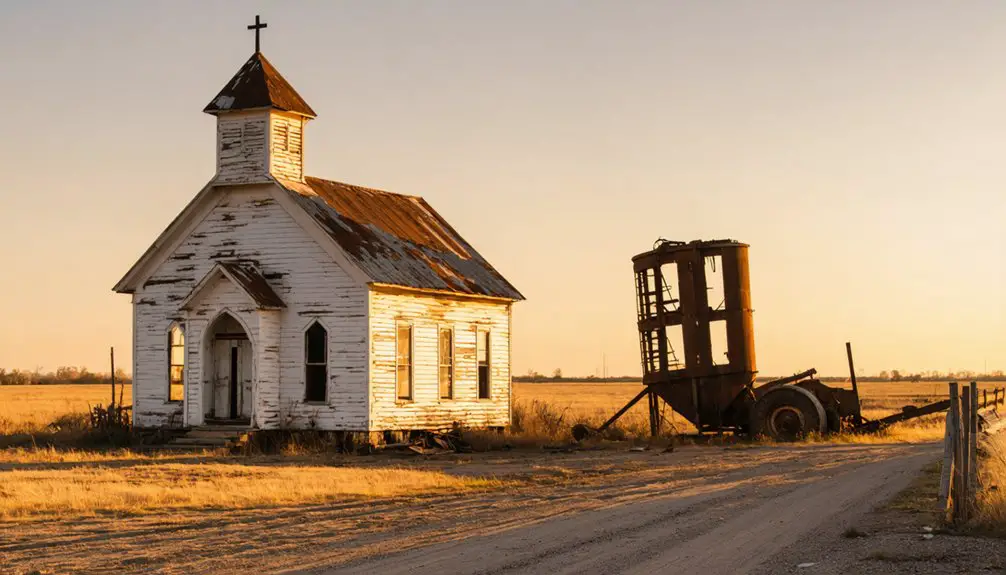
- One standing church reflects the community’s preservation efforts
- The school foundation lies approximately 0.3 miles east of the main site
You’re not arriving at a theme park—you’re stepping into a living, partially surviving piece of Oklahoma’s Cherokee history.
What You Can Still See in Texanna Today
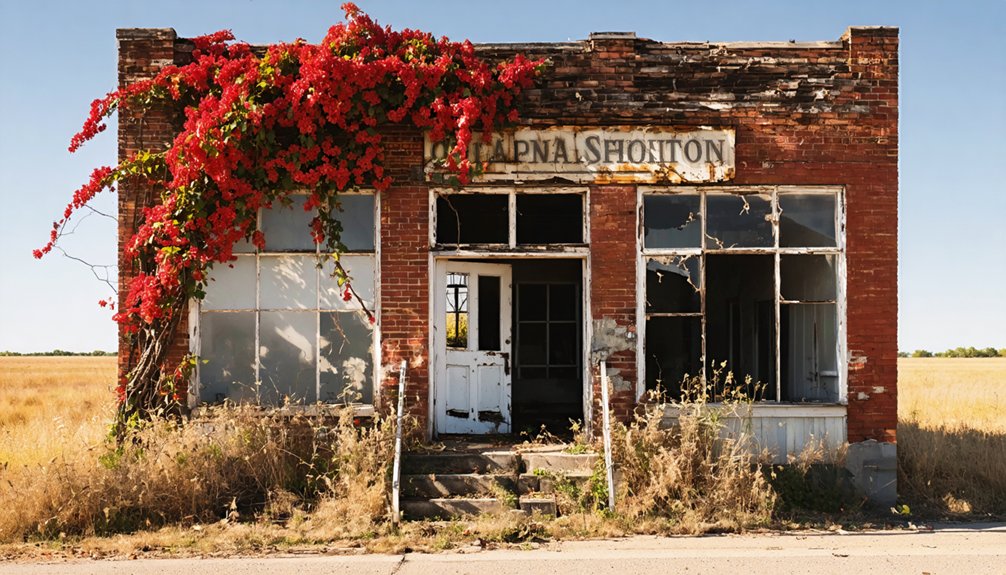
What’s left of Texanna isn’t much, but it’s enough to make the stop worthwhile. You’ll find one surviving church standing as a quiet marker of community preservation, alongside foundations where stores, homes, and gathering places once defined daily life. These historical artifacts ground you in the settlement’s past without requiring a museum or guided tour.
Several occupied houses confirm the area hasn’t fully surrendered to time, while one unoccupied business hints at the gradual retreat that shaped it into a ghost town.
Walk roughly 0.3 miles east and you’ll spot the school foundation — a small but tangible remnant worth the short detour.
Texanna rewards the curious traveler who’s comfortable reading a landscape more than a plaque.
Lake Eufaula and Porum Landing: What’s Near Texanna
Once you’ve walked Texanna’s remnants, Lake Eufaula sits just minutes away and rewards the detour. Porum Landing gives you direct water access, and the surrounding area ties historical preservation efforts to living landscapes worth exploring.
Local legends about early Cherokee settlers echo across both the ghost town and the shoreline.
Here’s what you can do near Texanna:
- Launch a boat or fish from Porum Landing
- Explore Lake Eufaula’s 102,000 acres of open water
- Photograph shoreline scenery after your ghost town walk
- Ask locals about regional history and Cherokee heritage stories
- Pair your visit with a lakeside picnic during spring or fall
The combination makes Texanna more than a single stop — it becomes a full day of discovery on your own terms.
Best Time of Year for a Texanna Road Trip
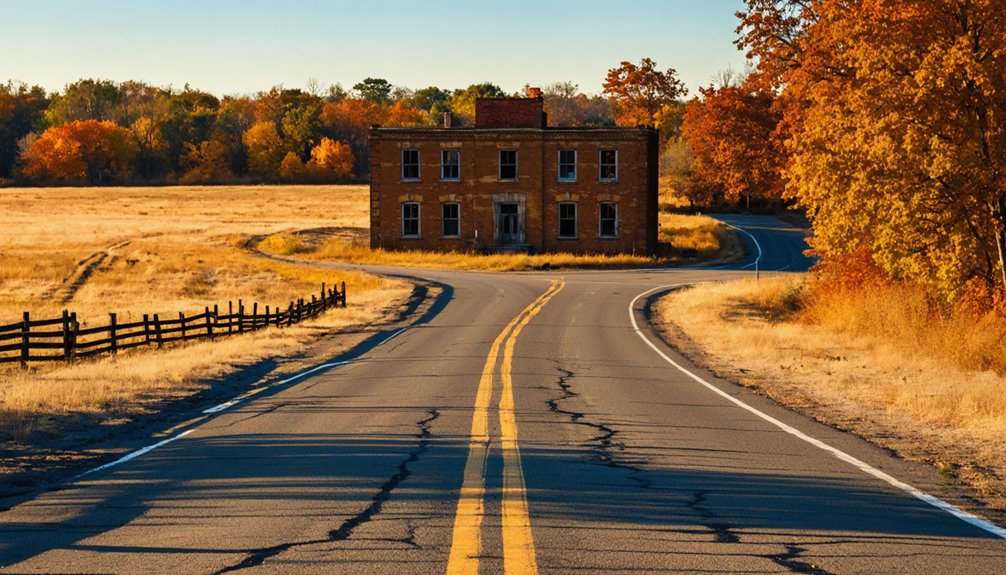
Timing your Texanna visit makes a real difference. Spring and fall offer the most comfortable conditions for exploring local history on foot, when temperatures stay moderate and the landscape stays readable.
Summer’s heat and humidity can make wandering foundation sites and roadsides genuinely miserable, so skip it if you can.
Fall is particularly rewarding. The light sits lower, shadows define the remaining foundations more clearly, and the surrounding countryside takes on color near Lake Eufaula. You’ll move at your own pace without fighting the weather.
Spring works well if you want greener scenery framing your cultural heritage stops along Texanna Road. Just check for wet road conditions before heading the 7–8 miles east off U.S. 69.
Either season gives you the freedom to explore without limitations holding you back.
Before You Go: Safety at Abandoned Sites
Ghost town structures have stood without maintenance for decades. Floors, stairs and roof timbers fail without warning, and a building that looks solid from outside may not hold your weight. Stay out of standing structures unless the site is actively maintained and open to visitors.
Mine workings are the more serious hazard. Vertical shafts can be hundreds of feet deep, are often unfenced, and may be hidden by brush or capped with rotted boards. Never enter an adit, tunnel or shaft: abandoned workings can hold oxygen-poor or toxic air that gives no warning before you lose consciousness.
Enclosed spaces with rodent droppings carry a risk of hantavirus, which is contracted by breathing contaminated dust. Do not sweep or stir up dust inside old cabins and outbuildings.
Cell coverage at these sites is usually poor or absent. Tell someone your route and expected return time, and carry more water than you think you need.
Frequently Asked Questions
Is There an Admission Fee or Permit Required to Visit Texanna?
You don’t need an admission fee or permit to explore Texanna! It’s a freely accessible site offering rich historical preservation and countless photography opportunities, so you’re free to roam and capture its fascinating remnants.
Are There Restrooms or Facilities Available at the Texanna Site?
Facilities fall flat here — Texanna offers no visitor amenities or restrooms on-site. You’ll want to plan ahead for history preservation adventures by stopping at nearby Porum Landing, where you’ll find better facilities before exploring.
Can Visitors Legally Walk Onto the Texanna Foundations and Structures?
You’ll want to respect private property boundaries at Texanna’s foundations and structures. Stick to public areas for historical preservation, and you’ll still find incredible photography opportunities capturing the remnants that tell this Cherokee settlement’s compelling story.
Is Texanna Suitable for Children or Elderly Visitors With Mobility Needs?
You’ll find Texanna’s flat, 2WD-accessible road perfect for elderly accessibility options, and its open-air remnants offer engaging child-friendly activities. You can explore foundations, the church, and scenic surroundings comfortably at your own pace.
Are There Guided Tours Available for the Texanna Ghost Town Area?
You won’t find guided tours here, but that’s oddly perfect — you’re free to explore at your own pace, discover historical preservation remnants independently, and seize spontaneous photography opportunities that a structured tour might’ve rushed you past.
References
- https://gateway.okhistory.org/ark:/67531/metadc2123502/
- https://www.youtube.com/watch?v=gg3ICLT5OZY
- https://www.travelok.com/articles/oklahomaghosttowns
- https://www.facebook.com/route66roadrelics/posts/texola-oklahoma-the-town-that-time-forgot/1203159765258114/
- https://www.okhistory.org/publications/enc/entry?entry=GH002
- http://www.ghosttowns.com/states/ok/texanna.html
- https://en.wikipedia.org/wiki/List_of_ghost_towns_in_Oklahoma
- https://www.texasescapes.com/MikeCoxTexasTales/Ghost-Town-without-a-Trace.htm
- https://www.tshaonline.org/handbook/entries/texana-tx