Planning a ghost town road trip to Trinity, Washington means heading deep into Chelan County’s Cascades along Phelps Creek, where a once-thriving copper mining camp employed up to 275 workers before going silent around 1937. You’ll find weathered cabins, ore carts, narrow-gauge tracks, and a crumbling powerhouse waiting among the ruins. Visit in summer for the best access, bring high-clearance 4WD, and always confirm current land ownership rules before you go—there’s much more to uncover ahead.
Key Takeaways
- Trinity, Washington, is a historic copper mining ghost town in Chelan County’s Cascades, accessible via Phelps Creek Road in the Chiwawa Valley.
- Visit between late June and September for the best road conditions, trail visibility, and safe access to remaining structures.
- Remnants include a powerhouse, ore carts, narrow-gauge tracks, weathered cabins, and scattered foundations from the camp’s late 1920s peak.
- High-clearance 4WD vehicles are recommended; spring brings mud, swollen creek crossings, and unstable terrain that complicate access.
- Confirm current land ownership and access restrictions with Chelan County before visiting, as ownership and rules have changed multiple times.
What Is Trinity, Washington?
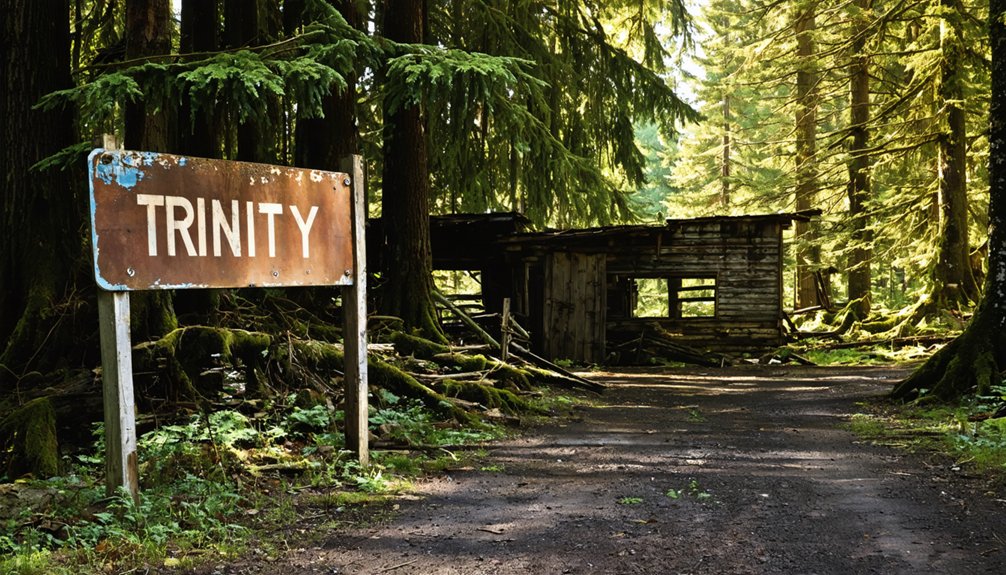
Tucked deep in the Cascades of Chelan County, Washington, Trinity is a former copper mining camp that once hummed with the activity of hundreds of workers but now sits quietly abandoned along Phelps Creek in the remote Chiwawa Basin.
Mining began around 1900, with serious development kicking off between 1914 and 1918 under the Royal Development Company. Workers employed underground mining techniques through roughly 2,500 feet of tunnels to extract copper, silver, and gold.
By the late 1920s, the camp supported up to 275 workers and featured a power plant, mess hall, commissary, and rooming houses.
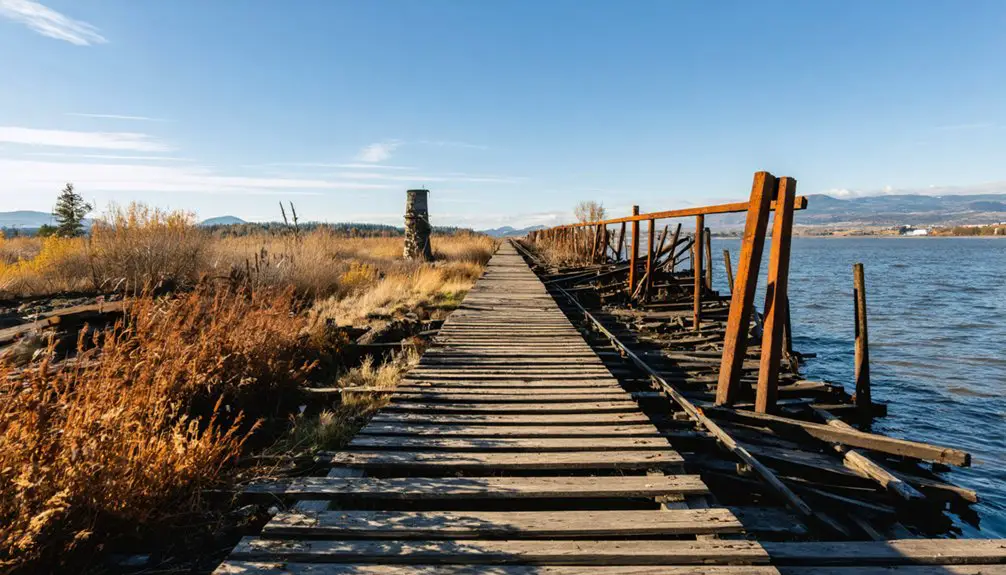
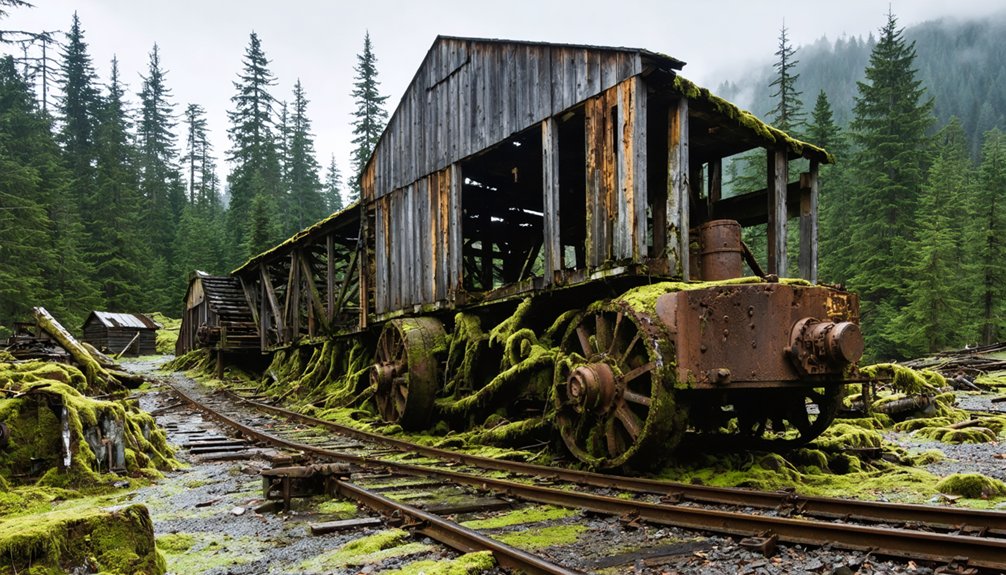
Today, you’ll find scattered historical artifacts like ore carts and narrow-gauge tracks among the few surviving structures.
Economic decline and ore quality issues shut the operation down by 1937 or 1938.
How Trinity’s Copper Mine Shaped the Chiwawa Basin
When the Royal Development Company moved into the Chiwawa Basin in the early 1910s, it didn’t just dig tunnels — it transformed an isolated mountain wilderness into a functioning industrial community. Workers cut roughly 2,500 feet of underground tunnels, hauled copper ore through a dedicated adit, and built a sawmill, power plant, mess hall, and rooming houses to support up to 275 men.
That local mining history reshaped the entire drainage, pushing roads and infrastructure into terrain that had previously seen only prospectors and pack animals. Copper was the economic engine, with silver helping offset costs.
Why Trinity Was Abandoned and When Operations Ended
By the late 1930s, Trinity’s days were numbered — not because of a single catastrophe, but because the ore simply wasn’t worth chasing anymore. Even with advancing mining technology, the copper deposits couldn’t justify the rising operational costs.
Low ore grades, brutal winters, and avalanche-prone terrain made every season a financial gamble.
Production records from 1935 show modest yields — roughly 39,660 pounds of copper and 2,863 ounces of silver — numbers that couldn’t sustain a full workforce.
By 1937 or 1938, operations ceased completely, and the remaining crew slowly cleared out.
What’s left behind fuels ghost town legends that still draw adventurous travelers today. You can almost feel the weight of those final days walking through the ruins — a camp that time and the mountains quietly reclaimed.
What Remains at the Trinity Ghost Town Today?
After the last workers walked away, Trinity didn’t vanish entirely — and that’s part of what makes it worth the trip. You’ll find a landscape layered with historical artifacts and quiet evidence of what once hummed with industrial energy. Preservation efforts remain minimal, so what survives does so mostly on its own terms.
Trinity didn’t vanish when the workers left — what remains endures quietly, entirely on its own terms.
Expect to encounter:
- Powerhouse/generator plant — one of the sturdiest surviving structures still standing on site
- Ore carts and narrow-gauge tracks — raw, tangible historical artifacts scattered across the terrain
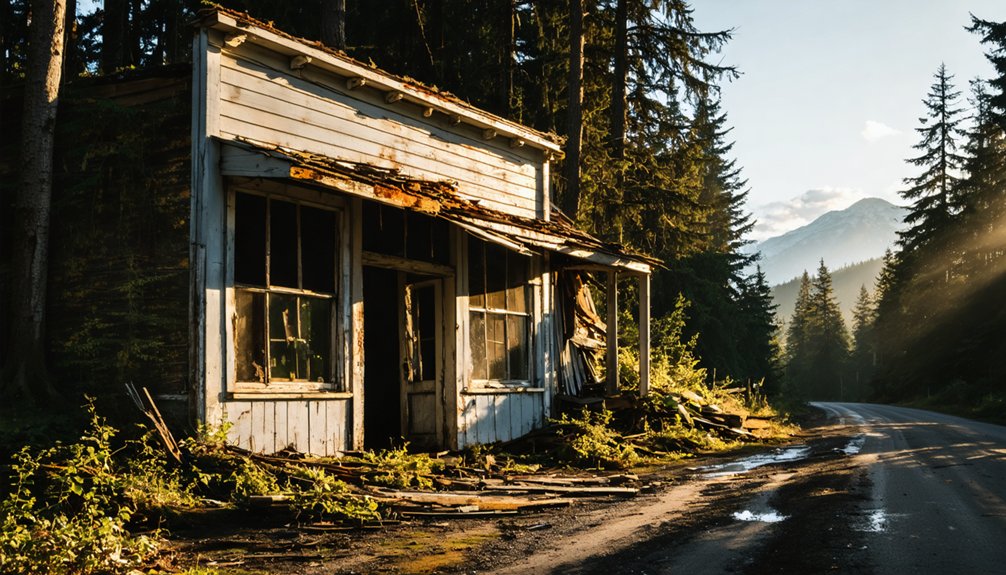
- Scattered cabins and residences — weathered but recognizable remnants of camp life
- Ruins of former infrastructure — foundations and debris where the mess hall, commissary, and sawmill once operated
Snow damage and fire claimed most of the original camp, making every surviving piece feel that much more significant.
Check Public Access Before You Visit Trinity
Before you load up the car and head out to Trinity, you’ll want to confirm whether the site is currently open to the public, since at least one source reports it’s been closed to visitors.
The site sits on private or managed land, so property boundaries may restrict where you can legally walk or photograph.
Seasonal conditions add another layer of complexity, as heavy snowfall and avalanche risk can shut down access roads well into spring.
Current Land Access Status
Since Trinity sits on private or restricted land, you’ll want to confirm public access status before loading up the car.
This former copper camp carries deep mining history and abandoned infrastructure worth exploring, but showing up uninvited could cut your trip short fast.
Before you head out, check these key points:
- Land ownership — Trinity has changed hands multiple times; verify current ownership through county records or the USFS.
- Seasonal closures — Heavy snow and avalanche risk make winter access dangerous or outright impossible.
- Permission requirements — Private land may require written consent before entry.
- Current trail or road conditions — Forest Service roads in the Chiwawa Basin can wash out or remain gated seasonally.
Confirming these details protects your freedom to actually enjoy the visit.
Private Property Boundaries
Trinity’s private property boundaries shift depending on who currently holds the deed, and that ambiguity can turn an exciting backcountry detour into a trespassing citation if you don’t do your homework first.
Land ownership at Trinity has changed multiple times since the mine closed, passing through logging companies, recreational buyers, and private caretakers. Those changes mean posted signs, locked gates, and enforced boundaries can appear without warning.
Before you load the truck, contact Chelan County or the relevant land management agency to confirm current access rights. You’re chasing history, not a legal headache.
A quick phone call or records search clarifies exactly where public land ends and private property begins, keeping your road trip on the right side of the law.
Seasonal Closure Considerations
Snow doesn’t wait for your schedule, and neither do avalanches. Trinity sits deep in the Cascades, where seasonal hazards shut down access fast and without warning. Before you chase mining artifacts through Chiwawa Basin, verify current conditions.
Check these before heading out:
- Road status: The Chiwawa River road closes seasonally; confirm opening dates with Okanogan-Wenatchee National Forest.
- Snow depth: Heavy winter snowpack lingers well into spring, blocking access trails.
- Avalanche risk: Steep terrain surrounding Trinity creates real danger during unstable conditions.
- Public access: At least one source confirms the site has been closed to visitors entirely.
Arriving unprepared wastes your trip and risks your safety. A quick call to the ranger station saves both.
How Do You Get to Trinity in Chelan County?
Reaching Trinity means committing to a serious backcountry drive into the Chiwawa Basin of Chelan County, Washington. You’ll follow the Chiwawa River Road northeast from Lake Wenatchee, winding deeper into the Cascades until pavement gives way to rough forest road.
The final stretch deposits you near Phelps Creek, where Trinity’s remnants quietly wait. Expect washboards, sharp curves, and terrain shaped by decades of forest fires and harsh winters.
Once there, scattered mining equipment — ore carts, narrow-gauge tracks, and powerhouse ruins — rewards the effort. Check current road conditions and public-access status before departing, since closures have been reported.
A high-clearance vehicle is strongly recommended. The remoteness is exactly the point; Trinity doesn’t meet you halfway, and that’s part of its enduring appeal.
When Is the Best Time to Visit Trinity?
Summer gives you the best shot at reaching Trinity, since the remote Cascades terrain stays buried under heavy snow for much of the year.
You’ll want to avoid the winter months entirely, as avalanches and deep snowpack make the roads to Phelps Creek impassable.
Spring might seem tempting, but melting snow turns the backcountry routes into muddy, rutted obstacles that can stop a vehicle cold.
Summer Offers Best Access
Because Trinity sits deep in the Cascades at high elevation, heavy snowpack typically closes off access for much of the year, making summer your most reliable window to visit. From late June through September, you’ll find the most navigable conditions for reaching the site’s abandoned structures and scattered mining equipment.
Plan your trip during this window to make the most of what remains:
- Trails and roads are clearest of snow and debris
- Abandoned structures are fully visible and easier to photograph
- Mining equipment like ore carts and narrow-gauge tracks are accessible
- Daylight hours are longer, giving you more time to explore
Always confirm current access status before heading out, since the site has previously been closed to the public.
Avoid Heavy Snow Months
Trinity’s high-elevation setting in the Cascades means heavy snowpack can shut down access for a significant chunk of the year, so timing your visit matters. Winter and early spring bury the remote Phelps Creek corridor under dangerous accumulations, and avalanches historically disrupted the mining techniques workers relied on here.
Those same avalanches contributed to the camp’s eventual decline, adding weight to local legends about Trinity’s brutal winters defeating even seasoned operators. You’ll want to avoid late October through May, when roads turn impassable and conditions become genuinely hazardous.
Plan your arrival between late June and early September, when snowmelt reveals the remnants of tunnels, ore carts, and narrow-gauge tracks. Confirming current access status before departure keeps your road trip on track.
Spring Brings Muddy Roads
Even after the snowpack retreats, spring doesn’t hand you easy access to Trinity—it trades one obstacle for another. Melting snow saturates the unpaved roads leading into the Chiwawa Basin, turning them into thick mud traps that’ll swallow tires whole. You’ll want to time your arrival carefully.
Watch for these spring-specific challenges:
- Soft road surfaces that shift unpredictably under vehicle weight
- Creek crossings swollen with snowmelt, making fords risky
- Unstable terrain around surviving mining equipment and structures
- Slippery conditions near railroad remnants and narrow-gauge track areas
A high-clearance 4WD vehicle isn’t optional here—it’s essential. Check road conditions through Chelan County before departing, and always confirm current public-access status, since the site has previously been closed to visitors.
What to Pack for a Remote Trinity Ghost Town Day Trip
Since Trinity sits deep in Chelan County’s backcountry with no services, no reliable cell coverage, and terrain that can turn dangerous fast, packing smart isn’t optional — it’s the difference between a great day and a serious emergency. Bring plenty of water, high-calorie snacks, a first-aid kit, and a paper map or downloaded offline route.
For capturing historical artifacts like surviving ore carts, narrow-gauge tracks, and the powerhouse ruins, your photography tips start with gear: pack a wide-angle lens for tight structural shots and a polarizing filter to cut glare off weathered metal.
Sturdy boots handle uneven ground, and layers manage unpredictable mountain weather. A flashlight helps you safely explore darker corners without disturbing fragile remnants of Trinity’s copper-mining past.
Where to Find the Best Photography at Trinity’s Ruins
Once you’re moving through Trinity’s ruins, the powerhouse and generator plant become your anchor subject — the heavy industrial bones of the operation have held up better than most structures, making them ideal for wide compositions that frame collapsed timber against surviving stonework.
Mining folklore and local legends add narrative depth to every frame you capture here. Work these specific spots:
- Ore carts and narrow-gauge tracks for close-up detail shots with strong leading lines
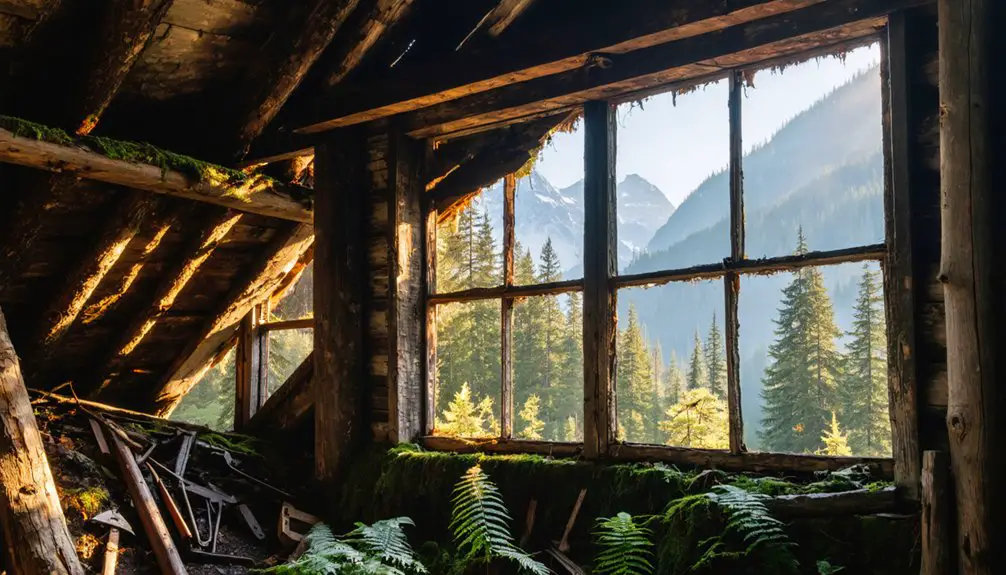
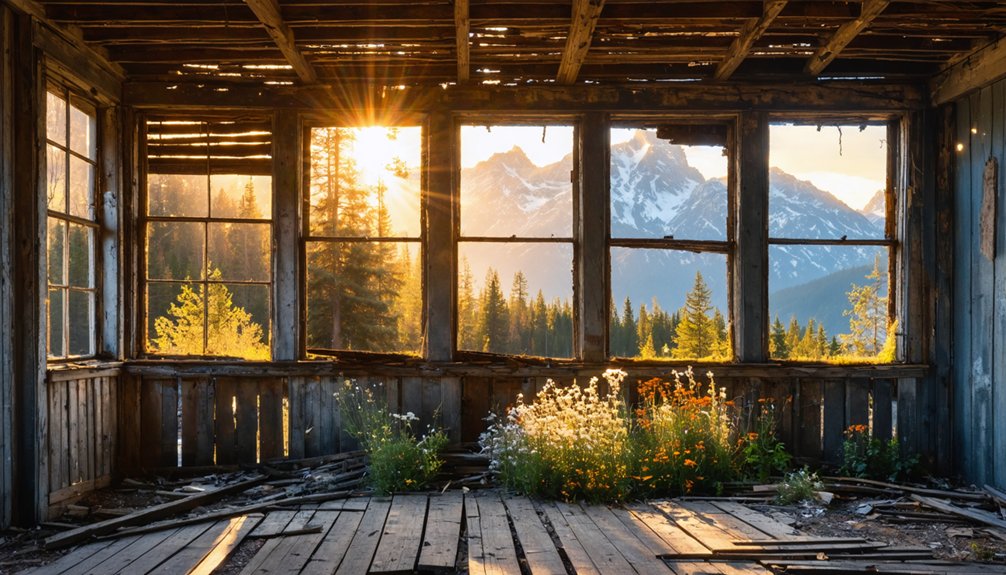
- Roofless cabin interiors where light drops through collapsed ceilings dramatically
- Phelps Creek corridor as a natural foreground element against ruined structures
- Scattered equipment relics that reward macro photography and contextual storytelling
Shoot during golden hour when raking light deepens shadows across weathered wood and rusted metal, revealing textures that flat midday light completely erases.
Other North Cascades Ghost Towns to Add to Your Route
Trinity fits naturally into a broader North Cascades ghost-town circuit, and the surrounding Chiwawa Mining District gives you immediate regional context for additional stops. Extending your route north and west connects you to additional abandoned mining settlements scattered across the range, each shaped by the same brutal historic weather patterns that hampered Trinity’s own operations.
Snow, avalanches, and punishing winters repeatedly stalled production throughout the region, leaving behind a trail of fascinating ruins. As you move between sites, watch for local wildlife — elk, black bear, and mule deer frequent these remote valleys.
Research current access conditions before committing to any stop, since land ownership and road closures shift seasonally. A well-planned multi-site itinerary rewards curiosity and transforms a single ghost-town visit into a genuinely immersive heritage expedition.
Frequently Asked Questions
Was Trinity, Washington Ever Known by a Different Name?
Isn’t it fascinating how places reinvent themselves? The knowledge available doesn’t confirm Trinity ever held a different name. For ghost town tourism and historic preservation enthusiasts like you, Trinity’s identity remains uniquely tied to its mining camp roots.
Did Any Notable Figures or Companies Invest in Trinity’s Mine?
You’ll find the Royal Development Company stands out as a notable investor, driving mining innovations at Trinity around 1914–1918. They’re the primary company that shaped the mine’s copper and silver extraction efforts considerably.
Were Any Workers Ever Injured or Killed at Trinity’s Mine?
You won’t find detailed mine safety records or accident reports for Trinity’s workers, but dangerous conditions—heavy snowfall, avalanches, and underground tunneling—likely made injuries inevitable at this remote, rugged Cascades copper operation.
Did Trinity Have a Post Office or School During Its Operation?
The available records don’t confirm Trinity had a post office or school. You’ll find its historic landmarks centered on industrial infrastructure, making it a unique ghost town tourism destination focused on mining heritage rather than civic community life.
Is the 1972 Caretaker Homicide at Trinity Historically Verified?
Ghost town legends often blur with facts — you can’t confirm the 1972 caretaker homicide through verified historical accuracy. It surfaces only on social media, so treat it cautiously until independent, credible sources back the claim.
References
- https://www.treasurenet.com/threads/trinity-washington-ghost-town.39959/
- https://www.facebook.com/ghosttownsofwashington/posts/trinity-mining-camp-chelan-county-wa-1930trinity-was-built-around-the-extraction/1175790347910711/
- http://ghosttownsusa.com/trinity.htm
- https://en.wikipedia.org/wiki/List_of_ghost_towns_in_Washington
- https://thehillernewspaper.org/6570/news/traveling-through-trinitys-timeline/
- http://gonzopublicrelations.blogspot.com/2011/08/chiwawa-basin-day-1-trinity-mine.html
- https://www.instagram.com/p/DFWZzHyCOo9/
- https://pbase.com/mad_monte1/trinity
- https://stateofwatourism.com/ghost-towns-of-washington-state/
- https://secure2.pbase.com/mad_monte1/ghost_towns_of_the_pacific_northwest