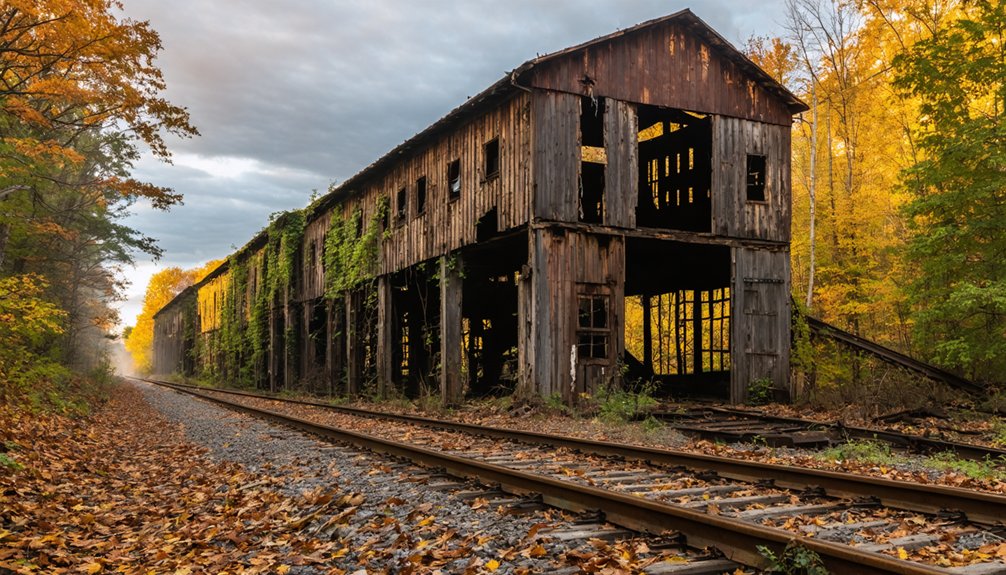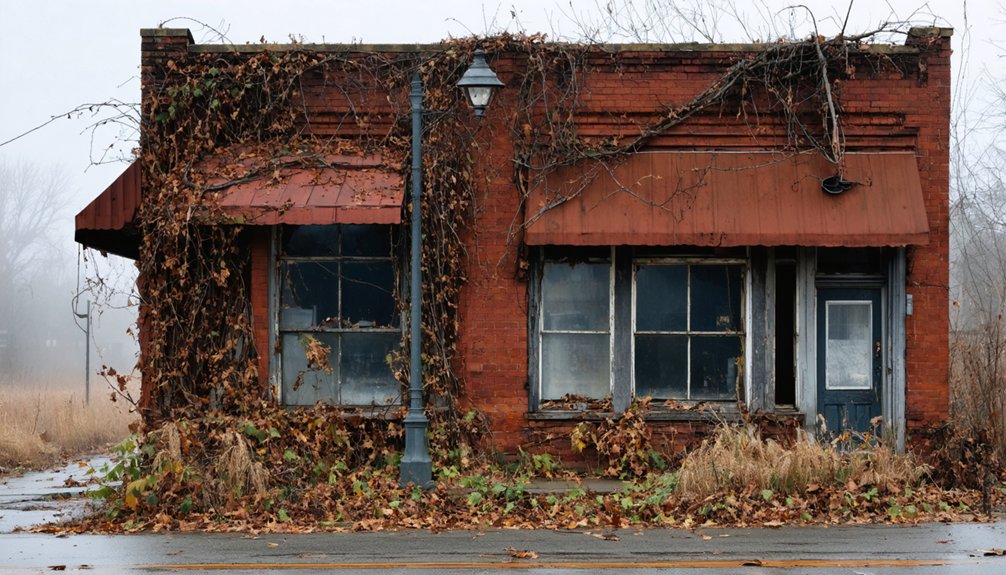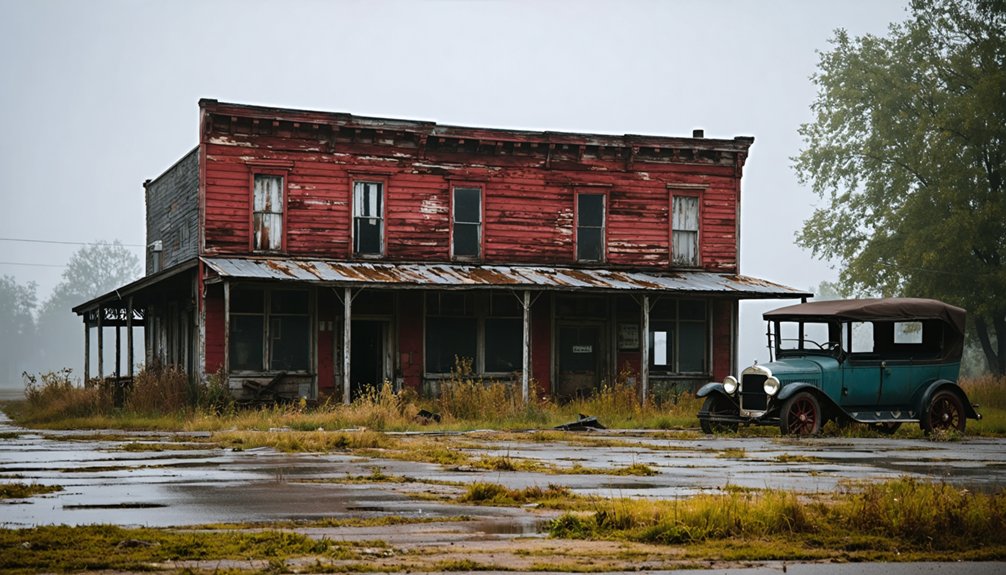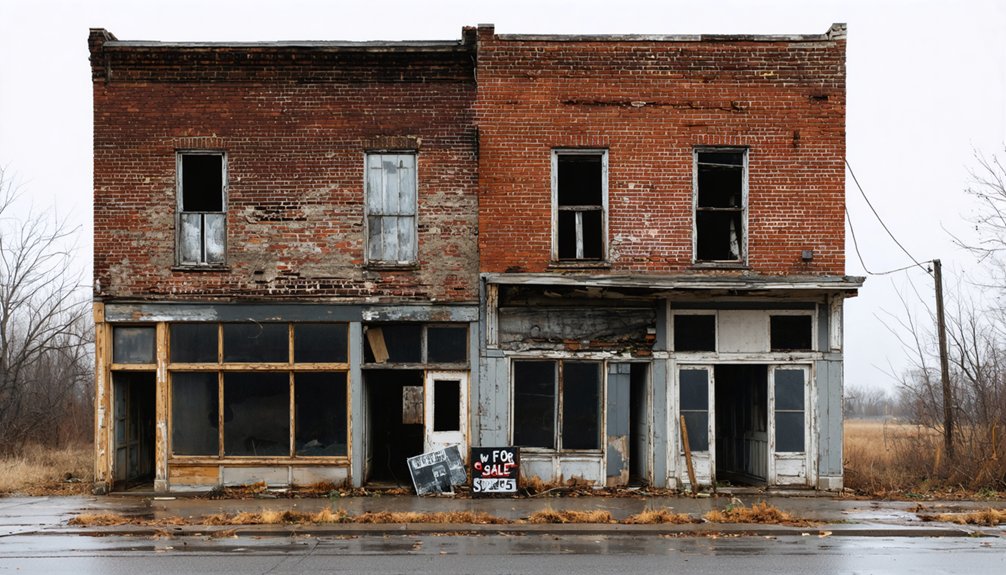
You’ll find Story Inn as Indiana’s only available ghost town, listed at $3.8 million for 14 preserved 19th-century structures across 17.4 acres in Brown County. Established by Dr. George Story in 1851, this National Register Historic District survived the Great Depression and now operates as a destination restaurant and lodging facility. The property includes a 100-seat restaurant, guest accommodations, and original architectural elements, though federal preservation covenants permanently restrict modifications to protect its historical integrity. The sale’s complete terms and revenue potential await your further exploration.
Key Takeaways
- Story Inn, a preserved 19th-century settlement in Brown County, is currently listed for sale at $3.8 million.
- The property includes 14 historic buildings on 17.4 acres with a 100-seat restaurant and guest accommodations.
- Buyers must comply with permanent federal preservation covenants that legally restrict modifications to maintain architectural integrity.
- Indiana has approximately 41 designated ghost towns, though Story Inn is the primary documented example currently available for purchase.
- Revenue opportunities include tourism, event programming, lodging, and dining operations demonstrated by Story Inn’s current business model.
What Defines a Ghost Town in Indiana
When examining Indiana’s landscape, a ghost town emerges as any settlement abandoned by most or all of its residents, leaving behind tangible evidence of its former existence.
You’ll find no universal ghost town criteria applies here—approximately 41 sites collectively lost to Indiana’s history share this designation. These communities require visible remains, from intact structures to foundations and canal remnants.
Understanding abandonment causes helps you identify authentic ghost towns. Economic collapse drives most depopulation—exhausted resources, bypassed railroad lines, or failed agricultural ventures end a town’s viability.
Economic collapse from exhausted resources, bypassed railroads, or failed agriculture transforms thriving communities into abandoned ghost towns across Indiana’s landscape.
You’ll discover Indiana’s small settlements along routes like the MONON railroad faded when transportation patterns shifted. Natural disasters also contributed to abandonment, similar to how flooding from dam construction created ghost towns in other states. Government actions sometimes forced populations to relocate, creating abandoned settlements across the state. Southern Indiana hosts 13 visitable examples, including former canal sites like Millville, where populations dwindled from hundreds to nearly zero, leaving clustered houses and restored infrastructure.
Story Inn: A Preserved 19th Century Settlement
President Millard Fillmore’s 1851 land patent to Dr. George Story established what would become Story’s largest settlement by 1880.
You’ll find the original patent displayed at Story Inn, where preserved 19th century architecture documents Indiana’s frontier expansion. Dr. Story’s timber-harvesting family constructed buildings using local hardwoods—structures that survived when 50% of Brown County’s population fled during the Great Depression.
Between 1929-1933, abandoned homesteads transformed Story into an authentic ghost town. The Schultzes’ 1980s acquisition rescued 23 acres of original settlement, preserving stamped tin ceilings, wooden floors, and globe lighting without modernization. The settlement’s National Register status recognizes its significance as an intact example of 19th century rural architecture.
Today’s Story Inn operates as destination lodging and acclaimed restaurant, representing the Midwest’s best-preserved 19th century villages—accessible yet frozen in time, embodying genuine historical autonomy rather than manufactured nostalgia. The property includes 18 unique rooms and cottages, each reflecting the settlement’s distinct historical character.
The History of Storyville and Dr. George Story
In 1851, President Millard Fillmore issued a land patent to Dr. George P. Story for 173 acres of Indiana wilderness.
The Ohio-born physician transformed this frontier tract into something remarkable. He constructed a home and medical office from local hardwoods—a structure you’ll still find standing today as guest accommodation.
The Storyville origins trace directly to Dr. George’s vision of building community infrastructure. Working alongside his family, he erected additional buildings from abundant domestic timber, attracting settlers seeking both medical care and opportunity. The settlement established its first post office in 1882, marking the community’s official recognition. By the early 1900s, the town thrived with two general stores, a church, and a one-room schoolhouse serving the growing population.
Dr. George’s legacy extends beyond mere bricks and mortar. His original patent document remains on display at Story Inn, a tangible connection to one man’s determination to carve civilization from untamed land on his own terms.
Current Ownership and Preservation Efforts
When you examine Story’s modern stewardship, you’ll find Rick Hofstetter acquired the property in 1978 and maintained its historical integrity through active commercial operation as a hotel and event venue.
The town’s designation as a National Register Historic District formalized protection of its remaining structures, including the general store, inn, and multiple guesthouses across the 17-acre site.
Hofstetter established covenants ensuring future buyers must preserve the mill town’s character, a legal safeguard attached to the $3.8 million listing price in 2019.
Like other abandoned communities, Story serves as a reminder of change and impermanence while its structures continue to deteriorate over time. While Story represents a preserved historical property, many economically depressed areas across the Midwest face vacancy rates exceeding 14%, with median home values falling significantly below statewide averages.
Rick Hofstetter’s Legal Background
Hofstetter’s commitment to architectural integrity shaped every restoration decision across the property.
He leveraged four decades of collective stewardship to maintain authentic 19th-century character while converting structures for modern tourism use.
His current sale requirements reflect unwavering principles: he’s actively rejecting commercial developments that would compromise Story’s historic essence, ensuring only preservation-minded buyers control this settlement’s legacy.
The Indianapolis lawyer purchased the entire town in the early 1990s, establishing himself as Story’s longest-term modern proprietor.
Story’s infrastructure includes a general store, inn, restaurant, cottages, and barns that Hofstetter meticulously restored after acquiring the neglected property.
National Register Historic District
While several Indiana ghost towns carry historical significance, Story Historic District stands alone with formal National Register of Historic Places designation, protecting 17.4 acres that trace back to an 1851 land grant from President Millard Fillmore to Dr. George Story.
You’ll find this mid-1800s settlement evolved from a peak population under 175 residents into a documented case study in historic preservation. The district’s 14 remaining buildings now demonstrate substantial tourism potential, anchored by Story Inn’s operation as a rustic retreat for guests and weddings.
Though the 1909 post office closure and 1920s decline reduced current occupancy to three humans and four dogs, restricted access after Brown County State Park’s 2019 creation hasn’t diminished its appeal as authenticated heritage property with revenue-generating capacity.
Covenant-Protected Future Sale
Since Indianapolis lawyer Rick Hofstetter acquired Story’s 17.4 acres and 14 buildings in 1999, the property’s $3.8 million listing reflects dual mechanisms protecting its 19th-century character while maintaining commercial viability.
Indiana Landmarks’ Exterior Covenant establishes covenant enforcement standards that restrict alterations to architectural features—documented preservation work includes stabilized roofs, chimneys, and foundations across properties the organization rehabilitates before resale.
You’ll find the lease arrangement separating land ownership from Story Inn operations functions like retail tenants in commercial malls, ensuring tourism continues regardless of ownership transfer.
Future developments remain constrained by restoration guidelines while accommodating potential uses including artist residencies or book town concepts.
This framework preserves the remote village’s appeal—marketed as “One Inconvenient Location Since 1851″—without requiring National Register designation.
Buildings and Structures Included in the Sale
At the heart of this Indiana ghost town sale stands the Story Inn General Store, a structure that anchors the property’s collection of 14 historic buildings spread across 17.4 acres.
You’ll find the 100-seat restaurant preserves original wooden floors, globe lighting, and tin ceilings—authentic building features that document 150 years of commercial use.
The Wheeler-Hedrick House showcases Queen Anne architecture, while the Story-Griffitt House dates to 1858, both converted into guest accommodations.
Two historic homes dating from the Victorian era now serve modern guests while maintaining their 19th-century architectural character.
Structural integrity remains evident throughout the sawmill and gristmill operations.
Together, these properties offer 18 overnight rooms across six houses and guest cabins.
The barn and restored outbuildings complete this documented collection, providing you unrestricted ownership of a functioning 19th-century village centered on tourism and wedding operations.
Pricing and Sale Terms for the Property
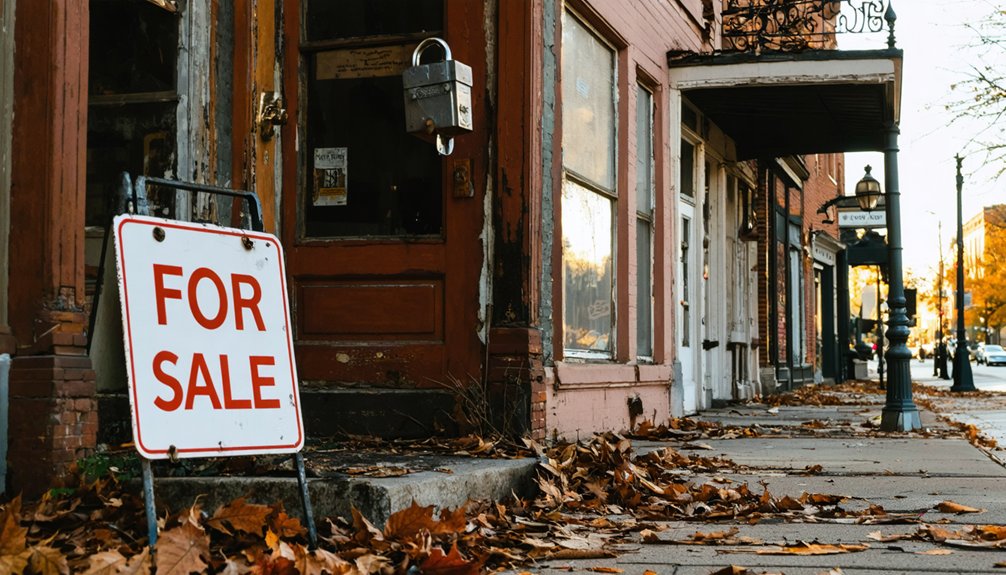
You’ll encounter an asking price of $3.8 million for the 17.4-acre Story Inn property, with per-acre valuation calculated below $220,000.
The sale terms don’t specify whether existing business operations transfer with the real estate transaction or remain separate from the purchase agreement.
Historical preservation restrictions likely apply given the property’s National Register of Historic Places designation, potentially limiting structural modifications or commercial alterations.
8 Million Asking Price
Story, Indiana carries a $3.8 million asking price that reflects its transformation from abandoned settlement to restored historic property.
You’re looking at a significant appreciation from the $65,000 paid in the late 1970s for just 4.5 acres. The current valuation accounts for 17.4 acres, six restored houses, and commercial-grade facilities that support Indiana tourism operations.
The price positions Story competitively against other ghost town sales nationwide.
You’ll find it priced above Bridgeville, California’s $1.2 million and Lajitas, Texas’s $1.8 million, yet below Campo, California’s $6.6 million.
The asking price reflects National Register designation, renovation investments, and established revenue streams from overnight accommodations.
You’re purchasing documented history dating to an 1851 presidential land grant, not merely real estate.
Business Operations Excluded
While Story’s $3.8 million purchase includes all real property and historic structures, the sale specifically excludes the existing business operations that have generated revenue since the property’s restoration.
You’ll acquire the physical assets essential for ghost town preservation, but operational businesses remain separate entities.
The transaction structure protects both parties:
- All buildings, land parcels, and historic structures transfer to you as the buyer
- Current business licenses, contracts, and revenue streams stay with the seller
- You’ll need to establish new operational frameworks for commercial activities
- Existing staff employment agreements don’t automatically transfer with the property
- Historic property investment focuses purely on architectural and land assets
This separation allows you to determine your own vision while preserving Story’s architectural heritage without inherited business obligations or liabilities.
Preservation Covenant Requirements
Before you can finalize the purchase of a ghost town like Story, Indiana, you must understand that historic property acquisitions carry legally binding preservation requirements that extend decades beyond the initial transaction.
Federal preservation covenants attach permanently to your property title when previous owners accepted National Park Service development grants. These restrictions mandate specific maintenance standards based on the original grant amount—ranging from 5 to 15 years of covenant enforcement.
You’ll bear all costs preserving the site’s architectural, historical, and archeological integrity. Indiana’s Department of Historic Preservation and Archaeology reviews any ground disturbance within 100 feet of burial sites, requiring 60-day approval periods.
State-funded alterations demand certificates from the Indiana Historic Preservation Review Board. These preservation challenges represent non-negotiable obligations transferring with ownership.
Restrictive Covenants and Historic Protections
Indiana’s property records reveal layers of restrictive covenants that shaped—and continue to influence—ghost town landscapes across the state.
When you’re evaluating abandoned settlements like Morango or Teleton, you’ll encounter restrictive agreements with both historical significance and modern implications.
Key covenant types affecting ghost town properties:
- Discriminatory covenants from the 1920s-1960s (unenforceable since Shelley v. Kraemer but still appearing in deeds)
- Environmental restrictions under IC 13-22-3-3 for contaminated or regulated lands
- Neighbor maintenance rights triggered by vacant properties under blight statutes
- Informal historic protections at Underground Railroad sites
- Common law restrictions binding successors through recorded instruments
Under P.L.20-2021, you can invalidate discriminatory provisions.
Environmental covenants remain binding indefinitely, potentially restricting development on former industrial ghost town sites.
Revenue Opportunities From Tourism and Events
How might abandoned settlements generate sustainable revenue streams beyond traditional real estate transactions?
You’ll find documented evidence in Pennsylvania’s Ghost Town Trail, which produces $1.7 million annually through trail-based accommodations and food services from 75,557 visitors.
Tourism revenue flows from strategic infrastructure development—trailhead access points distribute spending across regional communities rather than concentrating economic activity.
Indiana’s 41 ghost towns offer comparable potential through heritage site programming.
You can implement event programming like haunted tours, historical reenactments, and storytelling experiences that capitalize on documented paranormal tourism demand.
Seasonal calendars coordinate multi-site touring packages, transforming isolated properties into interconnected circuits.
This model demonstrates economic diversification for rural areas while preserving authentic historical narratives—freedom from single-use development constraints creates lasting value.
Finding the Right Buyer for Historic Preservation

When you’re positioning a ghost town property for preservation-focused acquisition, documented organizational frameworks separate viable transactions from failed transfers.
Indiana Landmarks and similar entities demonstrate proven buyer outreach strategies through covenant-protected sales that return properties to tax rolls while maintaining architectural integrity.
Your preservation funding success depends on attracting qualified purchasers who’ll complete restoration work.
Strategic buyer identification requires:
- Platform utilization: Zillow and specialized real estate channels reach preservation-minded investors
- Covenant documentation: Legal agreements ensuring historic character compliance throughout renovation
- Title protection: Established insurance companies mitigating quitclaim deed risks from tax sales
- Pre-sale restoration: Completed exterior work demonstrating property viability and reducing buyer burden
- Partnership leverage: Municipal collaborations accessing estate holdings and distressed property inventories
You’ll maximize transaction success by implementing structured transfer processes proven across Wabash, Bedford, and South Bend projects.
Frequently Asked Questions
What Are the Property Taxes for Owning a Historic Ghost Town in Indiana?
Your property assessments face a 2% constitutional cap on gross assessed value, though maneuvering tax exemptions requires documenting the ghost town’s historical classification—homestead status reveals phased deductions reaching 33.4% by 2030.
Can New Buildings Be Constructed on the Story Inn Property?
Yes, you can construct new buildings on Story Inn property, but you’ll need compliance with Brown County’s zoning regulations and obtain required building permits through the Area Plan Commission’s development review process.
Are There Financing Options Specifically Available for Historic Property Purchases?
Yes, you’ll find historic preservation financing options including Indiana Landmarks’ low-interest loans up to $100,000, HUD 203(k) rehabilitation mortgages, and Fannie Mae HomeStyle Renovation loans that bundle purchase and restoration costs together.
What Ongoing Maintenance Costs Should Buyers Expect for 19th-Century Buildings?
You’ll face substantial restoration expenses including cyclical roof inspections every 5-10 years, masonry repairs averaging $75,000-$250,000, and HVAC system replacements costing $100,000-$300,000, with preservation challenges requiring ongoing assessment investments.
Is the Population Allowed to Increase Beyond Current Residents and Visitors?
You’ll find population growth isn’t restricted by ghost town status—zoning regulations and municipal planning codes determine development capacity. Historical records show these communities once thrived before decline, and they’re legally eligible for revitalization under current Indiana statutes.
References
- https://money.com/indiana-town-for-sale/
- https://www.mentalfloss.com/article/579398/entire-town-of-story-indiana-for-sale
- https://www.atlasobscura.com/articles/story-indiana-for-sale
- https://www.wfyi.org/news/articles/historic-town-of-story-for-sale
- https://www.ezhomesearch.com/blog/towns-for-sale-in-the-usa/
- https://toptenrealestatedeals.com/weekly-ten-best-home-deals/home/indiana-small-town-for-sale
- https://abc11.com/post/small-town-of-story-indiana-up-for-sale/5375390/
- https://www.youtube.com/watch?v=7TC6DtgcvJs
- https://en.wikipedia.org/wiki/Ghost_town
- https://westernmininghistory.com/664/what-is-a-ghost-town-wmh-town-classifications-explained/