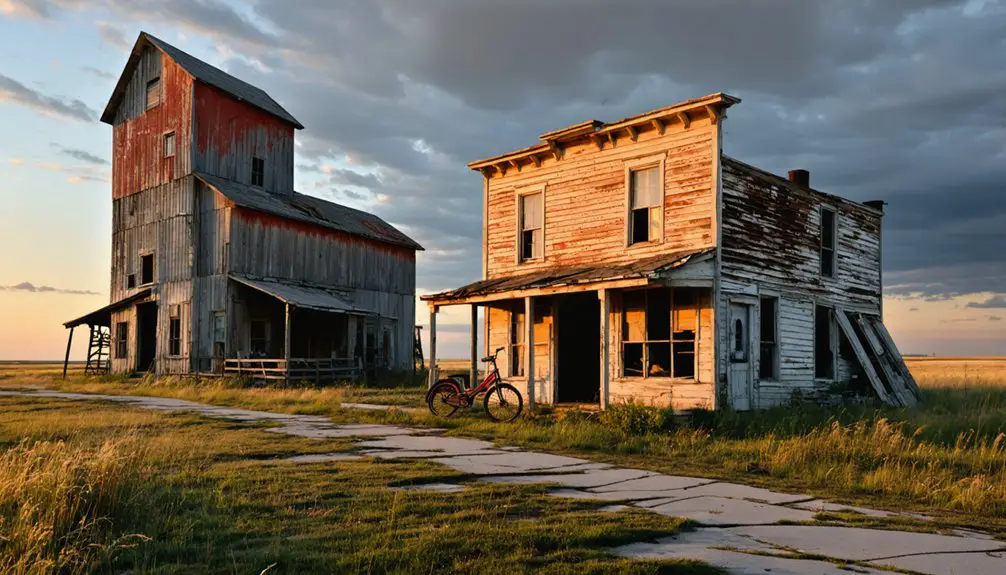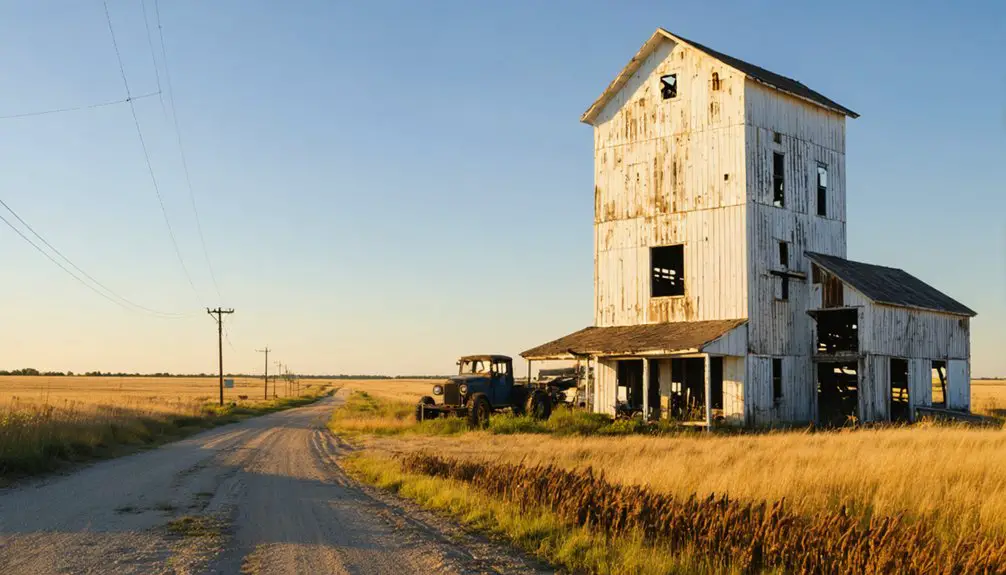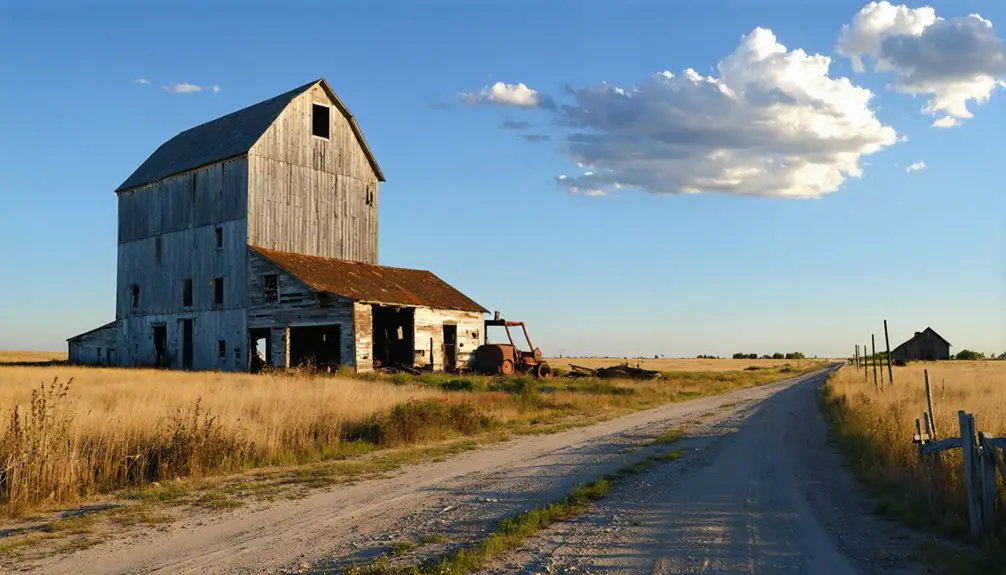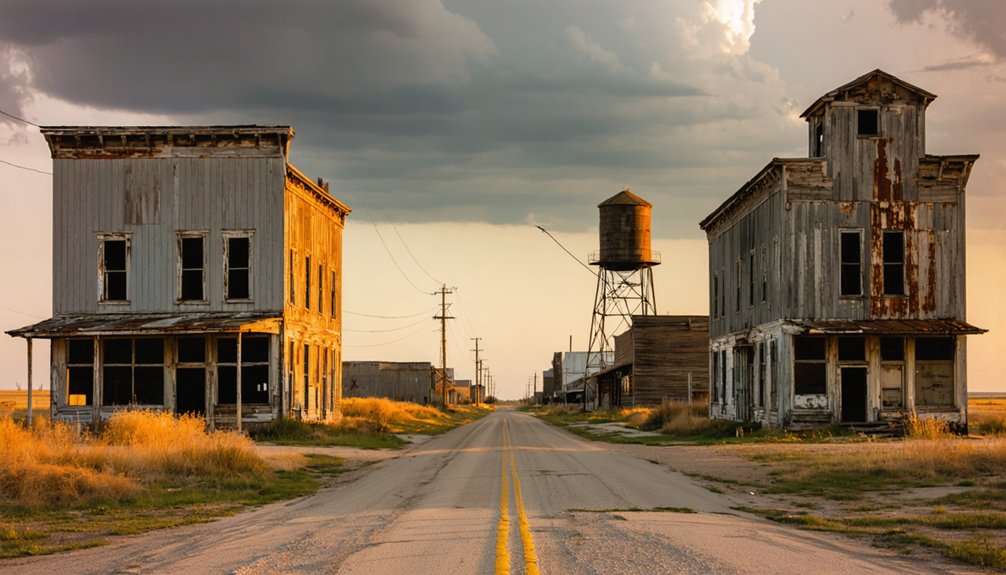
You’ll find several ghost towns available for purchase in North Dakota, with prices typically ranging from $250,000 to $650,000. These properties include deeded acreage, standing structures, and infrastructure remnants like grain elevators from settlements abandoned during the Depression and Dust Bowl era. North Dakota’s 3,000+ documented settlements offer quantifiable investment opportunities, with per-acre costs averaging $64,484. Properties near the South Dakota border, including sites with commercial buildings and original fixtures, attract international buyer interest—though renovation costs and market viability warrant careful analysis of the financial commitments involved.
Key Takeaways
- North Dakota has over 3,000 documented ghost town settlements available for acquisition, including deeded land, structures, and infrastructure remnants.
- Ghost town properties average $650,000 with per-acre costs around $64,484, featuring authentic prairie architecture and historical significance.
- Notable listings include properties near the Nebraska border with taverns, structures, and acreage previously listed between $250,000 and $399,000.
- Towns like Charbonneau and Brisbane offer grain elevators and foundations for sale, attracting international buyers from China, Russia, and Australia.
- Investment opportunities include tourism ventures and cultural events, though challenges involve renovation costs, infrastructure upgrades, and extreme isolation.
Understanding the Ghost Town Phenomenon in North Dakota
North Dakota’s ghost town landscape represents a tangible asset class born from one of America’s most dramatic boom-bust cycles.
You’re looking at over 3,000 documented settlements where abandonment trends followed predictable economic patterns: railroad expansion created speculative communities in the 1880s-1910s, agricultural promises drove peak populations by 1920, then Depression-era collapse and Dust Bowl devastation triggered mass exodus.
The historical significance translates directly into acquisition opportunities—these aren’t romanticized ruins but quantifiable properties with deeded land, standing structures, and infrastructure remnants.
Towns like Charbonneau and Brisbane retain grain elevators and foundations you can purchase.
Understanding this cycle means recognizing that government intervention (Homestead Act, Garrison Dam) created then destroyed settlement patterns, leaving behind real estate priced at fractions of developed land costs.
Some settlements like Sully Springs vanished so completely that no physical remnants exist today, with only historical records proving the town’s existence.
Highway 200 provides access to numerous abandoned sites across over 400 miles of North Dakota’s longest state highway, connecting multiple ghost town properties.
You’re evaluating century-old investments that failed their original stakeholders but offer modern repositioning potential.
Omemee: A Once-Thriving Community That Disappeared
When railroad companies platted Omemee in Bottineau County’s Willow Vale area in 1887, they created what would become a textbook case of speculative settlement failure—a dual-junction hub that peaked at 650 residents in 1906 yet couldn’t sustain viability beyond four years.
The Omemee history demonstrates how railroad impact alone couldn’t guarantee economic sustainability. Despite Great Northern Railroad’s 1893 depot and Soo Line’s 1905 junction creating infrastructure supporting grain elevators, opera house, hotel, and The Omemee Herald newspaper, population collapsed by 1910.
The town gradually emptied over decades until bulldozers demolished remaining structures between 2010-2013. You’ll find virtually nothing today—just archaeological remnants where entrepreneurs once operated banks, blacksmith shops, and restaurants. The few surviving structures are constructed from fieldstone, standing as silent monuments to the town’s former prosperity. Only a couple of buildings remain hauntingly empty at the site.
A questionable 2005 lot sale attempt failed, confirming market recognition that infrastructure without sustainable economic drivers creates worthless assets.
Boom Towns Along the Dam: Big Bend and Silver City
Big Bend’s founder staked lots for a clothing store, barber shop, pool hall, drug store, and even a Landstrom Jewelry Store—converting grain bins into profit-generating businesses that served thousands of dam workers.
At its peak in 1953, Steve’s bar alone employed seven bartenders and four waitresses, demonstrating the economic density these boom towns achieved during construction.
While Big Bend and Silver City have largely vanished, federally-built Riverdale survived with its red brick houses and paved infrastructure, proving that government-backed planning created lasting value where speculative ventures couldn’t sustain beyond the construction payroll. The construction of the dam led to the emergence of boom towns like Dakota City and American City in 1945-1946 to accommodate workers alongside Silver City. The Garrison Dam construction in 1946 triggered this wave of speculative development that transformed the North Dakota landscape.
Big Bend’s Business Plans
As construction crews mobilized for the Big Bend Dam project in 1959, enterprising developers recognized an immediate market opportunity: housing and servicing a peak workforce of 1,300 laborers who’d need accommodations, supplies, and entertainment throughout the multi-year build.
The Big Bend boom town emerged with strategic business models centered on construction’s seven-year timeline—from 1959 groundbreaking through the 1966 formal dedication.
Smart investors calculated returns based on guaranteed demand: workers required housing, groceries, equipment, fuel, and recreation facilities. The economic impact rippled through south central South Dakota as businesses capitalized on steady federal payroll dollars flowing into the region.
The dam’s two-mile-long embankment would eventually create Lake Sharpe, an 80-mile reservoir that transformed the landscape and river ecology.
Savvy operators knew their window closed when the last generating unit went operational in July 1966, making every investment decision time-sensitive and profitability-focused during this infrastructure gold rush. While most ventures succeeded during the construction boom, some business owners faced access restrictions when attempting to secure additional permits or expand operations beyond their original scope.
Riverdale’s Survival Story
While Big Bend’s developers bet on a seven-year construction window, federal planners building Garrison Dam took a fundamentally different approach to worker housing that created lasting value.
Between 1946 and 1950, they constructed Riverdale with red brick houses on paved, curved roads—infrastructure built to last beyond the 2,300-man workforce’s temporary needs.
This Federal planning created what speculative developers couldn’t: permanent equity. Riverdale’s resilience stems from durable construction and strategic location on bluffs overlooking Lake Sakakawea, 60 miles south of Minot.
You’ll find it’s North Dakota’s only incorporated boom town survivor from that era, while Big Bend and Silver City became ghost towns.
The market spoke clearly—quality infrastructure and ownership freedom transformed temporary worker housing into a viable community that’s thrived 75+ years. Unlike the damming of the Missouri River that forced Elbowoods’ abandonment, Riverdale’s elevated position turned the reservoir into an asset rather than a threat.
The contrast is stark when you consider railroad towns like Balfur, which once boasted 500 residents along the Sooline between Carrington and Minot, now sits largely abandoned with only remnants of churches and schools marking where Main Street businesses once thrived.
Swett, South Dakota: A Ghost Town Near the North Dakota Border
Swett, South Dakota sits just 2.5 hours southeast of Rapid City on 6.16 acres that shifted from a $399,000 listing in 2014 to a reduced $250,000 price after cleanup.
You’ll find a property portfolio that included Swett Tavern, a haunted house, an auto body shop, and three trailers before Lance Benson lost it to foreclosure in 2014.
The town’s proximity to the North Dakota border positions it within a regional market that’s drawn international buyer interest from China, Russia, and Australia despite its evolution from 40-resident settlement to commercial development.
Property Features and Inclusions
Though ghost towns rarely come turnkey, this 6.16-acre property in Swett offers buyers a cleaned-up site with two primary structures that determine its baseline value.
You’ll find an empty house with haunted properties reputation and the defunct Swett Tavern, which retains potential liquor licensing opportunities.
The Nebraska bank that acquired this tract invested in substantial cleanup efforts, removing three decaying mobile homes and an aging transport truck that previously diminished market appeal.
This preparation work positions the property for off grid living ventures or unconventional development projects.
The site’s ghost town status and paranormal reputation create niche marketing angles for buyers targeting reality show filming locations or tourism-based revenue models.
You’re purchasing improved land with structural assets, not raw acreage requiring extensive remediation.
Ownership and Sales History
The property’s value proposition becomes clearer when you examine Swett’s ownership timeline, which reveals patterns of financial distress and market repositioning that directly impact current pricing.
Lance Benson’s ownership changes demonstrate classic ghost town dynamics—he purchased the entire settlement in 1998, lost it through divorce, reacquired it in 2012, then faced foreclosure.
The listing history tells you everything about market reality:
- Initial June 2014 asking price: $399,000
- Generated international interest from China, Russia, Australia
- Price slashed to $250,000 by 2015 after bank cleanup
- Multiple offers fell through despite off-grid enthusiast attention
You’re looking at a property where financial pressures consistently forced downward price adjustments.
No confirmed sale materialized from either listing period, signaling fundamental valuation disconnect between seller expectations and buyer willingness.
Pricing and Location Details
At $250,000, you’re paying approximately the national average home price for 6.6 acres of remote South Dakota prairie with multiple structures—a pricing anomaly that reflects both the property’s extreme isolation and its distressed sale history.
The ghost town pricing dropped from $399,999 after failed offers, revealing market resistance to Bennett County’s extreme remoteness. You’ll find yourself four hours west of Sioux Falls and two hours southeast of Rapid City—123 miles from any substantial services.
The location significance centers on South Dakota’s unincorporated pheasant-hunting territory near the Nebraska border, where fewer than a handful of residents remain from a peak population of 40.
This valuation accounts for multiple buildings including Swett Tavern, but factors in the liquor license discontinuation and complete infrastructure absence.
What’s Included When You Buy a Ghost Town
When evaluating a ghost town purchase, you’re typically acquiring more than bare land—most listings bundle structures, acreage, and fixtures into a single transaction.
North Dakota’s unrestricted parcels average $64,484 per acre, with ghost town amenities varying by property condition and historical preservation status.
Per-acre pricing in North Dakota reflects unregulated land status, while ghost town valuations depend on structural integrity and historical designation requirements.
Standard acquisitions include:
- Original structures featuring authentic prairie architecture from late 1800s mining-era establishments
- Operational buildings like renovated churches (under $50,000), workshops, and garages with wood-burning fireplaces
- Multi-acre parcels ranging from 6 to 6.6 acres with unincorporated hamlet designations
- Additional fixtures including trailers, antique furnishings, and crushed rock brick foundations
You’ll encounter properties spanning depleted mining communities with remnant saloons and general stores to functional hotels.
Some listings face foreclosure history, offering acquisition opportunities below market rates for those seeking unrestricted development potential.
The Price of Owning History: Investment Considerations
Beyond structural inventories and property boundaries, ownership demands careful financial analysis across multiple cost categories. North Dakota ghost towns average $650,000, with per-acre costs hitting $64,484.
However, renovation costs escalate quickly—structures predating safety codes require extensive compliance upgrades, while absent utilities demand full infrastructure installation. The $50,000 c.1919 church listing illustrates entry points, but restoration expenses typically exceed purchase prices.
Investment risks include market volatility demonstrated by properties languishing unsold for years. Price fluctuations reveal uncertain demand—comparable towns sold between $800,000-$1.15 million based on acreage and building counts.
Revenue potential exists through tourist attractions, film locations, and historical tourism, yet proximity to amenities remains critical. Properties 123+ miles from major cities face accessibility challenges affecting long-term viability and exit strategies.
Comparable Ghost Town Sales Across the Region
Recent ghost town transactions reveal volatile pricing patterns that directly impact North Dakota investment strategies.
You’ll find regional comparables ranging from Swett, South Dakota’s $250,000 reduction after market resistance to Arizona’s Villa commanding $1.95 million for its 62-acre movie set infrastructure. These valuations hinge on ghost town tourism potential and property restoration costs.
Consider these market indicators:
- Bridgeville, California’s $1.25 million sale collapsed due to improvement challenges, remaining unsold since 2007
- Henry River Mill Village parcels fetch $800,000-$1.15 million based on building count and Hunger Games recognition
- Montana’s Frontier Town sold in 2025 with modern amenities commanding premium pricing
- Swett’s 37% price cut demonstrates market skepticism toward remote properties
Your acquisition strategy demands rigorous due diligence on restoration expenses versus projected revenue streams.
How to Purchase Ghost Town Properties in the Dakotas
Acquiring ghost town properties in the Dakotas demands a methodical approach that begins with verifying legal ownership through county recorder offices. You’ll need to confirm clear title chains, especially for foreclosed parcels like Swett’s $250,000 listing.
Cash purchases dominate this market, though USDA rural development loans provide financing alternatives for qualified buyers. Your due diligence must include zoning verification for commercial conversions and structural assessments of century-old buildings.
Properties range from individual structures—like North Dakota’s $50,000 Saint Paul Lutheran Church—to complete ghost town packages spanning 6.6 acres. Expect to document proof of funds and navigate liquor license reapplications for tavern structures.
Post-acquisition, you’ll face permit requirements for modern amenities, but community revival potential remains significant with authentic prairie architecture positioned for tourism development.
Frequently Asked Questions
Are There Property Taxes on Ghost Town Land in North Dakota?
Yes, you’ll pay property taxes on ghost town land unless you qualify for tax exemptions. All North Dakota property undergoes assessment and taxation by default. The $1,600 Primary Residence Credit won’t eliminate your obligation on vacant land.
Can Ghost Towns Be Rezoned for Residential or Commercial Development?
Like a phoenix rising, you can rezone ghost towns, but rezoning challenges demand thorough plans and compliance with county or township regulations. Development potential hinges on proving compatibility, meeting setbacks, and steering multi-jurisdiction approval processes affecting property valuations.
What Utilities Are Typically Available in Abandoned North Dakota Towns?
You’ll find virtually no utilities in North Dakota’s abandoned towns—electricity access is nonexistent without poles or lines, water supply infrastructure has vanished or sits submerged, and heating costs index at 109 where any services barely survive.
Do Ghost Town Purchases Include Mineral Rights Beneath the Property?
Striking gold isn’t guaranteed—your land acquisition typically won’t include mineral ownership unless explicitly stated. North Dakota’s severance history means you’ll likely purchase surface rights only, requiring separate verification of subsurface asset control for complete valuation.
Are There Environmental Cleanup Requirements Before Purchasing Ghost Town Properties?
You’re not legally required to conduct environmental assessments before purchasing, but they’re financially prudent. Undiscovered contamination creates liability exposure and cleanup costs that’ll directly impact your property’s value and development potential.
References
- https://www.smithsonianmag.com/smart-news/sale-haunted-ghost-town-180957430/
- https://www.10news.com/ghost-towns-sale-us/
- https://news.prairiepublic.org/show/dakota-datebook-archive/2022-05-18/ghost-town-boom-towns
- https://cool987fm.com/any-ghost-towns-near-bismarck-nd-must-have-plenty/
- https://boingboing.net/2015/12/02/grim-looking-abandoned-commun.html
- https://fortune.com/2015/12/01/abandoned-south-dakota-town/
- https://www.atlasobscura.com/places/scenic-ghost-town
- https://www.oldhousedreams.com/state/north-dakota/
- https://prairieroserealty.com/properties
- https://everafterinthewoods.com/these-forgotten-ghost-towns-in-north-dakota-are-eerily-fascinating/