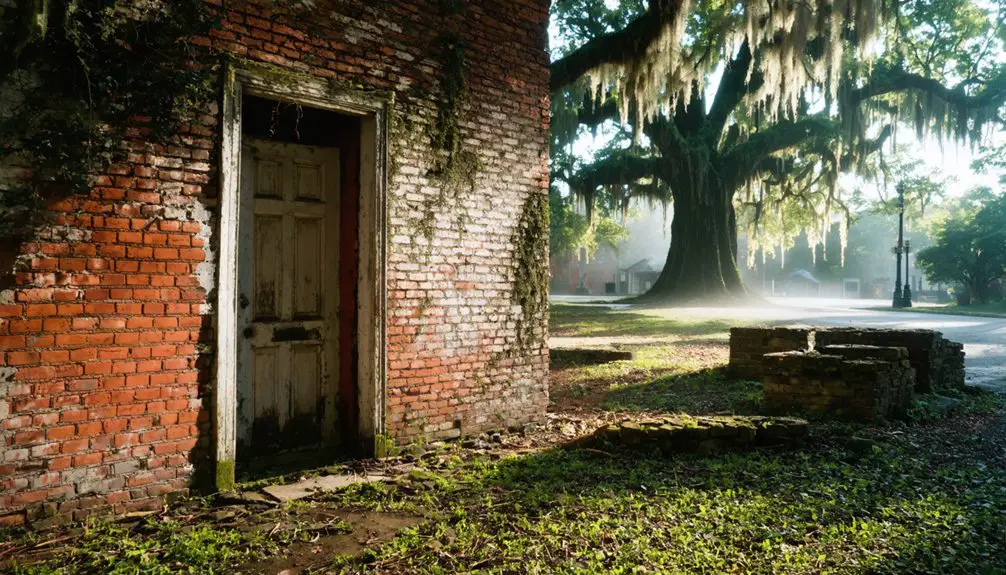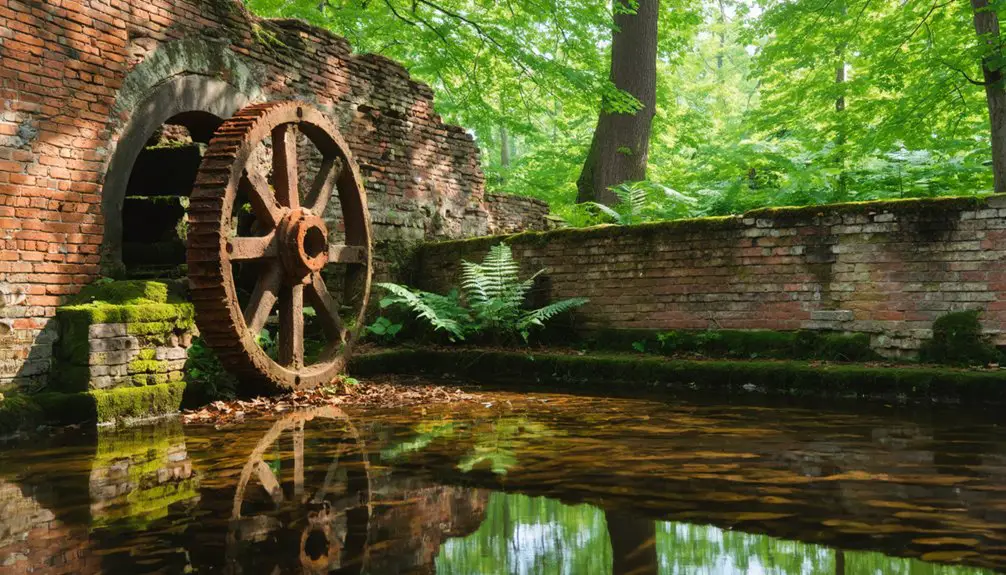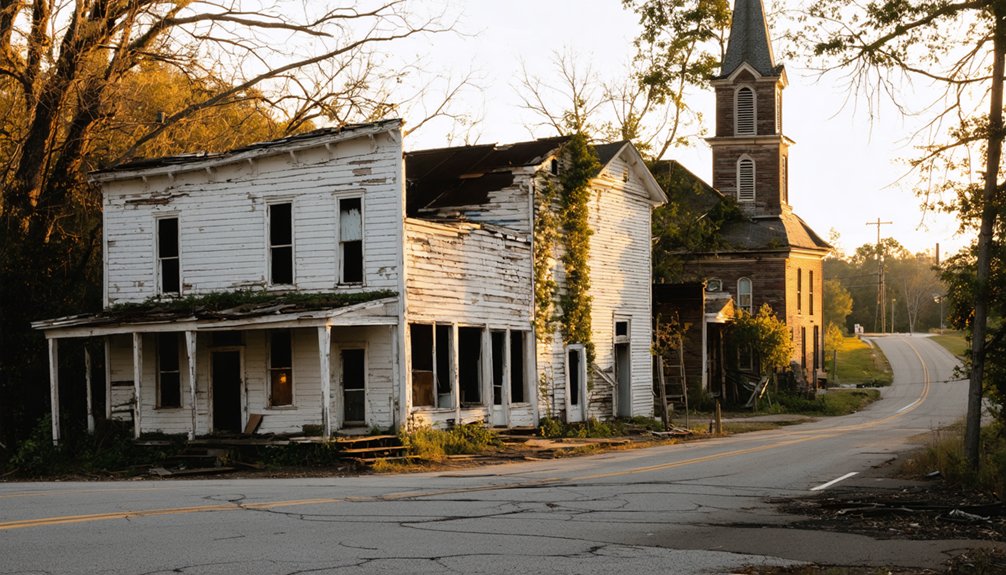
You won’t find complete ghost towns listed for sale in Virginia as of 2026, despite the state’s nearly twenty documented abandoned settlements dating back to 1611. Instead, you’ll discover 67 distressed properties averaging $273,942—well below Virginia’s $404,963 median home value. These historic sites, including remnants of mining communities like Pocahontas and tobacco settlements like Union Level, require maneuvering through complex zoning regulations, restoration challenges, and 30-year abandonment statutes. The complete investment landscape reveals surprising opportunities beyond traditional ghost town purchases.
Key Takeaways
- No complete ghost towns are currently listed for sale in Virginia as of 2026.
- Virginia offers 67 distressed properties averaging $273,942, well below the state’s average home value of $404,963.
- Historic properties range from $45,000 handyman specials to $699,000 estates, with most listed below $200,000.
- Ghost town investments face restoration costs, zoning regulations, limited utilities, and environmental concerns requiring careful evaluation.
- Valuation factors include historical significance, property size, and restoration potential, ranging from $99,000 to $22.5 million.
Understanding Virginia’s Ghost Town Landscape
While most travelers flock to Virginia’s celebrated colonial landmarks, the Commonwealth’s landscape harbors nearly twenty abandoned settlements that tell stories of economic collapse, resource depletion, and cultural transformation.
These ghost town origins stretch back to 1611’s Henricus—destroyed during the 1622 Indian Massacre—through 1688’s Brent Town, to gold mining communities like Gold Hill and coal-powered Pocahontas.
You’ll discover their cultural significance reflects Virginia’s 400-year evolution: tobacco agriculture’s decline, depleted mining operations, and shifting transportation routes that left once-thriving communities empty.
From Lignite’s exhausted resources to Ca Ira’s economic fade, each site preserves tangible evidence of America’s industrial past.
Sites like Pocahontas retain crumbling buildings with ornate facades, offering direct connections to forgotten eras beyond sanitized historical narratives. Many of these settlements originally developed along rivers and canals that served as vital commercial arteries before modern highways redirected trade. Though Virginia’s ghost towns differ vastly from Nevada’s Virginia City—which achieved National Historic Landmark status in 1961 through active preservation—both illustrate how mining communities transform from boom to abandonment.
Union Level: A Tobacco Fortune Relic Near the North Carolina Border
- Southern Railroad’s arrival sparked commerce, sustaining over 20 businesses including Bank of Union Level (founded 1915)
- C.P. Jones’s Rexall Drug Store and Luther W. Lett’s Esso-equipped general store anchored Saturday trading
- Great Depression devastation closed the bank permanently
- Eight abandoned storefronts remain as Virginia’s most photographed ghost town
- Post office closure in the 1990s marked final commercial surrender
- James Bridgeforth served as first postmaster in 1836
- Zion Methodist Church, founded in 1805, predates the town’s commercial era
You’ll find this relic near North Carolina’s border, frozen in agricultural memory.
Current Market Availability of Ghost Towns in Virginia
Union Level’s protected status reflects a broader reality across Virginia’s ghost town landscape: you won’t find entire abandoned communities listed for sale in the Commonwealth.
Unlike western states where Nevada and Colorado towns appear regularly on the market, Virginia’s real estate databases show zero complete ghost towns available as of 2026.
The ghost town economics that drive western sales—bundled historic structures with investment potential—simply don’t exist here. Instead, you’ll encounter 67 distressed properties averaging $273,942 and 166 Victorian homes priced from $214,000 upward.
Preservation challenges have pushed Virginia’s focus toward individual historic structures rather than full town packages. While Markham village sold previously for $3.5 million, such opportunities remain exceptionally rare east of the Mississippi, where historic properties sell separately rather than as cohesive communities.
Buyers should research state zoning laws and county regulations thoroughly before pursuing any Virginia property, as restrictions may significantly limit development options.
Prospective buyers should verify all property details directly with listing agents, as real estate databases update daily but cannot guarantee complete accuracy of available inventory.
Pricing Expectations for Abandoned Communities and Historic Properties
You’ll find ghost town property valuations in Virginia markedly undercut the state’s $404,963 average home value, with most historic settlements and distressed properties listing below $200,000 compared to Northern Virginia’s $600,000-plus median prices.
Comparable ghost town markets like Virginia City, Nevada demonstrate median listings around $198,250, though exceptional estates with considerable acreage can reach $2.4 million.
These depressed valuations reflect limited infrastructure and amenities, positioning Virginia’s abandoned communities as accessible entry points for preservation investors seeking alternatives to metropolitan markets where Arlington properties command $805,000 and Fairfax County averages $750,000. Affordable housing options remain concentrated in outlying areas like Culpeper, Spotsylvania, and Winchester, where properties in the $400k-$500k range provide alternatives to ghost town purchases for budget-conscious buyers.
North-central Virginia’s median price is projected to reach $505,980 with a 1.5% increase in 2026, further widening the gap between conventional suburban properties and distressed historic settlements.
Typical Ghost Town Valuations
Ghost town valuations span a remarkable spectrum, with properties ranging from $99,000 for a 62-acre California desert parcel abutting Cerro Gordo to $22.5 million for Eagle Mountain’s sprawling California site sold in April 2023.
You’ll find median pricing around $425,000 as of September 2025, though valuation factors vary dramatically based on acreage, location, and infrastructure condition.
Price determinants you’ll encounter:
- Historical significance through preserved mining buildings and authentic remnants
- Property size: 6-acre Swett, South Dakota at $250,000 versus 305-acre Colorado mountain properties near $925,000
- Restoration potential with existing amenities versus complete reconstruction needs
- Geographic premium in desirable states like California, Arizona, and Colorado
- Hidden costs including environmental remediation and infrastructure repair
Fixer-uppers typically command $200,000 median prices, offering substantial freedom for creative restoration projects.
Water Valley, Tennessee’s seven-acre property with four general stores from before 1900 listed at $725,000 demonstrates how historical building inventory impacts valuation in this specialized market. Some properties offer unique revenue opportunities, with Silverton’s Blair Street location commanding $1,600,000 for a tourist-friendly operation featuring a gift shop, art gallery, and gold-panning experience.
Virginia’s Distressed Property Costs
Virginia’s distressed property market presents distinctly different economics than Western ghost towns, with 68 abandoned and neglected properties averaging $273,942—substantially below the national ghost town median of $425,000.
You’ll find acreage costs averaging $27,678, making land acquisition accessible for distressed property renovations. Properties range from $45,000 handyman specials to $699,000 historic estates like the Gray Ghost birthplace, offering diverse entry points.
Historic preservation incentives become essential when evaluating these investments, particularly for structures relocated from ghost towns like Penniman’s munitions plant community.
Union Level’s remnants demonstrate how former agricultural hubs retain value despite abandonment. Your renovation budget must account for neglect-related repairs, but Virginia’s lower baseline costs compared to Western ghost towns create opportunities for restoration-focused investors seeking architectural preservation projects.
Comparable Historic Settlement Sales
Understanding Virginia’s distressed property baseline requires examining comparable historic settlement sales that establish realistic pricing expectations for abandoned communities.
Recent Virginia acreage transactions demonstrate premium valuations, with Upperville’s 7.57 acres commanding $2,725,000 and Purcellville’s 12.74 acres selling for $2,700,000. These figures contrast sharply with out-of-state ghost town opportunities.
Comparable Settlement Pricing Benchmarks:
- Henry River Mill Village NC offered multiple restored 1900s structures with Hunger Games filming history and community revitalization potential.
- Swett SD’s six-acre prairie property included tavern and house at $250,000, demonstrating accessible entry points.
- Virginia City NV maintains $198,250 median with mining-era architecture attracting historic preservation investors.
- Western ghost towns typically bundle commercial structures like saloons and stores from late 1800s expansion.
- Small-town properties provide authentic period details without Virginia’s inflated land premiums.
Alternative Investment Options: Distressed Properties Across the State
If you’re drawn to historic preservation but can’t acquire an entire ghost town, Virginia’s distressed property market offers substantial alternatives.
You’ll find 166 Victorian-era homes statewide ranging from $214,000 fixer-uppers in Altavista to $21.95 million estates, while large distressed farms span 74 to 359 acres with prices between $1.5 and $5 million.
These properties concentrate in wine country and rural corridors where tobacco and railroad economies once flourished, providing similar restoration opportunities at more accessible price points.
Statewide Distressed Property Overview
While ghost towns represent the most dramatic form of distressed real estate in Virginia, the state’s broader landscape of struggling properties offers practical investment alternatives for those seeking value opportunities.
Virginia’s foreclosure activity reached 686 homes in November 2025, with delinquency rates climbing to 4.04%. Despite investment challenges from elevated borrowing costs causing an 18% decline in property purchases, strategic opportunities persist across multiple regions.
Key Distressed Property Indicators:
- Petersburg City, Dinwiddie, and Martinsville City show highest foreclosure concentrations per housing unit
- VA loan foreclosures surged to 5-year highs following federal program expiration
- Seriously delinquent mortgages accelerated from 0.92% to 1.22% year-over-year
- Rural markets feature aging housing stock with limited new construction competition
- Richmond and Norfolk secondary markets demonstrate strong rental demand despite abandoned properties
Average Pricing and Acreage
Virginia’s distressed property market spans an extraordinary price spectrum, from sub-$50,000 historic homes requiring restoration to multi-million dollar village parcels preserving entire communities.
Pricing trends reveal distinct tiers: individual Victorians average $214,000-$220,000 for 3,500-4,000 square feet, while complete settlements like Markham Village command $3.5 million for multiple structures.
Acreage analysis shows hunt country estates ranging from 50.8 acres at $700,000 to 359-acre spreads at $5 million.
You’ll find exceptional value in small-scale opportunities—a farmhouse with general store sits under $108,000 on 1.5 acres.
Comparable ghost town transactions outside Virginia, like South Dakota’s Swett at $250,000 for six acres, establish precedent for accessible entry points into preservation-worthy properties.
Victorian-Era Homes and Historic Houses as Substitutes
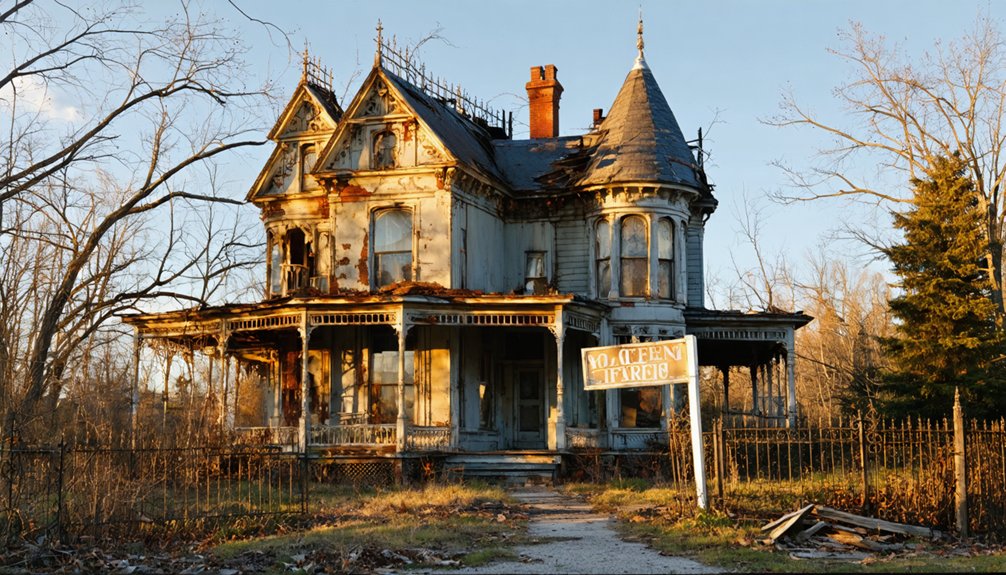
Although authentic ghost towns rarely appear on Virginia’s real estate market, you’ll find substantial alternatives in the Commonwealth’s collection of 3,800 vintage homes and 166 Victorian-era properties currently listed for sale.
These structures offer tangible connections to abandoned settlements and declining communities across the state.
Notable Historic preservation opportunities include:
- Greek Revival estates like the 1841 Ellen Glasgow House in Richmond with intact period architecture
- Federal-era manors throughout Central Virginia featuring pre-1940 craftsmanship
- Victorian architecture in Norfolk ranging from $259,900 to $544,900 with high ceilings and original details
- Eastern Shore properties dating to 1607 settlements in America’s oldest continuously inhabited towns
- Turn-of-century mansions like Hillcrest Inn in Clifton Forge available for adaptive reuse
Prices span $220,000 to $1,987,000 depending on location and square footage.
Comparable Ghost Town Sales in Neighboring States
For context on Virginia’s limited ghost town market, examining recent sales in neighboring states reveals the pricing structure and investment potential of these properties.
Preston, West Virginia sits closest to Virginia’s border, where the old Borgman store property on Company House Road represents available distressed commercial structures. This neighboring state location demonstrates how ghost town tourism can drive economic revitalization in Appalachian communities.
Regional comparisons show Montana’s Frontier Town sold with authentic Old West architecture and modern amenities, while South Dakota’s Swett—formerly housing 40 residents—listed at $250,000 before foreclosure.
These sales establish baseline valuations for authentic small-town properties. You’ll find similar preservation opportunities require substantial capital investment, with Texas’s Lajitas commanding $1.8 million for its historic sites and remaining community foundation, illustrating premium pricing for developed ghost town assets.
Legal Considerations and Property Access Requirements
Before committing capital to any ghost town property in Virginia, you’ll need to navigate complex abandonment statutes that primarily address cemetery lots rather than thorough municipal parcels. Understanding these legal implications proves essential for securing legitimate property rights.
Virginia’s ghost town property laws focus on cemetery abandonment rather than comprehensive municipal land acquisition frameworks.
- Court decree requirement: Abandonment determinations demand judicial proceedings with proper notice to recorded owners.
- 30-year abandonment threshold: Unoccupied properties require documented maintenance failure spanning three decades.
- Fee simple transfer: Dedicated public lands convert to municipal ownership upon acceptance.
- Due process protections: Registered mail notices and consecutive weekly publications safeguard previous owners’ interests.
- Sale proceeds restrictions: Revenue allocation follows Title 57 specifications for cemetery-related dispositions.
Title transfer complexity and jurisdictional limitations greatly restrict straightforward ghost town acquisitions in Virginia.
Frequently Asked Questions
Can I Restore Abandoned Buildings or Must I Demolish Them?
You can choose either restoration or demolition for abandoned buildings. The restoration process offers tax abatement incentives, while building permits receive expedited processing for demolition. Both options require locality-approved plans with clear timelines for completion.
Are Mineral or Timber Rights Included in Ghost Town Purchases?
Don’t assume you’ll strike gold automatically—mineral rights and timber rights vary considerably across Virginia ghost town properties. You’ll need thorough title searches and legal documentation verifying whether these valuable resource rights transfer with your purchase or remain separately held.
How Do Zoning Laws Affect Commercial Development of Ghost Towns?
You’ll face strict zoning regulations that determine commercial viability, requiring conditional use permits to transform historic properties. Virginia’s Dillon Rule limits local flexibility, while parking minimums and setback requirements often restrict your development freedom considerably.
What Insurance Coverage Is Available for Historic or Abandoned Properties?
You’ll find property insurance for abandoned ghost towns ironically harder than protecting occupied buildings—specialized HO-8 policies cover historic structures meeting preservation standards, while liability coverage protects against visitor injuries on derelict properties requiring minimum $100,000 deductibles.
Can Ghost Towns Qualify for Historic Preservation Tax Credits?
Yes, you can qualify ghost towns for historic preservation tax credits if they contain certified buildings or contributing structures within listed districts. You’ll receive 25% state credits when rehabilitation expenses meet assessment thresholds.
References
- https://theforgottensouth.com/union-level-virginia-ghost-town-history/
- https://www.ezhomesearch.com/blog/towns-for-sale-in-the-usa/
- https://www.loveproperty.com/gallerylist/51810/entire-villages-and-towns-for-sale-that-you-can-actually-buy
- https://www.zillow.com/va/victorian_att/
- https://www.youtube.com/watch?v=T8Ep1C0_r9o
- https://www.landsearch.com/distressed/virginia
- https://www.oldhousedreams.com/state/virginia/
- https://www.realtor.com/news/unique-homes/buy-village-markham/
- https://oldhousesunder50k.com
- https://www.worldatlas.com/articles/ghostowns-of-america-virginia-city.html