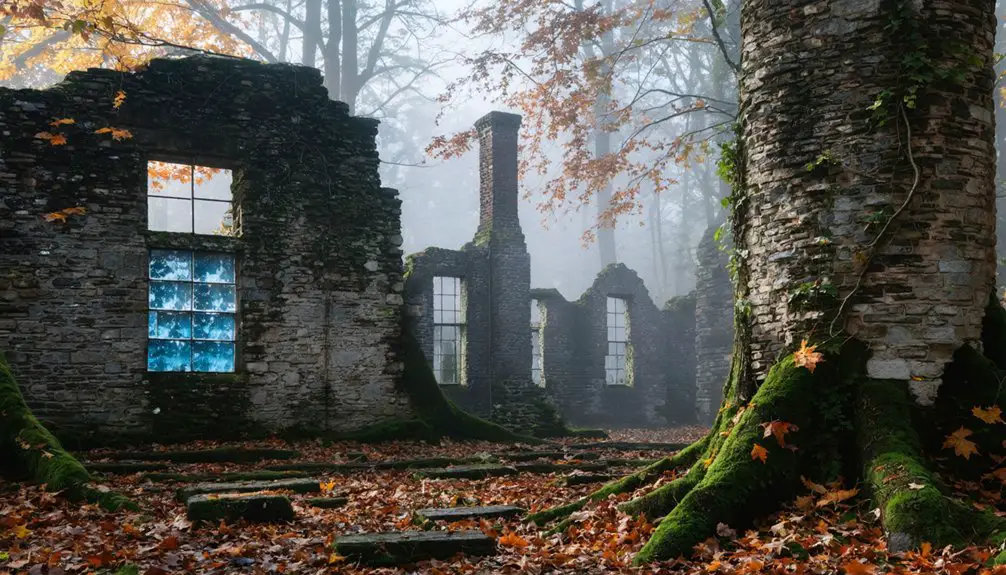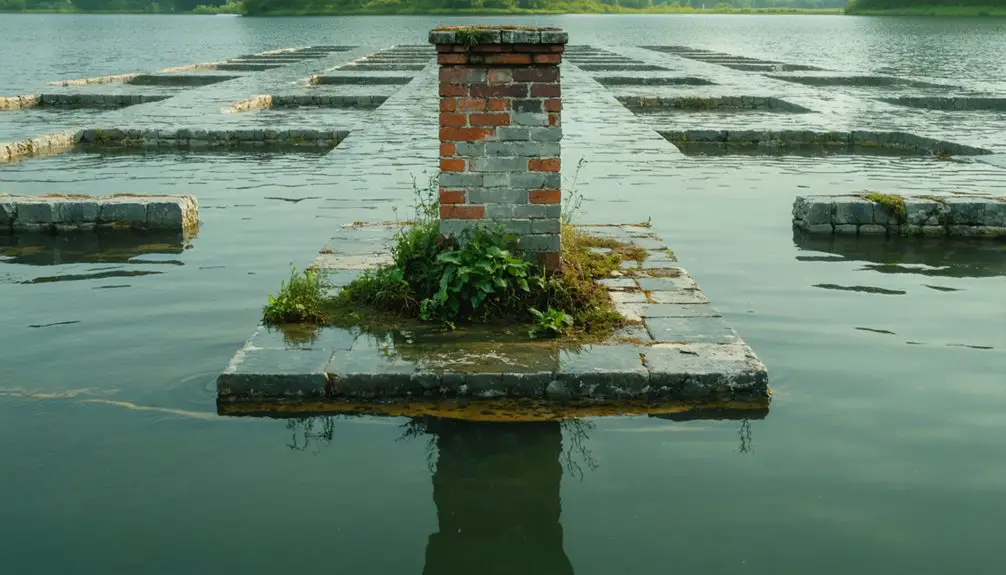
You’ll find Massachusetts’ best summer ghost towns along accessible trails when warm weather makes exploration comfortable. Dogtown’s 60+ cellar holes sprawl across 3,600 acres between Gloucester and Rockport, while Dana sits hauntingly above Quabbin Reservoir’s waterline with visible stone foundations. Long Point requires a 4.5-mile dune trek near Provincetown, and Davis offers 150 cellar holes from its 1882 mining era. Summer’s extended daylight hours let you safely navigate overgrown paths and crumbling homesteads, though you’ll want sturdy boots and detailed maps to discover what lies hidden in these abandoned settlements.
Key Takeaways
- Dogtown near Gloucester offers 3,600 acres of hiking trails with 60+ cellar holes and carved Babson boulders to explore.
- Davis ghost town in Rowe features 150 cellar holes from 1882 mining operations, accessible via trails from John Bottume House.
- Summer provides optimal conditions with longer daylight hours, warm weather, and better trail accessibility for ghost town exploration.
- Dana’s remains sit above Quabbin Reservoir’s waterline, featuring stone foundations within a 120,000-acre watershed ideal for summer hiking.
- Wear sturdy shoes, carry navigation tools, bring water and sun protection, and inform others of plans before visiting remote sites.
Dogtown: A Haunted Settlement Between Gloucester and Rockport
Deep in the forests between Gloucester and Rockport lies a peculiar wilderness where stone foundations peek through tangled undergrowth and glacial boulders loom like silent sentinels.
Stone foundations emerge through wilderness tangles while ancient glacial boulders stand watch like frozen guardians of forgotten settlements.
You’ll discover Dogtown—a 3,600-acre ghost settlement abandoned in 1828, where 60+ numbered cellar holes mark homes that once sheltered Revolutionary War widows and their protective dogs.
Today’s preservation efforts protect this watershed as untamed hiking terrain, free from development constraints.
You’re welcome to explore trails winding past carved Babson boulders bearing inspirational messages, or trace routes where eccentric Tammy Younger once lived.
Wildlife encounters here feel otherworldly—perhaps it’s the feral descendants still roaming, or just the eerie quiet of a community that vanished when coastal opportunities called families seaward, leaving only stones and stories behind.
At its peak, this thriving farming community was surveyed in 1741 and housed 20% of Gloucester’s population across prominent families who considered it the best part of town.
The area shares its name with multiple other locations, as the term “Dogtown” appears in various places throughout the United States.
Catamount: Remote Farming Village Turned State Forest
Perched on a mountainside in Colrain’s western Massachusetts wilderness, Catamount once thrived as a farming settlement so fiercely independent that it became the first town to fly the United States flag over its schoolhouse in 1812.
Today, you’ll find 1,125 acres of reclaimed wilderness where historical preservation meets nature’s takeover. The Commonwealth acquired this ghost town in 1967, transforming it into Catamount State Forest—a sanctuary where wildlife habitats flourish among crumbling cellar holes.
You’ll access the ruins via Stacy Road’s parking area, since erosion claimed the vehicle roads a decade ago. Deteriorated roads remain closed to vehicles but are accessible by foot, allowing visitors to explore the historical site at their own pace.
What awaits:
- Stone markers marking the original schoolhouse site
- Forest trails weaving through abandoned homesteads
- Summer hiking routes revealing centuries-old foundations
Pack water and sturdy boots—this remote terrain rewards adventurers seeking authentic glimpses into Massachusetts’ vanished frontier communities. The village’s abandonment came in the 20th century, as settlers found the remote location and difficult terrain too challenging to sustain the farming community.
Dana: Quabbin Reservoir’s Elevated Ghost Town
Unlike most ghost towns swallowed entirely by progress, Dana stands as a peculiar monument to sacrifice—its common ground remains just above the waterline of Quabbin Reservoir, a cleared plateau where 2,000 residents once built their lives before the state claimed everything in 1938.
You’ll find stone foundations and granite steps scattered across the barren landscape, ghostly breadcrumbs for reconstructing what Historical preservation efforts couldn’t save. The state systematically destroyed every building, exhumed 7,500 graves, and burned what wouldn’t sink.
Walk these grounds and you’re treading where government eminent domain erased entire communities for Boston’s water supply. Dana joined Enfield, Greenwich, and Prescott as disincorporated towns, sacrificed to flood the Swift River Valley.
The ecological impact created something unexpected: 412 billion gallons feeding three million people through gravity-fed aqueducts, surrounded by filtering forests. The reservoir’s 25,000-acre expanse sits within a 120,000-acre watershed that now supports abundant wildlife and natural habitat.
Freedom lost, utility gained—that’s Dana’s uncomfortable legacy.
Long Point: Abandoned Fishing Village Near Provincetown
Thirty wooden houses drifted across Provincetown Harbor like a floating neighborhood in the late 1850s, their owners literally relocating rather than abandoning their investments.
When fishing failed and resources vanished, Long Point families floated their entire homes across the harbor to start fresh.
You’ll find Long Point at Cape Cod’s tip, where 200 residents once thrived on mackerel and salt production before exhaustion drove them away.
Historical preservation here means blue-and-white plaques marking those “floaters” in Provincetown’s West End—physical evidence of community reconstruction through literal migration.
Today’s Long Point offers:
- Remote wilderness access requiring a 4.5-mile trek over dunes
- Civil War fortifications locals dubbed “Fort Useless”
- Automated lighthouse standing since 1875
Within Cape Cod National Seashore, you’re free to explore where windmills once spun and seine nets hauled abundant fish.
The settlement’s decline accelerated after 1850 when cheaper salt deposits from Syracuse, New York undercut the local salt works industry.
Salt production relied on solar evaporation, a labor-intensive process that couldn’t compete with inland mining operations.
Only ruins and migratory birds occupy this ghost settlement now.
Davis: Historic Ruins Along Accessible Trails
Hidden within Rowe’s hardwood forests, 150 cellar holes mark where miners and their families once built lives around Massachusetts’ largest pyrite operation. You’ll discover the mining heritage through blacksmith shop foundations, scattered machinery, and stone walls that trace Herbert Jerome Davis’s 1882 empire.
The archaeological exploration begins at the John Bottume House visitor center, where you’ll grab trail maps leading through the abandoned settlement. Four capped mine shafts remind you why this place emptied after the 1911 collapse—poor mining practices sealed its fate.
Walk freely through the 17-acre wildflower field and hardwood trails, examining sulphur ore deposits still visible where Amherst College students first spotted iron pyrite. The deteriorated mining school stood until the 1970s, stubbornly marking this industrial ghost town‘s defiant past. Near the settlement ruins, you’ll find a foundation of a spring house with remnants of old water infrastructure that once supplied the mining community. At Dana Commons along Route 32A, you can explore stone foundations and cellar holes left behind when the town was abandoned in 1938 for the Quabbin Reservoir.
Enfield: Flooded Town of the Quabbin Project
You’ll find no physical trace of Enfield today—the entire town lies beneath 412 billion gallons of water in the Quabbin Reservoir.
When the Swift River was sealed in 1939, it swallowed four complete communities, transforming Enfield’s hills into submerged peaks and its Main Street into a watery grave.
What remains accessible is the Quabbin Memorial Park, where you can stand above the flooded valley and imagine the farewell ball residents held in 1938, dancing one last time before midnight erased their town from the map.
Quabbin Reservoir Flooding History
In 1927, the Massachusetts State Legislature made a decision that would erase four entire towns from the map. The Swift River Act condemned the valley to create Quabbin Reservoir, Boston’s lifeline holding 412 billion gallons.
You’ll find no trace of Enfield, Dana, Prescott, or Greenwich—they vanished at midnight on April 28, 1938.
What disappeared beneath the waters:
- 2,500 displaced residents who’d built lives across generations
- 7,500 exhumed graves, relocated to preserve historical preservation
- Every building, tree, and farmland burned to moonscape before flooding
The environmental impact was staggering. Workers stripped 75,000 acres bare, torching everything organic.
The reservoir filled slowly from 1939 until June 1946, drowning memories and Main Streets alike.
Today, gravity feeds this unfiltered water supply through underground aqueducts—a monument to progress that demanded freedom’s ultimate sacrifice.
Visiting Enfield’s Remnants Today
Though Enfield lies drowned beneath 412 billion gallons, fragments of its existence cling stubbornly to the waterline. You’ll spot the rubber factory’s foundation breaking the surface, stone walls threading through forest where streets once ran.
Grab trail maps at the John Bottume House visitor center, then hike designated paths around the reservoir’s perimeter. You can’t wander freely, but you’ll find cellar holes at nearby Dana center.
Local traditions speak of haunted echoes from displaced residents, mythical legends born from relocated graves and mysterious plane crashes. The golf course clubhouse still stands on a reservoir island, defiant. No church spires pierce the water—everything was demolished before flooding.
Come prepared: you’re walking through America’s largest forced abandonment, where 3,000 people danced goodbye in 1938.
Best Times and Tips for Visiting Massachusetts Ghost Towns
Planning your ghost town adventure in Massachusetts requires strategic timing to maximize both comfort and supernatural atmosphere. Summer months deliver ideal conditions for exploring historical architecture and abandoned sites, with June through August offering warm weather that makes outdoor walking tours comfortable.
The best seasons for exploring ghost towns are often considered to be late spring and early fall. During these times, the weather remains mild, allowing for enjoyable exploration without the intense heat of summer. Additionally, the changing foliage in the fall adds a unique charm to the haunting landscapes.
As you set out on your journey of exploring ghost towns in Massachusetts, be sure to research each location for its historical significance and unique stories. Many of these towns once thrived with life before being abandoned, and their remnants provide a captivating glimpse into the past. Capturing photographs of the eerie surroundings not only enhances the experience but also preserves memories of your adventure.
You’ll want to schedule evening excursions between 8:00 and 9:00 pm when local legends come alive in the darkness.
Essential planning tips:
- Book popular attractions like Salem Witch Museum at least an hour in advance, as presentations sell out quickly.
- Wear layers and sensible shoes—most ghost tours involve ½ to 1 mile of walking over 90 minutes to 2 hours.
- Check age restrictions before committing; some experiences require participants to be 12 or 18 years old.
Download the Destination Salem app to discover spontaneous events enhancing your supernatural exploration.
What to Bring on Your Ghost Town Adventure
Last autumn, I learned the hard way that proper gear transforms a Quabbin ghost town hike from frustrating to fulfilling when my phone died halfway to Dana Common, leaving me without navigation.
You’ll need a reliable compass and detailed maps of the reservoir area, since cell service disappears among these forest-reclaimed village sites.
Pack a sturdy first aid kit, waterproof hiking boots, and extra water—the rocky trails to Prescott’s foundations and overgrown cellar holes demand preparation that matches your curiosity about Massachusetts’ drowned towns.
Essential Hiking Gear
When you’re threading through overgrown trails toward Dana or the crumbling foundations of Prescott, the right gear transforms a potentially miserable trudge into an adventure you’ll actually remember fondly.
Your packing list should adapt to Massachusetts’ temperamental weather considerations—morning fog burns off into scorching afternoons, then cools dramatically by evening.
Core essentials for ghost town exploration:
- Footwear that actually works: Trail runners handle Dana’s gentle paths; light hiking boots grip Prescott’s rocky slopes
- Layers you’ll actually use: Lightweight fleece for dawn starts, waterproof windbreaker when thunderheads roll in
- A proper daypack (20-25L): Enough room for water, snacks, first aid, and that abandoned artifact you’ll photograph but leave behind
Don’t forget sun protection and trekking poles—those overgrown cellar holes hide uneven ground that’ll test your ankles.
Why do experienced ghost town explorers carry twice as much orientation gear as weekend hikers? Because unmarked trails at October Mountain and The Mount won’t forgive your smartphone’s dead battery.
You’ll need sturdy boots for slippery rocks, especially during fall and winter conditions. Trail signage disappears near abandoned settlements, so pack a compass and detailed maps—cell service vanishes in these remote areas.
Summer brings its own challenges: heat warnings intensify across Massachusetts, and tick-infested counties demand constant vigilance. Wildlife encounters increase when you’re exploring foundations at Quabbin’s Gates 11-12 or traversing the 12.4-mile South Taconic Trail.
Always inform someone of your destination and expected return time. The freedom to explore ghost towns comes with responsibility—respect private property boundaries and carry twice the water you think you’ll need.
Frequently Asked Questions
Are Pets Allowed When Exploring Massachusetts Ghost Towns?
Pet policies vary wildly—you’ll find freedom at North Truro’s ruins with leash regulations, but Quabbin’s strict ban protects water supplies. Prioritize pet safety around crumbling foundations and wildlife. Dogtown welcomes leashed companions despite rocky hazards ahead.
Do Any Ghost Towns Require Entrance Fees or Permits?
Most Massachusetts ghost towns don’t charge entrance fees since they’re abandoned, but you’ll need photography permissions for historical preservation sites. You’re free to explore public areas, though private property requires landowner consent before entering.
Are Guided Tours Available for Any of These Abandoned Settlements?
You won’t find guided tours at Massachusetts’ actual ghost towns—they’re abandoned. However, Salem and Boston offer excellent historical preservation tours where you’ll hear local legends about hauntings, murders, and colonial-era mysteries that’ll satisfy your adventurous spirit.
If you’re looking for winter destinations in Massachusetts, consider exploring the picturesque charm of the Berkshires or the coastal beauty of Cape Cod. These areas not only offer breathtaking scenery but also a range of winter activities like skiing, snowshoeing, and cozy fireside dining. Don’t miss out on local festivals that celebrate the season and bring communities together.
Can You Camp Overnight Near These Ghost Town Locations?
You can’t pitch your tent just anywhere—historical preservation and private property restrictions limit overnight stays. However, nearby state forests like Harold Parker and Myles Standish offer designated campsites where you’ll experience Massachusetts’ haunted wilderness firsthand.
Are the Ghost Towns Wheelchair Accessible or Suitable for Children?
Most locations address accessibility concerns with paved paths and wheelchair-friendly routes. You’ll find family-friendly activities at outdoor memorials and trolley tours. The Paper House welcomes kids, though it lacks accessible restrooms—plan accordingly for your adventure.
References
- https://bostonuncovered.com/ghost-towns-massachusetts/
- https://bostonghosts.com/a-terrifyingly-exciting-haunted-massachusetts-road-trip/
- https://www.tripadvisor.com/Attractions-g28942-Activities-c47-t14-Massachusetts.html
- https://985thesportshub.com/listicle/the-12-most-haunted-places-in-massachusetts/
- https://historyofmassachusetts.org/ghost-towns-massachusetts/
- https://www.youtube.com/watch?v=T4yhm_S-dHc
- https://www.outoftheoffice4good.com/post/hiking-to-the-abandoned-town-of-dana-massachusetts
- https://en.wikipedia.org/wiki/Dogtown
- https://www.thedacrons.com/eric/dogtown/story_dogtown_gloucester.php
- https://www.bostonhiddengems.com/blog/dogtown-ma