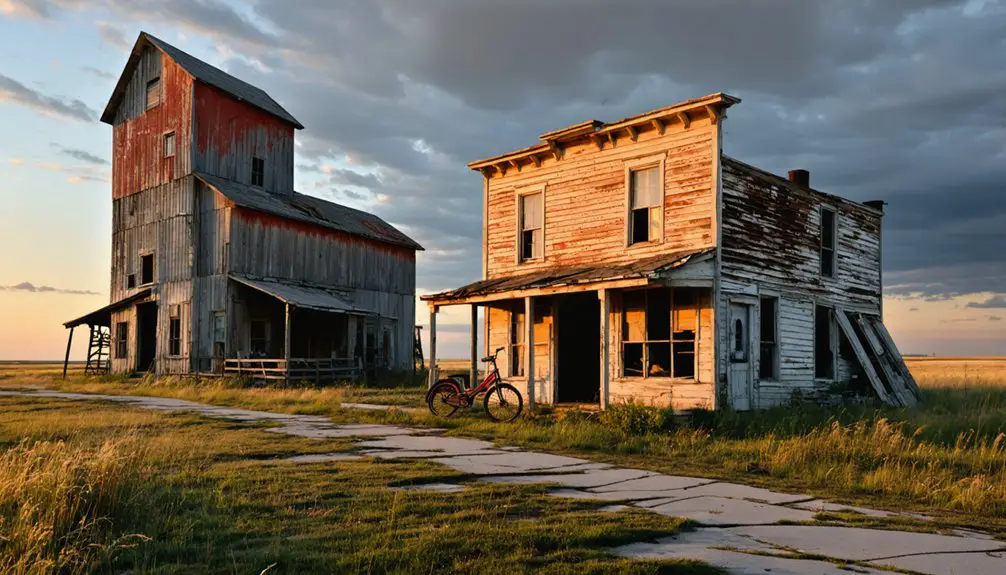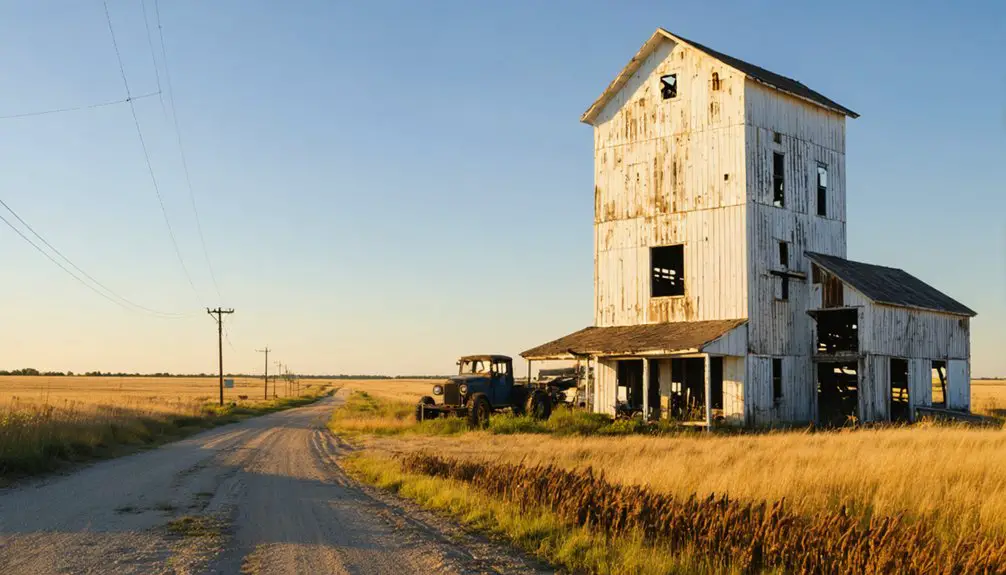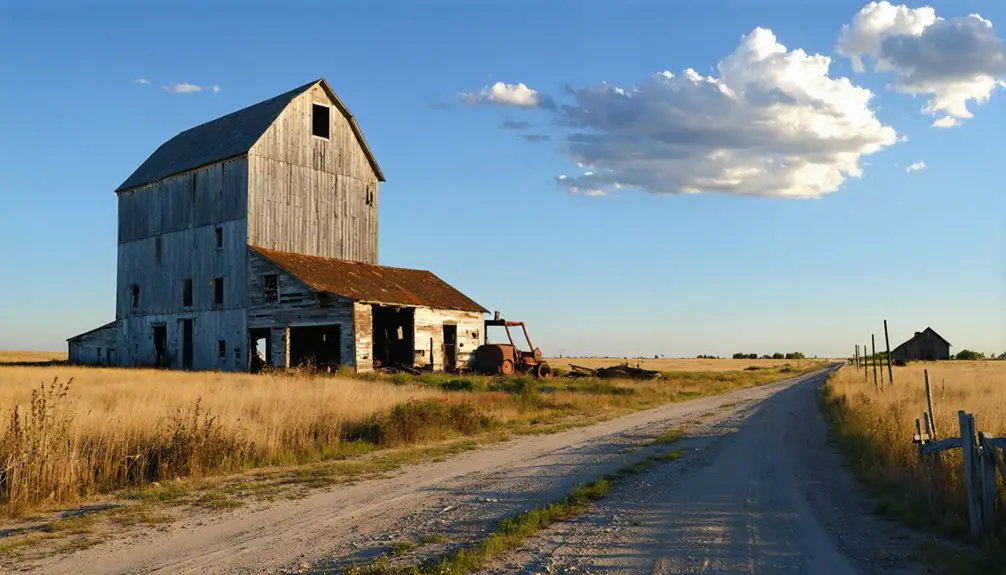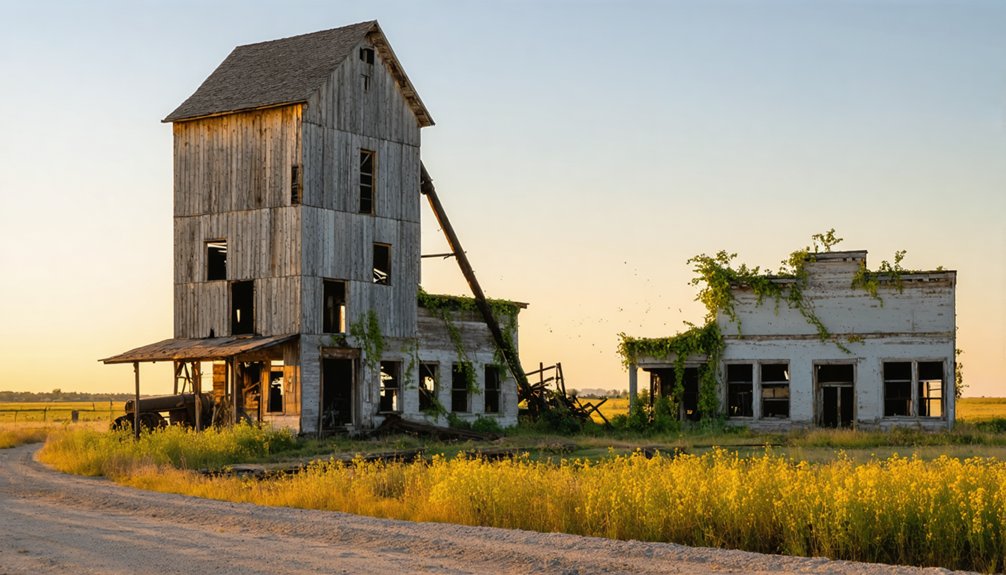
You’ll find North Dakota’s abandoned settlements vanishing beneath wildflowers and prairie grass, where nature steadily erases what economic collapse left behind. Over 323 grain elevators stand as weathered monuments to communities that disappeared after rail lines fell silent in the late 1970s. In places like Freda, crumbling train depot foundations lie hidden beneath overgrown pathways, while the Garrison Dam submerged entire tribal settlements under 156,000 acres of water. These forgotten foundations tell stories of boom-bust cycles that continue shaping the region’s landscape today.
Key Takeaways
- Wildflowers and prairie grass reclaim abandoned towns like Freda, covering former yards, pathways, and crumbling train depot foundations.
- Wild orchards grow and barns collapse as nature transforms human-built structures back into natural prairie landscapes across North Dakota.
- Gravestones from 1910 near the Missouri River are now obscured by bushes, marking where settlements once thrived.
- Garrison Dam flooded 156,000 acres, submerging entire communities and leaving foundations hidden beneath water and overgrown vegetation.
- Abandoned grain elevators stand as weathered monuments among tall grass concealing the foundations of vanished North Dakota communities.
The Silent Prairie: Where Wildflowers Replace Main Streets
Sidewalks once channeled the footsteps of farmers and merchants in Freda, Grant County; wildflowers now bloom unchecked across forgotten pathways. You’ll find prairie grass waving over former family yards, while tall grass conceals the crumbling train depot foundation, abandoned around 1975. This wildflower resurgence transforms what human hands built into something wholly natural.
The prairie tranquility you’ll experience here speaks to nature’s patient persistence. Rolling green hills near the Missouri River frame this reclamation, where bushes now obscure gravestones dating to 1910 and earlier. In Sims, Morton County, a weathered church and cemetery remain active while the abandoned town crumbles around them, creating a striking contrast between maintained sacred ground and nature’s reconquest.
You’re witnessing what happens when civilization retreats—orchards grow wild, barns collapse slowly, and the vast prairie reclaims every trace of settlement. Ring-neck pheasants nest where children once played, completing the transformation from town to wilderness. Inside old schoolhouses, peeling paint and bird nests occupy spaces where roll-top desks once served students until 1951.
Grain Elevators Standing Watch Over Empty Horizons
Across North Dakota’s windswept plains, grain elevators rise like weathered sentinels marking settlements that dwindled or disappeared entirely after rail lines fell silent.
When railroads abandoned branch lines in the late 1970s, they stranded 323 elevators—70 percent of the state’s facilities. Ten percent became truck-only operations, isolated from efficient transport networks. Rural roads couldn’t handle the shifted grain traffic, accelerating community decline.
You’ll find these structures embodying rural nostalgia, particularly in places like Kloten, where six to ten households remain but mowed yards suggest stubborn persistence. The abandoned elevators face mounting operational expenses from deteriorating infrastructure, making preservation increasingly challenging for communities with dwindling tax bases.
Thirty percent of elevators already exceeded fifty years old when abandonments began. Today, elevator preservation efforts recognize these wooden towers as more than agricultural infrastructure—they’re monuments to self-sufficient communities that thrived before centralized systems reshaped the landscape.
When Progress Drowned History: The Garrison Dam’s Legacy
When engineers dammed the Missouri River in 1946, they submerged more than land—they drowned the economic heart of the Three Affiliated Tribes.
You’ll find no trace of those Mandan, Hidatsa, and Arikara settlements now—156,000 acres vanished beneath Lake Sakakawea while 90 percent of residents fled to higher ground.
The Army Corps never asked permission. They built first, negotiated later, offering compensation far below what non-Indians received for comparable losses.
Secretary Krug admitted the settlement “does not cover what these people have lost.”
The Missouri River, called Oyate in Hidatsa, had guided migration stories and cultural identity for generations before the flooding. Seventy years later, that $40 million in annual hydroelectric profits flows elsewhere while reservation communities still grapple with poverty and displacement’s lasting wounds. The flooding destroyed the tribal headquarters and medical clinic, facilities the federal government promised to replace but took sixty years to fulfill. Yet cultural resilience persists where bureaucrats expected erasure, and recent ecological restoration efforts acknowledge what sovereignty always demanded—consent matters.
From Boom to Abandonment: Economic Forces That Emptied Towns
Economic forces hollowed out North Dakota’s towns with boom-bust cycles that transformed landscapes faster than communities could adapt.
You’ll find abandoned developments from two distinct collapses: the 1930s farm crisis and recent oil busts.
The Great Depression triggered rural decline through:
- Over 70% of North Dakotans requiring public assistance as foreclosures accelerated
- Farm debt combined with commodity crashes forcing thousands off their land
- State population peaking in 1930, then dropping until 1950
- Financially stable operators consolidating holdings while displacing smaller farmers
Modern oil booms repeated this pattern.
When 4,000 workers lost jobs in one quarter, economic migration reversed instantly.
You’ll see 400+ discarded vehicles near Alexander and man camps at 65% occupancy—physical evidence of cycles that built then abandoned entire communities.
Municipalities struggle with unfinished building units that investors and local governments can neither complete nor fill.
Towns like Kauga experienced catastrophic population collapse, dropping from 219 residents at their 1930 peak to just 40 today.
Forgotten Foundations Hidden Beneath North Dakota’s Tall Grass
Beneath the relentless tall grass that reclaims North Dakota’s prairie, foundations of vanished communities lie scattered across the landscape like archaeological fragments.
You’ll find Tagus’s train depot crumbling among hollow-windowed buildings, while Freda’s remnants disappear into Missouri River hills southwest of Mandan.
Charbonneau’s skeletal grain elevators stand near grass-swallowed schoolhouse bases, visible from the BNSF Mainline.
Arena’s foundations hide 35 miles northeast of Bismarck, marked only by St. John’s Lutheran Church.
Deisem’s overgrown ruins include a former Seventh Day Adventist Church alongside the remains of a general store and post office consumed by tall grass.
Lark’s hardware store and lumber yard once served a thriving railway community before nature reclaimed the town 10 miles west of Flasher.
Most haunting is Elbowoods, where Garrison Dam’s 1954 flooding submerged entire Mandan, Hidatsa, and Arikara foundations beneath Lake Sakakawea—hidden histories erased by deliberate destruction.
Droughts occasionally expose these bases, revealing nature’s reclamation of sacred sites that once anchored generational communities across Grant and Burleigh Counties.
Frequently Asked Questions
Can Visitors Legally Explore Abandoned Ghost Town Sites in North Dakota?
You’ll face strict exploration regulations at North Dakota ghost towns on protected lands—removing artifacts, disturbing sites, or camping overnight violates state code. However, visitor guidelines permit hunting, photography, and wildlife observation on designated areas respecting cultural preservation.
Are There Organized Tours Available to Visit These Ghost Towns?
Yes, you’ll find guided excursions through Photo Cascadia, offering expert-led photography tours of abandoned structures. These experiences weave historical narratives while you independently explore homesteads, churches, and barns across North Dakota’s forgotten landscapes at your own pace.
What Wildlife Species Now Inhabit These Abandoned Town Locations?
You’ll find remarkable wildlife diversity across these sites—pheasants, deer, antelope, elk, moose, and eagles demonstrate species adaptation to abandoned human settlements. Historical records and archival sources document how nature’s reclaimed these spaces, transforming human-nature interactions completely.
How Do Local Communities Preserve Memories of These Lost Towns?
You’ll find memory preservation through community engagement initiatives like documenting town histories, posting interpretive signs at ghost town sites, organizing heritage festivals, and using archival sources to create educational materials that honor settlers’ relationships with North Dakota’s evolving landscape.
Are Any Ghost Towns Being Considered for Historical Landmark Status?
You’ll find preservation efforts underway at several sites. Saint Olaf Lutheran’s restored school earned historical register status, while Antler’s Customs House fundraising demonstrates how communities recognize historical significance and fight against nature’s relentless reclamation of frontier structures.
References
- https://everafterinthewoods.com/these-forgotten-ghost-towns-in-north-dakota-are-eerily-fascinating/
- https://us1033.com/a-look-at-some-real-life-north-dakota-ghost-towns/
- https://www.geotab.com/ghost-towns/
- https://www.ndstudies.gov/sites/default/files/LessonPlans/LessonPlan-HighSchool-GhostTownsOfNorthDakota.pdf
- https://www.lovemoney.com/gallerylist/86648/americas-empty-ghost-towns-and-why-theyre-abandoned-today
- https://www.blm.gov/sites/default/files/documents/files/2012AnnualReportWeb_0.pdf
- https://en.wikipedia.org/wiki/List_of_ghost_towns_in_North_Dakota
- https://www.youtube.com/watch?v=0n3LvrSDRLU
- https://www.littlepassports.com/blog/state/north-dakota/
- https://www.youtube.com/watch?v=dZPQ8fTNsGo