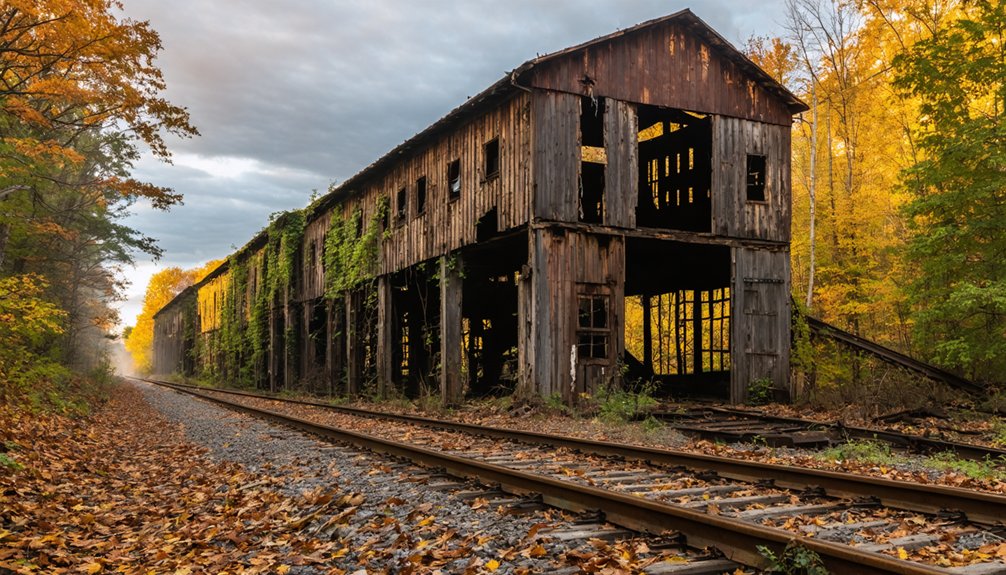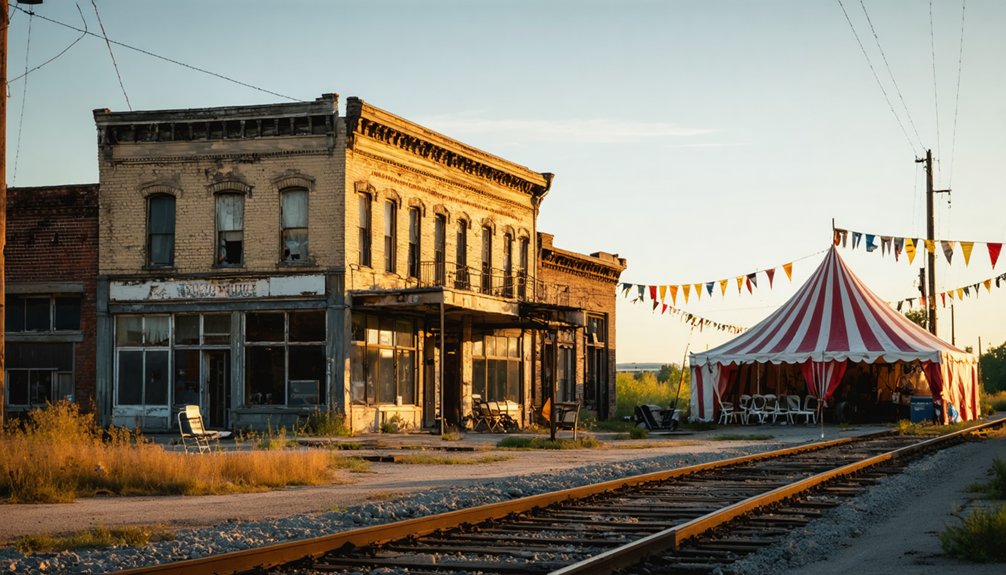
You’ll find Indiana’s most authentic ghost town celebration at Hindostan Falls, where Hindostan Days takes place every October (the sixth annual event runs October 4, 10 a.m.-5 p.m.). This former Martin County seat—abandoned after an 1820s disease outbreak killed 138 residents—now hosts pioneer demonstrations, artisan displays, and live music among authentic mill ruins carved into bedrock. Other sites like Tunnelton offer reenactments of historic tragedies, while Metamora combines canal-era history with seasonal festivals that bring vanished communities back to life through grassroots preservation efforts and immersive storytelling.
Key Takeaways
- Hindostan Falls hosts Hindostan Days each October with pioneer demonstrations, artisans, music, and local culinary traditions near historic mill ruins.
- The Sassafras Tea Festival features 1860s living history demonstrations and celebrates frontier heritage at Indiana ghost town sites.
- Tunnelton presents annual reenactments of the 1882 Wilson gang massacre with period-accurate performances and historical interpretation.
- Fort Ouiatenon’s gathering recreates 18th-century French and Native American interactions through cultural performances and authentic demonstrations.
- Ghost town festivals include blacksmith demonstrations, Underground Railroad tours, mystery dinners, and art exhibitions celebrating industrial heritage.
Hindostan Falls: Indiana’s Most Celebrated Ghost Town
Hindostan Falls emerged in 1816 at the cascading waters of the East Fork White River, strategically positioned along one of the few roads threading through the newly formed Indiana territory.
At the crossroads of wilderness and westward expansion, Hindostan Falls claimed its place in Indiana’s territorial dawn.
You’ll find this once-thriving settlement grew to 1,200 residents by 1820, serving as Martin County’s seat with bustling commerce fueled by stagecoach traffic between Vincennes and New Albany.
The town’s mills, anchored through 128 eighteen-inch square holes carved into flat rock, supported local culinary traditions and trade.
By 1853, disease claimed 138 lives in three months, forcing survivors to abandon their homes for nearby Loogootee.
The town’s post office closed in 1830, marking the beginning of its irreversible decline.
Today, you can explore this preserved site as a peaceful nature retreat where wildlife conservation thrives.
Square-cut rocks mark mill locations, while legends persist about buried treasure beneath the falls.
Each year on the last Saturday of September, Hindostan Days celebrates the town’s fascinating history and natural beauty.
The Tragic History Behind the Annual Commemoration
While Hindostan Falls’ decline stemmed from disease, other Indiana ghost towns met far more violent ends that communities now commemorate through annual remembrance events. Fontanet’s 1907 powder mill explosion obliterated the town center, killing residents and launching debris that struck the superintendent’s home.
Tunnelton faced the 1882 Wilson gang massacre, adding to ancient folklore surrounding its Underground Railroad past.
Metamora’s history includes canal drownings, railway accidents, and crimes of passion that locals remember through preservation efforts. The town offers haunted historical tours throughout October, sharing stories of past residents linked to its tragic and colorful history. These communities host gatherings where you’ll find local cuisine alongside historical exhibits, honoring those lost to tragedy.
These communities are also affected by natural disasters such as F5 tornadoes and subsequent calamities, which accelerated abandonment. However, annual commemorations ensure these violent chapters aren’t forgotten, preserving stories for visitors seeking authentic historical exploration. Despite the devastation, Fontanet maintains its Bean Dinner Festival tradition that has continued since 1890.
Hindostan Days: A September Tradition Since Its Founding
Unlike commemorations rooted in catastrophe, the annual celebration at Hindostan honors a town that thrived before disease claimed it.
Hindostan Day celebrates a prosperous frontier settlement’s vibrant legacy rather than mourning the cholera epidemic that ended it.
You’ll find Hindostan Day held each October weekend, bringing the settlement’s 1816-1853 legacy to life through pioneer demonstrations and natural area exploration.
The fifth annual event runs Saturday, October 4, from 10 a.m. to 5 p.m., where you can discover local culinary traditions that sustained 1,200 residents along the White River.
Indigenous plant use demonstrations connect you to the land’s original inhabitants and early settlers who relied on regional resources.
Since the post office closed in 1830 and residents relocated to Loogootee by 1853, this tradition preserves what buildings cannot—the frontier spirit of Indiana’s once-thriving commercial hub. Today, the site near Hindostan Falls features only square cuts in large flat rocks where mills once operated, with a restored church and pioneer cemeteries marking the area’s historical significance. Artisan booths and live music create a festive atmosphere that contrasts with the town’s somber ending.
What Visitors Can Experience at the Annual Celebration
You’ll witness costumed interpreters bring Hindostan’s 1800s pioneer life back through authentic demonstrations of frontier skills like blacksmithing, candle making, and open-hearth cooking.
Local historians share documented accounts of the town’s devastating 1828 plague and its abandonment, connecting you directly to the families who once called this Martin County settlement home. Nearby attractions include Charlestown State Park’s seasonal events featuring trick-or-treating, night hikes, and costume contests for visitors exploring Southern Indiana’s historical sites.
The celebration’s location along the East Fork of the White River lets you explore the same wooded hills and waterways that shaped daily life for Hindostan’s original residents. Evening activities feature haunted historical tours where guides lead visitors through dimly lit spaces while sharing paranormal stories and documented encounters from the site’s past.
Historical Reenactments and Storytelling
At Indiana’s ghost town celebrations, you’ll step directly into living history through meticulously researched reenactments that bring vanished communities back to life. In Tunnelton, actors recount the 1882 massacre involving Ben Willoughby’s robbery plot, transforming this Level 4 ghost town into a theatrical stage. You’ll hear tales of the 1907 steam locomotive fire that destroyed the packing house, church, and businesses.
Zionsville’s Ghost Walk Tours guide you through 45-minute journeys where performers animate haunted legends at preserved village homes.
Fort Ouiatenon’s 58th annual gathering recreates 18th-century French and Native American interactions with military drills, fife and drum corps, and continuous programming across five stages. Located four miles southwest of West Lafayette on the Wabash River banks, this early autumn festival marks Indiana’s first fortified European outpost. Fort Ritner offers insights into railroad history, where visitors learn about the devastating 1909 train collision that claimed five lives when approaching trains failed to see each other on a curve. While not featuring medieval weapons, these events showcase authentic period demonstrations, culinary traditions, and cultural performances that capture Indiana’s vanished frontier settlements.
Natural Beauty and Exploration
When autumn descends on Indiana’s ghost town celebrations, the natural landscapes become as compelling as the historical narratives themselves. You’ll discover expansive flat rock formations at Hindostan Falls displaying 128 mill-carved holes, each measuring 18 by 18 inches—geological evidence of vanished industry.
Wildlife observation opportunities abound as you traverse wooden bridges through rustling trees, where gray mist rises from curving rivers at dusk. The river banks reflect sky blue while foliage turns brilliant yellow, orange, and red beneath waxing crescent moons.
These preserved natural settings offer cell-free retreats where you’ll walk lantern-lit trails through authentic landscapes. From Charlestown’s forested paths to Waverly’s riverside views, you’re exploring environments that remain largely unchanged since these communities thrived, connecting you directly with Indiana’s wilderness heritage.
Exploring the Physical Remnants of a Lost Community
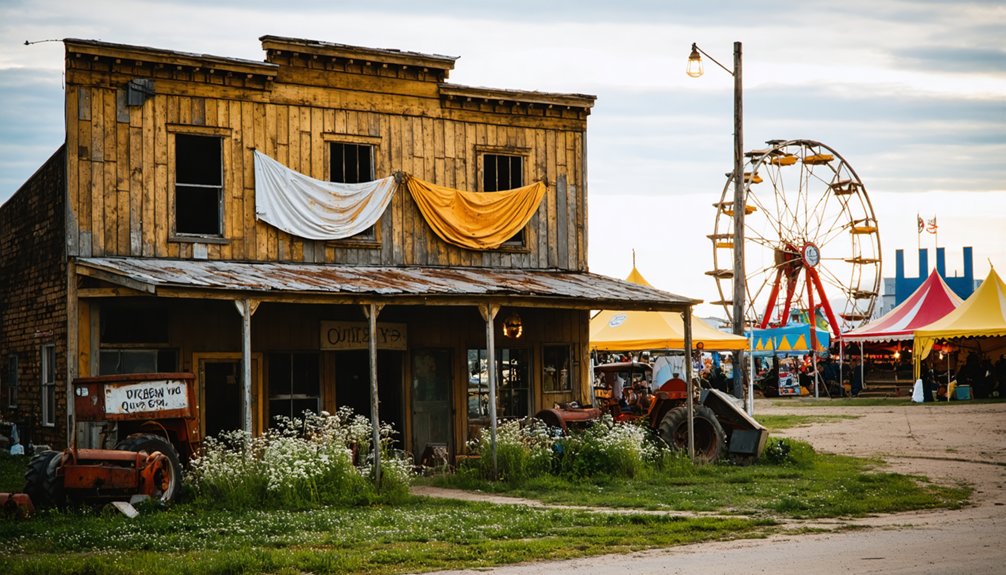
Indiana’s ghost towns offer tangible connections to vanished communities through weathered structures, carved stone, and overgrown foundations that dot the landscape.
At Hindostan Falls, you’ll discover 128 precisely carved holes—each 18 by 18 inches—cut into flat rock, industrial relics from former mills that showcase remarkable craftsmanship. Foundation pits mark where the county seat once thrived before residents departed for Mt. Pleasant.
Southern Indiana’s approximately 41 ghost towns reveal deteriorating structures at sites like Youngs Creek, Marengo, and Tunnelton.
You’ll find Millville’s restored locks and brick grist mill preserved as a state memorial along a 14-mile park stretch. These physical remnants demonstrate community traditions and settlement patterns, offering freedom-seekers authentic exploration without crowds.
Most mining town traces rest on private property, though accessible sites provide genuine connections to Indiana’s frontier past.
The Legend of Buried Gold and Treasure Hunters
You’ll find Hindostan’s most enduring mystery isn’t its cholera-ravaged streets but the iron pot of gold and silver coins a tax collector buried during the 1828 epidemic before dying without revealing its location.
Modern treasure hunters still comb the rolling hills with metal detectors. Their searches have been intensified by the 2023 discovery of 700+ gold coins across the river and persistent rumors linking the ghost town to Reno Gang hideouts in nearby caves.
These gold-seeking expeditions have become an unofficial annual tradition, with paranormal investigators often joining the hunt since many believe the collector’s restless spirit guards his forgotten cache.
Origins of Gold Tales
Between 1864 and 1868, the notorious Reno Gang orchestrated a series of train robberies across Indiana, Iowa, and Missouri. They stole over $2 million in gold, silver, and currency—equivalent to roughly $3 million today.
Gold legends emerged after gang members were arrested or killed, leaving their loot hidden in southern Indiana‘s wilderness. You’ll find the most compelling clues at Little Goss Cave in Floyd County, where cave carvings carved over 150 years ago might reveal treasure locations:
- Three-level cave system suitable for concealing horses and deep storage
- Rock markings interpreted as directional maps by treasure hunters
- Similar carvings discovered in Perry County wilderness areas
- Gold pieces reportedly found near White River post-robberies
The Reno Gang’s Seymour headquarters remains the epicenter of these persistent treasure tales.
Modern Treasure Hunting Activity
The Reno Gang’s legendary hidden loot has sparked a modern treasure hunting movement that blends historical investigation with paranormal exploration across Indiana’s ghost towns.
You’ll find smartphone-based adventures tracking spirits through downtown Pendleton’s historic sites, where puzzles reveal both cultural heritage and supernatural encounters.
Urban exploration enthusiasts can investigate Crown Point’s Old Jail and haunted alleys, documenting EVP recordings while respecting structural integrity.
Fort Wayne’s tours connect serial killer legends with Johnny Appleseed folklore, emphasizing artifact preservation alongside ghost detection.
Indianapolis offers self-paced hunts through landmarks like Benjamin Harrison Memorial, where 700 child phantoms reportedly roam.
These experiences cost $8-$40, letting you compete for fastest completion times while contributing to historical documentation efforts at genuine haunted locations.
Paranormal Meets Treasure Seeking
Indiana’s most persistent treasure legends intertwine spectral guardians with stolen gold, creating a supernatural barrier that’s captivated seekers for over 150 years.
You’ll find these paranormal-protected sites share distinct characteristics:
- Reno Gang’s cave hideout harbors $2 million in stolen currency, allegedly cursed by outlaw spirits haunting the southern Indiana limestone chambers.
- Chief White Loon’s silver horde near Wabash River remains guarded by Miami warrior spirits, with ancient artifacts like musket balls marking the site.
- Dark Silver Mine’s 200-year-old ingot cache supposedly protected by mythical creatures from Native American folklore throughout Clark and Floyd counties.
- Little Goss Cave conceals bandit loot where horses once carried treasure deep into rock-carved passages near Palmyra.
These legends persist because searchers respect the supernatural warnings, believing spiritual protection shields undiscovered wealth beneath Indiana’s forgotten settlements.
Paranormal Activity and Ghost Stories That Draw Crowds
When darkness falls across Indiana’s abandoned settlements, paranormal enthusiasts gather at former medical facilities and historic sites where documented hauntings have persisted for decades.
You’ll find supernatural phenomena at the Indiana State Sanatorium in Rockville, where overnight investigations reveal unexplained activity that’s drawn ghost hunters since its medical days ended. The facility hosts scheduled events with tickets starting at $156.30, allowing you to explore corridors where ghostly encounters occur regularly.
Overnight paranormal investigations at Indiana State Sanatorium draw ghost hunters to explore active corridors where unexplained phenomena continues after dark.
Beyond Rockville, you can join lantern-lit tours through Corydon’s haunted corners or walk Fort Wayne’s Bell Mansion, where paranormal activity manifests in the original embalming room.
Indianapolis offers ghost tours highlighting the city’s darkest tragedies, while Syracuse’s downtown streets reveal spectral legends during annual October walks through historically documented haunted locations.
How to Visit Hindostan Falls and Plan Your Trip
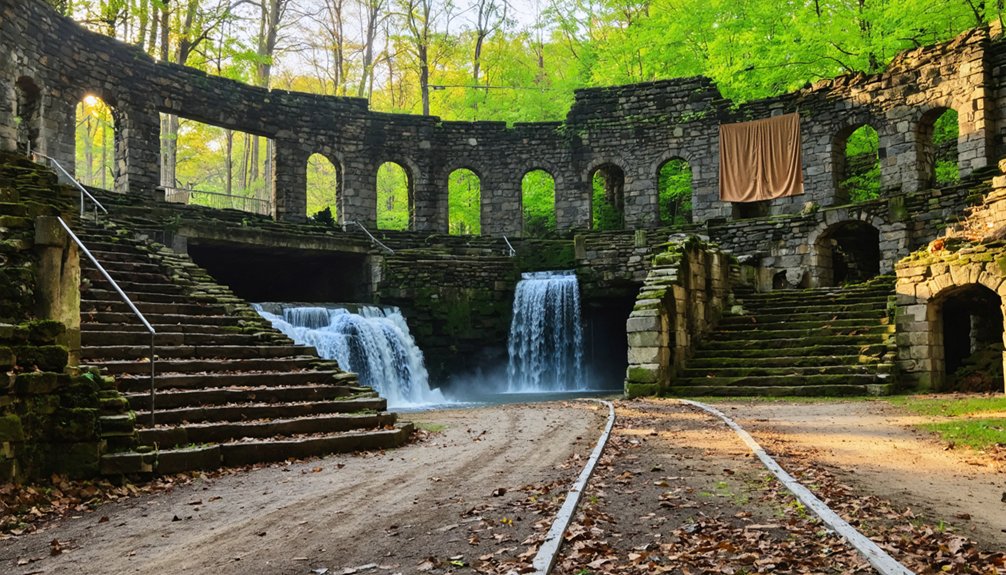
Located at the falls of the East Fork of the White River in Martin County, Hindostan Falls sits four miles from Loogootee along what was once the bustling stagecoach route between New Albany and Vincennes. You’ll find the marker at SR 550 and CR 55, where 134 acres of state-owned fishing and wildlife area await exploration without cell service or internet.
Plan your visit with these essentials:
- Transportation options: Drive directly to the site; no public transit serves this remote location.
- Water conditions: Visit during low water to see the 128 carved mill post holes.
- Safety awareness: Exercise caution near the falls’ drowning hazards.
- Local cuisine: Stop in Loogootee beforehand for provisions and authentic Hoosier dining.
This free-access site offers complete disconnection from modern constraints.
Preserving Frontier History Through Community Events
Throughout Martin County’s forgotten landscape, annual commemorations breathe life into abandoned settlements where cholera epidemics and economic shifts erased entire communities from Indiana’s maps.
You’ll discover authentic frontier preservation at Hindostan Falls Days, where 128 millstone holes carved into bedrock tell stories of the 138 souls lost during the 1820s outbreak.
The Sassafras Tea Festival connects you with 1860s living history through blacksmith demonstrations and Underground Railroad site tours, while local cuisine at the Mystery Dinner strengthens community bonds.
Art exhibitions featuring Decay Devils’ work at Gary Fest transform industrial ruins into cultural preservation spaces.
These gatherings aren’t tourist attractions—they’re grassroots efforts protecting your right to explore uncensored history through first-person interpreters, re-enactments, and direct engagement with America’s vanished settlements.
Frequently Asked Questions
Are There Camping Facilities Available Near Hindostan Falls for Overnight Stays?
While Hindostan Falls itself doesn’t offer camping amenities, you’ll find nearby accommodations at West Boggs Park with 250+ campsites, or explore Martin State Forest and Spring Mill State Park for your overnight wilderness freedom.
What Safety Precautions Should Visitors Take When Exploring the Flat Rock Formations?
Slips cause 80% of outdoor injuries. You’ll need proper footwear—sturdy ankle-high boots—and constant hazard awareness when traversing flat rocks. Plan each step carefully, avoid running, and watch for wet, slippery surfaces that’d compromise your independent exploration.
Are Pets Allowed at Hindostan Falls and the Annual Hindostan Days Celebration?
Pet policies at Hindostan Falls require six-foot leashes throughout the property. However, no specific guidelines exist for event attendance during Hindostan Days—you’ll want to contact organizers directly since similar celebrations typically restrict pets except service animals.
What Other Ghost Towns in Indiana Host Similar Annual Commemorative Events?
Like time capsules waiting to be opened, Indiana’s ghost towns rarely host organized events—Hindostan stands alone. You’ll find historic preservation efforts focus on Local legends through interpretive sites rather than annual celebrations, letting you explore independently on your own terms.
Is Metal Detecting Permitted at Hindostan Falls for Treasure Hunting Enthusiasts?
Metal detecting regulations at Hindostan Falls aren’t explicitly defined, so you’ll need treasure hunting permits clarification from Indiana DNR before exploring. Contact local authorities to respect preservation efforts while pursuing your freedom to hunt legendary buried gold responsibly.
References
- https://www.gosoin.com/blog/post/how-to-have-a-spooky-time-in-southern-indiana/
- https://events.in.gov/event/northwest-indiana-storytelling-festival-and-ghost-stories-indiana-dunes-state-park
- https://www.eventbrite.com/e/indiana-state-sanatorium-overnight-ghost-hunt-tickets-1977779083479
- https://www.visitfortwayne.com/blog/stories/post/spooky-fort-wayne-events-for-horror-lovers/
- https://www.indianahauntedhouses.com/indiana-paranormal-events.aspx
- https://www.discoversouthernindiana.com/blog/post/the-ghost-town-of-hindostan-falls-indianas-lost-jewel/
- https://www.chautauquawawasee.org/syracuse-ghost-tour-2025/
- https://www.decaydevils.org/events
- https://www.indianadunes.com/event/nw-indiana-storytelling-festival/10111/
- https://www.indianamuseum.org/event/real-haunted-happenings-dark-corners-of-corydon-3/