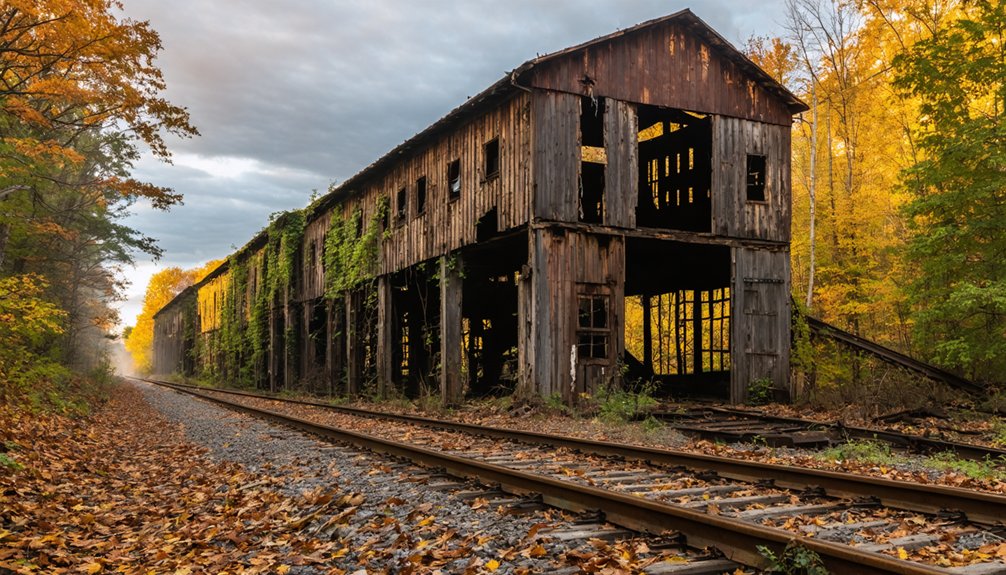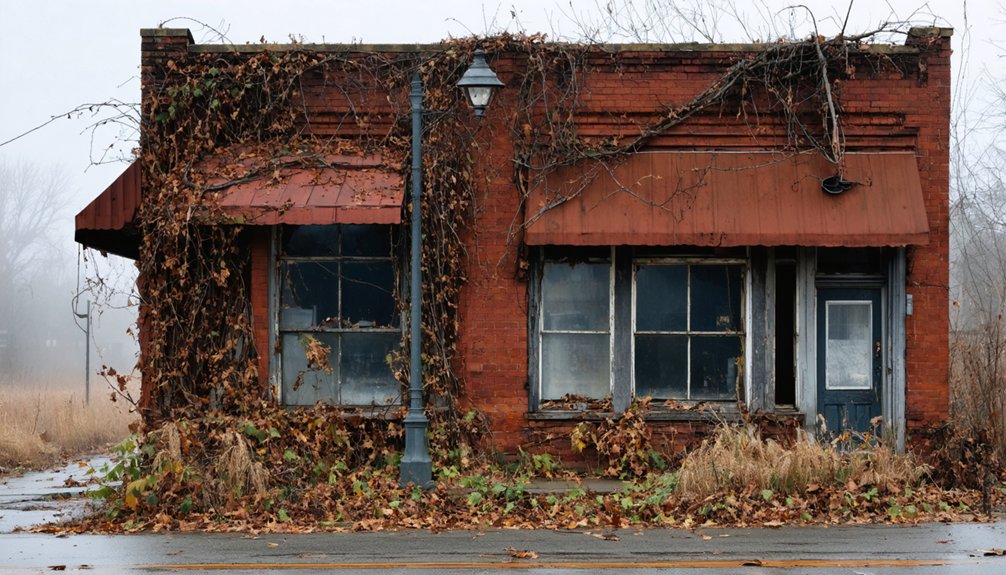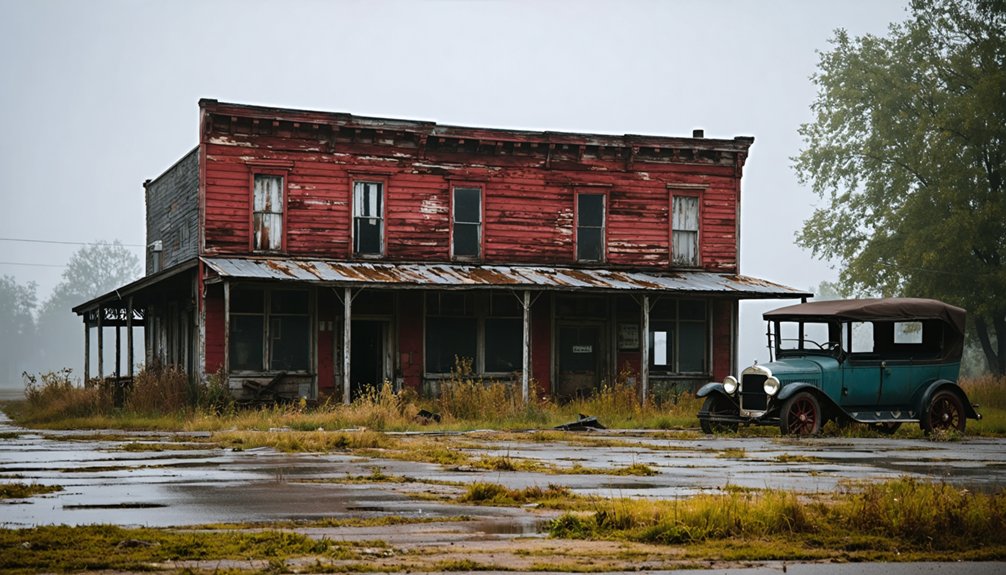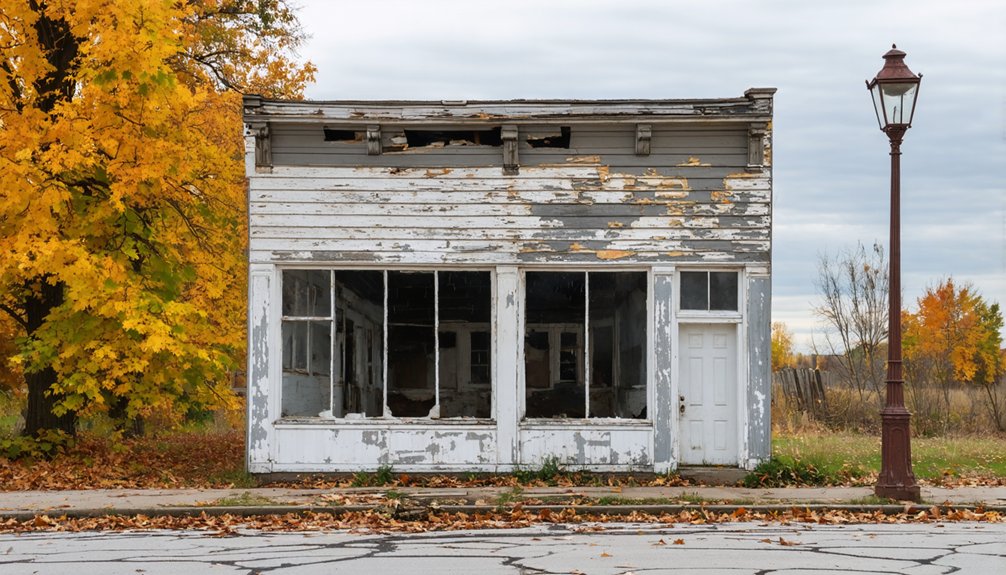
You’ll find southern Indiana’s best ghost town experiences at Hindostan Falls, where limestone ledges hide 128 mysterious mill holes, and Birdseye, whose weathered storefronts and limestone jail stand frozen mid-abandonment. Visit mid-October when fall foliage frames crumbling facades and reveals foundations hidden during summer’s growth. Eckerty offers the eeriest exploration—mounted deer heads still watch from walls where residents left everything behind. Don’t miss Elkinsville’s baffling sandstone formations and Marengo’s underground chambers. Pack offline maps since cell service vanishes, and there’s considerably more to these vanished settlements than first appears.
Key Takeaways
- Mid-October offers peak fall colors and optimal lighting for exploring Indiana’s ghost towns like Hindostan Falls and Birdseye.
- Hindostan Falls features limestone ledges, mass graves, pioneer tombstones, and legends of buried gold without cell service.
- Birdseye preserves authentic ruins including a limestone jail, Masonic lodge, and weathered storefronts with minimal tourist interference.
- Eckerty displays frozen-in-time interiors with personal effects and mounted deer heads, known for paranormal activity and abandonment stories.
- Autumn reveals hidden foundations, stone walls, and cemetery headstones typically obscured by summer vegetation in ghost towns.
Hindostan Falls: Where Nature Reclaims History
Deep in the hardwood forests of southern Indiana, where autumn transforms the canopy into brilliant shades of copper and gold, the falls of the East Fork White River still tumble over limestone ledges just as they did in 1816.
You’ll find 128 square holes drilled into flat rock—silent testimony to abandoned mills that once powered a thriving town of 1,200 souls. Captain Caleb Fellows founded Hindostan here, naming it after his India service, but cholera swept through in the 1820s, killing 138 in three months.
Mass graves still mark the earth. The town’s post office, which opened in 1819, closed in 1830—a clear signal of Hindostan’s irreversible decline. Legend whispers that the town treasurer died without revealing where he’d hidden the town’s funds, possibly in a well whose location remains a mystery. Today you’ll discover no cell service, no internet—just Native legends of buried gold beneath the falls and pioneer tombstones reclaimed by forest. It’s yours to explore completely off-grid.
Marengo Cave Park Area: Exploring Underground Mysteries
On a crisp September morning in 1883, fifteen-year-old Blanche Hiestand stood in the kitchen of Marengo Academy, overhearing schoolboys whisper excitedly about a mysterious sinkhole in the woods. She grabbed her eleven-year-old brother Orris, snatched candles, and beat them to the discovery. What they found became Indiana’s premier subterranean adventures destination.
Today, you’ll explore nearly five miles of passageways carved through limestone over a million years ago:
- Crystal Palace Tour – Marvel at stalagmite totem poles growing one inch per millennium
- Dripstone Trail – Navigate chambers where ancient rivers collapsed
- Active Stream Levels – Witness Indiana’s largest underground room discovered in 1992
- Historic Signatures – Examine soot marks from torch-carrying 1800s explorers
The cave has served as a filming location for movies including *Abby* (1974), *Madison* (2001), and *Fire from Below* (2008). This National Natural Landmark maintains a constant 52°F year-round at Marengo Cave. The surrounding 122-acre park offers gemstone mining, pedal karts, and campsites for families seeking surface-level adventures between underground explorations.
Elkinsville and Browning Hill: Indiana’s Stonehenge
Atop Browning Mountain, Brown County’s highest peak, massive sandstone boulders the size of sedans sit arranged in patterns that’ve baffled visitors since the 1800s. You’ll find these dressed stones—some squared into perfect cubes, others towering as 20-foot pillars—jutting from the earth like fragments of a buried fortress.
Archaeological mysteries deepen when you learn these boulders aren’t native; the closest matching quarry lies 90 miles away.
The 15-25 minute hike from Combs Road climbs 928 feet through Hoosier National Forest’s deep woods. Native Americans regarded the mountain as sacred holy ground, where legends tell of a spirit guardian watching over visitors.
Ancient legends whisper of pre-pioneer civilizations, though scientists attribute the formations to natural processes. Still, tool marks remain visible on the worked stone.
Nearby Elkinsville itself vanished in the 1960s when the village was relocated by eminent domain to make way for Lake Monroe’s construction, though former residents still hold annual reunions near Browning Hill.
Park carefully at the Elkinsville Road trailhead and decide for yourself whether these formations are nature’s caprice or something deliberately placed.
Birdseye: Discovering Hidden Ruins Along Scenic Routes
Southern Indiana’s winding backroads reveal Birdseye like a secret—this Dubois County settlement emerges from the rolling hills as a collection of weathered storefronts and empty windows that tell stories of a vanished commercial past.
Weathered facades and hollow windows whisper tales of commerce long departed from these forgotten Indiana hillsides.
You’ll discover layers of history at scenic viewpoints along routes threading through Birdseye, English, and Marengo. English itself survived flooding in the early 1990s by relocating uphill, leaving its original creek valley site as an empty field while the modern town maintains remaining buildings nearby.
Must-see landmarks:
- One-room stone jail – Indiana limestone construction guarantees this ruin’s permanence.
- Masonic lodge – Lone survivor of downtown’s former grandeur.
- Koerner Block site – Where the 1893 Italianate masterpiece once stood before arson claimed it.
- Abandoned storefronts – Metal cornices and window hoods still showcase architectural details.
Despite historic preservation efforts preventing demolition, Birdseye’s ruins remain largely untouched—offering you authentic exploration without tourist crowds overwhelming the experience. As you wander through these remnants, you’ll notice weeds and tiger lilies reclaiming storefronts, creating a haunting beauty where nature gradually merges with crumbling architecture.
Eckerty: Frozen in Time With Belongings Left Behind
Where State Highway 157 cuts through Crawford County’s forested valleys, Eckerty appears like a Marie Celeste of the heartland—buildings stand with deer heads still mounted on walls, shotguns resting in corners, and personal effects scattered as though residents simply walked away mid-task.
This railroad town that never was faded when tracks bypassed its buggy shops and general store, leaving abandoned relics frozen in suspended animation.
You’ll find the most compelling exploration during fall when overgrown structures emerge through thinning foliage. The eerie preservation fuels haunted legends that’ve circulated for decades, making Eckerty a magnet for paranormal investigators. Documented cases of ghost sightings have led researchers to include Eckerty in databases tracking unexplained phenomena across the Midwest.
Park near the county road junction and wander empty streets where nature reclaims civilization. The untouched interiors reveal more than history books ever could about sudden abandonment and forgotten dreams. Like Palestine’s cemetery that grew faster than the town itself due to persistent health problems, Eckerty’s decline tells a story of communities that couldn’t sustain themselves against unforgiving circumstances.
English: Forgotten Communities Revealed by Autumn Leaves
When October winds strip the canopy bare along Crawford County’s forgotten backroads, English emerges from its verdant camouflage like a photograph developing in solution. You’ll discover foundations, weathered frameworks, and artifacts that summer’s overgrowth conceals—each structure telling stories of frontier ambition and eventual decline.
What autumn reveals in English:
- Building interiors accessible through collapsed walls, exposing belongings frozen mid-abandonment
- Property boundaries marked by stone walls and fence lines invisible during growing season
- Foundation patterns tracing the town’s original grid where families once built futures
- Neighboring ghost towns including Birdseye and Eckerty, forming exploration routes through southern Indiana’s vanished settlements
Historical preservation here happens through your documentation and respectful exploration, keeping community memory alive when institutional efforts fade.
Best Time to Visit Indiana Ghost Towns in Fall
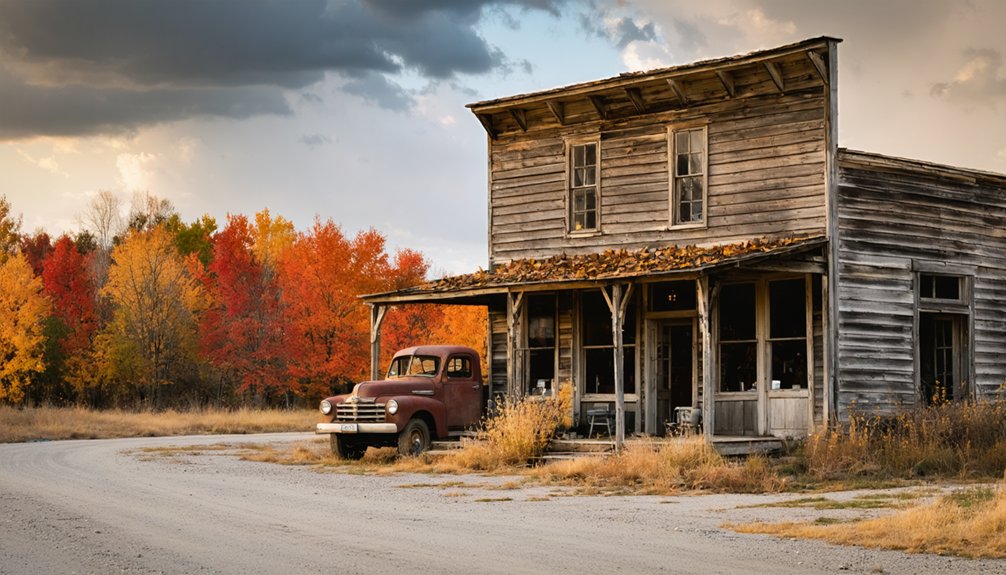
Mid-October transforms Indiana’s abandoned settlements into photographer’s gold, particularly when you’re targeting locations like Elkinsville in Brown County.
You’ll catch breathtaking fall colors at their peak—vibrant reds and golds framing weathered bridges and forgotten cemeteries.
Plan your arrival for early morning or late afternoon. The low sun casts dramatic shadows across ruins, making seasonal photography infinitely more compelling than flat midday light.
You’ll need sweater weather gear for comfortable trail navigation through overgrown paths leading to old homesteads.
Autumn’s cooler temperatures do you another favor: reduced vegetation reveals hidden headstones and crumbling foundations you’d miss in summer’s chaos.
The state’s foliage maps confirm mid-October timing, and you’ll dodge the crowds flocking to Brown County’s official scenic drives.
Just remember—photograph from outside these unstable structures.
What to Bring on Your Ghost Town Adventure
Before you set foot in Indiana’s forgotten settlements, pack like your comfort depends on it—because it does. October’s unpredictable weather demands layers, waterproof gear, and sturdy boots for roaming Hindostan Falls’ crumbling paths.
Your Essential Ghost Town Kit:
- Navigation backup – Download offline maps before cell service vanishes in Marengo’s wilderness
- Safety essentials – First aid kit, whistle, and pepper spray for wildlife encounters in isolated areas
- Protection gear – Bug spray, gloves for handling rusted historical artifacts, and dust masks for abandoned structures
- Trail fundamentals – Headlamp for dusk exploration, portable charger, and high-energy snacks
Pack a water-resistant backpack with emergency supplies and trash bags—leaving these sites pristine preserves their stories for future wanderers seeking their own off-grid adventures.
Photography Tips for Capturing Abandoned Places
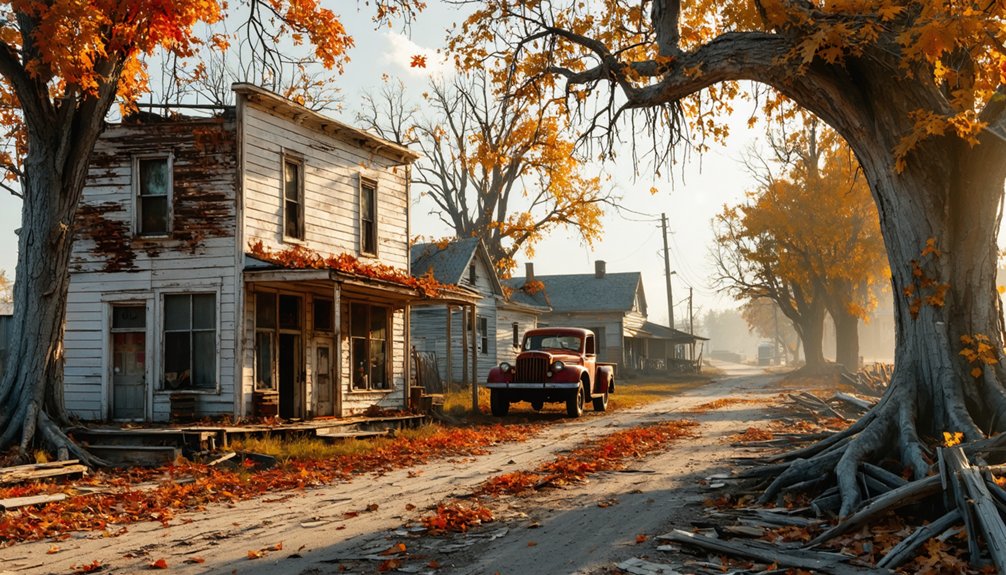
Your backpack’s loaded with survival gear, but the real magic of ghost town exploration happens through your camera lens. Ditch head-height shots—crouch low or climb high for perspectives that’ll make viewers stop scrolling.
Break symmetry deliberately, letting weathered doorframes and crumbling facades tell Indiana’s forgotten stories through your composition.
Golden hour transforms decay into art. Shoot when dawn’s soft light reveals rust patterns and peeling paint textures. For dark interiors, bracket your exposures at ISO 800 and merge them later—you’ll capture details invisible to the naked eye.
Focus on intimate elements: shattered glass, weathered wood grain, abandoned tractors reclaimed by nature. These close-ups honor historical preservation through ethical photography that documents without disturbing.
Walk the entire perimeter. Your best shot’s waiting where others didn’t bother looking.
Safety Considerations When Exploring Ruins
You’ll need to assess every structure before entering—a rotted floorboard or crumbling wall can collapse without warning, turning your adventure into an emergency.
Most abandoned sites in Indiana sit on private land, so obtain permission before exploring or you risk trespassing charges and hefty fines.
Cell service disappears quickly in rural areas, making it essential to share your route with someone and carry backup communication devices in case you need help.
Watch for Unstable Structures
When you approach a seemingly intact building in an Indiana ghost town, that weathered facade often masks deadly hazards lurking inside. Structural hazards demand constant vigilance as you explore these abandoned spaces.
Critical dangers to assess before entering:
- Crumbling foundations and cracked walls – These signal imminent collapse that could trap or crush you within seconds.
- Rotted floorboards and compromised stairs – One wrong step sends you plummeting through decayed wood into basement voids.
- Leaky roofs and water damage – Years of exposure weaken load-bearing beams beyond recognition.
- Vegetation risks from invasive roots – Plants aggressively penetrate walls and foundations, accelerating deterioration while concealing structural weaknesses.
Never venture into buildings showing obvious distress. Your curiosity isn’t worth becoming another cautionary tale in Indiana’s forgotten settlements.
Respect Private Property Boundaries
Beyond the physical dangers of crumbling buildings lies another serious risk that many ghost town explorers overlook—most of Indiana’s abandoned settlements sit squarely on private property. Sites like Millville in Franklin County and Ghost Town Trail locations in Indiana County aren’t public parks. They’re someone’s land. You’ll need landowner permission before stepping foot on places like Old Tip Town or Claghorn to avoid trespassing charges, fines, or arrest.
As you explore ghost towns in Indiana’s autumn beauty, it’s essential to be aware of the surrounding environment and its history. The vibrant foliage adds a stunning backdrop to these silent relics of the past, making the adventure even more captivating. However, remember to respect the land and its private nature, ensuring that your exploration complies with local regulations.
Boundary awareness starts with GNIS aerial photos showing farm clusters surrounding remnants like New Harmony’s original location. Those plowed fields at Brisco aren’t invitation zones—they’re actively owned farmland.
Check GPS coordinates, look for fences at county road intersections, and verify property status before your visit.
Freedom means respecting others’ rights while pursuing your exploration passion.
Prepare for Limited Connectivity
Modern explorers often take for granted that a quick 911 call will solve any emergency—until they’re standing in Hindostan Falls with a shattered ankle and zero bars on their phone.
Southern Indiana’s ghost towns offer the ultimate digital detox, but offline preparation separates confident adventurers from stranded ones.
Essential connectivity backup strategies:
- Download offline maps with coordinates for Marengo, English, and Tunnelton before departure.
- Share your itinerary with expected return times—someone needs to know you’re exploring Fort Ritner’s ruins.
- Carry a satellite communicator for genuine emergencies in signal-dead zones.
- Schedule check-ins at the nearest service-enabled town like Rockville.
Pack physical maps, portable power banks, and first-aid supplies.
You’re trading convenience for freedom—embrace the disconnection while respecting its risks.
Frequently Asked Questions
Are Ghost Town Explorations in Indiana Suitable for Children and Families?
Yes, you’ll find ghost town explorations family-friendly in Indiana. They’re perfect for heritage preservation lessons while adventuring together. Just prioritize exploration safety by staying on marked paths, watching for unstable structures, and keeping kids close during your discoveries.
Among the haunted ghost towns in Indiana, you can uncover fascinating stories of the past and engage in exciting ghost hunting activities. Many of these sites offer guided tours that provide insight into the historical significance of the towns, making the experience both educational and thrilling. As you explore, keep your cameras ready; you might just capture a glimpse of the mysterious legends that linger in these abandoned places.
Do I Need Permission to Enter Abandoned Buildings in These Towns?
Yes, you’ll need permission—most abandoned buildings face legal restrictions under Indiana’s trespassing laws with $1,000 fines. Property ownership remains active even in decay. Contact owners directly, respect posted signs, and stick to public roads for your adventurous autumn exploration.
Are There Guided Tours Available for Indiana’s Ghost Towns?
You’ll find guided tours for Indiana’s haunted historic sites, but not abandoned ghost towns. Tour operators prioritize tour safety guidelines and historical preservation by sticking to maintained locations. For true ghost towns, you’re exploring solo—adventure awaits independently.
Can I Camp Overnight Near These Ghost Town Locations?
You’re barking up the wrong tree—most ghost towns don’t allow overnight camping. Instead, check nearby state park campground regulations and follow safety precautions. You’ll find freedom exploring dispersed camping options within surrounding national forest boundaries.
What Wildlife Might I Encounter While Exploring These Abandoned Areas?
You’ll encounter urban wildlife like deer, raccoons, and diverse bird species thriving in these abandoned spaces. Habitat preservation has allowed nature to reclaim ghost towns, creating unexpected sanctuaries where you’re free to observe wildlife adapting remarkably.
References
- https://indianahannahblog.com/2025/09/15/50-of-the-best-places-to-visit-in-indiana-during-the-fall/
- https://www.discoversouthernindiana.com/blog/post/the-ghost-town-of-hindostan-falls-indianas-lost-jewel/
- https://www.gosoin.com/blog/post/how-to-have-a-spooky-time-in-southern-indiana/
- https://www.youtube.com/watch?v=45D4dbASJyE
- https://indianacountyparks.org/our-trails/ghost-town-trail/ghost-town-trailheads/
- https://www.youtube.com/watch?v=-iNr8SJNJLk
- https://www.onlyinyourstate.com/trip-ideas/indiana/ghost-town-road-trip-indiana
- https://www.atlasobscura.com/things-to-do/indiana/abandoned
- https://www.onlyinyourstate.com/state-pride/indiana/untold-story-hindostan-falls-in
- http://exploresouthernindiana.blogspot.com/2011/10/haunting-of-hindostan-falls.html