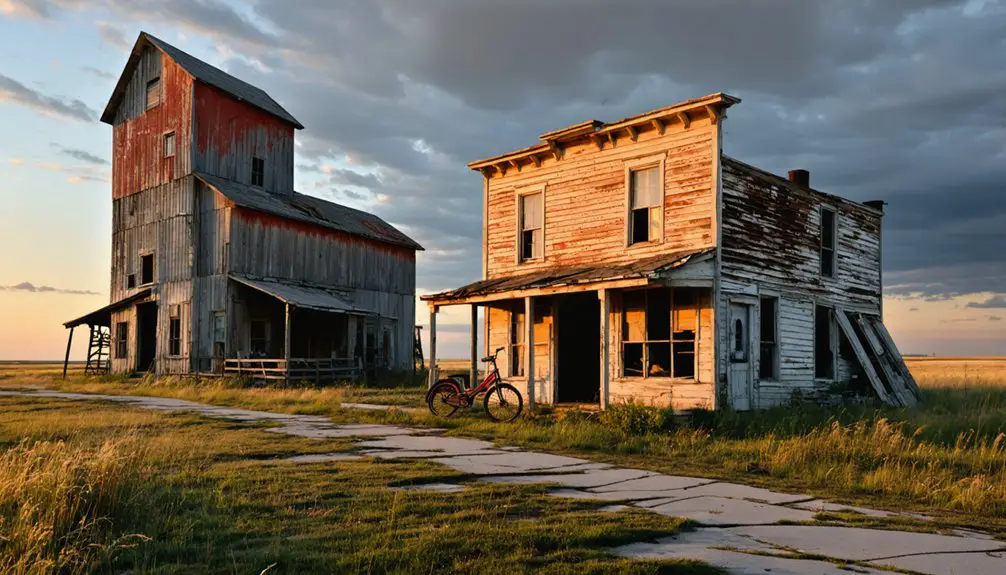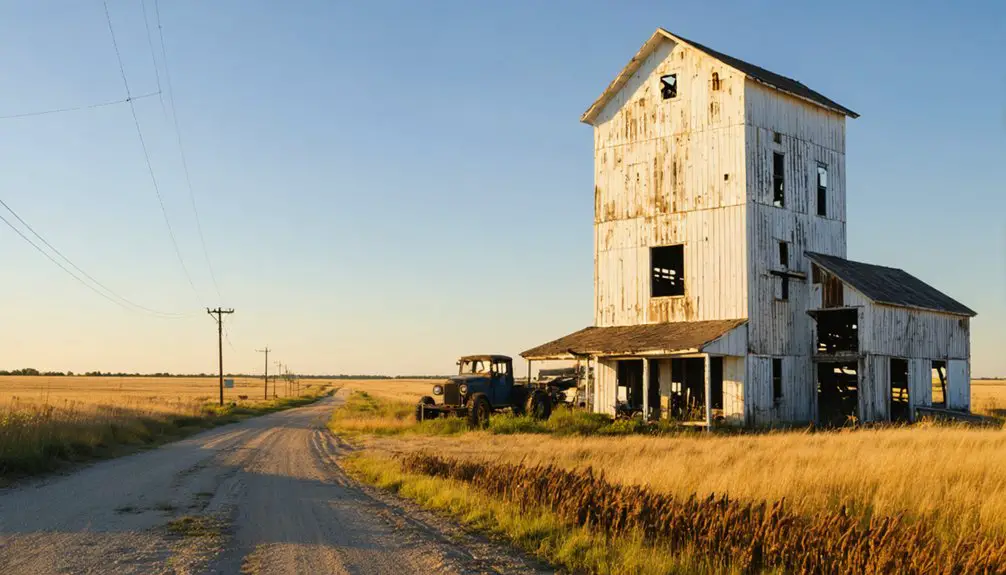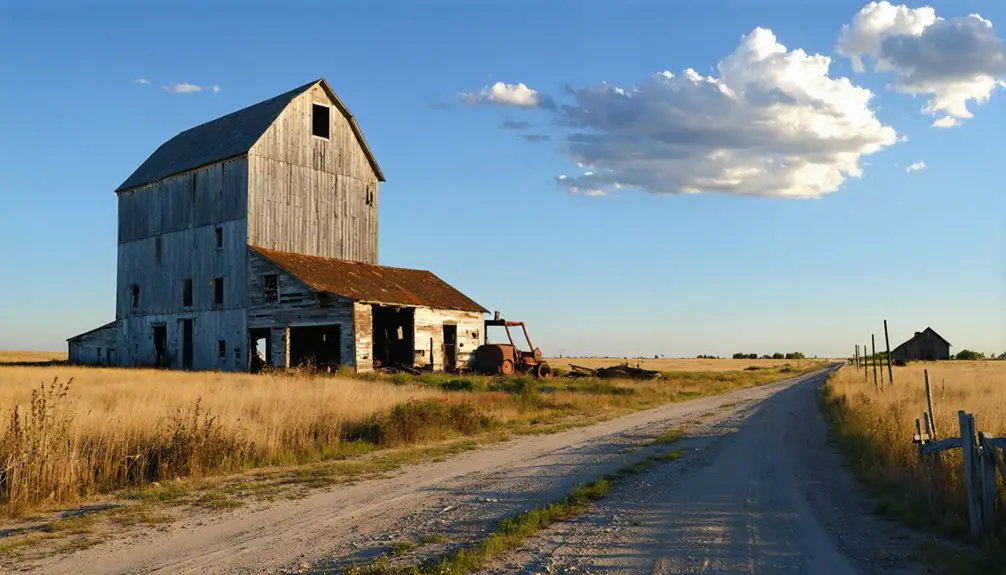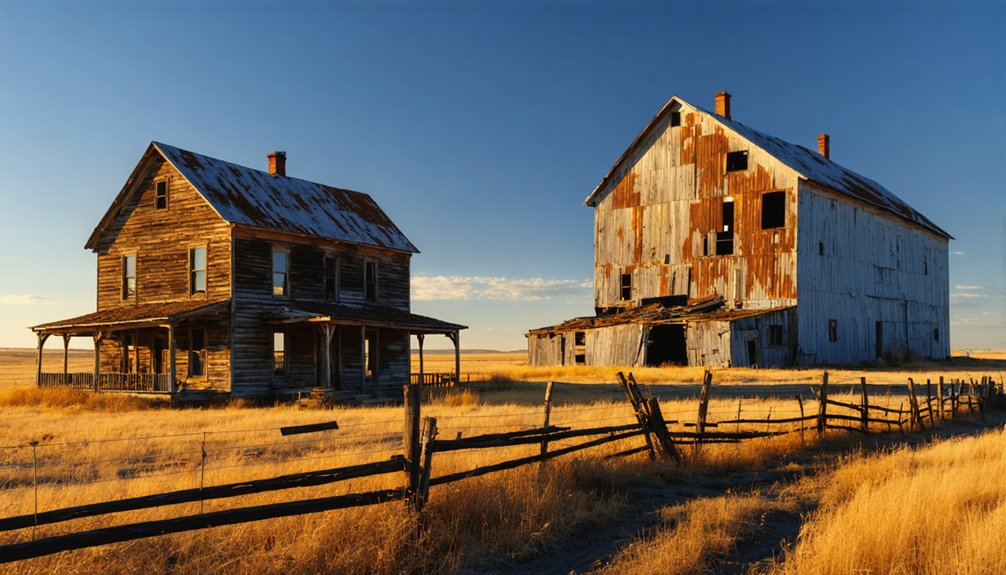
You’ll find North Dakota’s most atmospheric ghost towns scattered across the western prairie, where October winds whistle through Arena’s leaning St. John’s Lutheran Church and Sims’ weathered grain elevators stand sentinel over abandoned main streets. Base yourself in Bismarck or Dickinson to explore Gascoyne’s preserved commercial buildings, Brisbane’s historic storefronts, and the eerie burned church ruins at Tagus—dubbed the “stairway to hell.” Beyond these weathered facades lie countless stories of railroad dreams, dust bowl despair, and the persistent legends that keep drawing curious explorers back.
Key Takeaways
- Arena features a leaning Lutheran church 35 miles from Bismarck, while Brisbane and Sims offer accessible historic structures and documented ghost stories.
- Gascoyne preserves commercial buildings like post offices and water towers, with Armourdale showcasing ghostly railroad station outlines from around 1900.
- Base exploration from Bismarck, Dickinson, Minot, or Watford City to efficiently visit clustered sites within 30-60 minute drives.
- Monitor North Dakota’s 511 system for road conditions, as mid-October brings snowstorms, mud, and winds exceeding 40 mph on gravel roads.
- Tagus’s burned church ruins and San Haven Sanatorium offer paranormal experiences alongside architectural photography opportunities throughout the prairie landscape.
Top Ghost Towns Worth Exploring This Autumn
As autumn’s golden light sweeps across North Dakota’s prairie, the state’s forgotten settlements emerge from the grasslands like weathered monuments to another era. You’ll find Arena thirty-five miles northeast of Bismarck, where the Patterson Land Company’s 1906 dreams crumbled into dust.
At Wheelock, you can wander among collapsed houses and peer into shops whose purposes time has obscured—each structure whispers local legends of railroad promises that never arrived.
Sims offers something different: a living Scandinavian Lutheran Church standing defiant among the ruins, where urban legends blend with documented history. The church gained attention when it was visited by Laura Bush in 2008, and locals speak of the Gray Lady ghost said to haunt the area.
Lincoln Valley’s complete disappearance haunts the landscape where Joe Leintz once stood as the final guardian. When the fall season arrives, these eerie locations pair perfectly with North Dakota’s haunted houses and hayrides that bring seasonal thrills to visitors seeking both historical and supernatural experiences.
These sites aren’t merely abandoned—they’re raw testimonies to freedom’s price when economic tides shift beneath your feet.
Western North Dakota’s Abandoned Railway Settlements
The Milwaukee Road Railroad carved its steel pathway across Bowman County in 1907, birthing towns that would bloom and wither within a single lifetime.
You’ll find Gascoyne’s weathered bones seventeen miles southeast of Bowman—sixteen souls still clinging to what Henry Fishbein founded. The original commercial buildings stand defiant against prairie winds, their empty windows watching Highway 12’s occasional travelers.
Urban decay tells stories here that guidebooks can’t capture. Walk through Sims, Griffin, or Haley, where preservation challenges mount as nature reclaims what humans abandoned. The town once sustained a population of ninety-seven residents when it peaked in 1930, supporting hardware stores, grocery shops, and even a bowling alley.
The 1930s Depression drove tens of thousands away, and automobiles finished what grasshoppers started. Along the SOO Line, you can still trace Armourdale’s ghostly outline—a railroad station and rural post office from around 1900 now largely absent from modern maps. You’re free to explore these skeleton towns, touching history through peeling paint and rusted rails, feeling the weight of dreams that dried up with the dust.
Ghost Towns Near Bismarck for Weekend Adventures
Within an hour’s drive from Bismarck’s Capitol towers, you’ll discover five forgotten settlements where prairie grass pushes through cracked foundations and wind whistles through abandoned grain elevators.
Arena’s St. John’s Lutheran Church stands sentinel 35 miles northeast.
While Brisbane’s ghostly main street lies southeast near Carson.
The cultural folklore surrounding Dogtooth—named for buttes resembling canine molars—draws you eastward toward Raleigh, where a local bar preserves its memory.
Lark beckons hunters west along Highway 21, and mysterious Freda waits somewhere in the surrounding prairie.
These sites face restoration challenges you’ll witness firsthand: weathered timbers, collapsed roofs, and nature’s relentless reclamation.
At Sims in Morton County, the Gray Lady Ghost is said to haunt the church and play the organ, adding an eerie dimension to your autumn exploration.
Brisbane once bustled with activity when its post office opened in 1910, supporting a general store, school, hardware store, blacksmith, and restaurant.
Remember, you’re free to explore these remnants of pioneer ambition, but respect private property boundaries.
Always seek permission before wandering these wind-swept ruins.
Haunted Locations and Paranormal Activity Sites
Beyond weathered wood and crumbling stone, North Dakota’s abandoned places harbor something darker than decay. You’ll find Tagus’s burned church ruins—locals call it the “stairway to hell”—where screams allegedly echo from below.
At St. Olaf Lutheran Cemetery, gravestones glow without explanation while phantom trains rumble past.
Haunted legends draw you to Sims, where the Gray Lady Ghost plays church organ melodies for unexpected visitors. San Haven Sanatorium’s tunnels pulse with captured EVPs—desperate voices calling for help through the darkness.
Fort Abraham Lincoln’s cemetery flickers with strange lights as spectral horses thunder across the plains.
Meanwhile, Rough Riders Hotel serves up moving silverware alongside its dinner menu. The Liberty Memorial Building chills visitors with cold spots in stairwells and the apparition of a ghostly librarian wandering the halls. In Tagus, explore the farmhouse with green shingles that stands as an eerily beautiful reminder of the town’s past glory. Paranormal investigations continue documenting these phenomena, offering you experiences beyond typical autumn adventures.
Architectural Treasures Among the Ruins
Standing amid North Dakota’s ghost towns, you’ll discover architectural poetry written in brick, timber, and stone—structures that refused to surrender completely to prairie winds.
At Sims, the Gray/Anderson House’s crumbling red brick facade speaks of 1880s railroad prosperity, while skeletal grain elevators pierce autumn skies like sentinels. You’ll find schoolhouse stairs leading nowhere, depot foundations mapping forgotten routes, and two-room classrooms with weathered gray walls collapsing inward. The Horlitz store stands in crumbling testimony to the town’s commercial past, its deteriorating front near collapse.
Charbonneau preserves its postmaster’s residence—where commerce and family life intertwined—alongside water towers that once fed steam locomotives. This urban decay reveals pragmatic prairie architecture: German-Russian church spires, Norwegian timber framing, utilitarian pump houses.
Arena’s church and schoolhouse lean dramatically after decades of prairie winds, their weathered frames testifying to agricultural dreams that withered during the Great Depression. Preservation efforts remain minimal here, granting you unfiltered access to settlement-era craftsmanship before weather claims everything.
Planning Your Ghost Town Road Trip Route
You’ll want to map your journey by clustering ghost towns regionally—grouping northern sites like Kuroki and Tolley into one day, then tackling western destinations like Charbonneau another time to maximize your windshield hours.
Fall’s unpredictable weather means checking gravel road conditions before venturing toward isolated spots like Griffin, where early snows can transform rutted tracks into muddy challenges.
For multi-day adventures, you can anchor yourself in Minot and radiate outward to Tagus, Ruso, and Bergen in easy 30-60 minute drives, or craft a longer western arc connecting Beach, Bowman County sites, and the Badlands into one sweeping expedition.
Regional Clustering and Distance
Since North Dakota’s ghost towns scatter across a canvas spanning over 70,000 square miles, you’ll want to cluster your visits by region rather than zigzagging between distant counties. Regional clustering transforms exhausting marathons into manageable adventures—consolidate Bowman County’s southwestern settlements like Griffin, or loop through Golden Valley County from Beach to Thelen in a single autumn day.
As you venture through these areas, you’ll discover the rich history and unique stories behind exploring ghost towns in North Dakota. Keep your camera ready to capture the haunting beauty of crumbling buildings and forgotten landscapes. Each town holds a piece of the past that contributes to the state’s captivating narrative.
Distance considerations matter when freedom calls: Minot’s ghost towns sit just 30-60 minutes out, while Bismarck offers five abandoned sites within a 50-mile radius. Base yourself in Watford City for western expeditions, or anchor near Dickinson to explore Stark County’s cemetery-dotted landscapes.
You’ll cover more ground, burn less fuel, and actually experience each weathered structure instead of watching endless prairie blur past your windshield.
Seasonal Road Conditions
Even the best-planned route crumbles when October’s first snowflakes transform gravel roads into slick ribbons of mud and ice. You’ll need North Dakota’s 511 system before chasing ghost towns—
Seasonal road conditions shift faster than prairie winds. I’ve watched Travel Alerts escalate to No Travel Advised within hours, stranding adventurers miles from abandoned homesteads.
Download the ND Mobile App and check RWIS stations for real-time surface temperatures along your route.
Northern regions face sudden blizzard-like gusts exceeding 40 mph, turning open roads into white tunnels. Weather safety demands you monitor multiple sources—web maps, weather cameras, friction data—before heading into rural corridors where emergency responders can’t reach you.
That crumbling grain elevator isn’t worth risking your freedom.
Multi-Day Itinerary Options
When frost paints the prairie gold and crimson, North Dakota’s ghost towns form natural clusters that beg for multi-day exploration rather than frantic single-site dashes. You’ll find Bismarck’s abandoned settlements—Lark, Arena, Freda—scattered within fifty miles, perfect for a weekend escape.
As you wander through these ghost towns in North Dakota, each site tells a story of resilience and change. Explore the decaying facades and remnants of communities that once thrived, inviting reflections on the past and the passage of time. The haunting beauty of the landscape enhances the experience, making it a journey into the heart of the American frontier.
The Highway 200 corridor strings together Chaseley, Lincoln Valley, and Charbonneau like forgotten pearls, while Minot‘s nearby Tagus and Ruso offer quick thirty-minute drives through amber-lit landscapes.
Pair Medora‘s weathered buildings with Theodore Roosevelt’s badlands, timing your visit for Wild West Fall Fest cultural festivals. The Pembina Gorge’s autumn forest whispers local legends through thirty miles of trails.
Plot your route using Ghosts of North Dakota‘s searchable database, marking each crumbling homestead like treasure on a freedom-seeker’s map.
Photography Opportunities at Abandoned Sites
You’ll find your best shots in the crumbling textures of Arena’s St. John’s Lutheran Church, where peeling white paint reveals weathered wood beneath like layers of forgotten time.
The fall sun hangs lower across these prairies, casting long shadows through empty doorframes at Nanson’s four abandoned homes—golden hour here stretches into a photographer’s dream.
At Charbonneau, I’ve watched October light transform rust-streaked metal roofs into copper canvases, while amber grasses frame compositions you simply can’t stage anywhere else.
Architectural Details and Decay
- Utilitarian details in Arena’s 1906 stone buildings and Rian’s standout structures that defy restoration challenges.
- Ethnic influences visible in rural churches and homesteads throughout the mosaic.
- Creative craftsmanship in Charbonneau’s postmaster house with its divided layout and original stamp window.
San Haven’s three-story tuberculosis sanatorium offers haunting scale photography. Its massive decay is enhanced by minimal tree coverage.
Fall Lighting and Composition
As autumn’s slanting light rakes across the North Dakota prairie, you’ll find your camera’s sensor practically begging for the golden-hour glow that transforms weathered clapboard into honey-toned canvases.
Position yourself at James River Church as that low-angle sun paints shadows across its hilltop foundation, or catch Sims Scandinavian Lutheran framed by prairie grasses turned bronze.
The seasonal foliage—sparse but strategic—provides clean backdrops without cluttering your compositions. When overcast skies roll in, you’ll nail those interior shots at abandoned homesteads near Highway 200, where diffused light reveals every crack in plaster walls.
For silhouette photography, stake out Wheelock or Cathay at sunset; those barn outlines against harvest-season skies capture the haunting isolation you’re after.
Backlight turns decay into drama.
Historical Context Behind North Dakota’s Ghost Towns
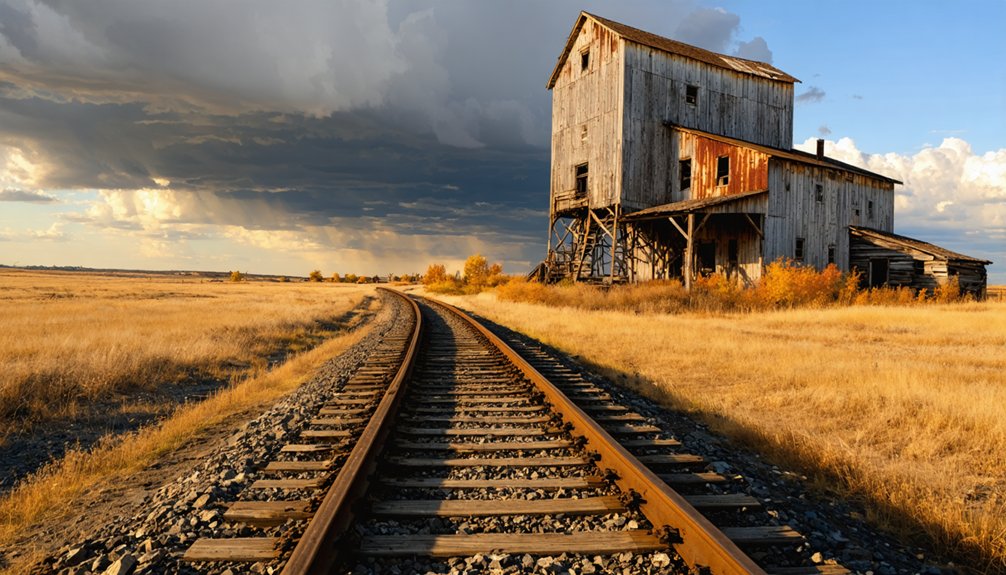
- The Dust Bowl catastrophe ravaged crops through relentless drought and grasshopper swarms, forcing families to abandon their homesteads.
- Agricultural mechanization eliminated the need for densely populated farming communities.
- Transportation route changes isolated towns when Interstate 94 bypassed them and railroads vanished.
You’ll find wooden buildings collapsed into prairie grass, where populations plummeted from hundreds to zero within decades—freedom’s promise transformed into haunting silence.
Frequently Asked Questions
What Permits or Permissions Are Required to Visit North Dakota Ghost Towns?
You won’t need general permits for wandering these weathered ruins, but you’ll respect private property boundaries and preservation laws protecting cultural resources. If you’re excavating or disturbing historic sites, you’ll need State Historical Society approval first.
Are Ghost Towns Safe to Explore With Children During Fall Months?
Ghost towns aren’t safe for children—collapsed structures, flooded basements, and vandalism create serious hazards. You’ll find historical preservation efforts can’t overcome sagging roofs and unstable foundations. Safety precautions demand you explore family-friendly museums instead, where history breathes without danger.
Which Ghost Towns Have Nearby Lodging or Camping Facilities Available?
Like whispers through prairie grass, you’ll find lodging near Tagus (via Minot), Sims (near Bismarck), and Charbonneau (Watford City). These historic preservation sites blend local legends with modern comfort, letting you chase freedom through abandoned streets before retreating to warm beds.
What Should I Bring for a Day Trip to Multiple Ghost Towns?
Pack layers, sturdy boots, and a camera with zoom lens. You’ll discover incredible photography opportunities among weathered structures while respecting historical preservation. Bring water, snacks, and binoculars—essentials for your independent exploration across North Dakota’s forgotten prairie landscapes.
Can I Enter Buildings or Must I Stay Outside the Structures?
You can enter Tagus’s buildings while most others remain external-only viewing. Access restrictions protect active churches and private property, while structural dangers lurk in decaying floors and collapsing roofs—freedom demands respecting boundaries and your safety simultaneously.
References
- https://www.northdakotahauntedhouses.com/haunted-attractions/
- https://us1033.com/a-haunting-look-at-some-real-life-north-dakota-ghost-towns/
- https://www.youtube.com/watch?v=0n3LvrSDRLU
- https://ghostsofnorthdakota892857007.wordpress.com/tag/ghost-town/
- https://www.youtube.com/watch?v=MZ_xZ0d_TBY
- https://www.tripadvisor.com/Attractions-g28955-Activities-c47-t14-North_Dakota.html
- https://www.ndtourism.com/articles/find-fall-adventures-north-dakota
- https://en.wikipedia.org/wiki/List_of_ghost_towns_in_North_Dakota
- https://www.onlyinyourstate.com/trip-ideas/north-dakota/ghost-town-autumn-trip-nd
- https://www.legendsofamerica.com/gascoyne-north-dakota/